
By Matt Busel, who built the apps, crates and game he writes about · every number links to its source and every dataset is downloadable (methods) · corrections · featured in Kirino, gamebiz, This Week in Rust, New Mobile Life, By-Press
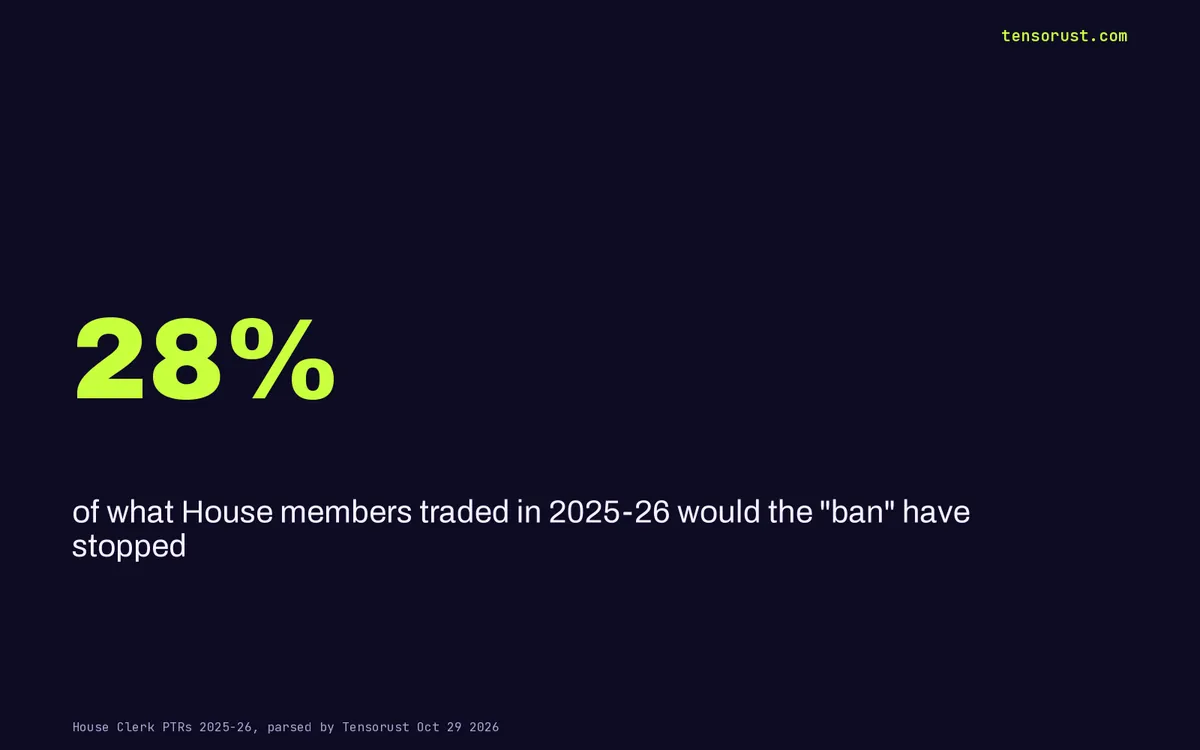
Congress stock ban: we checked 10,732 House trades. It stops 28%
On this page · 13 sections
- Key numbers
- The "ban" was built to miss most of the money
- The rider nobody voted on separately
- After the vote, both sides kept buying
- One in five trades reached the public late
- 730 trades inside their own jurisdiction
- Follow the money: the sponsor and the PACs
- "Bought before the contract" is mostly noise
- Did all that trading even beat the market?
- The Senate side is harder to even see
- What this means for you
- How we got the data
- Sources
Short answer: The House "Stop Insider Trading Act" (H.R. 7008), which passed 232-198 on July 22 2026 and died in the Senate on September 30, would have blocked only 28% of the dollars House members actually traded in 2025 and 2026. We know because we pulled every House periodic transaction report filed since January 2025, parsed all 10,732 trade lines from 121 members, and ran each one through the bill's own text. The rest, $252.8M at the low end of the disclosed ranges, is sales the bill allows with a notice and assets it never touches.
TL;DR: Of $354.3M in disclosed House trades (low end of ranges), the bill bans $100.4M of stock and option buys; $78.0M of sales stay legal with 7 to 14 days' notice and $174.8M in bonds, funds and other assets are not covered at all. After the vote, members kept buying the exact stocks the bill bans: 101 such buys by Yes voters (30 of them by Rep. Michael McCaul's spouse in August) and 135 by No voters. One in five House trade lines, 2,062 of 10,728, reached the public after the STOCK Act deadline, 730 lines were in companies the member's own committee oversees, and the typical stock buy still trailed the S&P 500 by 1.92 points over 180 days.
Key numbers
| What | Number | Source, checked Oct 29 2026 |
|---|---|---|
| House trade lines 2025 to Oct 2026 (reports with a text layer, members matched to roll 280) | 10,732 lines, 121 members | House Clerk FD index + PTR PDFs, parsed by us |
| Dollars traded (low end of ranges) | $354.3M | data.csv (our parse) |
| Share the bill would have banned | 28.3% of dollars ($100.4M), 41.3% of lines | H.R. 7008 engrossed text applied to every line |
| House vote, July 22 2026 | 232-198 (R 218-0, D 13-198) | Clerk roll call 280 |
| Senate cloture, Sep 30 2026 | Failed 53-47 (60 needed) | Roll Call |
| Banned-type buys after the vote | Yes voters 101, No voters 135 | PTRs filed after Jul 22 (incl. 158 hand-read scanned lines) |
| Trade lines disclosed late | 2,062 of 10,728 (19%), 51 members | House Ethics PTR due-date rule |
| Trades in companies the member's own committee oversees | 730 lines, 37 members | House Rules jurisdiction x SEC SIC codes |
| Average stock buy vs S&P 500, 180 days | -1.92 points (40% beat it), 3,888 buys | Yahoo daily closes, our calc |

The "ban" was built to miss most of the money
Read the engrossed text and the design is plain. Members, spouses and dependent children may not buy stock or options in a public company. They may keep everything they already own. Nothing in any version says "divest."
Sales stay legal; they just need a public notice 7 to 14 days ahead. Diversified funds, blind trusts and small-business stakes are excluded by name. Treasuries and municipal bonds are not public-company stock, so they sit outside it too.
So we ran every House trade line since January 2025 through those rules. The result: $100.4M of the $354.3M traded (low end of the disclosed ranges) is the kind of trade the bill bans. Using the top of the ranges the share is 34%. Either way, two thirds of the money walks straight past it.
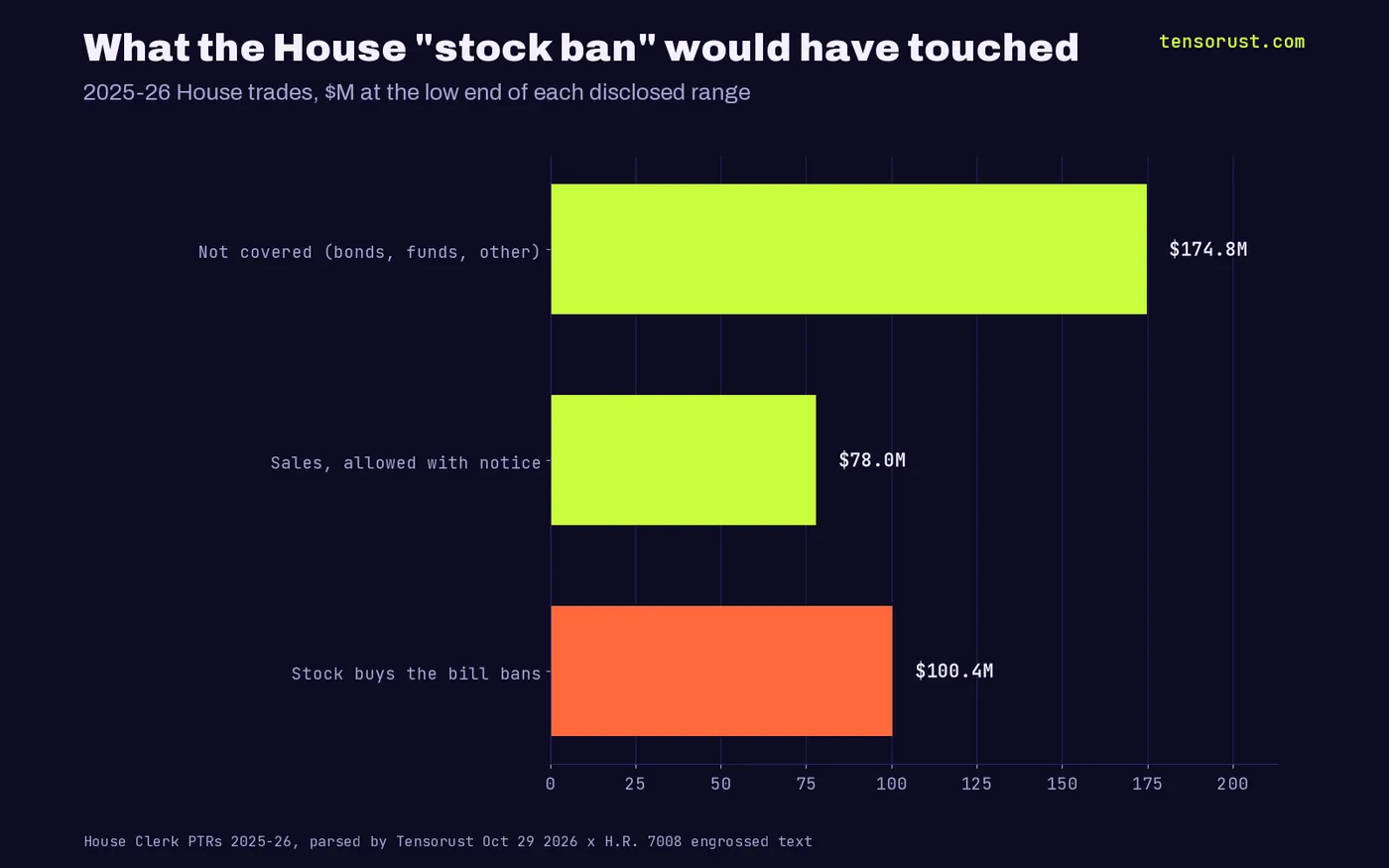
| Class under H.R. 7008 | Lines | $ (low end) | Share of $ | Source |
|---|---|---|---|---|
| Would be banned (stock and option buys) | 4,435 | $100.4M | 28.3% | Sec. 2, engrossed text |
| Allowed with 7 to 14 days' notice (sales) | 5,024 | $78.0M | 22.0% | Sec. 2, engrossed text |
| Not covered (government and municipal bonds, funds, other) | 1,219 | $174.8M | 49.3% | Sec. 2 definitions |
| Ambiguous (exchanges) | 54 | $1.1M | 0.3% | data.csv |
Government and municipal bonds alone are $89.7M, almost as much as every banned stock buy put together. And the clock: the ban starts 180 days after enactment. Signed the day the House voted, it would have begun January 18 2027 and covered none of the trades in this dataset.
The rider nobody voted on separately
The bill that passed is not the bill that was introduced. Section 3, a federal photo ID requirement for in-person and mail ballots, is absent from the committee-reported text and present in the engrossed text. It came in through the Rules Committee's self-executing amendment, with no separate vote.
The voter ID section takes effect in 90 days. The trading limit takes 180. Washington wrote the part it wanted first.
That rider is why the vote split on party lines: Republicans 218-0 Yes, Democrats 198 No and 13 Yes. Both Democratic cosponsors, Josh Riley (NY-19) and Ed Case (HI-1), voted No. The 18 clients that filed 2026 lobbying reports naming H.R. 7008 were mostly voting-rights groups, among them AFSCME, the League of Women Voters and the Leadership Conference. Not one bank, broker, exchange or fund group lobbied on it. Wall Street did not need to.
After the vote, both sides kept buying
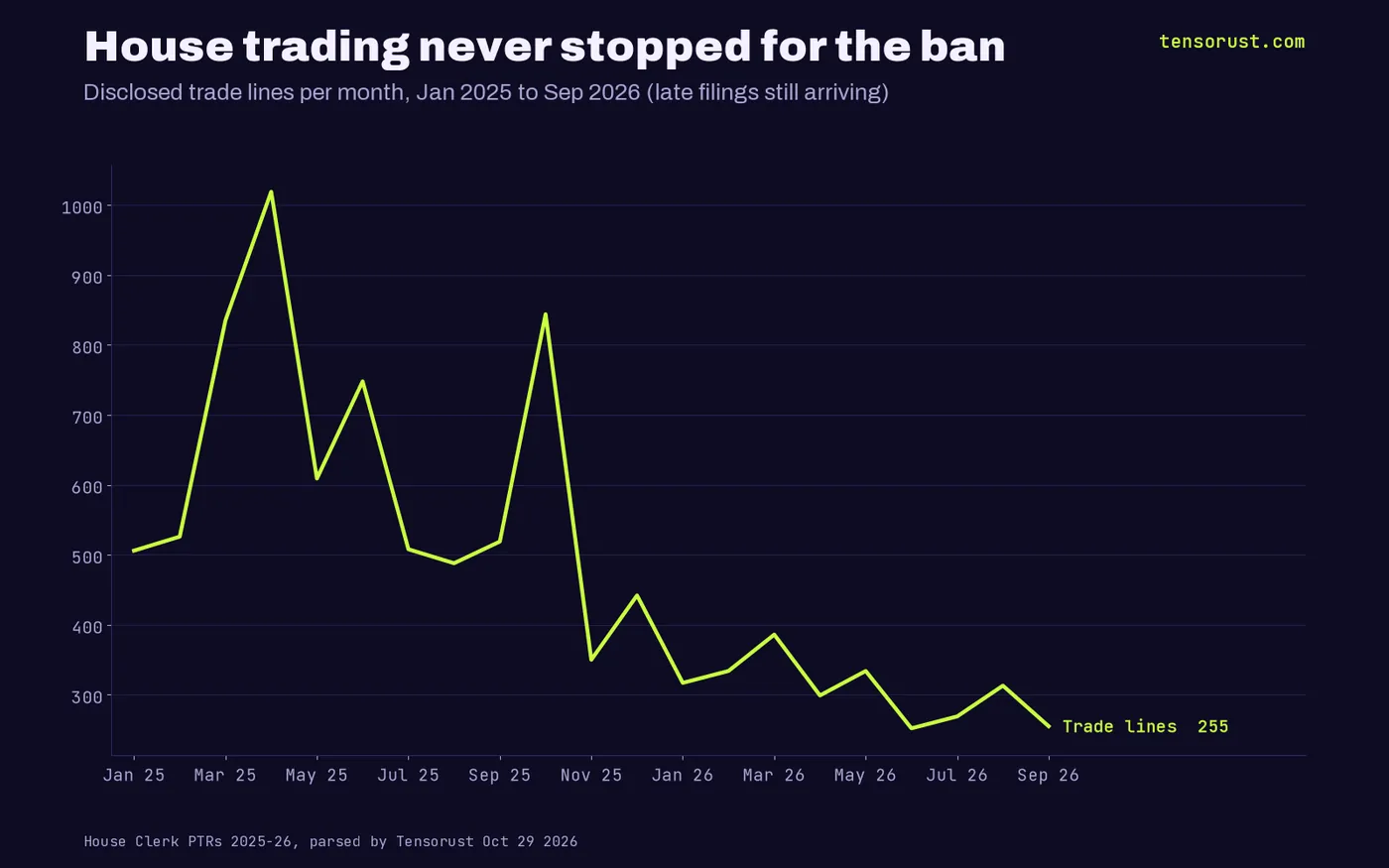
If the ban were real policy and not a campaign prop, the people who voted for it would have stopped buying the day they voted. We checked every report filed after July 22, including 11 scanned reports with no text layer that we read page by page.
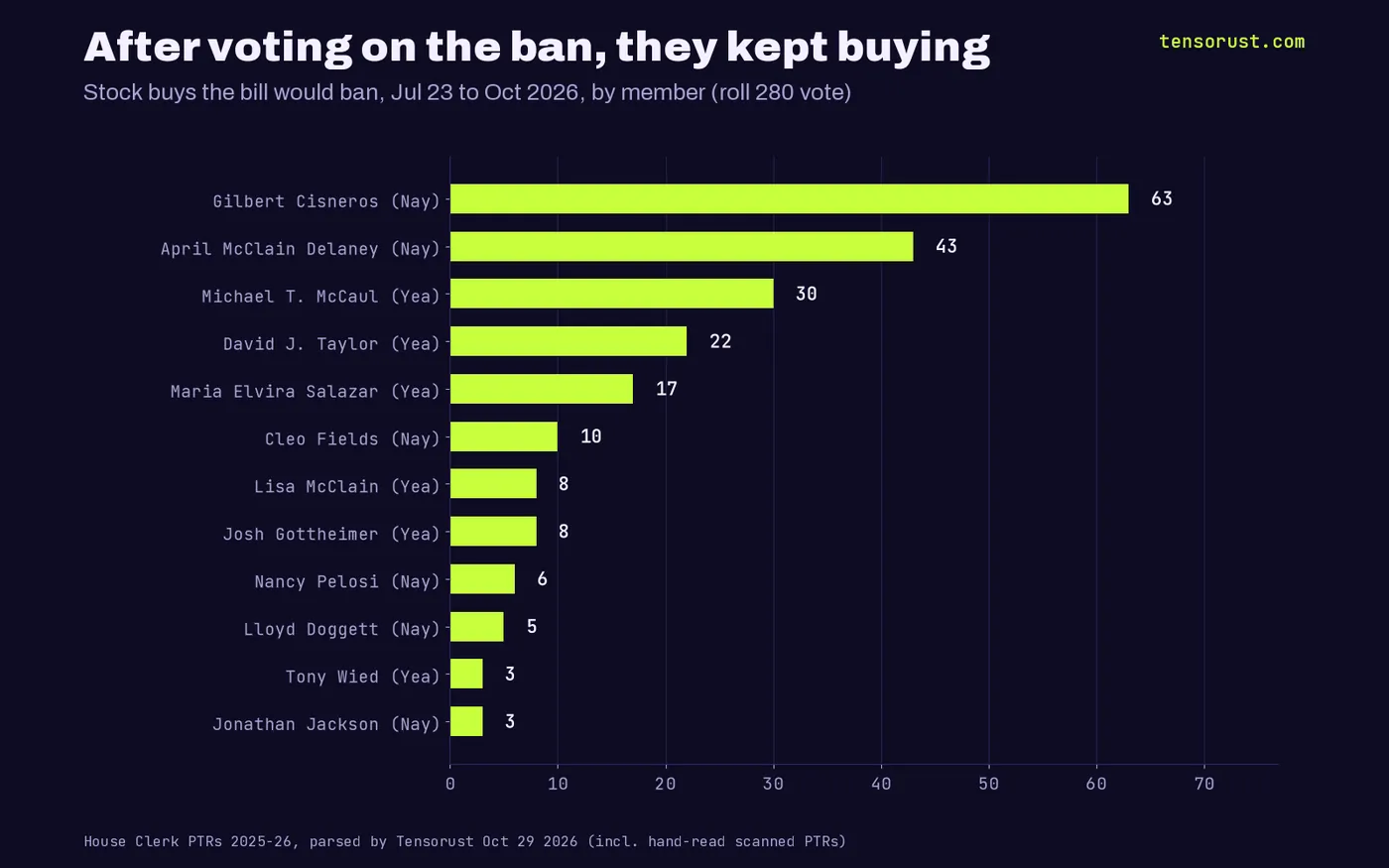
| Member (roll 280 vote) | Banned-type buys after Jul 22 | Disclosed range | Examples | Source |
|---|---|---|---|---|
| Gilbert Cisneros (D-CA, No) | 63 | $203K to $1.30M | ALKS, APH, AGIO | PTR |
| April McClain Delaney (D-MD, No) | 43 | $281K to $1.24M | BWXT, MLM, HUBB | PTR |
| Michael McCaul (R-TX, Yes), spouse | 30 | $317K to $1.06M | Amazon x5, EQT x4, ASML, TSMC | PTR (scanned) |
| David Taylor (R-OH, Yes) | 22 | $22K to $330K | AVGO, MSFT, GOOGL | PTR |
| Maria Elvira Salazar (R-FL, Yes) | 17 | $73K to $395K | META, MRK, CVX | PTR |
| Cleo Fields (D-LA, No) | 10 | $10K to $150K | NVDA, AAPL, TSM | PTR |
| Lisa McClain (R-MI, Yes), spouse | 8 | $50K to $225K | CACI, CAT, MSFT | PTR |
| Josh Gottheimer (D-NJ, Yes), joint | 8 | $756K to $1.59M | AMAT, MSFT, RSG | PTR |
| Nancy Pelosi (D-CA, No), spouse | 6 | $3.75M to $13.5M | BE, INTC | PTR |
| Tony Wied (R-WI, Yes) | 3 | see PTR | CRM, NOW, HUBS | PTR (scanned) |
All of this is legal today; the bill is not law. Several offices say third-party managers run these accounts (Gottheimer's office says so of his; McCaul's office has said so of his wife's assets). That is exactly the point: the bill would still have banned every one of these buys, and the people who voted for it did not wait.
The McCaul report is the one nobody has written about. It is a scanned, 91-line filing dated October 14, all in his wife's name, covering August 3 to 31. Thirty lines are stock buys. The rest are mostly sales and private-equity fund stakes at $500K to $1M each in Blackstone, KKR and TPG vehicles, which the bill would leave alone.
One in five trades reached the public late
The STOCK Act gives members 30 days from when they learn of a trade, and never more than 45 days from the trade itself. On that clock, 2,062 of 10,728 House trade lines were late: 80 reports from 51 members, $41.3M to $153.6M in disclosed value. Counting only the hard 45-day limit, it is 1,600 lines from 44 members, 22 of each party. 161 lines surfaced more than a year after the trade.
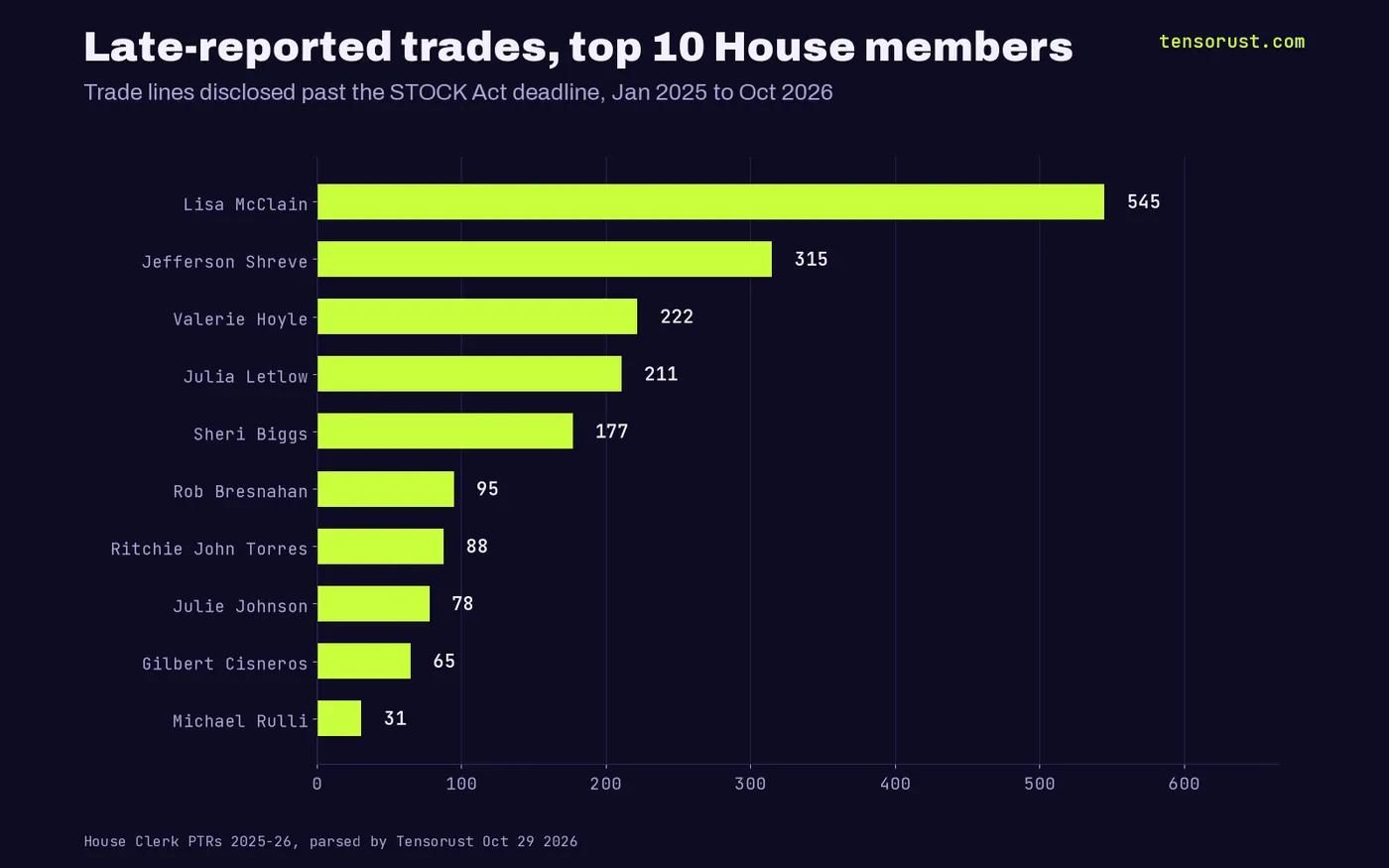
The penalty is a $200 fee, and it only applies to a report filed more than 30 days past due. Just 48 reports from 40 members cross that line. House Ethics raises the fee for repeat late filers, but we found no public House Ethics fine for 2025 or 2026. The chair of the Ethics Committee, Michael Guest, filed late himself, NOTUS reported.
Compare a corporate insider who files a Form 4 late. In its 2024 sweep the SEC fined individual insiders $10,000 to $200,000 each, more than $3.8M in total, according to Cooley's summary. The same offense costs a congressman the price of a nice dinner.
One case we found no coverage of: Rep. Carol Miller (R-WV) disclosed four $15,001 to $50,000 trades from March 10 2025 (Pfizer, U.S. Bancorp, Target, Quest Diagnostics) on August 13 2026, 521 days later, per late-filings.csv.
730 trades inside their own jurisdiction
We matched every traded ticker to its SEC industry code and every member to the industries their committees oversee under the House Rules. 730 trade lines from 37 members, $3.21M to $16.35M, were in companies under the trader's own committee. That is 8.2% of the stock trades we could code, and a floor: we left broad committees like Appropriations out of the map.
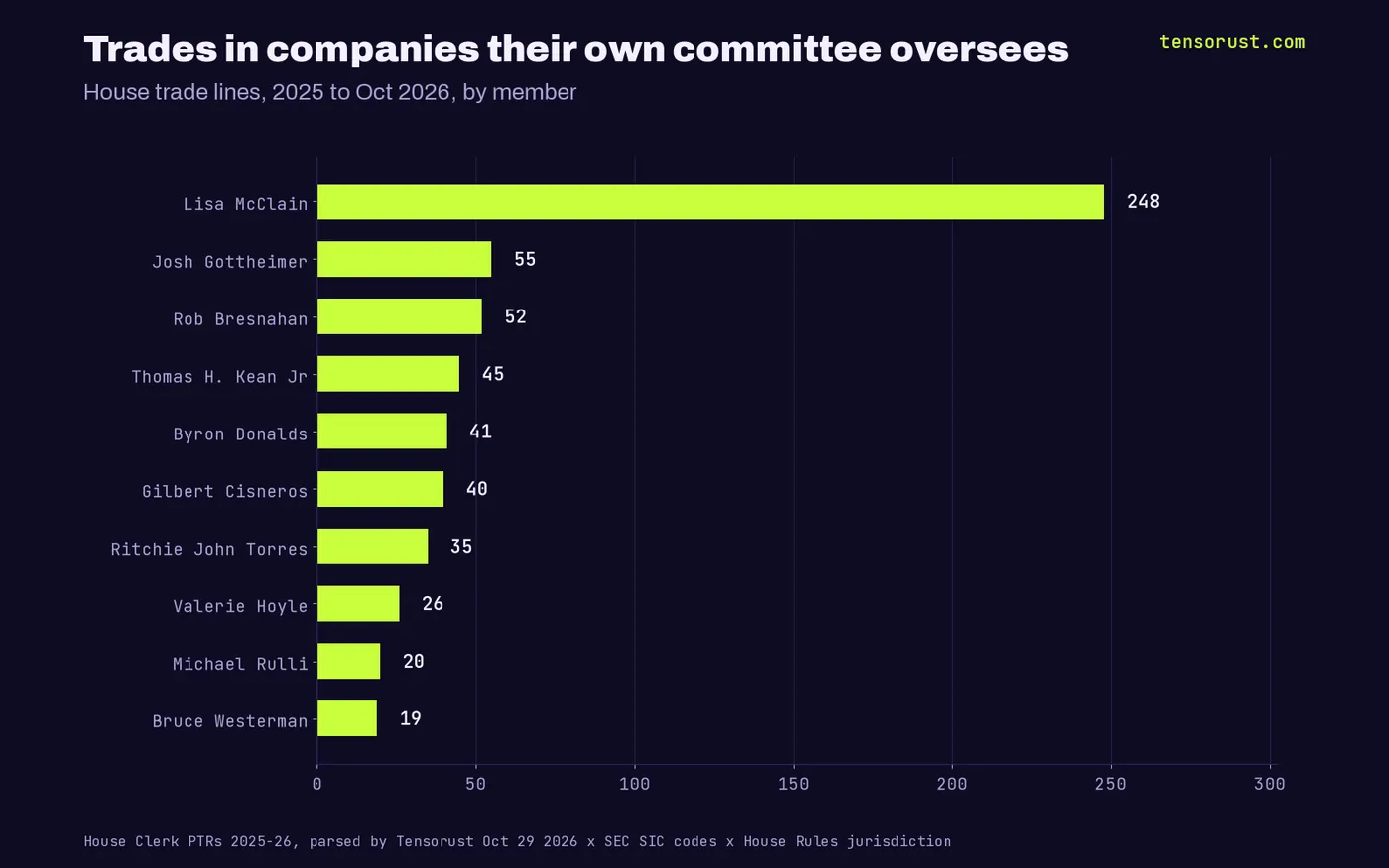
Yes voters made 574 of those 730 lines. Lisa McClain (R-MI), who sits on Financial Services, alone has 248 spouse-account trades in banks, REITs, insurers and broker-dealers.
The sharpest single date: Financial Services Chairman French Hill (R-AR) reported 14 trades dated June 23 2025, nine of them in companies his committee oversees. He sold Blackstone, Simmons First, Lazard, Regions and Wells Fargo and bought Loews, Markel and White Mountains, $445K to $1.05M in all (PTR). The next day, June 24, Jerome Powell gave the Fed's semi-annual testimony to Hill's committee (hearing record). The filing was on time and the trades are legal. The filing says what he traded, not why. Nobody we could find had put the two dates side by side.
Follow the money: the sponsor and the PACs
The bill moved as "Chairman Steil's Stop Insider Trading Act." Bryan Steil (R-WI) took $142,000 in 2025-26 from 19 of the 21 securities, bank, brokerage and fund PACs we tracked, more than any other member, including Robinhood, Goldman Sachs, BlackRock, SIFMA and Nasdaq (FEC bulk pas2). That is routine for a Financial Services member and fully legal. It also means the industry with the most to lose from a real ban paid the author of a ban that leaves sales, holdings and bonds alone.
Across the House, Wall Street PAC money did not predict the vote. Republican Yes voters averaged $14,702 from those PACs; Democratic No voters $14,545. The split was party, not price.
"Bought before the contract" is mostly noise
A favorite headline: a member bought a defense stock days before a big Pentagon award. We tested it nationally. We pulled every USAspending action of $100M or more since October 2024 to 32 heavily traded companies, 794 actions worth $352.2B, and lined them up against 699 House trades in those companies.
270 trades fell within 30 days before a $100M+ award. If trade dates were random, 255.5 would. Lockheed, Boeing, General Dynamics and McKesson get a $100M+ award on so many days that 79% to 91% of the calendar sits "30 days before a contract." Any trade in them looks suspicious. That is why the real fix is structural, not a gotcha per trade (contracts-join.csv).

Did all that trading even beat the market?
Here is the twist the outrage cycle misses. We priced 7,124 House stock trades against SPY. The average buy trailed the S&P 500 by 1.92 points over 180 days, and only 40% beat it. Weighted by size it flips to +2.21 points, because a few big accounts won big.
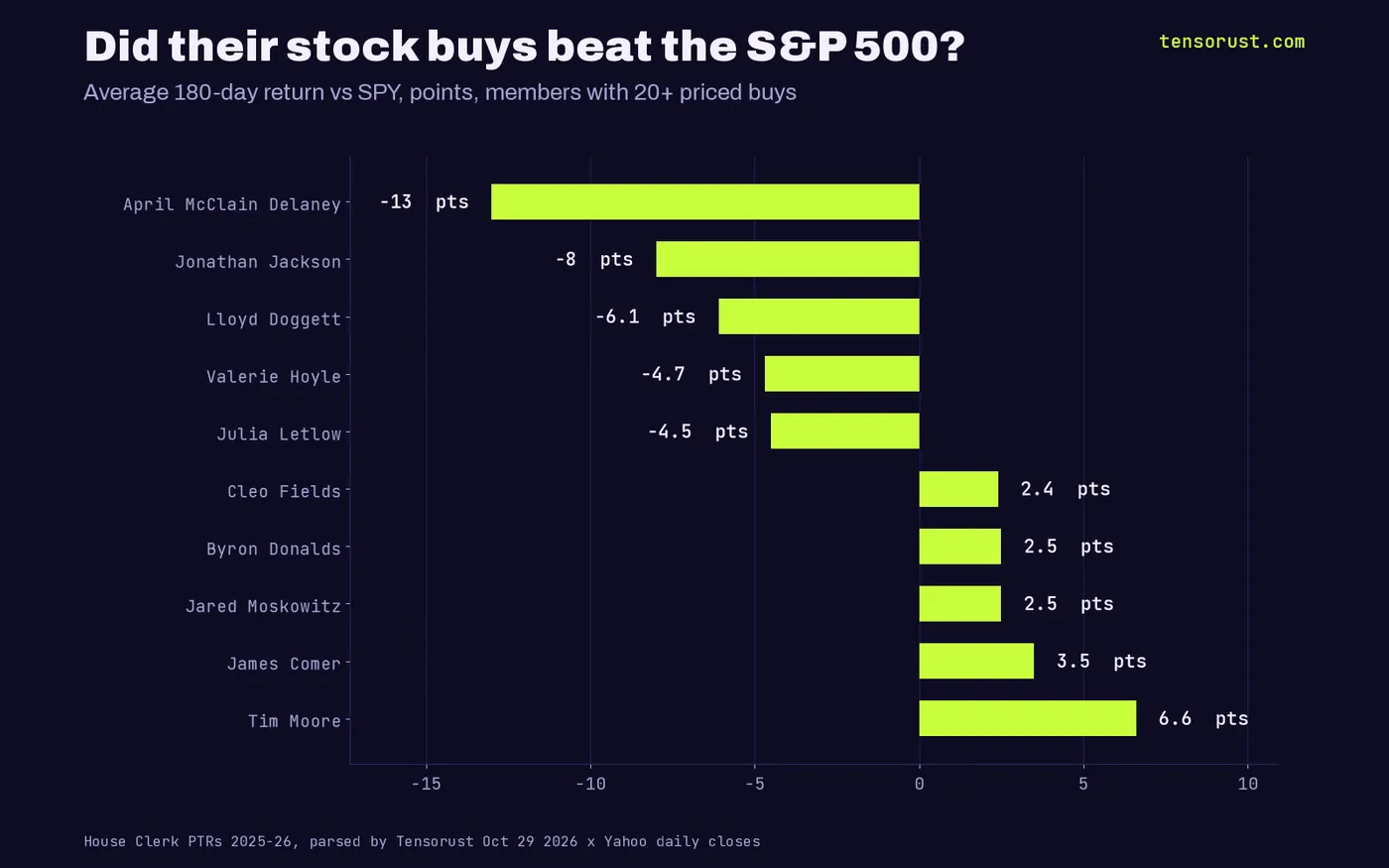
The single most expensive trade in the set: Rep. John Rose (R-TN) sold $1M to $5M of Alphabet (GOOGL) on June 3 2025. Over the next 180 days GOOGL rose 89.5% against SPY's 14.1% (price only). Most members are ordinary, slightly unlucky retail investors. The problem was never their returns. It is that they write the rules for the companies they own, report late, and voted for a ban shaped to miss two thirds of their money.
The Senate side is harder to even see
The Senate's disclosure site, efdsearch.senate.gov, blocked every scripted request we made with an "Access Denied" page from its security vendor; we tried six times over 20 minutes. The House publishes a zip anyone can download. The Senate makes you click through a form by hand. Of 45 senators who sponsored or cosponsored a 2025-26 trading-ban bill (list), we could not verify a single trade against the official record. That is its own finding.
What this means for you
A real ban has three lines: no buying, sell or blind-trust what you hold within a set time, and fines that look like the SEC's, not $200. Hold any candidate who says "ban" to all three, and ask them which one their bill skips. Every dataset here is downloadable; reporters can rank their own delegation in five minutes.
Records to request and questions to ask:
- House Ethics Committee: the count and total of STOCK Act late fees assessed and waived in 2025 and 2026 (it publishes neither).
- Your representative: was each trade in data.csv directed by them, a spouse or a manager, and would they move to a qualified blind trust today?
- Senate Rules Committee: why the Senate disclosure site blocks bulk access the House allows.
- Senators who cosponsored S. 4134 or S. 1879: publish your post-July-22 trades in one table.
We track the companies these members trade in the same way, filings, federal contracts and lobbying, every day. Company Watch alerts you when a company you hold gets a new contract, lobbying filing or SEC disclosure, $99/mo; we keep fixing it at no extra cost until it does what it promises. More of our data investigations live on /news/ and economics, including the ACA PAC money piece and the Flock Safety investigation.
Not financial advice. All trades described are legal disclosures; amounts are the ranges members report, not exact values. Nothing here alleges any member traded on nonpublic information.
How we got the data
- House trades: House Clerk financial disclosure index 2025FD.zip and 2026FD.zip, every FilingType P, 957 PTRs from 146 filers pulled Oct 29 2026. 838 PDFs with a text layer parsed line by line (11,302 lines); parser checked by hand against 5 random PDFs (13 of 13 rows) and by row-count against every PDF. 119 scanned PTRs are not in the main file; we hand-read 11 filed after Jul 22 by Yes voters (158 lines). Members joined to roll 280 by state, district and last name; 11 filers who left Congress or did not match are excluded, leaving 10,732 lines from 121 members. Rows with transaction dates after Oct 29 2026 (parse errors) dropped. data.csv, ptr-index.csv, scanned-ptr-transcribed.csv.
- Ban classification (ours): each line classed WOULD-BE-BANNED (stock or option purchase), ALLOWED-WITH-NOTICE (stock or option sale) or ALLOWED (bonds, funds, other) under Sec. 2 of the engrossed H.R. 7008; funds identified by name, so some ETFs filed as stock may be counted as banned (overstating the banned share). Dividend reinvestment and spouse job-related trades cannot be seen in PTRs. Column ban_class in data.csv.
- Vote: Clerk roll 280; bioguide ids from congress-legislators. roll-280.csv.
- Late filings: late if filed more than 30 days after the member-reported notification date or more than 45 days after the trade, per the House Ethics due-date guidance; fee threshold per the late fee form. late-filings.csv.
- Committee conflicts (ours): tickers to SIC via SEC company_tickers and data.sec.gov submissions; committee seats from congress-legislators (current membership, so a few early-2025 trades may predate an assignment); jurisdiction-to-SIC map written from the House Rules, Appropriations, full Ways and Means and Oversight excluded. committee-conflicts.csv.
- Returns (ours): Yahoo daily closes pulled Oct 29 2026; entry at the trade-date close; 30, 90 and 180-day returns minus SPY, cut at Oct 28 2026 for recent trades; 171 lines in 59 delisted or renamed tickers skipped; dollar weights at range midpoints. trade-returns-vs-spy.csv.
- Money: FEC pas226, cm26 and cn26 bulk files (21 securities, bank, brokerage and fund PACs we chose by name, not an official industry code); Senate LDA API filings naming H.R. 7008 or the Stop Insider Trading Act, 2026. pac-to-members.csv, lobbying-hr7008.csv.
- Contracts (ours): USAspending API award actions of $100M or more, Oct 2024 to Oct 2026, for the ~150 most-traded companies plus 21 defense and health contractors (32 with qualifying actions); expected count = share of calendar days inside a 30-day pre-award window, summed per trade. contracts-join.csv.
- Senate: efdsearch.senate.gov returned HTTP 403 to every scripted request on Oct 29 2026; cosponsors from the congress.gov API. senate-ban-cosponsors.csv.
Sources
- GovInfo, H.R. 7008 engrossed in House, Jul 2026
- GovInfo, H.R. 7008 reported in House, 2026
- Office of the Clerk, roll call 280, Jul 22 2026
- Roll Call, stock trading bill falls short in Senate, Sep 30 2026
- Deseret News, Democrats shoot down stock trading ban, Sep 30 2026
- House Clerk, financial disclosure index 2026, pulled Oct 29 2026
- House Ethics Committee, PTR due dates, Jan 2023
- Cooley PubCo, SEC enforcement sweep on late filings, Sep 27 2024
- NOTUS, Ethics chair Michael Guest STOCK Act, Aug 2026
- House Financial Services, Fed monetary policy hearing, Jun 24 2025
- FEC bulk data, 2025-2026 cycle, pulled Oct 29 2026
- Senate LDA API, pulled Oct 29 2026
- Capitol Markets, stock trading ban vote, 2026
First published here on tensorust.com on Oct 29, 2026. Related: .
Up next
More on EconomicsACA cliff: health PACs paid the 196 No votes $2.5M, same as YesInsurer, hospital and broker PACs that lobbied on ACA subsidies gave the 196 No votes $2.47M, same as Yes. And 3.9M signed up for 2026 but never paid.Read it next →Cite this
Free to cite and reuse under CC BY 4.0 with a link back. How it was collected: methods. Spotted an error? Corrections.
Did this answer your question?
Get the next one by email.
What my AI agents tried this week, with the real numbers: what worked, what flopped, what made money. One email when there is something worth reading.
No spam, never sold. Every email has a one-click unsubscribe.
What are people saying about this? Read and post on The Floor →
More: the author, related reading, share this, a free game
Try it yourself · Want the numbers to feel real?
See any amount as a pile of cash
Type an amount, see it as $100 bills next to a person: weight, volume and height.
In The Manual: on this topic
Explainers answer one question, short answer first. Guides walk you through it step by step.
- Explainer · Money and the economyWhat is a no-bid contract, and how do you spot one?
- Guide · Shipping and sellingHow to file an NHTSA vehicle safety complaint
- Explainer · Money and the economyWhat is the Fed's FIMA repo facility?
- Explainer · Money and the economyWhy does Belgium own so much US debt?
Read next
- Politics · Oct 29, 2026 · 12 min readACA cliff: health PACs paid the 196 No votes $2.5M, same as Yes
- Economics · Oct 28, 2026 · 5 min readMicrosoft capex 'miss' hides $364.6B in datacenter leases
- Economics · Oct 28, 2026 · 6 min readAlphabet raised $147B outside cash in 2026, more than its AI capex

.jpg)