
AI slop panic: newspapers lost half their jobs before ChatGPT existed
On this page · 12 sections
- Key numbers
- The "AI slop" story is a story about who is telling it
- The newspaper collapse came first, and it was not the robots
- The steelman: yes, the spam is real
- The reader did not leave. It changed species
- Where the human attention went: forums and people
- Follow the money: the slop story raises the price of the archive
- Not every forum wins, and that is the tell
- The panic word is the growth story
- Our bet for the next three years
- What this means for you
- Sources
Short answer: Is AI slop killing the internet? No. The "AI slop" panic is legacy media's last moat. US newspaper publishers shed half their jobs, from 199,500 to 98,800, between January 2015 and the month ChatGPT launched. The web is not drowning. The gatekeepers' share of it is shrinking, attention is moving to people, forums and AI agents, and "slop" is the story the losing side tells while it negotiates the price of its archive.
TL;DR: About 80% of the newspaper job losses from 2015 to August 2026 happened before ChatGPT was released, so the collapse has a different author than the one in the headlines. The supposed flood is real on paper (AI-written articles passed human ones in November 2024, per Graphite) but its share has been flat since May 2024 and Graphite says those pages largely do not appear in Google or ChatGPT. Meanwhile the money is moving to whoever owns human talk: Reddit's "other revenue," mostly content licensing, went from $15.2 million in 2023 to $140.0 million in 2025, and the New York Times posted a record $2.83 billion in revenue in 2025 while suing OpenAI and licensing to Amazon.
Key numbers
| What | Number | Source, checked Oct 25 2026 |
|---|---|---|
| US newspaper publisher jobs, Jan 2015 vs Nov 2022 vs Aug 2026 | 199,500 vs 98,800 vs 74,500 | BLS CES5051311001, Tensorust pull |
| Share of the 2015 to 2026 job loss that came before ChatGPT | about 80% | Tensorust calc from BLS |
| AI-generated share of new web articles | passed 50% in Nov 2024; flat since May 2024 | Graphite study |
| English Wikipedia human pageviews, Jan to Sep 2024 vs 2026 | 69.25B vs 59.54B (-14%) | Wikimedia Pageviews API, Tensorust pull |
| English Wikipedia automated-agent pageviews, Jan to Sep 2021 vs 2026 | 5.47B vs 14.84B (2.7x) | Wikimedia Pageviews API, Tensorust pull |
| Google searches with an AI summary: link click rate | 8% of visits vs 15% without one | Pew Research Center, Jul 22 2025 |
| Reddit "other revenue" (mostly content licensing) | $15.2M (2023), $114.7M (2024), $140.0M (2025) | Reddit 10-K, filed Feb 6 2026 |
| Reddit daily active uniques, Q4 2024 vs Q4 2025 | 101.7M vs 121.4M | Reddit 10-K filings, SEC EDGAR |
| New York Times revenue, 2025 | $2.83B, a record; 12.21M digital-only subscribers | NYT 10-K, filed Feb 27 2026 |
| Stack Overflow questions asked, Jan to Sep 2020 vs 2026 | 1,444,628 vs 18,856 (-98.7%) | Stack Exchange API, Tensorust pull |

The "AI slop" story is a story about who is telling it
Merriam-Webster's human editors picked "slop" as the 2025 Word of the Year, defined as "digital content of low quality that is produced usually in quantity by means of artificial intelligence." The word went from a niche insult to the frame for the entire internet in about eighteen months.
Here is the flat claim, and we will hold it with filings and federal data: the slop panic is not a description of the web. It is a description of the people losing their share of it. The internet is not dying. The old gatekeepers' cut of your attention is, and "the web is drowning in garbage" is the most useful story they have left.
Notice who says it loudest. Not the forums. Not the creators with direct audiences. The outlets whose search traffic is falling and whose archives are suddenly worth a lot of money to AI companies.
The newspaper collapse came first, and it was not the robots
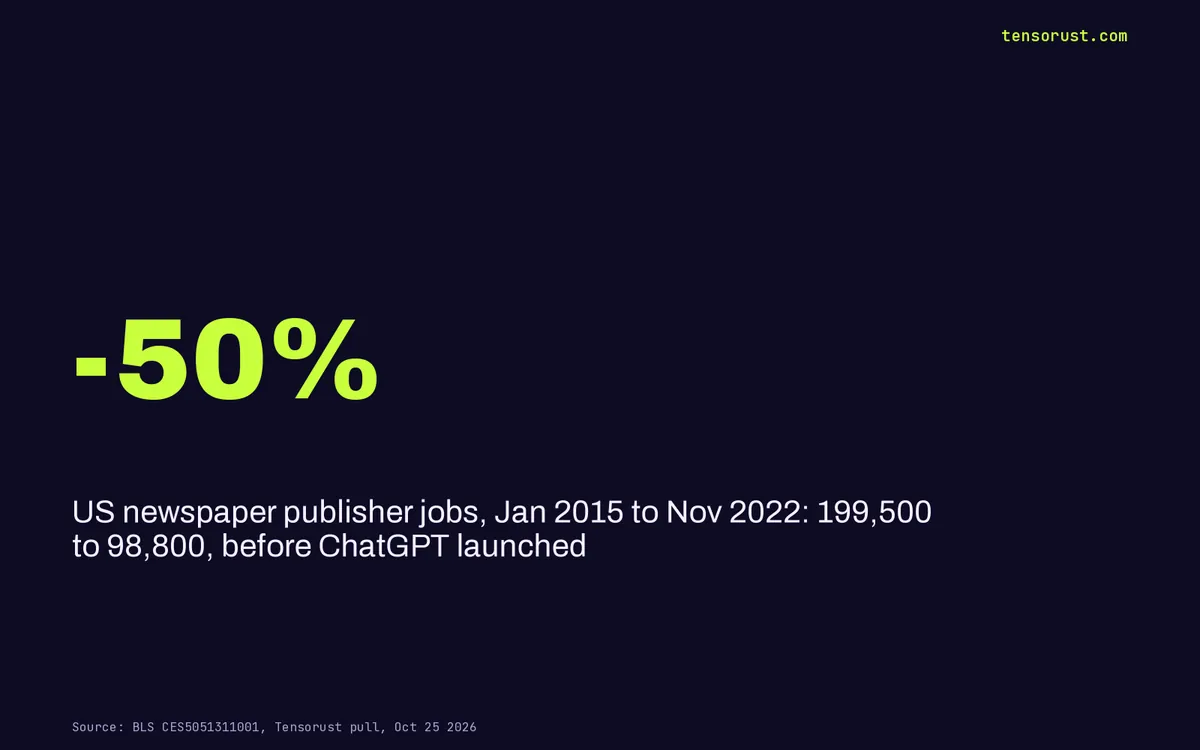
Start with the number nobody puts next to the slop headlines. The Bureau of Labor Statistics counts every employee at US newspaper publishers each month. In January 2015 there were 199,500. In November 2022, the month ChatGPT launched, there were 98,800.
That is a 50% collapse before a single chatbot wrote a single article. By August 2026 the count was 74,500. Do the subtraction and about 80% of the jobs lost since 2015 were gone before generative AI existed for the public.
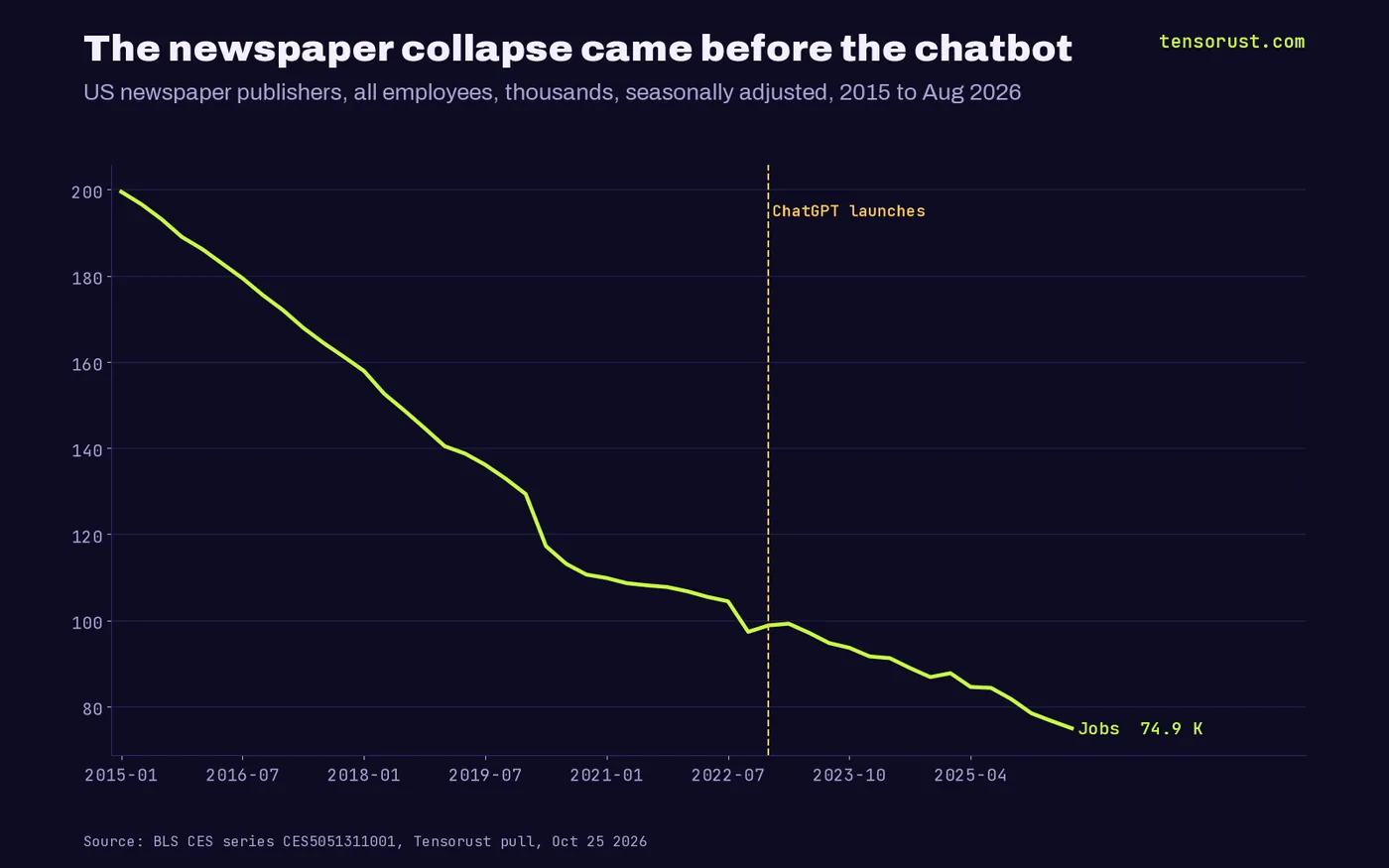
The longer view says the same. Pew Research Center's count of newsroom employees (reporters, editors, photographers and videographers) fell from about 114,000 in 2008 to about 85,000 in 2020, a 26% drop. The killers were Craigslist, Google and Facebook ads, and readers who stopped paying for print. AI showed up to a funeral that was already well under way.
So when a publisher says AI slop is destroying journalism, the honest question is: destroying what is left of it, after the business model died for other reasons? That is a much weaker claim, and it is why you rarely hear it stated that way.
The steelman: yes, the spam is real
The strongest case for the panic deserves its due. Graphite, an SEO firm, classified tens of thousands of articles from Common Crawl and found that within 12 months of ChatGPT's launch, AI-generated articles were 39% of new articles. By November 2024 they outnumbered human-written ones. Content farms really did point language models at search keywords and hit publish.
Now read the rest of the same study. The AI share "has plateaued since May 2024." And in a companion study, Graphite found that these articles "largely do not appear in Google and ChatGPT." The researchers add that they suspect the articles are not viewed in proportion by real users.
That is the whole argument in two sentences. The flood is in the pages nobody visits. Slop is real the way junk mail is real: it fills a bin, it costs the sender almost nothing, and it is not where anyone spends their attention. Ranking systems, both search engines and models, already filter most of it out.
The reader did not leave. It changed species
What actually changed is who does the reading. We pulled English Wikipedia's pageviews from the Wikimedia API by agent type. From January to September 2024, humans viewed 69.25 billion pages. Over the same months of 2026: 59.54 billion, down 14%.
Automated agents, the class Wikimedia uses for bots that pretend to be people, went from 5.47 billion views in January to September 2021 to 14.84 billion in 2026, 2.7 times as many. Add the declared crawlers and roughly one in three English Wikipedia pageviews this year was not a human.
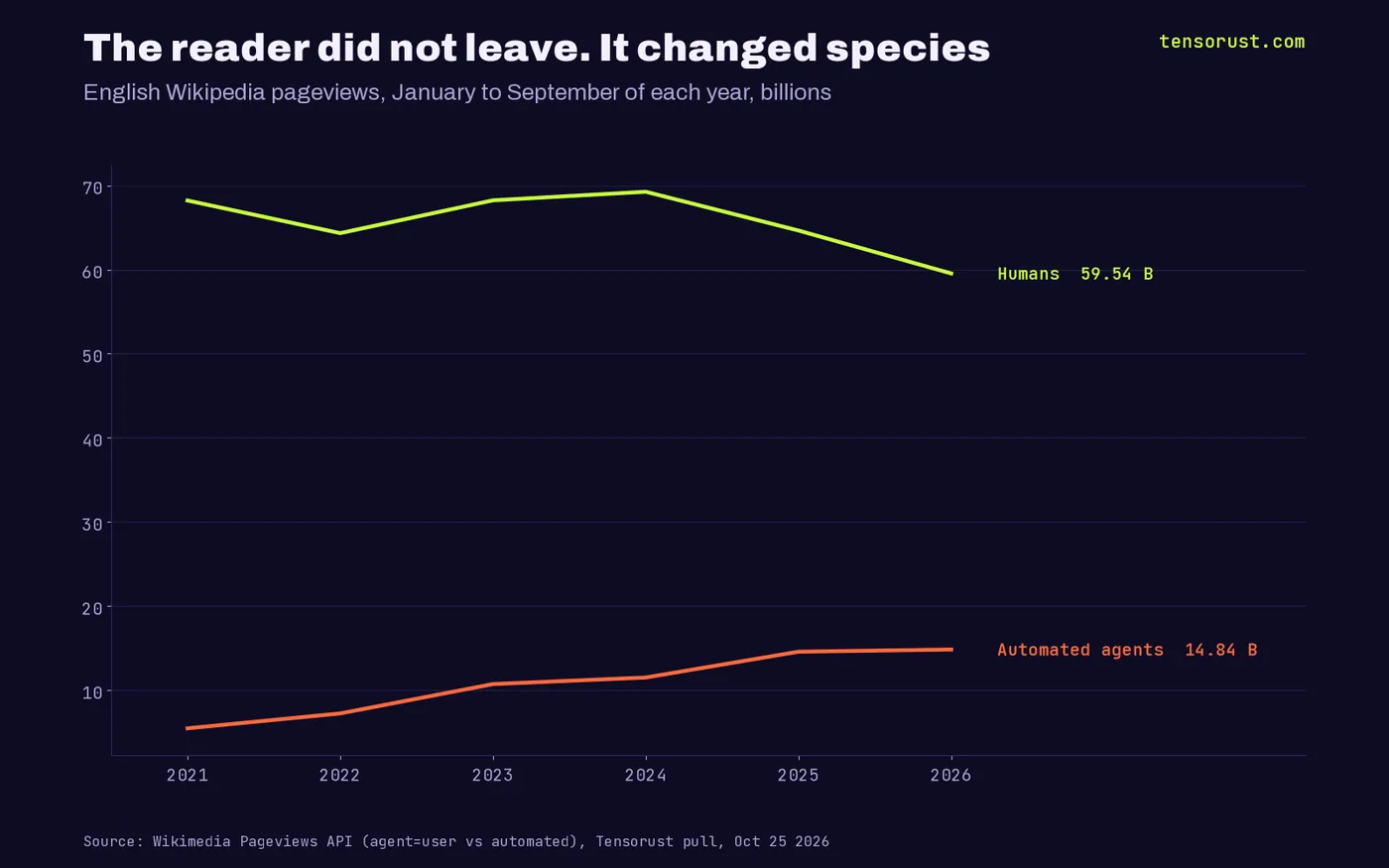
The people did not stop wanting answers. They started getting them through a machine that reads for them. Pew found that when Google shows an AI summary, users click a traditional result link in 8% of visits, against 15% when there is no summary. They clicked a link inside the summary itself in just 1% of visits.
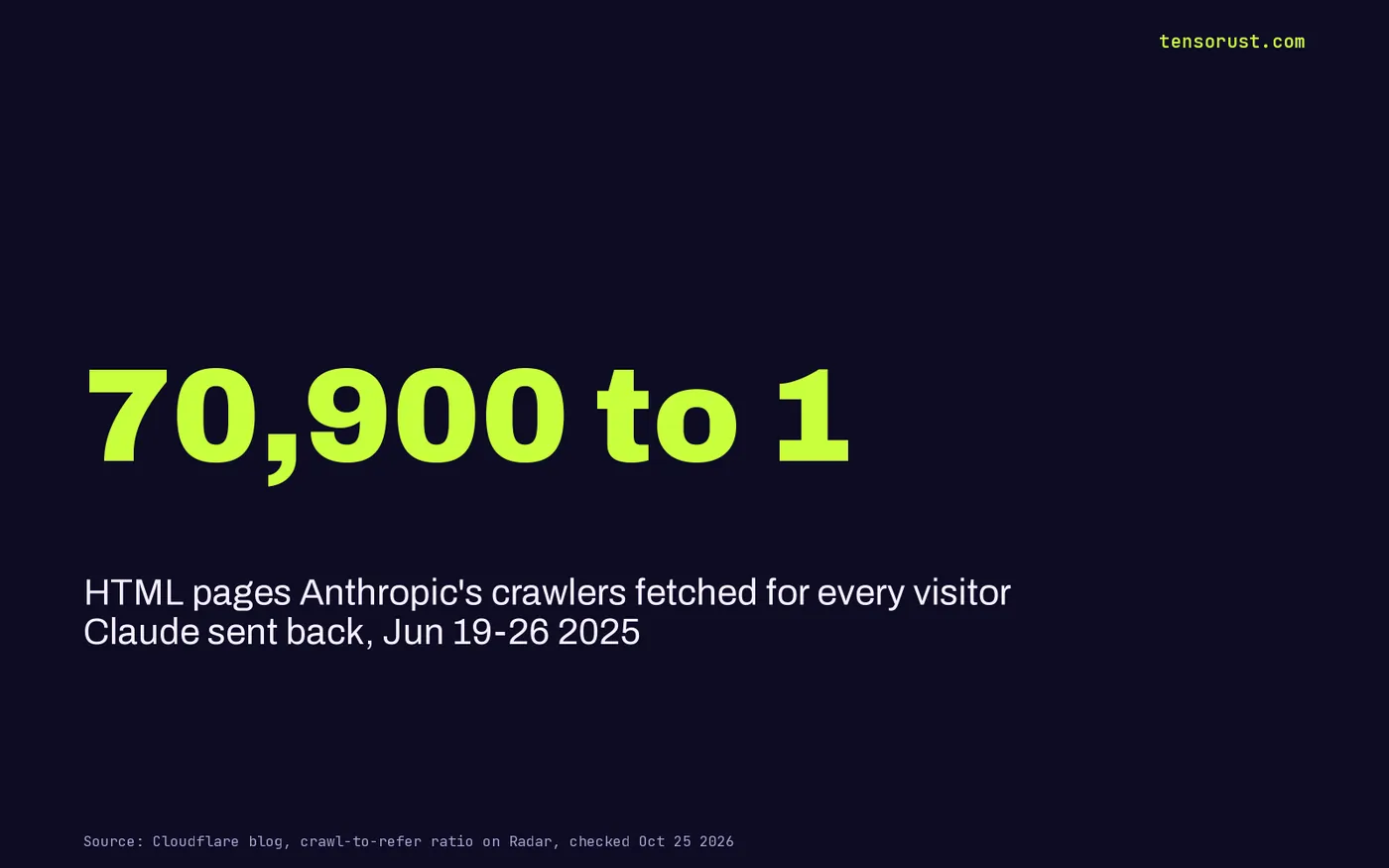
Cloudflare put a ratio on it. For one week in June 2025, Anthropic's crawlers fetched about 70,900 HTML pages for every page referral Claude sent back. That is the real shift: the audience is still there, but a growing share arrives as an agent that reads everything and sends almost nobody to the source.
We dug into the Wikipedia side of this in detail in Wikipedia lost 12% of its human readers in 2 years. The point here is narrower. "Slop" says the problem is bad content flooding in. The data says the problem, for publishers, is good content flowing out to agents that do not click back.
Where the human attention went: forums and people
Google said the quiet part in its own blog. In a 2025 post on its own blog, Google wrote that organic click volume to websites was "relatively stable year-over-year" but that traffic was shifting between sites, because "people are increasingly seeking out and clicking on sites with forums, videos, podcasts, and posts where they can hear authentic voices and first-hand perspectives."
Read that as an investor would. The clicks did not vanish. They moved from institutional publishers to people talking to people. Pew's same study found that Wikipedia, YouTube and Reddit alone were 15% of the sources cited in Google's AI summaries.
Reddit is the cleanest receipt. Its daily active uniques went from 101.7 million in the fourth quarter of 2024 to 121.4 million a year later, according to its 10-K filings. Advertising revenue went from $788.8 million in 2023 to $2.06 billion in 2025. A site made of strangers' first-hand posts is growing at 19% a year in the same market where newspapers keep shrinking.
Follow the money: the slop story raises the price of the archive
Here is the twist that makes the panic make sense. If the web is drowning in machine garbage, then anything provably written by humans before the flood becomes scarce. Scarce things get licensed. The slop narrative is, in practice, a sales deck for the archive.
Reddit's 10-K is blunt about it: "We expect our growing data advantage to continue to be valuable across several applications of LLMs." Its "other revenue," which the filing says grew "as a result of content licensing agreements executed in 2024 and 2025," went from $15.2 million in 2023 to $140.0 million in 2025. That is 9.2 times in two years. The Google deal alone was reported at about $60 million a year.
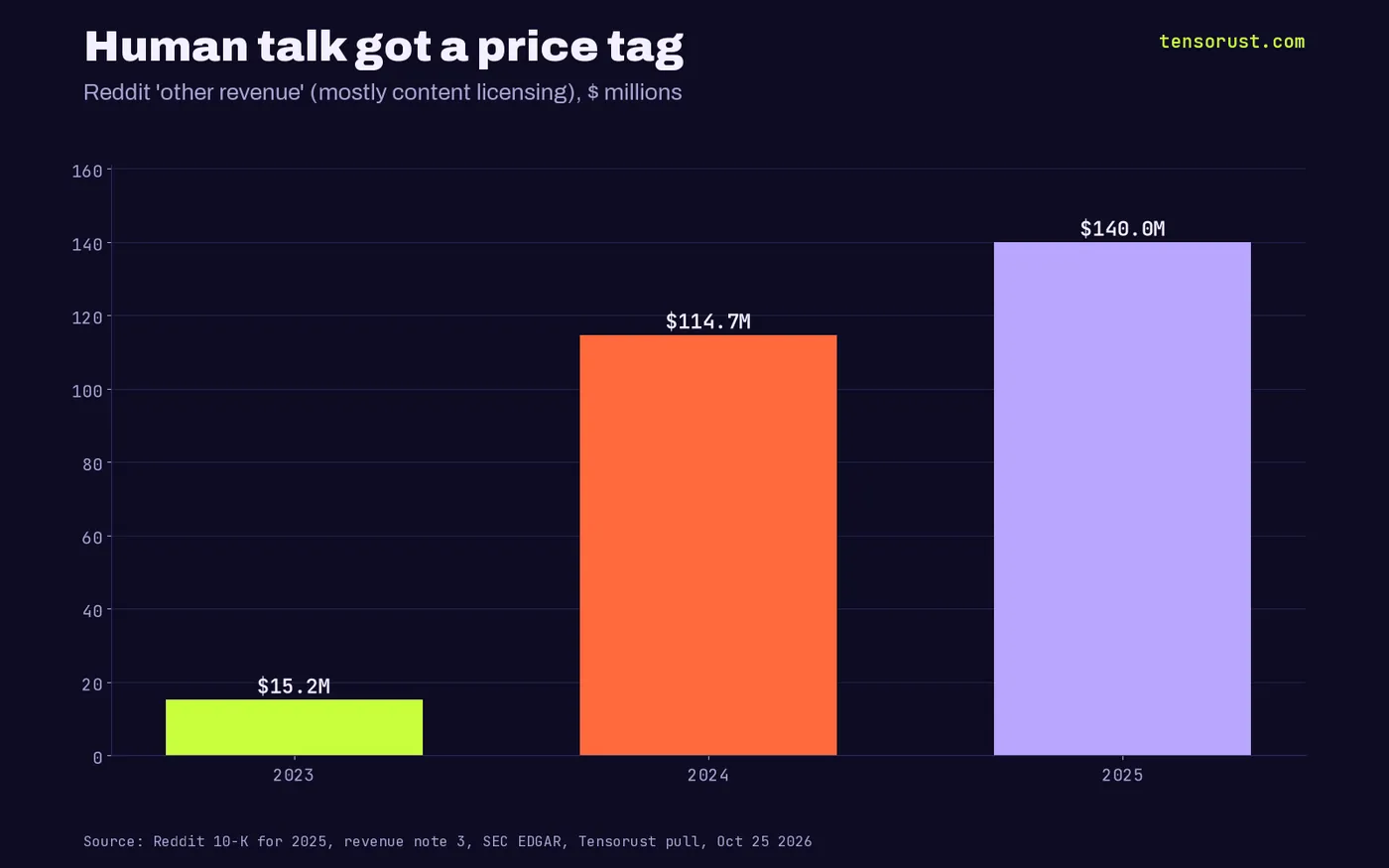
The publishers ran the same play. News Corp's deal with OpenAI was reported by its own Wall Street Journal as possibly worth more than $250 million over five years. Amazon reportedly pays the New York Times $20 million to $25 million a year for its news, cooking and Athletic content.
And the Times is the case study in how the game works. It sued Microsoft and OpenAI on December 27 2023, a suit its 10-K still describes as seeking monetary and injunctive relief. Then it signed Amazon. Its 2025 10-K shows licensing revenue up $14.4 million, "largely related to commercial agreements with third-party digital platforms," on the way to a record $2.83 billion in total revenue and 12.21 million digital-only subscribers, a net gain of 1.4 million in one year.
Sue one platform, license the next. The lawsuit is the price negotiation, and the slop headline is the marketing that sets the price. That is our reading, and the filings line up with it: the outlets that complain the loudest about AI are booking record money from it.
Reddit plays both sides too. It sued Anthropic in June 2025 over scraping while licensing to Google. Penske Media, owner of Rolling Stone and Variety, sued Google on September 12 2025 over AI Overviews. Every suit is a bid: pay us, or we make "AI steals from journalists" the story of the year.
Not every forum wins, and that is the tell
To be fair to the doom crowd, some places are dying. Stack Overflow is the clearest. Using the Stack Exchange API, we counted questions asked from January to September of each year that are still on the site: 1,444,628 in 2020, 336,438 in 2024, and 18,856 in 2026. That is a 98.7% collapse.
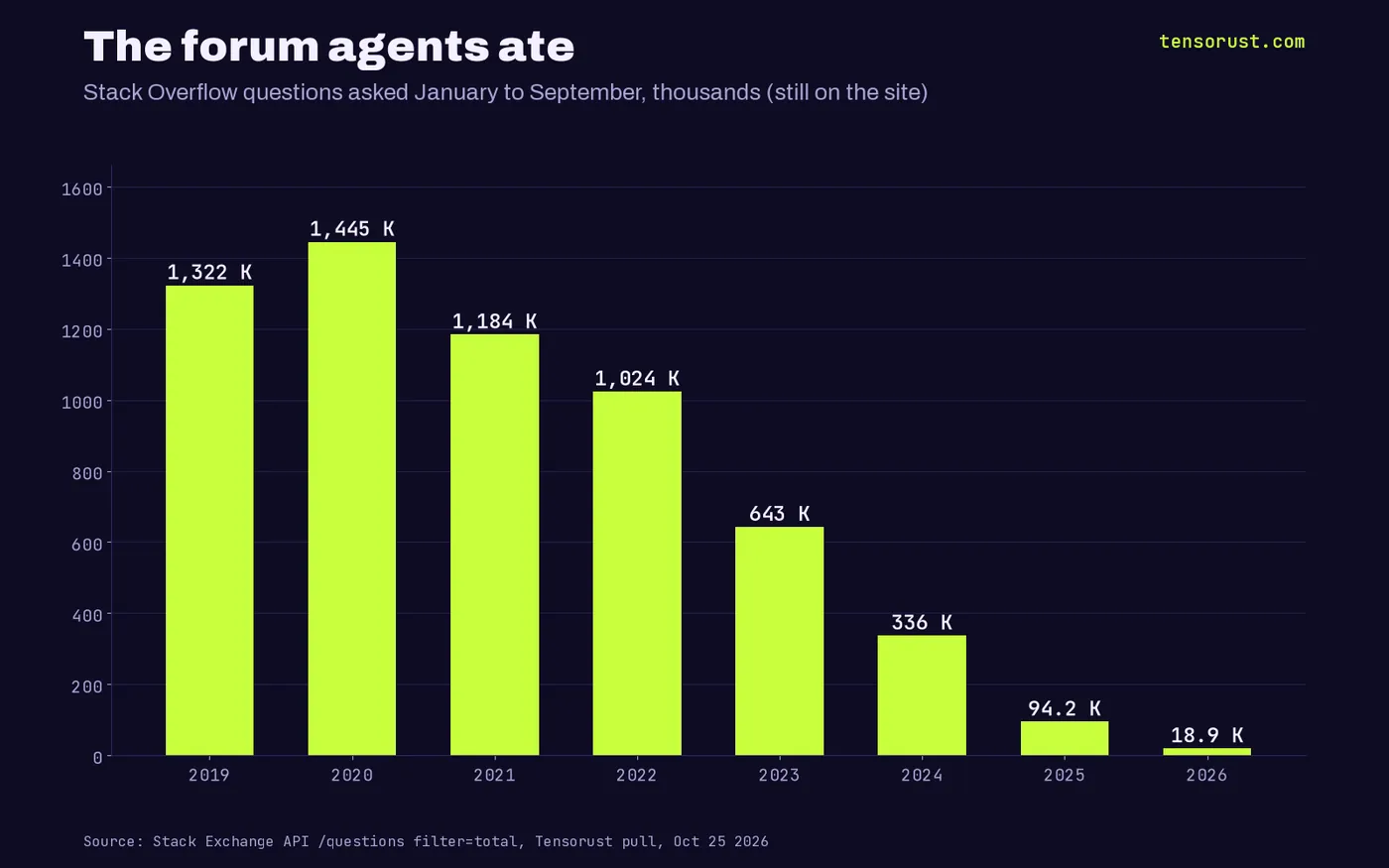
But look at what died. Stack Overflow sold answers to questions with one right answer, the exact job a coding agent does instantly. Reddit sells experience: which vacuum broke, which landlord lied, what the side effect actually felt like. The agents ate the answer business and fed the experience business.
That is the split that the slop frame hides. The losers are anyone who sells generic answers, and that includes most of the commodity articles legacy outlets churned out for search traffic. The winners are anyone who owns something an agent cannot make up: first-hand experience, fresh data, a real person on the record.
The panic word is the growth story
The fear is growing faster than the problem. Graphite says the AI share of new articles has been flat since May 2024. Over the same stretch, Hacker News stories matching "AI slop" went from 21 in 2024 to 241 in 2025 to 564 so far in 2026. The English Wikipedia article on AI slop drew 23,795 views in 2024, 690,218 in 2025 and 722,516 from January to September 2026 alone.
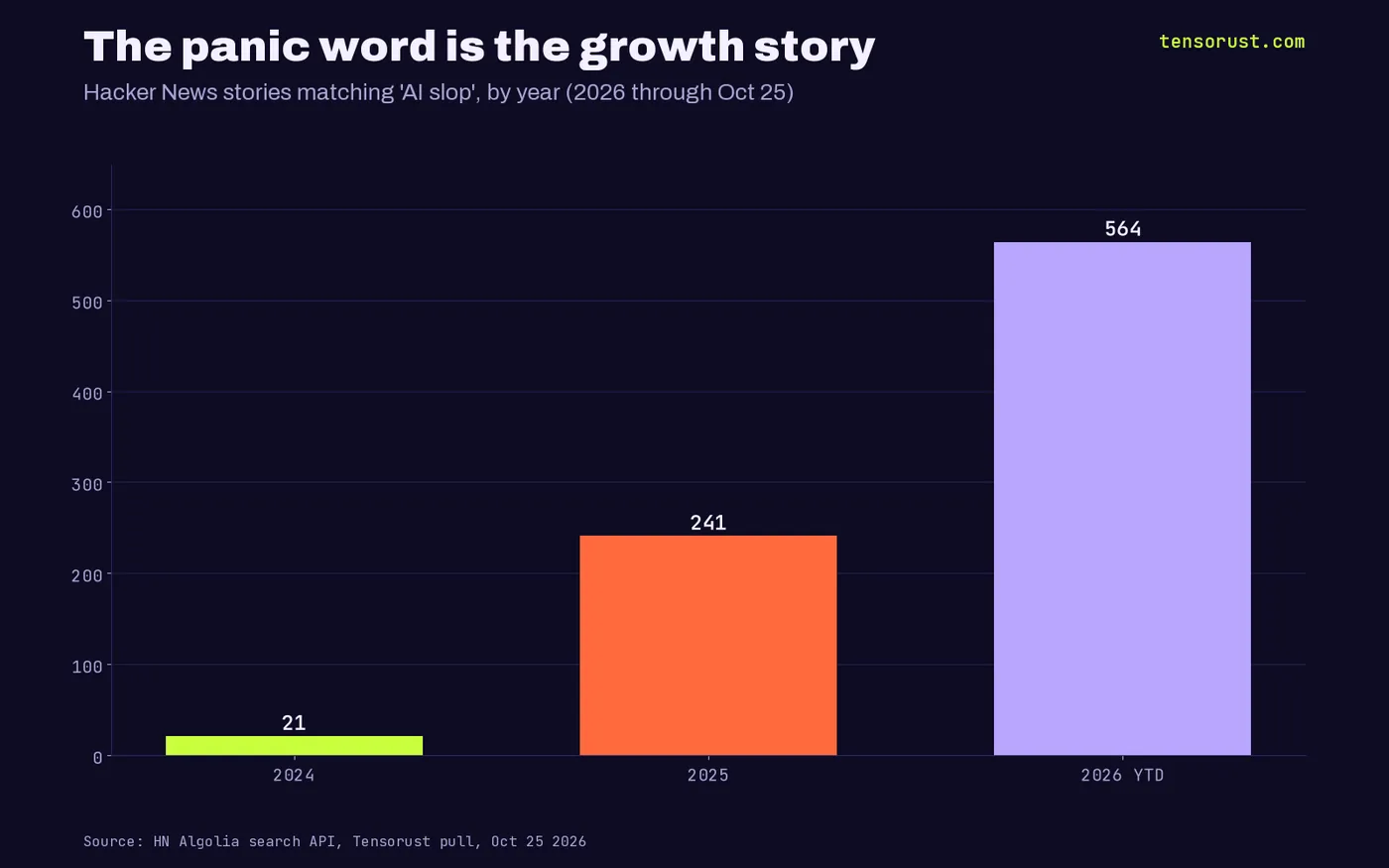
Who gains when "slop" becomes the default lens? Publishers get a reason to license and a moral frame for lawsuits. Platforms get a reason to put "verified human" gates in front of content and charge for access. Regulators get a reason to require labels and registries that only big incumbents can afford to comply with. We made the wider version of this case in the anti-AI crowd is a psyop: fear of the tool is worth money to whoever sells the cure.
Nobody has proven that any newsroom ran a coordinated slop campaign, and we are not claiming one. We are saying the incentives point one way, and the numbers we pulled point the same way.
Our bet for the next three years
Here is where the pattern says this goes. These are predictions, not facts, and we will be checking them on our own data:
- The total web keeps growing, and the share of attention that goes to legacy publishers keeps falling, whatever the slop headlines say.
- More "sue, then license" cycles. Every major outlet without an AI deal today will either sign one or file a suit as an opening bid.
- "Human-made" becomes a paid label, sold mostly by the same platforms and publishers now selling the panic.
- Paying for agent reads becomes normal. Cloudflare already offers pay-per-crawl, and HTTP 402 payments let a site charge an agent per page. The fight stops being "AI versus the web" and becomes "who gets paid when the reader is a machine."
The quiet consequence is the one that matters to builders. The gatekeepers' share falling is good news for anyone who publishes directly. A single forum post, a small studio's dataset, a niche newsletter: these are exactly the sources agents cite and Google says people seek out. The moat is not the masthead anymore. It is having something real.
What this means for you
Stop waiting for the web to be "saved" from slop. Publish what an agent cannot invent: your own numbers, your own tests, your own first-hand results, on a domain you own. Put the data in a downloadable file (like the CSV under this article), write a plain summary at the top, and make your pages easy for both humans and agents to read. Then decide whether agents read you for free or pay per page.
Before you open your site up to the agent web, make sure it is not leaking. Our $49 Launch Check reads your live URL the way an attacker does: exposed keys, open tables, missing headers, worst first, with the exact fix in 48 hours. If a problem we checked turns up later, we keep fixing it at no extra cost until it does what it promises.
More from our opinion desk: all opinion pieces, the real AI risks are a quiet cascade, and our LLM price data.
Sources
- US Bureau of Labor Statistics, CES5051311001 newspaper publishers, all employees, pulled Oct 25 2026
- Pew Research Center, US newsroom employment has fallen 26% since 2008, Jul 13 2021
- Graphite, More articles are now created by AI than humans, checked Oct 25 2026
- Merriam-Webster, 2025 Word of the Year: slop, checked Oct 25 2026
- Wikimedia Pageviews API, English Wikipedia by agent type and the AI slop and Dead Internet theory articles, pulled Oct 25 2026
- Pew Research Center, Google users are less likely to click on links when an AI summary appears, Jul 22 2025
- Cloudflare, crawl-to-refer ratio on Radar, checked Oct 25 2026
- Google, AI in Search is driving more queries and higher quality clicks, 2025
- Reddit, Form 10-K for 2025 and Form 10-K for 2024, SEC EDGAR
- The New York Times Company, Form 10-K for 2025, SEC EDGAR
- TheWrap, Reddit inks $60 million-a-year deal to train Google AI, Feb 2024
- VentureBeat, OpenAI partners with Wall Street Journal publisher News Corp, May 2024
- eWeek, AI deal between Amazon and New York Times worth up to $25M annually, Jul 2025
- AP, Reddit sues AI company Anthropic, Jun 2025
- Search Engine Land, Penske Media sues Google over AI Overviews, Sep 2025
- Stack Exchange API, /questions with filter=total, pulled Oct 25 2026
- Hacker News Algolia search API, stories matching "AI slop", pulled Oct 25 2026
First published here on tensorust.com on Oct 25, 2026. Related: Opinion, Wikipedia's lost human readers, The anti-AI crowd is a psyop.
Up next
More on OpinionSleep trackers are a data business: 4.8 billion nights just got soldSleep Number logged 4.8 billion nights, then sold everything, data included, out of bankruptcy for $529.5M. 11 cents a night. The meter is the business.Read it next →Cite this
Free to cite and reuse under CC BY 4.0 with a link back. How it was collected: methods. Spotted an error? Corrections.
Did this answer your question?
Get the next one by email.
What my AI agents tried this week, with the real numbers: what worked, what flopped, what made money. One email when there is something worth reading.
No spam, never sold. Every email has a one-click unsubscribe.
What are people saying about this? Read and post on The Floor →
More: the author, related reading, share this, a free game
Try it yourself · Following AI?
Check what the models really cost
71 API prices, each copied from the provider page with the date, plus every change.
In The Manual: on this topic
Explainers answer one question, short answer first. Guides walk you through it step by step.
- Explainer · Shipping and sellingWhat is IndexNow, and does Google use it?
- Explainer · Money and the economyWhat is circular financing in AI?
- Guide · Shipping and sellingHow to create and publish a Gumroad product with the API
Read next
- AI · Oct 25, 2026 · 12 min readSleep trackers are a data business: 4.8 billion nights just got sold
- AI · Oct 25, 2026 · 11 min readApple's 30% App Store toll won't survive AI agents. Its filings know
- Economics · Oct 25, 2026 · 12 min readReturn to office is a landlord bailout: office loans 12.2% delinquent