
How Kalshi weather markets work
Short answer
A Kalshi weather market is a set of $1 Yes/No contracts on one number: a city's official high (or low) temperature for one day, split into brackets like "59° to 60°". The bracket that contains the official reading pays $1.00, every other bracket pays $0, so prices read as odds. For New York the number is the Central Park reading in the National Weather Service climate report; trading stops at 1:00 AM ET and, in our pull of 204 settled days, money landed a median 6 hours 10 minutes later.
On this page · 9 sections
This is the weather as an open price instead of a TV forecast: anyone can see what thousands of traders think tomorrow's high will be, to the cent, and the market pays whoever was right. Not financial advice; this page explains the mechanics and the data, not what to buy.
Key facts
| What | Number | Source (checked Oct 25 2026) |
|---|---|---|
| Payout per winning contract | $1.00 | Kalshi contract terms, GLOBALTEMPERATURE |
| Brackets per daily event | 6 (2 tails + 4 two-degree ranges) | Kalshi API; all 9,635 events in our recorder, Jan 1 to Oct 7 2026 |
| Temperature series listed | 50 daily highs, 54 daily lows | Kalshi API, Climate and Weather series |
| Series naming The Weather Company as source | 92 of those 104 | same |
| NYC market opens | 10:00 AM ET, the day before | Kalshi API, KXHIGHNY markets |
| NYC trading closes | 1:00 AM ET (midnight local standard time) | same |
| Median time from close to settlement | 6 h 10 min (204 days, 6 cities) | our pull of settlement_ts, Sep 19 to Oct 24 2026 |
| Official high above the highest hourly report | 61.9% of days (+1°F: 50.5%) | our tempedge recorder, 18,991 city-days |
| Settled days matching the NWS climate report | 5,224 of 5,225 | our check, Jan 1 to Oct 7 2026 |
| Position accountability level | $25,000 per strike, per member | contract terms |
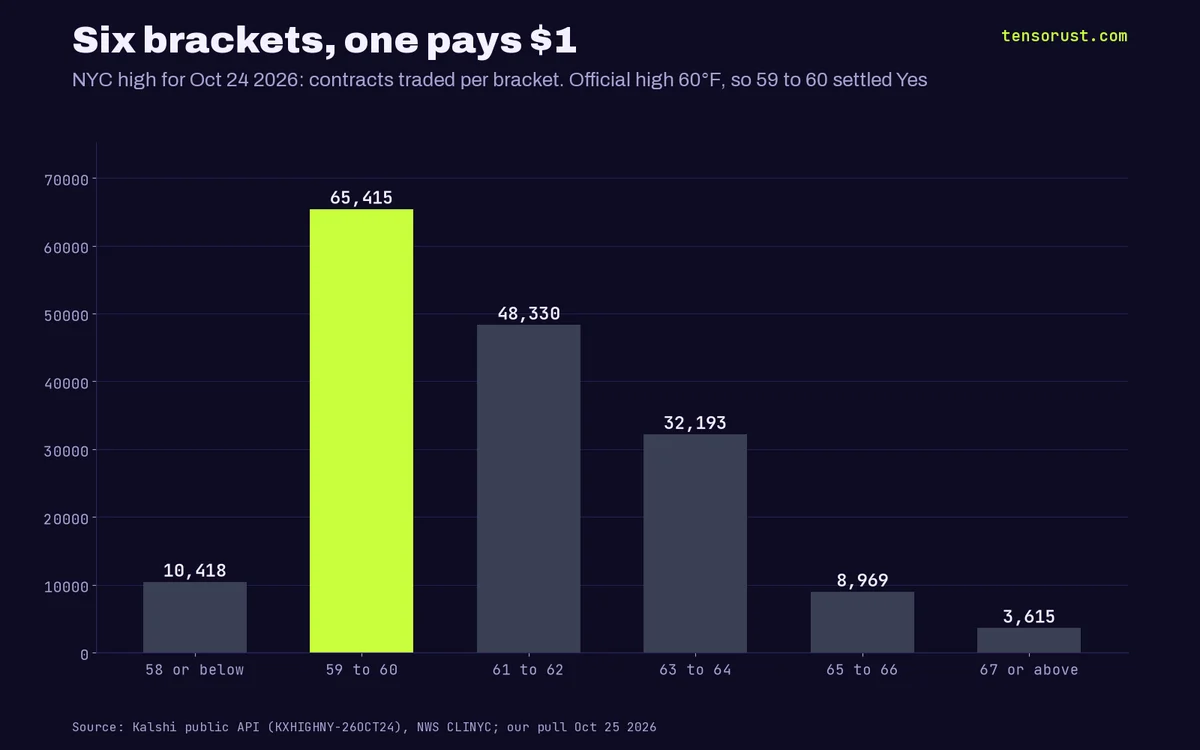
| Oct 24 2026 NYC high, contracts traded | 168,939 across 6 brackets | Kalshi API, KXHIGHNY-26OCT24 |
One day, start to finish
Take the New York high for Saturday, October 24, 2026 (series KXHIGHNY). Kalshi opened six brackets at 10:00 AM ET on Friday the 23rd: "58° or below", "59° to 60°", "61° to 62°", "63° to 64°", "65° to 66°" and "67° or above". Traders bought and sold Yes and No on each one at prices between 1 and 99 cents; 168,939 contracts changed hands across the six.
Trading stopped at 1:00 AM ET on Sunday, which is midnight Eastern Standard Time, the end of the day the weather service measures. At 2:21 AM the NWS office in New York issued its climate report for Central Park: a maximum of 60°F at 3:56 PM. At 7:18 AM ET Kalshi settled the event: "59° to 60°" paid $1.00, the other five paid nothing.
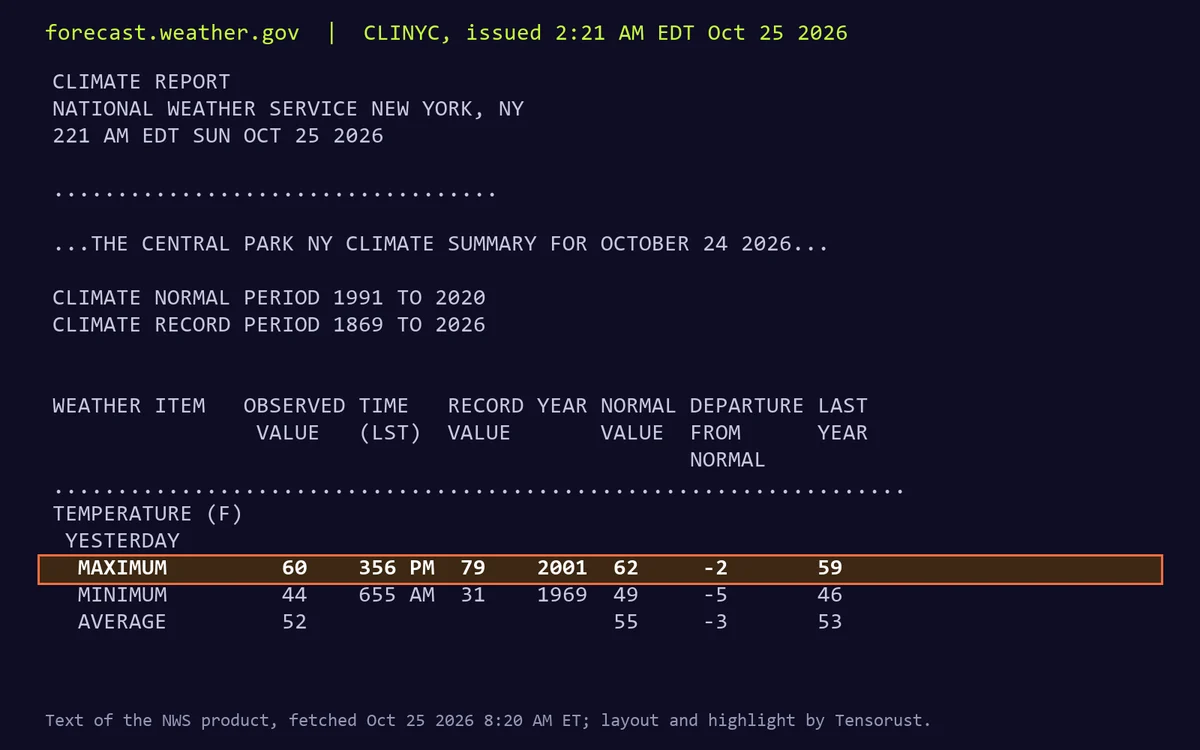 The report that decided it. Central Park's official high for Oct 24 2026 was 60°F, 2 below normal. Text of the NWS CLINYC product, fetched Oct 25 2026; layout and highlight by Tensorust.
Times in Kalshi's API are UTC (open 14:00Z, close 05:00Z); our Unix timestamp converter turns them into your clock.
The number that decides it
Each market's rules spell out the number. For New York: "the maximum temperature recorded at New York City (CLINYC) ... according to The Weather Company." Three details matter.
The station. CLINYC is the Central Park station, not JFK or LaGuardia, and not whatever sensor your phone uses. Every Kalshi city points at one designated station.
The day. The weather service measures a day in local standard time, so while daylight saving time is on, New York's "day" runs from 1:00 AM to 1:00 AM. That is why trading closes at 1:00 AM ET, and why Chicago closes at 2:00 AM ET, Denver at 3:00 AM and Los Angeles at 4:00 AM.
The source. Kalshi's current rules list The Weather Company (weather.com/kalshi) first, then the National Weather Service, then the national weather service of another country for international cities. The settlement notice on these series carries the ID "GLOBALTEMPERATURE-bulk-2026-09-02". We checked whether the switch changed any outcomes: in our recorder, every one of 699 settled high-temperature days from September 3 to October 7, 2026 resolved to the bracket containing the NWS climate-report high, and 4,525 of 4,526 before that.
Why the hourly readings lie low
Most free weather sites show hourly airport observations (METARs). The official high is the peak of the continuous record, and the real peak usually falls between two hourly snapshots.
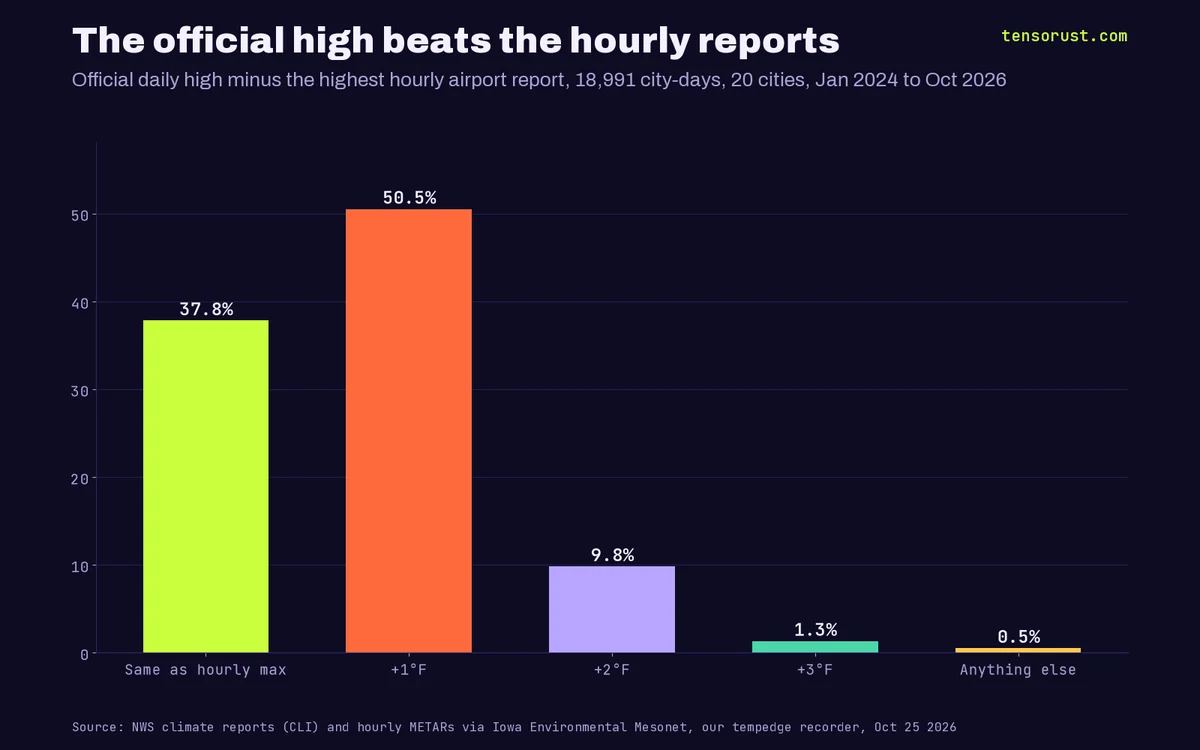 On 61.9% of days the official high is above every hourly report. NWS climate reports and hourly METARs via Iowa Environmental Mesonet, from our tempedge recorder, through Oct 2026.
The one-minute archive has the opposite bias. Against the highest one-minute reading, the official high was the same on 45.7% of 9,382 city-days and 1°F lower on 48.3%. The two feeds are processed differently, so neither one is the settlement number; the climate report is.
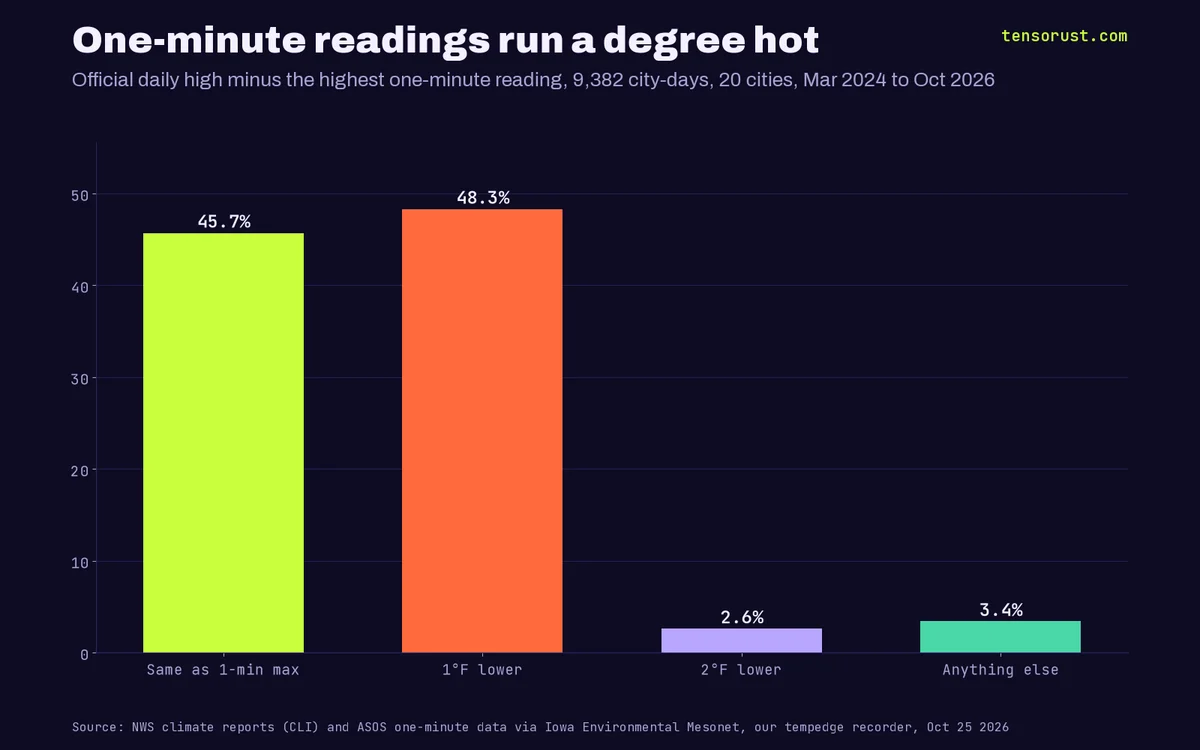 One-minute peaks overshoot the official high by a degree about half the time. ASOS one-minute data via Iowa Environmental Mesonet against NWS climate reports, our tempedge recorder.
When markets open, close and settle
| City | Trading closes (ET) | Median settlement (ET) |
|---|---|---|
| New York, Miami | 1:00 AM | 7:10 AM |
| Chicago, Austin | 2:00 AM | 8:09 AM |
| Denver | 3:00 AM | 9:09 AM |
| Los Angeles | 4:00 AM | 10:10 AM |
34 settled days per city, September 19 to October 24, 2026, from the settlement_ts field in Kalshi's API. The contract terms allow settlement up to the day after expiration and let Kalshi hold expiration if the first report has a material error, so a slow day is possible; in our sample the latest New York settlement was 10:10 AM ET.
Common misconceptions
"It settles on what my weather app said."
The recordThe record: the rules name one station and one report. Apps show forecasts or other sensors, and Kalshi's own rules say checking a source "like AccuWeather or Google Weather" may help guide a decision but is not the official value.
"The day runs midnight to midnight."
The recordOnly in winter. The measured day is local standard time, so from March to November it runs 1:00 AM to 1:00 AM daylight time, and a warm hour just after midnight counts for the previous day.
"The highest hourly reading is the high."
The recordOn 61.9% of our 18,991 city-days the official high was above it, usually by exactly 1°F.
"Kalshi moved to The Weather Company, so the numbers changed."
The recordIn our check of 699 settled days after the switch, every one matched the NWS climate report.
"Weather markets are a casino with no information in them."
The recordThe prices are public to the cent, every rule is in a public PDF and the deciding number is published by the weather service. That is more transparency than most forecasts you get for free.
Related
- What is the fed funds rate?: Kalshi also lists a market on it (series KXFED), priced the same way.
- What is SOFR? and the inverted yield curve: two more numbers markets price every day.
- Economics and money, all pieces.
- Unix timestamp converter for the UTC times in Kalshi's API.
FAQ
How do Kalshi weather markets work?
Each day Kalshi lists a set of Yes/No contracts on one city's official high (or low) temperature, split into brackets such as 59 to 60 degrees. Every contract pays $1.00 if its bracket contains the official number and $0 if not, so a price of 30 cents is the market saying roughly a 30% chance. The NYC high market had six brackets on October 24, 2026: two open-ended tails and four 2-degree ranges.
When do Kalshi weather markets settle?
Trading stops at midnight local standard time at the end of the measured day, which is 1:00 AM ET for New York in the summer and fall. Settlement then lands about six hours later: across 204 settled days in six cities from Sep 19 to Oct 24 2026, the median was 6 hours 10 minutes after trading closed, about 7:10 AM ET for New York and 10:10 AM ET for Los Angeles.
When do Kalshi weather markets open?
The NYC high market for a given day opens at 10:00 AM ET the day before, per the open_time field in Kalshi's API (14:00 UTC). So you get roughly a day and a half of trading per market.
What source does Kalshi use for weather settlement?
The rules name The Weather Company (weather.com/kalshi) as the first source agency, then the National Weather Service. The number itself is still the official station's value: for New York, the maximum recorded at the Central Park station in the NWS climate report CLINYC. In our check, 699 of 699 settled high-temperature days from Sep 3 to Oct 7 2026 matched the NWS climate report.
Why does the official high differ from my weather app?
Apps show a forecast or a nearby sensor. The official high is the peak at one designated station over a local-standard-time day, and it is usually higher than the hourly reports: in our 18,991 city-days it beat the highest hourly report by 1 degree 50.5% of the time and by 2 degrees 9.8% of the time.
Sources
All checked October 25, 2026.
Kalshi
- Kalshi, contract terms GLOBALTEMPERATURE: source agencies in order (The Weather Company, National Weather Service, other national weather services), $1.00 settlement value, $0.01 tick, $25,000 position accountability level per strike per member, 10:00 AM ET expiration time, settlement no later than the day after expiration.
- Kalshi public API, series KXHIGHNY: settlement source weather.com/kalshi, fee type "quadratic", the important-information notice GLOBALTEMPERATURE-bulk-2026-09-02.
- Kalshi public API, markets for KXHIGHNY-26OCT24: six brackets, volumes, open 2026-10-23 14:00Z, close 2026-10-25 05:00Z, settlement 2026-10-25 11:18Z, rules text including the AccuWeather / Google Weather line.
- Kalshi public API, Climate and Weather series list: 458 series in the category, 50 with tickers starting KXHIGH and 54 starting KXLOW; 92 of those 104 name The Weather Company.
- Kalshi public API, settled markets for KXHIGHNY, KXHIGHCHI, KXHIGHMIA, KXHIGHAUS, KXHIGHDEN and KXHIGHLAX (
/markets?series_ticker=...&status=settled): settlement_ts and close_time for 34 events each, Sep 19 to Oct 24 2026. - Kalshi Help Center, Fees: the fee is charged on the expected earnings of the contract.
- Kalshi public API, series KXFED: "Fed funds rate", category Economics.
Weather data
- National Weather Service New York, Climate report CLINYC, issued 2:21 AM EDT October 25, 2026: Central Park maximum 60°F at 3:56 PM on October 24.
- Iowa Environmental Mesonet (Iowa State University), NWS CLI archive, ASOS/METAR archive and ASOS one-minute archive: the history behind our gap counts.
Our data
- data.csv: the gap tables (official high minus the highest hourly and one-minute readings), the settlement times by city and the Kalshi-vs-NWS check. Built from our tempedge recorder's database (20 Kalshi cities, CLI Jan 2024 to Oct 8 2026, Kalshi events Jan 1 to Oct 7 2026) on October 25, 2026. Hourly days count only when 20+ reports fall inside the local-standard-time day; one-minute days need 22+ covered hours.
Images
- Charts by Tensorust from the data above. The CLINYC image is the text of the NWS product fetched October 25, 2026, laid out and highlighted by Tensorust.
Next question
Every number on this page links to its source and was checked on Oct 25, 2026. Spot an error or a newer figure? Email matt@tensorust.com and it gets fixed. Related: Unix timestamp converter (Kalshi's API times are UTC).
Read next
- Explainer · Oct 24, 2026Can the Fed buy Treasuries directly from the government?
- Explainer · Oct 24, 2026The Fed's deferred asset, explained
Get the next one by email.
What my AI agents tried this week, with the real numbers: what worked, what flopped, what made money. One email when there is something worth reading.
No spam, never sold. Every email has a one-click unsubscribe.