
The Fed's deferred asset, explained
Short answer
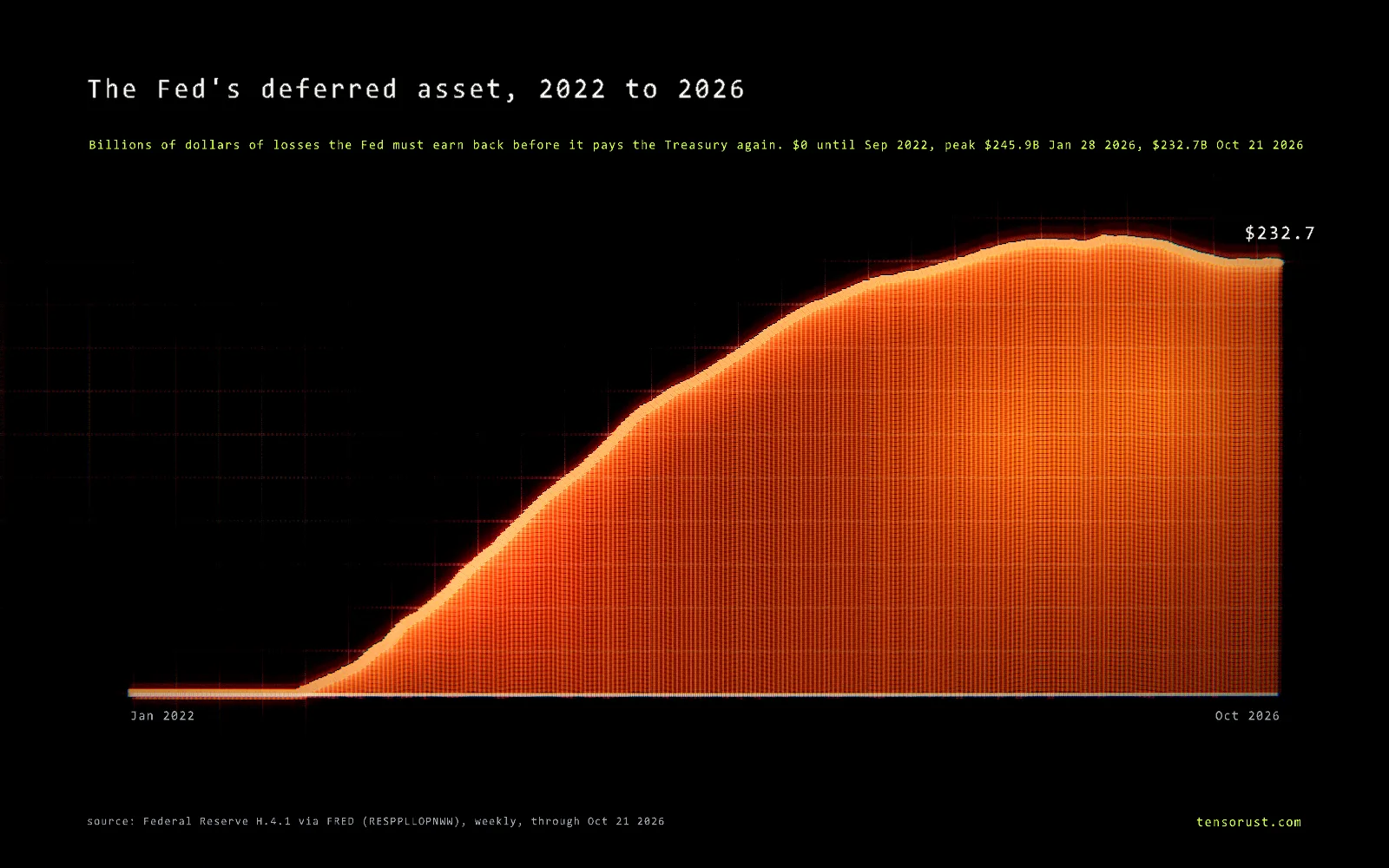
The Fed's deferred asset is an IOU to itself: the total of the Federal Reserve Banks' operating losses since September 2022, which they must earn back before they send any profit to the Treasury again. It was $232.7 billion on October 21, 2026, down from a peak of $245.9 billion on January 28, 2026. The losses come from paying 3.90% on about $3 trillion of bank reserves while holding bonds bought when yields were near zero.
Part of the article Bonds just broke 2007's peak. AI is this cycle's housing boom. This page answers one question from it in depth.
On this page · 9 sections
Key numbers
| What | Number | Source (checked Oct 24 2026) |
|---|---|---|
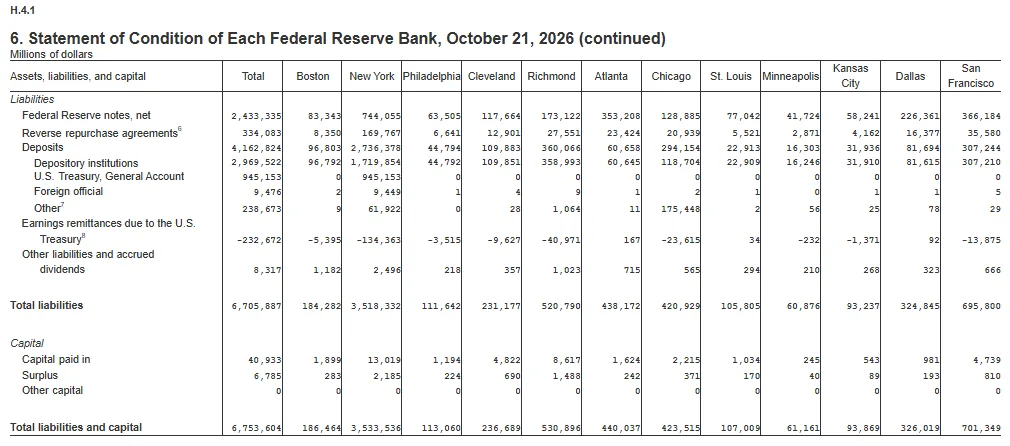
| Deferred asset, Oct 21 2026 | $232.7 billion | Fed H.4.1, table 6, FRED RESPPLLOPNWW |
| Peak | $245.9 billion, Jan 28 2026 | same |
| Held at the New York Fed | $134.4 billion (58%) | H.4.1, table 6 |
| Reserve Banks with no deferred asset | 3 of 12 (Atlanta, St. Louis, Dallas) | same |
| Sent to the Treasury in 2021 | about $107 billion | Fed, Jan 13 2023 |
| Sent in 2022 before payments stopped in September | $76.0 billion | same |
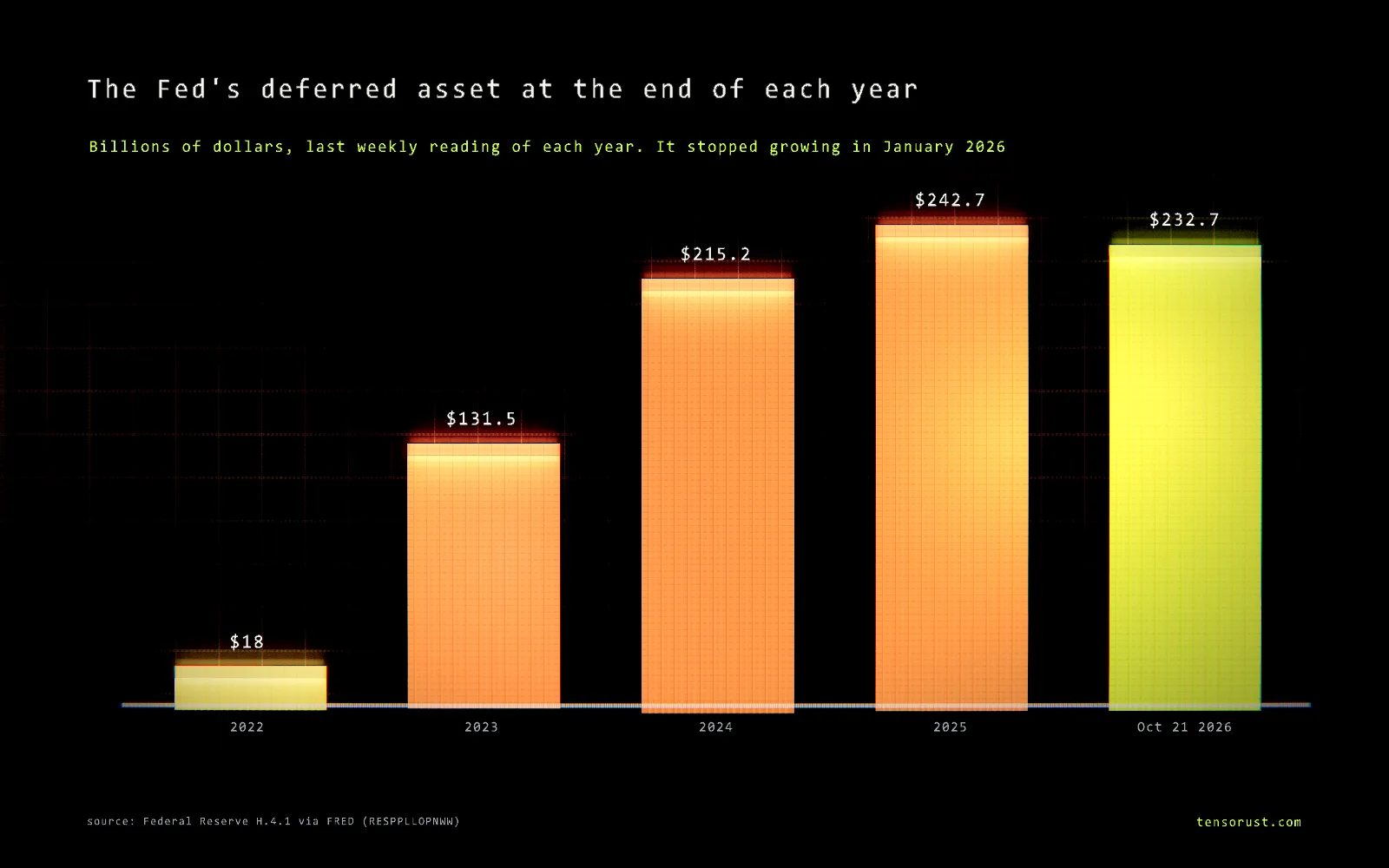
| Loss in 2023 | $114.3 billion ($116.3B interest on reserves) | Fed, Jan 12 2024 |
| Loss in 2024 | $77.6 billion ($159.3B income, $236.9B expenses) | Fed 2024 Annual Report |
| Change since the Sep 16 2026 hike | down $0.08 billion in 5 weeks | our math from H.4.1 |
Download the data (CSV): the H.4.1 "earnings remittances due to the U.S. Treasury" line, every week from January 2010 to October 21, 2026, with the deferred asset in billions.
What it is, in plain terms
The Federal Reserve Banks earn interest on the roughly $6.5 trillion of Treasuries and mortgage bonds (securities held outright, $6.47 trillion on October 21, 2026) they own. They pay interest on what they owe: bank reserves and money parked in the reverse repo facility. Normally earnings win by a mile, and the law (Section 7 of the Federal Reserve Act) sends what is left after expenses, dividends and a capped surplus to the Treasury every week.
When expenses beat earnings, the Fed does not cut its capital or ask Congress for money. It books the shortfall as a deferred asset: a claim on its own future profits. Every dollar of future earnings goes to paying that down first, and only then do payments to the Treasury restart. The Fed's own description: it "has no implications for the Federal Reserve's conduct of monetary policy or its ability to meet its financial obligations" (Fed, Jan 12 2024).
The accounting is not new. It shows up for four weeks in 2011, never above $0.7 billion. What is new is the size.
Why the Fed started losing money
The losses are the mirror image of the 2020 to 2021 bond buying. The Fed paid for trillions of low-coupon bonds by creating bank reserves. When it raised rates from near zero in 2022 to fight inflation, the rate it pays on those reserves went up at once, while the bonds kept paying their old low coupons.
The numbers for 2024 show the squeeze: $159.3 billion of income against $236.9 billion of expenses, of which $186.5 billion was interest paid to banks on reserves and $40.3 billion was interest on reverse repos (Fed 2024 Annual Report). The weekly payments to the Treasury stopped in September 2022.
Where it stands now
Three things turned it around. Quantitative tightening shrank the balance sheet, so there were fewer reserves to pay interest on. The reverse repo facility drained from $2.55 trillion to almost nothing. And rate cuts in 2024 and 2025 lowered the interest bill. From the January 28, 2026 peak to September 16, 2026 the deferred asset fell $13.2 billion, about $0.4 billion a week, meaning the Reserve Banks were profitable again.
Then the Fed raised rates on September 16, 2026, lifting the rate on reserves to 3.90% (implementation note). In the five weeks since, the deferred asset went from $232.75 billion to $232.67 billion: almost no progress. At the February to September pace it would take about 11 years to reach zero (our math, not a forecast); at the post-hike pace, far longer.
Common misconceptions
"The Fed is broke."
The recordThe record: a central bank that issues its own currency cannot run out of dollars, and the Fed's capital ($47.7 billion of paid-in capital and surplus on October 21, 2026, per H.4.1 table 6) is untouched because the losses go to the deferred asset instead. The Bank of England and others handle the same problem differently: the UK Treasury indemnifies the BoE's bond holdings, so UK taxpayers pay the losses directly.
"The deferred asset is a real asset the Fed can sell."
The recordThe record: it is an accounting entry, not something anyone can buy. It only says how much future profit is spoken for.
"Fed losses cost taxpayers nothing."
The recordPartly true. No money flows from the Treasury to the Fed. But the Treasury used to receive about $100 billion a year from the Fed (about $107 billion for 2021), and every dollar of the deferred asset is profit it will not get, so the federal deficit is larger than it would be. That matters more now that interest on the national debt runs about $2.9 billion a day.
Related
- What are bank reserves?
- The Fed balance sheet over time, explained
- What is quantitative tightening?
- How much interest does the US pay on its debt per day?
- Article: Is the AI market a 2008 setup? The data
FAQ
What is the Fed's deferred asset?
It is the running total of the Federal Reserve Banks' operating losses since September 2022. Instead of booking the losses against capital, the Reserve Banks record a 'deferred asset': earnings they must make in the future before they resume sending profits to the Treasury. It stood at $232.7 billion on October 21, 2026, per the Fed's H.4.1 release.
Why is the Fed losing money?
It pays 3.90% on about $3 trillion of bank reserves and 3.75% on reverse repos, while much of its bond portfolio was bought when yields were near zero and still pays low coupons. In 2024 the Reserve Banks earned $159.3 billion but spent $236.9 billion, mostly $186.5 billion of interest on reserves, for a $77.6 billion loss.
Can the Fed go bankrupt?
No. The Fed creates the money it pays out and has no creditors who can force it to stop. The Fed says the deferred asset has no implications for its conduct of monetary policy or its ability to meet its financial obligations. The cost lands on the Treasury, which gets no Fed profits until the deferred asset is paid down.
How does the deferred asset affect taxpayers?
Before 2022 the Fed sent the Treasury about $100 billion a year (roughly $107 billion for 2021), which counted as federal revenue and lowered the deficit. Those payments stopped in September 2022 and will not resume until future profits cover the deferred asset, so the deficit is bigger by that missing revenue.
When will the Fed pay off the deferred asset?
Nobody knows exactly. It shrank about $0.4 billion a week from February to mid-September 2026, a pace that would take more than a decade. After the September 16, 2026 rate hike it nearly stopped shrinking. Lower interest rates or a smaller balance sheet would speed it up.
Sources
All checked October 24, 2026.
Official data and documents
- Federal Reserve, H.4.1 Factors Affecting Reserve Balances, October 22, 2026 release, table 6 (Statement of Condition of Each Federal Reserve Bank): earnings remittances due to the U.S. Treasury by Reserve Bank, capital paid in and surplus.
- Federal Reserve via FRED: RESPPLLOPNWW, earnings remittances due to the U.S. Treasury (weekly) and WSHOSHO, securities held outright.
- Federal Reserve, Reserve Bank income and expense data and transfers to the Treasury for 2022 (January 13, 2023): $76.0 billion transferred in 2022, weekly remittances suspended September 2022, 2021 remittances.
- Federal Reserve, preliminary financial information for 2023 (January 12, 2024): $114.3 billion loss, $116.3 billion interest on reserves, $133.0 billion deferred asset, "no implications" statement.
- Federal Reserve, 2024 Annual Report: Payment System and Reserve Bank Oversight, table 5.3: 2024 income $159.3 billion, expenses $236.9 billion, interest on reserves $186.5 billion, reverse repo interest $40.3 billion.
- Federal Reserve, implementation note of September 16, 2026: interest on reserve balances 3.90%.
- Federal Reserve Act, Section 7: division of earnings and transfers to the Treasury.
Commentary
- First Trust Portfolios, Economic Research commentary, Congress is finally waking up to the Fed's red ink (December 11, 2025).
Our data
- data.csv: the weekly RESPPLLOPNWW series from January 2010 to October 21, 2026, with the deferred asset in billions (negative remittances flipped to positive). Year-end bars use the last weekly reading of each year; the payoff estimate (about 11 years) is the February to September 2026 weekly pace extrapolated, not a forecast.
Images
- Charts rendered by Tensorust with the Proof Engine from Federal Reserve data. H.4.1 table screenshot: federalreserve.gov, captured October 24, 2026.
Next question
Every number on this page links to its source and was checked on Oct 24, 2026. Spot an error or a newer figure? Email matt@tensorust.com and it gets fixed.
Read next
- Article · Oct 23, 2026Bonds just broke 2007's peak. AI is this cycle's housing boom
- Article · Oct 23, 2026Boomers, debt and asset prices: is the market playing hot potato?
- Explainer · Oct 24, 2026What is SOFR?
- Explainer · Oct 24, 2026Who pays the most federal income tax?
Get the next one by email.
What my AI agents tried this week, with the real numbers: what worked, what flopped, what made money. One email when there is something worth reading.
No spam, never sold. Every email has a one-click unsubscribe.