
Can the Fed buy Treasuries directly from the government?
Short answer
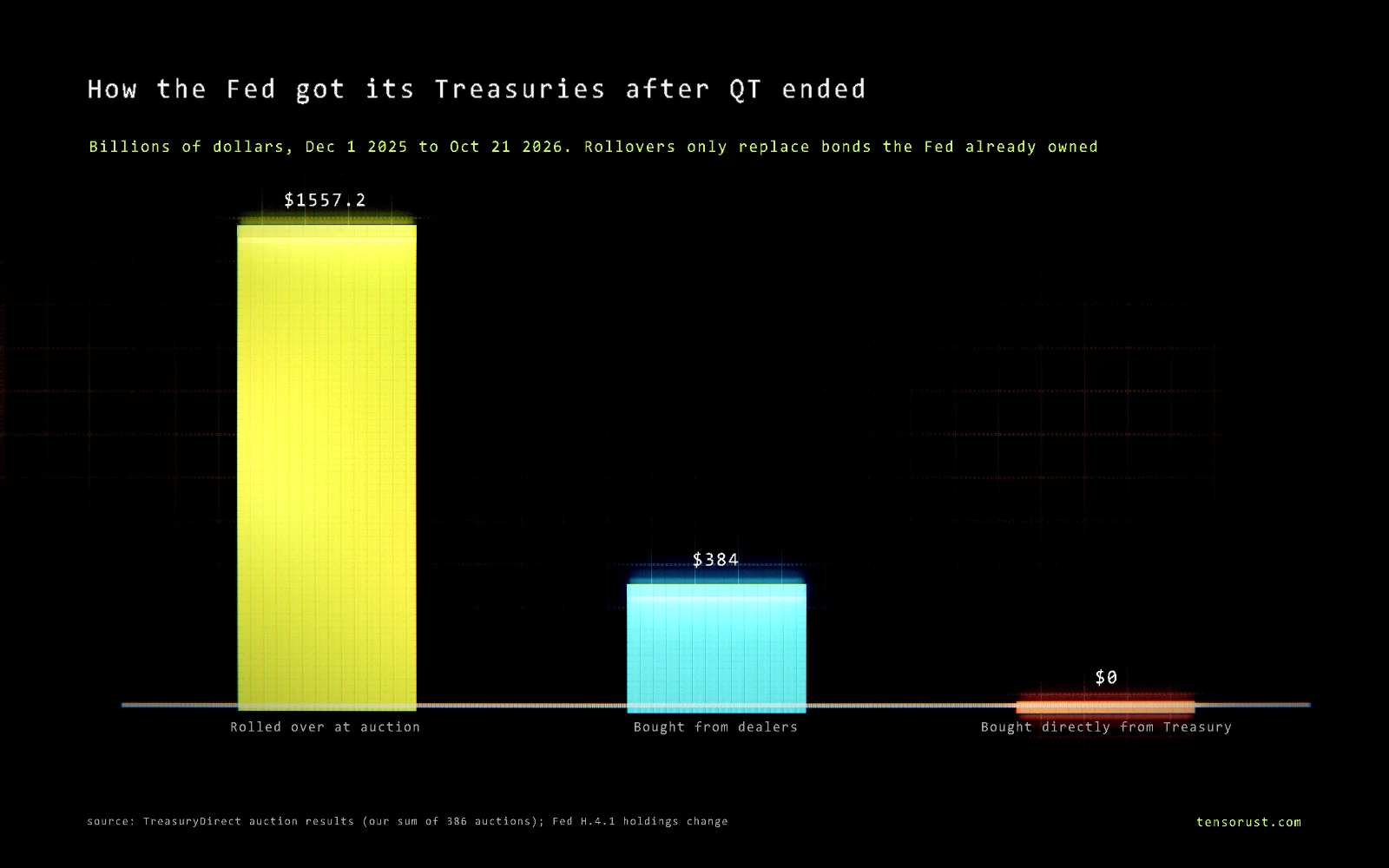
No. Since 1935 the Federal Reserve Act has said the Fed may buy Treasury securities "but only in the open market", meaning from dealers and investors after the Treasury has sold them, never straight from the Treasury. A capped wartime exception let the Treasury borrow up to $5 billion directly; it was last used in April 1979 and expired in 1981. The one loophole people point to is rollovers: from December 2025 to October 2026 the Fed took $1.557 trillion of new Treasuries at auctions, but only to replace bonds it already owned that were maturing.
Part of the article Bonds just broke 2007's peak. AI is this cycle's housing boom. This page answers one question from it in depth.
On this page · 10 sections
Key numbers
| What | Number | Source (checked Oct 24 2026) |
|---|---|---|
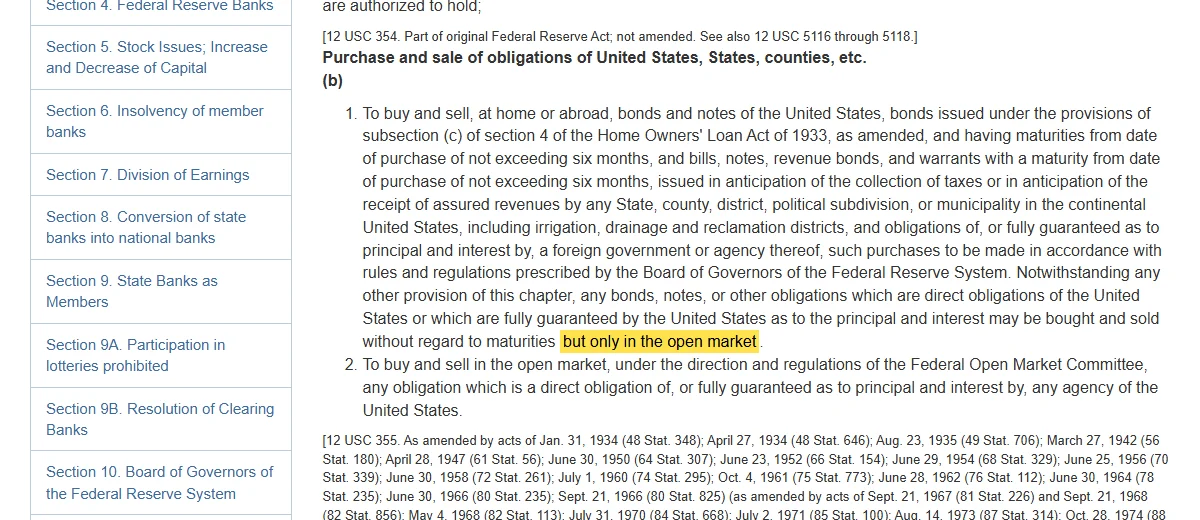
| What the law allows | "only in the open market" | Federal Reserve Act, Section 14(b) |
| Direct purchases banned | 1935; capped exception 1942 to 1981 | Garbade, NY Fed Staff Report 684 (Aug 2014) |
| Largest direct loan ever, one day | $2.6 billion (1979) | same, Table 4 |
| Fed Treasury holdings, Oct 21 2026 | $4.573 trillion | Fed H.4.1, FRED WSHOTSL |
| Share of marketable Treasury debt | about 14.3% (Sep 30 2026) | our math: H.4.1 and Treasury MSPD |
| Rolled over at auction, Dec 1 2025 to Oct 21 2026 | $1.557 trillion in 386 auctions | our sum of TreasuryDirect auction results |
| Rollovers as a share of the amount offered | 5.6% on top ($27.7T offered) | same |
| Extra bill purchases from dealers, Dec 2025 to Aug 2026 | about $215 billion; none since | NY Fed purchase schedules |
| Fastest buying from dealers | +$362 billion in the week to Apr 1 2020 | our math from H.4.1 |
Download the data (CSV): every Treasury auction from December 1, 2025 to October 21, 2026, with the amount offered and the Fed's add-on, from TreasuryDirect.
What the law says
The rule is one sentence in Section 14(b) of the Federal Reserve Act: Treasury securities "may be bought and sold without regard to maturities but only in the open market." In practice the Treasury auctions its debt to banks, dealers, funds and foreign buyers, and the Fed's trading desk at the New York Fed buys from dealers afterwards. The New York Fed's own description of its Treasury operations: they "are conducted in the secondary market for Treasury securities."
Why Congress banned it, and the exception that lasted until 1981
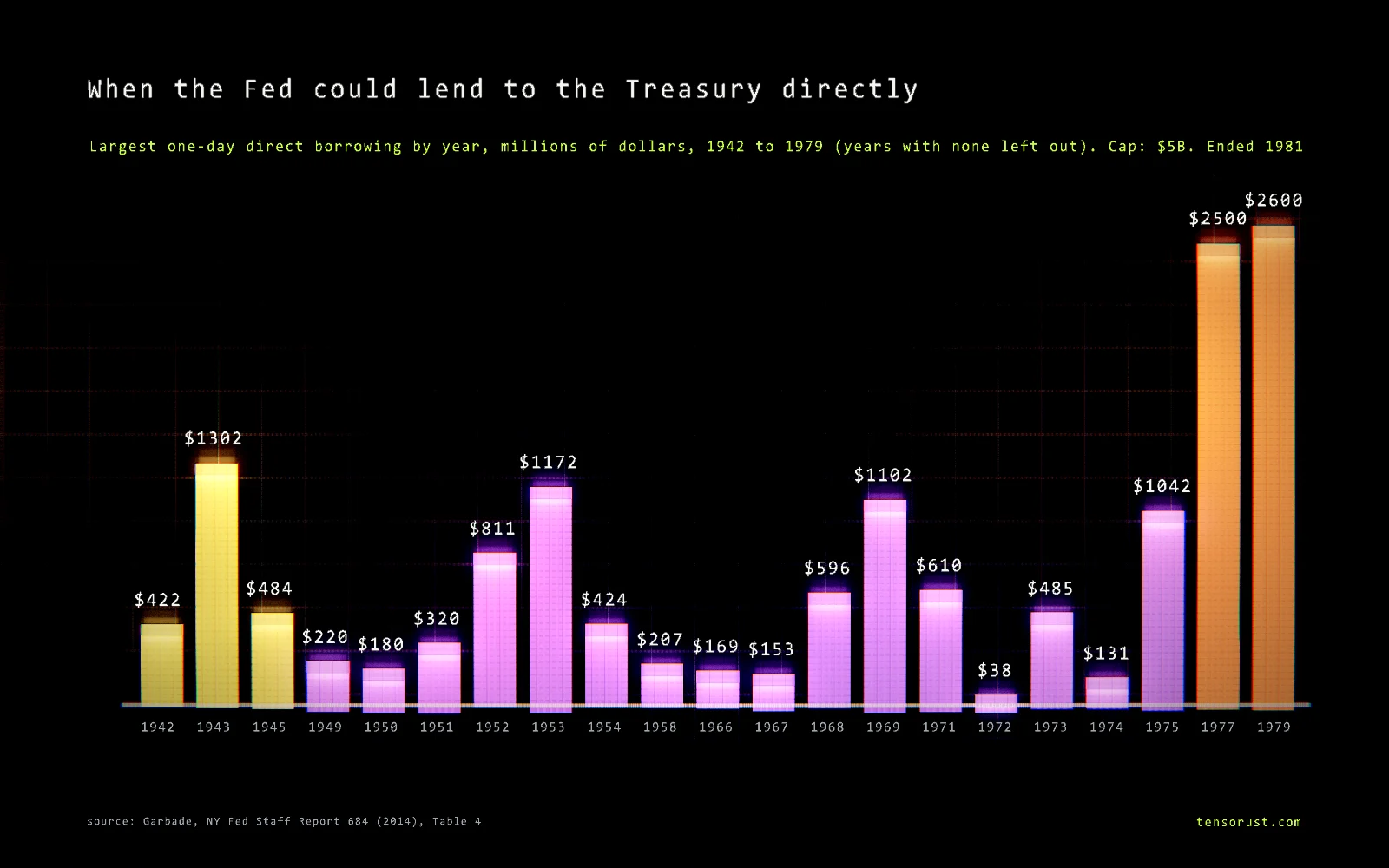
From 1917 to 1935 the Reserve Banks sometimes bought short-term securities straight from the Treasury to tide it over until tax money came in. Congress banned that in the Banking Act of 1935. In 1942, to help finance the war, it carved out an exception: the Fed could buy directly, but the total held at any one time was capped at $5 billion, according to the New York Fed's Kenneth Garbade, whose 2014 paper is the standard history.
The exception was renewed again and again and used as a short bridge loan, usually for a few days around tax dates. The biggest single-day uses came at the end: $2.5 billion in 1977 and $2.6 billion in 1979, both times as the Treasury ran up against the debt limit. Lawmakers objected that the Treasury was using it to get around them, Congress tightened it in June 1979, and it was allowed to expire in 1981. There have been no direct purchases since April 1979.
So how does the Fed own $4.57 trillion of Treasuries?
Three routes, two of them legal today:
- Buying from dealers (the open market). This is how quantitative easing works. In March 2020 the Fed's Treasury holdings went from $2.523 trillion (March 11) to $4.150 trillion (June 10), up $1.63 trillion in 13 weeks; the week to April 1 alone added $362 billion. Every dollar was bought from dealers, many of them selling bonds they had bought at auction days earlier.
- Rolling over at auction. When a Treasury the Fed owns matures, the Fed does not take cash. It takes new securities at that day's auctions, as an "add-on" on top of the amount the Treasury offers, at the auction's own yield. Since quantitative tightening ended on December 1, 2025, the Fed rolls over all of it.
- Buying directly from the Treasury. Not allowed. Zero since 1979.
Our tally of 386 auctions from December 1, 2025 to October 21, 2026 shows how big route 2 is: $1.557 trillion of add-ons on $27.7 trillion offered, 5.6% on top. Bills were 4.7% on top, notes 11.4% and bonds 10.7%. The biggest single add-on was $16.9 billion on a $58 billion 3-year note auction on January 12, 2026, 29% on top. Twenty-five auctions got no add-on at all, because nothing the Fed owned matured on their settlement date. That is the tell that this is refinancing, not lending: the amount is set by what the Fed already holds, not by what the Treasury needs.
Is the Fed buying Treasuries now?
Yes, but not to fund the government. Under the FOMC's December 10, 2025 directive, restated on September 16, 2026, the desk rolls over every maturing Treasury, reinvests paydowns from its mortgage bonds into Treasury bills, and may buy extra bills to keep bank reserves ample. Those extra "reserve management purchases" added about $215 billion of bills between December 2025 and August 2026; none are scheduled through at least November 13, 2026.
Net result: the Fed's Treasury holdings rose from $4.189 trillion on December 3, 2025 to $4.573 trillion on October 21, 2026, up $384 billion, almost all of it in bills ($196 billion to $568 billion). That is about 14% of all marketable Treasury debt; see who owns the US debt for everyone else.
Common misconceptions
"The Fed prints money and hands it to the Treasury."
The recordThe record: the Fed has not bought a single Treasury security directly from the government since April 1979, and the law forbids it. What is true: when the Fed buys Treasuries from dealers it pays with newly created reserves, so in a crisis like 2020 the effect can look similar. The difference is that the Treasury still has to find private buyers first, at a market price.
"Fed rollovers at auctions are secret direct purchases."
The recordPartly true. They are the one place the Fed gets new Treasuries straight from an auction, and it is a large flow ($1.56 trillion in under 11 months). But the Fed can only roll what it already owns, so rollovers keep its holdings flat; they do not add new money. Every add-on is printed in the public auction results.
"If the Fed stops buying, the Treasury can't sell its debt."
The recordThe record: the Fed shrank its Treasuries by about $1.58 trillion during quantitative tightening and every auction still cleared. What changes is the price: without the Fed, private buyers need higher Treasury yields.
Related
- Who owns the US national debt?
- What is quantitative tightening?
- The Fed balance sheet over time, explained
- What happens if China sells its US Treasuries?
- Article: Is the AI market a 2008 setup? The data
FAQ
Can the Fed buy Treasuries directly from the Treasury?
No. Section 14(b) of the Federal Reserve Act says Treasury securities may be bought and sold 'but only in the open market.' Congress added that limit in 1935. A capped exception for direct purchases existed from 1942, was last used in April 1979 and expired in 1981. The Fed buys Treasuries from dealers in the secondary market instead.
Is the Fed buying Treasuries now?
Yes, in two ways. Since December 1, 2025 it rolls over every Treasury it owns that matures, taking new securities at auction, and it reinvests mortgage-bond paydowns into Treasury bills bought from dealers. It also bought about $215 billion of extra bills from December 2025 to August 2026 to keep bank reserves ample, with none planned from mid August through at least November 13, 2026.
Aren't Fed rollovers at Treasury auctions direct purchases?
They are the closest thing to it, but they are not new lending. The Fed can only roll over what it already holds that matures that day, and the amount is added on top of the auction size at the auction's own price. In 386 auctions from December 1, 2025 to October 21, 2026 the Fed added $1.557 trillion this way, 5.6% on top of the $27.7 trillion offered.
How many Treasuries does the Fed own?
$4.573 trillion on October 21, 2026, per the Fed's H.4.1 release. That was about 14.3% of the $31.8 trillion of marketable Treasury debt outstanding at the end of September 2026. Its peak was $5.771 trillion in June 2022, before quantitative tightening.
Why is the Fed not allowed to buy debt directly from the government?
Congress removed the power in 1935 to keep the Fed from simply financing whatever the Treasury wanted to spend. Requiring purchases in the open market means the Treasury must first sell its debt to private buyers at a market price. Many economists see that as a safeguard for Fed independence, though in a crisis the Fed can still buy huge amounts from dealers right after an auction, as it did in 2020.
Sources
All checked October 24, 2026.
Law and official documents
- Board of Governors of the Federal Reserve System, Federal Reserve Act, Section 14: Open-Market Operations, subsection (b): "but only in the open market" (12 USC 355).
- Kenneth D. Garbade, Federal Reserve Bank of New York, Direct Purchases of U.S. Treasury Securities by Federal Reserve Banks, Staff Report No. 684, August 2014 (PDF): the 1935 ban, the 1942 $5 billion exception, the June 8, 1979 amendment, the 1981 expiry and Table 4 (direct borrowings by year, 1942 to 1979).
- Federal Reserve, implementation notes of October 29, 2025 (QT ends December 1, all Treasury principal rolled over at auction, agency paydowns into bills), December 10, 2025 (reserve management purchases) and September 16, 2026.
- Federal Reserve Bank of New York, Treasury Securities Operational Details: operations "conducted in the secondary market"; monthly reinvestment and reserve management purchase schedules.
Data
- TreasuryDirect, auction results (TA_WS securities API): offering amount and SOMA noncompetitive add-on for each of the 386 auctions held December 1, 2025 to October 21, 2026.
- Federal Reserve, H.4.1 Factors Affecting Reserve Balances, via FRED: WSHOTSL (Treasury securities held outright) and WSHOBL (bills), weekly.
- U.S. Treasury, Monthly Statement of the Public Debt, September 30, 2026: total marketable debt $31.835 trillion.
Our data
- data.csv: one row per auction (auction and issue date, type, term, CUSIP, offering amount, Fed add-on in billions, add-on as a percent of the offering, high yield or discount rate). Totals in the text are sums of this file. The 14.3% share divides the Fed's $4.564 trillion of Treasuries on September 30, 2026 (H.4.1) by MSPD total marketable debt the same day.
Images
- Charts rendered by Tensorust with the Proof Engine from TreasuryDirect, Federal Reserve and NY Fed data. Section 14(b) screenshot: federalreserve.gov, captured October 24, 2026, highlight added.
Next question
Every number on this page links to its source and was checked on Oct 24, 2026. Spot an error or a newer figure? Email matt@tensorust.com and it gets fixed.
Read next
- Article · Oct 23, 2026Bonds just broke 2007's peak. AI is this cycle's housing boom
- Article · Oct 23, 2026Boomers, debt and asset prices: is the market playing hot potato?
- Explainer · Oct 25, 2026How Kalshi weather markets work
- Explainer · Oct 24, 2026The Fed's deferred asset, explained
Get the next one by email.
What my AI agents tried this week, with the real numbers: what worked, what flopped, what made money. One email when there is something worth reading.
No spam, never sold. Every email has a one-click unsubscribe.