
What is LIHTC, the low-income housing tax credit?
Short answer
LIHTC (the Low-Income Housing Tax Credit) is the federal government's main way of paying for new affordable apartments. States hand the credits to developers; developers sell them to banks and other investors for cash up front; in return the building must rent units at capped rents to households earning up to 60% of the area median income, for at least 30 years.
Part of the article New apartments cut local rent: what happens when supply finally arrives. This page answers one question from it in depth.
On this page · 10 sections
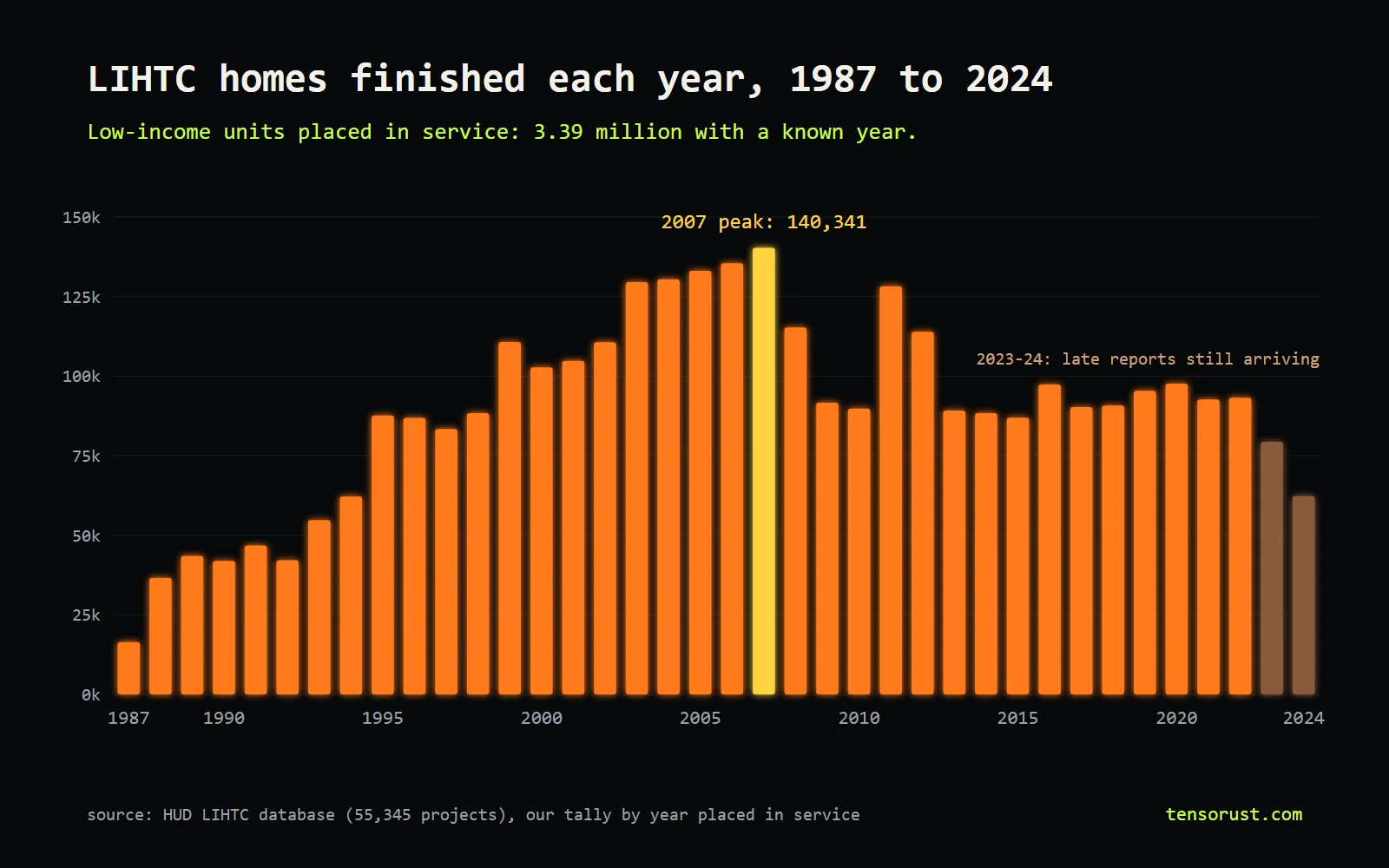
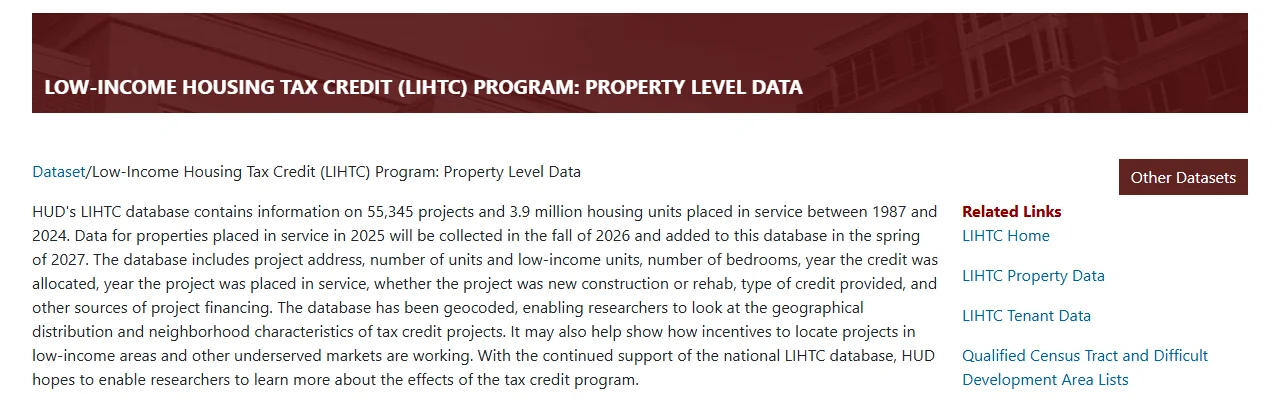
It is big: HUD's database counts 55,345 projects and 3.9 million homes placed in service from 1987 to 2024, and the Congressional Research Service puts the cost at about $14.4 billion a year. If you rent an "affordable" apartment in a newer building, it is probably a LIHTC property.
Key numbers
| What | Number | Source (checked Oct 24 2026) |
|---|---|---|
| Projects placed in service, 1987 to 2024 | 55,345 | HUD LIHTC database |
| Homes in those projects | 3.9 million (3.61 million income-restricted) | HUD; our tally of the database |
| Peak year for low-income units placed in service | 2007: 140,341 | our tally (data below) |
| Average a year, 2015 to 2022 | About 93,000 low-income units | our tally |
| Cost to the Treasury | About $14.4 billion a year (pre-2026 law) | CRS RS22389, Jul 11 2025 |
| 2026 state allocation (9% credit) | $3.416 per resident, minimum $3,953,600 | IRS Notice 2026-22 via Novogradac |
| Income limit most projects choose | 60% of AMI (89% of units that report one) | our tally of HUD's INC_CEIL field |
| Projects no longer monitored (affordability period over, sold or other) | 11,229 (441,722 low-income units) | our tally of HUD's NONPROG field |
Download the data (CSV): projects, total units and low-income units by year placed in service, 1987 to 2025, tallied from HUD's May 2026 release.
How it works, step by step
- Congress gives each state a credit budget. For 2026 it is $3.416 per resident, or $3,953,600 for small states. That is the "9%" pool. A separate, uncapped "4%" credit comes automatically with tax-exempt private activity bonds.
- The state picks projects. Each state's housing finance agency scores applications against its own Qualified Allocation Plan, which by law must favor projects that serve the lowest incomes for the longest time.
- The developer sells the credits. Credits are claimed over 10 years after the building opens, but the developer needs money now, so it sells the 10-year stream to investors (mostly banks, which also earn Community Reinvestment Act credit) for equity. Less debt means lower rents can still pay the bills.
- The building rents under caps. At least 20% of units to households at 50% of AMI, or 40% at 60% of AMI, or, since 2018, an average of 60% with nobody above 80%. Rents on those units are capped at 30% of the income limit.
- The state checks for decades. A 15-year compliance period with the IRS, then at least 15 more years of extended use under the state's agreement. Break the rules in the first 15 years and investors can lose credits.
9% vs 4%, in one paragraph
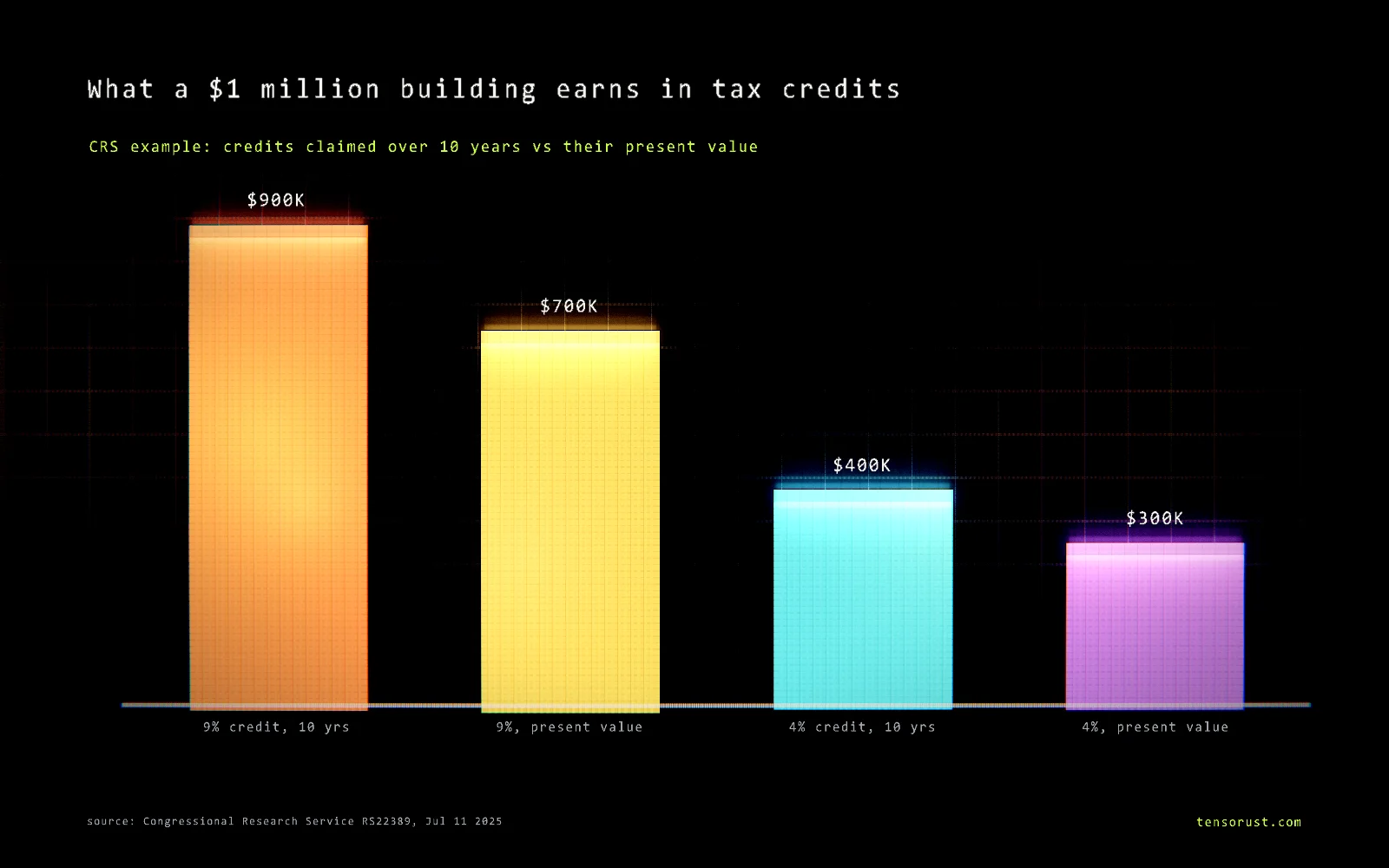
The 9% credit is designed to cover about 70% of a building's eligible cost (in present value), is competitive and capped by the state budget above, and usually funds new construction. The 4% credit covers about 30%, is not capped, and comes with tax-exempt bond financing; it is the workhorse for big projects and rehabs. Both rates have legal floors now: 9% permanently since 2015, 4% since 2021. Buildings in high-cost "difficult development areas" or poor "qualified census tracts" can claim the credit on 130% of their cost, a "basis boost".
What changed in 2025
The One Big Beautiful Bill Act (P.L. 119-21), signed July 4, 2025, made two permanent changes from 2026, per CRS:
- 12% more 9% credits for every state. Novogradac estimates the national 9% pool at about $1.2 billion of annual credit in 2026, a 14.4% rise on 2025 with population growth.
- The bond test drops from 50% to 25%. A project now needs only a quarter of its cost financed with tax-exempt bonds to get the automatic 4% credit, which stretches each state's bond cap across more buildings.
CRS cites an extra cost of $39 million in 2026 growing to $4.0 billion in 2034, as the new buildings start claiming credits.
Who can live there, and what rent is
Take an illustration, not a real county: if HUD's 60% income limit for a 1.5-person household (the size the rule assumes for a one-bedroom) is $48,000, the most a one-bedroom can cost is 30% of that, $1,200 a month including utilities. Every tenant in that unit size pays the same capped rent, whether they earn $25,000 or $47,000. Your own county's limits are in HUD's yearly MTSP income limits. To see how that compares with the market where you live, use the is my rent fair? guide.
Common misconceptions
"LIHTC is Section 8."
The recordSection 8 is a voucher that follows the tenant and sets their share at about 30% of their income. LIHTC caps the apartment's rent at 30% of the income limit. A LIHTC tenant with very low income can still pay more than a third of their income unless they also have a voucher.
"Affordable housing means it is affordable forever."
The recordThe legal minimum is 30 years, and some states require more. In HUD's own data, 11,229 projects with 441,722 low-income units are flagged as no longer monitored for the program, many because their affordability period ended. Whether they stayed affordable is not recorded.
"LIHTC is only for the very poor."
The recordMost units are set at 60% of the area median, a cashier or a new teacher in many metros, and income averaging allows some at up to 80%. That is also the main criticism: it rarely reaches households at 30% of AMI without extra subsidy.
"The government builds these."
The recordIt does not. Private and nonprofit developers build and own them; the Treasury gives up tax revenue instead of writing a check, which is why the cost shows up as a tax expenditure, not a budget line.
Related
- Does building more apartments lower rent? What the data shows: the article this explainer spins out of.
- Rent control pros and cons: what the studies actually say
- Can the president lower rent prices?
- Does building more housing lower rent?
- Is my rent fair? How to check it with free data
FAQ
What does LIHTC stand for?
Low-Income Housing Tax Credit. It is a federal tax credit, created by the Tax Reform Act of 1986, that states award to developers who agree to rent some or all of their apartments at capped rents to lower-income households for at least 30 years.
Who qualifies for a LIHTC apartment?
Households under an income limit, usually 60% of the area median income (AMI) adjusted for household size; some units are set at 50% or lower. Under income averaging, added in 2018, a unit can go to someone at up to 80% of AMI if another unit goes to someone well below 60%. HUD publishes the limits every year as the MTSP income limits.
Is LIHTC the same as Section 8?
No. Section 8 vouchers pay part of the rent for you, so your share is about 30% of your income. LIHTC caps the rent of the apartment itself, at 30% of the income limit, not 30% of your income. You can use a voucher in a LIHTC apartment, and many tenants do.
How is rent calculated in LIHTC housing?
The maximum gross rent, including a utility allowance, is 30% of the income limit the property elected (50% or 60% of AMI), based on an assumed 1.5 people per bedroom. It is the same for every tenant in that unit size, whatever their own income.
How much does LIHTC cost the government?
The Congressional Research Service puts it at about $14.4 billion a year before the 2025 One Big Beautiful Bill Act, which raised states' allocations 12% from 2026 and adds an estimated $39 million in 2026, rising to $4.0 billion a year by 2034.
Sources
All checked October 24, 2026.
Primary data
- U.S. Department of Housing and Urban Development, LIHTC Program: Property Level Data (LIHTCPUB.zip, May 2026 release): 55,345 projects and 3.9 million housing units placed in service 1987 to 2024. Our yearly tally, income-ceiling shares and no-longer-monitored counts are computed from this file (fields YR_PIS, LI_UNITR, N_UNITSR, INC_CEIL, NONPROG per the 2024 data dictionary).
- HUD User, Multifamily Tax Subsidy Projects (MTSP) income limits.
Law and cost
- Congressional Research Service, An Introduction to the Low-Income Housing Tax Credit (RS22389), updated July 11, 2025: $14.4 billion average annual cost before P.L. 119-21; 12% allocation increase and 25% bond test from 2026; $39 million (2026) to $4.0 billion (2034) added cost; 70%/30% present value design and the $1 million example; income tests; 30% rent rule; 130% basis boost; credit floors.
- Novogradac, IRS publishes LIHTC, PAB population figures for CY 2026 (IRS Notice 2026-22; Rev. Proc. 2025-32 as corrected October 22, 2025): $3.416 per capita, $3,953,600 small-state minimum; national 9% pool estimate of about $1.20 billion.
Our data
- data.csv: projects, total units, low-income units, units flagged with tax-exempt bonds and new-construction low-income units by year placed in service, 1987 to 2025 (2025 is partial; HUD adds it in spring 2027). The bond flag is sparsely reported after 2016, so we do not use it on the page.
Images
- Hero chart: made by Tensorust from the HUD database. Credit example chart: rendered by Tensorust with the Proof Engine from the CRS example.
- HUD database page: screenshot of huduser.gov (US government work, public domain), captured October 24, 2026.
Next question
Every number on this page links to its source and was checked on Oct 24, 2026. Spot an error or a newer figure? Email matt@tensorust.com and it gets fixed. Related: Check your rent against HUD's Fair Market Rent.
Read next
- Article · Oct 23, 2026New apartments cut local rent: what happens when supply finally arrives
- Explainer · Oct 24, 2026The Dodd-Frank Act, explained simply
- Explainer · Oct 24, 2026How much interest does the US pay on its debt per day?
Get the next one by email.
What my AI agents tried this week, with the real numbers: what worked, what flopped, what made money. One email when there is something worth reading.
No spam, never sold. Every email has a one-click unsubscribe.