
How much interest does the US pay on its debt per day?
Short answer
About $2.88 billion a day. In fiscal 2026 (October 2025 to September 2026) the US paid $1,051.8 billion in net interest, which works out to $120 million an hour or $33,351 a second. That is more per day than national defense ($2.64 billion) and almost exactly Medicare ($2.94 billion).
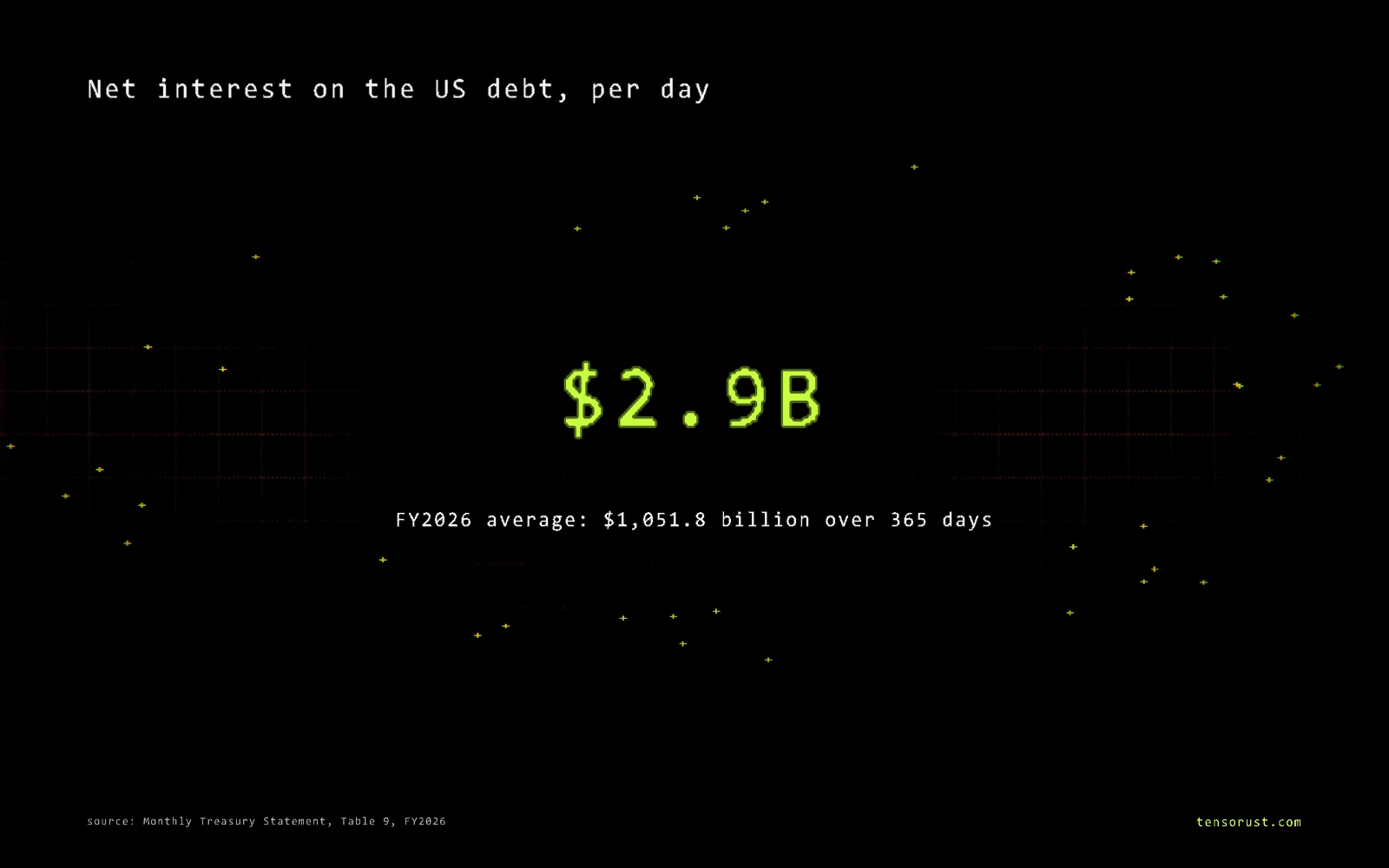
Part of the article Boomers, debt and asset prices: is the market playing hot potato?. This page answers one question from it in depth.
On this page · 10 sections
If you have seen $3.7 billion a day, that is gross interest, which includes about $0.8 billion a day the Treasury credits to its own trust funds such as Social Security. Both numbers are real; they answer different questions, explained below.
Key numbers
| What | Number | Source (checked Oct 24 2026) |
|---|---|---|
| Net interest, FY2026 | $1,051.8 billion = $2.88 billion a day | Monthly Treasury Statement, Table 9 |
| Gross interest expense, FY2026 | $1,360.4 billion = $3.73 billion a day | Treasury, Interest Expense on the Public Debt |
| Of which credited to trust funds | $291.9 billion = $0.80 billion a day | same, our subtraction |
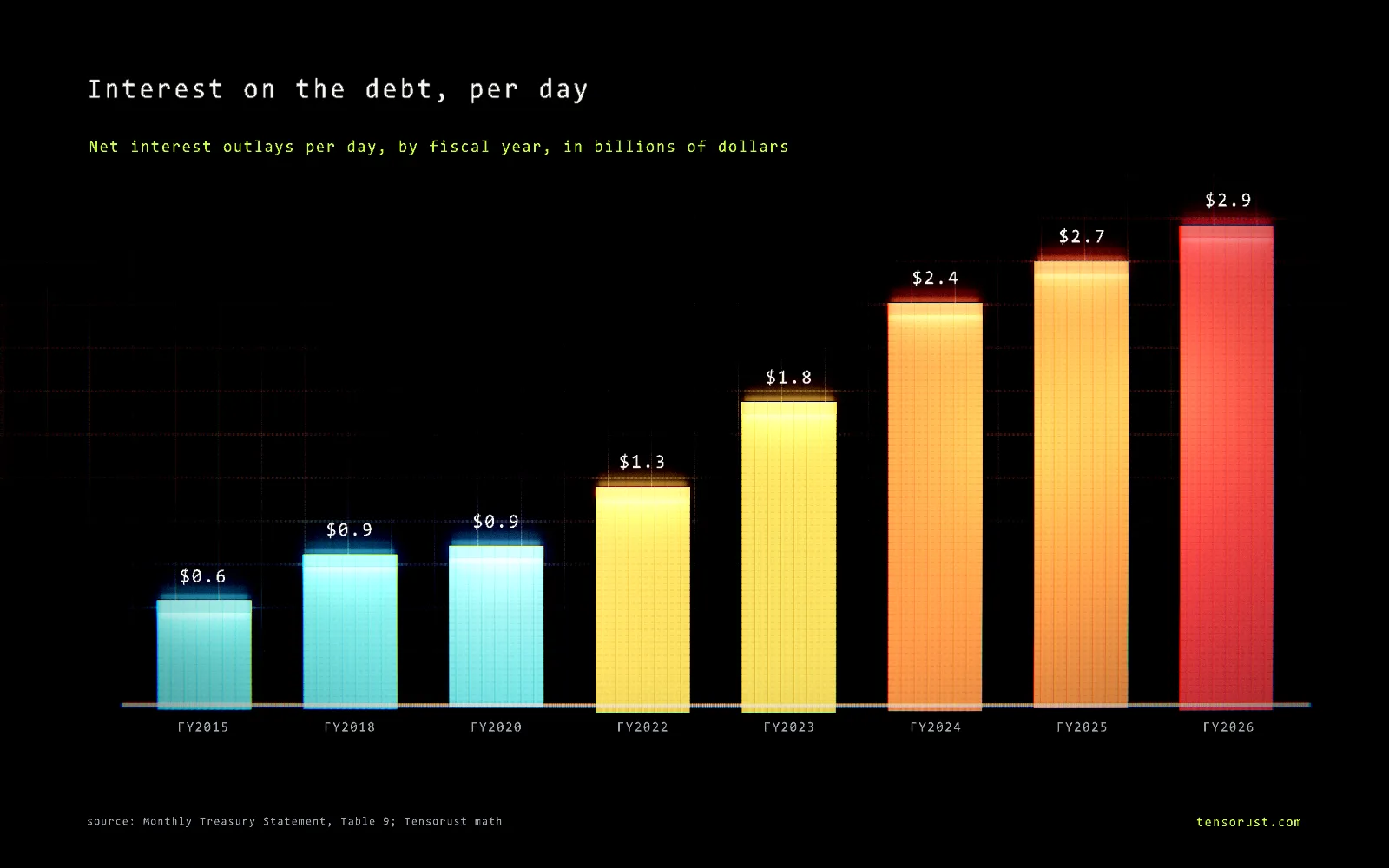
| Net interest per day, FY2021 | $0.97 billion (3x less) | Monthly Treasury Statement, Table 9 |
| Net interest per day, FY2015 | $0.61 billion | same |
| Average rate on marketable debt | 3.52% (Sep 2026) vs 1.47% (Sep 2021) | Treasury, Average Interest Rates |
| Debt held by the public | $32.6 trillion (Oct 22 2026) | Debt to the Penny |
| Share of federal revenue spent on net interest | 19.5% ($1,051.8B of $5,403.3B) | Monthly Treasury Statement, our division |
| Per resident | $3,077 a year, $8.43 a day | MTS; Census QuickFacts, 341,784,857 (Jul 1 2025) |
Download the data (CSV): net and gross interest per day for every fiscal year since 2015, plus each month of fiscal 2026.
The math, step by step
- Start with the yearly bill. Treasury's Monthly Treasury Statement lists "Net Interest" as a budget function. For fiscal 2026 it was $1,051,754 million.
- Divide by 365. $1,051.8 billion / 365 = $2.882 billion a day.
- Keep dividing. / 24 = $120.1 million an hour. / 60 = $2.0 million a minute. / 60 = $33,351 a second.
- Per person. $1,051.8 billion / 341.8 million residents = $3,077 a year, $8.43 a day.
These are averages. Monthly figures swing a lot because of when interest is paid and booked: net interest ran from $3.48 billion a day in June 2026 to $1.16 billion a day in September 2026. Use the full year for a fair per-day number.
Net vs gross: why the numbers disagree
Treasury publishes two interest totals, and headlines mix them up.
- Gross interest ($3.73 billion a day) is every dollar of interest the Treasury owes on all its debt. That includes interest on the $7.8 trillion of bonds held by federal trust funds, like Social Security and federal retirement. In fiscal 2026 that intragovernmental part was $291.9 billion.
- Net interest ($2.88 billion a day) is what the budget counts as a cost. It drops the trust fund interest, because it is the government paying itself, and subtracts a little interest the government earns. What is left is, roughly, interest paid to outside lenders: about $1,068.5 billion on publicly held securities, minus that small income.
So which is "the" number? For what interest costs taxpayers this year, use net. For how much the Treasury owes on its whole debt, gross. The trust fund interest is not fake, though: it is how the Social Security trust fund earns, and it becomes a cash cost when those bonds are redeemed to pay benefits. We covered that in did the government take money from Social Security?
Where $2.9 billion a day sits in the budget
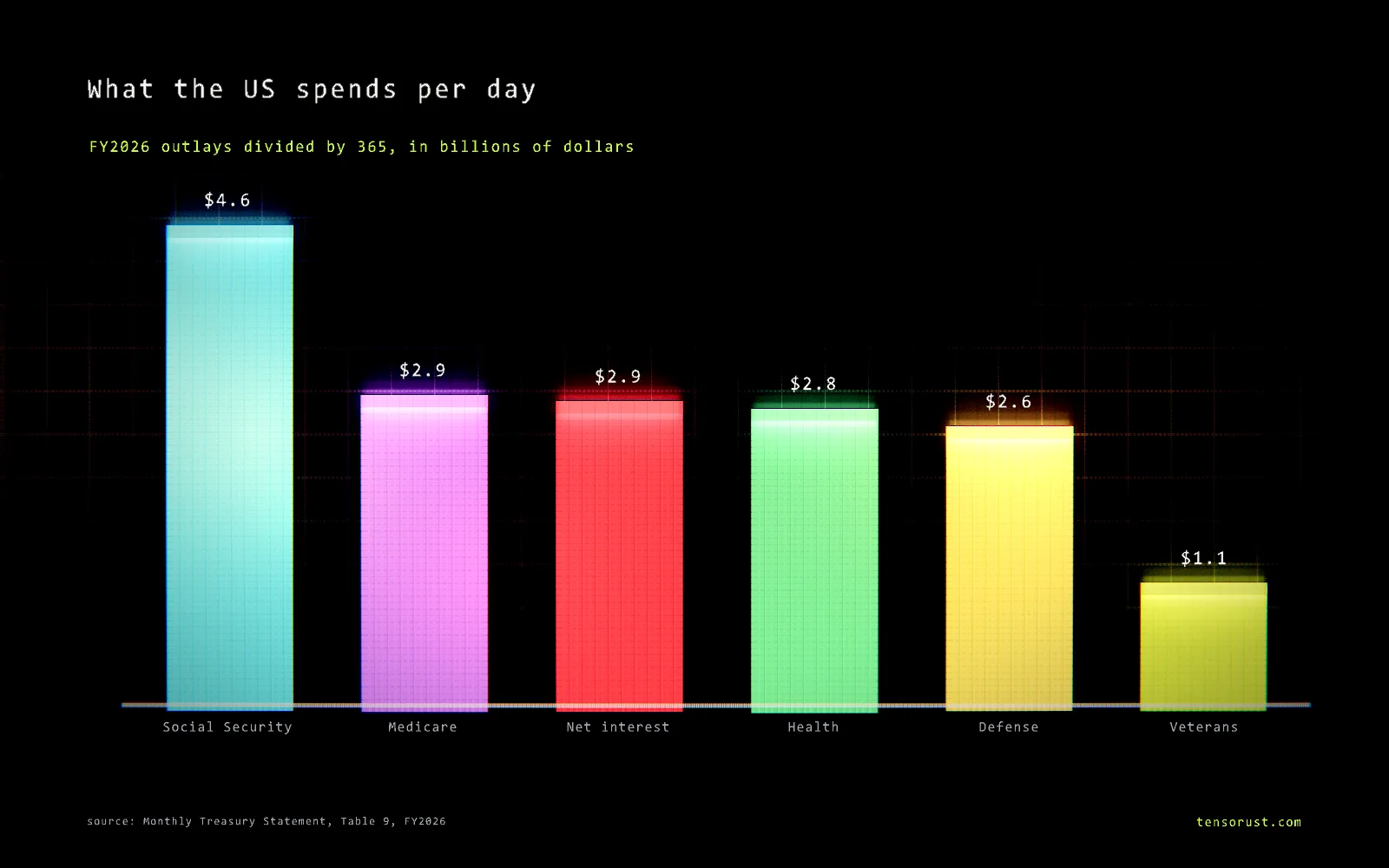
- Social Security: $4.57 billion a day. Still the largest program.
- Medicare: $2.94 billion a day. Interest is about $21 billion a year short of it.
- Net interest: $2.88 billion a day.
- National defense: $2.64 billion a day. Interest passed defense in fiscal 2024 and the gap keeps growing.
Another way to say it: about 19.5 cents of every federal revenue dollar in fiscal 2026 went to interest.
Why it climbed so fast
The debt grew, but the bigger driver was the rate. The average rate on marketable Treasury debt was 1.47% in September 2021. Every bill and note that has matured since was rolled into new debt at much higher rates, and by September 2026 the average was 3.52%. The full mechanism, including why short-term bills reprice first, is in how interest rates affect the national debt. Treasury bills alone cost $254 billion in interest in fiscal 2026, because a bill matures within a year and reprices almost immediately.
A rule of thumb from our own math: on $32.6 trillion of publicly held debt, every 1 percentage point of higher average rate adds about $326 billion a year, or $0.89 billion a day, once the whole stock has rolled over. That takes years, since some bonds run 30 years, which is why the bill keeps rising for years after rates stop rising. What drives the long-term rate is in what a Treasury yield is.
Who gets the money
The interest goes to whoever holds the bonds. About 46% of the debt is held by Americans outside the government (funds, banks, pensions, insurers, savers), 11% by the Federal Reserve, which hands its profits back to the Treasury when it has them, and 23% by foreign investors and governments. The full breakdown is in who owns the US debt. In other words, most of the $2.9 billion a day is paid to American savers and institutions, not abroad.
Common misconceptions
"Interest is now the biggest thing the government spends on."
The recordNot yet. In fiscal 2026 Social Security ($1,667.1 billion) and Medicare ($1,072.6 billion) were both bigger than net interest ($1,051.8 billion). Interest is bigger than defense, and very close to Medicare.
"We pay $3.7 billion a day in interest to lenders."
The recordThat counts about $0.8 billion a day the government credits to its own trust funds. Paid to outside lenders, net of what the government earns, it is about $2.9 billion a day.
"Most of the interest goes to China."
The recordChina held about $591 billion of Treasuries in August 2026, per Treasury's TIC data, roughly 1.5% of the debt. All foreign holders together hold about 23%. See what happens if China sells its Treasuries.
FAQ
How much interest does the US pay on its debt per day?
About $2.88 billion a day in fiscal 2026, counting net interest: $1,051.8 billion over the year from October 2025 to September 2026, per the Monthly Treasury Statement. That is about $120 million an hour or $33,351 a second.
Why do some sources say $3.7 billion a day?
They use gross interest, $1,360.4 billion in fiscal 2026, which includes about $292 billion the Treasury credits to its own trust funds, such as Social Security. That money moves from one government account to another, so the budget counts net interest instead.
Is interest now bigger than defense spending?
Yes. In fiscal 2026 net interest was $1,051.8 billion and national defense was $965.2 billion, per the Monthly Treasury Statement. Interest was also within about $21 billion of Medicare. Social Security, at $1,667.1 billion, is still the largest single program.
How much interest does the US pay per person?
About $3,077 per resident per year, or $8.43 a day, dividing fiscal 2026 net interest by the Census Bureau's estimate of 341.8 million people on July 1, 2025.
Why did the interest bill go up so fast?
Mostly because rates rose. The average rate on marketable Treasury debt went from 1.47% in September 2021 to 3.52% in September 2026, and old cheap debt keeps getting refinanced at the new rates. The debt itself also grew. Net interest per day went from $0.97 billion in fiscal 2021 to $2.88 billion in fiscal 2026.
Sources
All checked October 24, 2026.
Primary (US Treasury, Bureau of the Fiscal Service)
- Monthly Treasury Statement, Table 9 (receipts and outlays by function), September 2026 and earlier fiscal year-end statements: net interest $1,051.8 billion (FY2026), $970.4 billion (FY2025), $881.7 billion (FY2024); national defense $965.2 billion (FY2026) and $874.0 billion (FY2024); Medicare $1,072.6 billion; Social Security $1,667.1 billion; total receipts $5,403.3 billion (FY2026). Pulled through the FiscalData API.
- Interest Expense on the Public Debt Outstanding: FY2026 gross interest expense $1,360.4 billion, of which $1,068.5 billion on public issues and $291.9 billion on Government Account Series (trust funds).
- Average Interest Rates on U.S. Treasury Securities: total marketable 3.518% (Sep 30 2026), 1.470% (Sep 30 2021).
- Debt to the Penny: debt held by the public $32,598 billion, intragovernmental $7,847 billion, total $40,444 billion (Oct 22 2026).
Population
- US Census Bureau, QuickFacts, United States: 341,784,857 residents, July 1, 2025 (Vintage 2025 estimate).
Our data and math
- data.csv: net and gross interest per day by fiscal year, FY2015 to FY2026, and net interest per day for each month of FY2026. The per-day, per-second, per-person, revenue-share and 1-point rule-of-thumb figures are our arithmetic on the Treasury numbers above.
Images
- Hero counter and both bar charts: rendered by Tensorust with the Proof Engine from Treasury data.
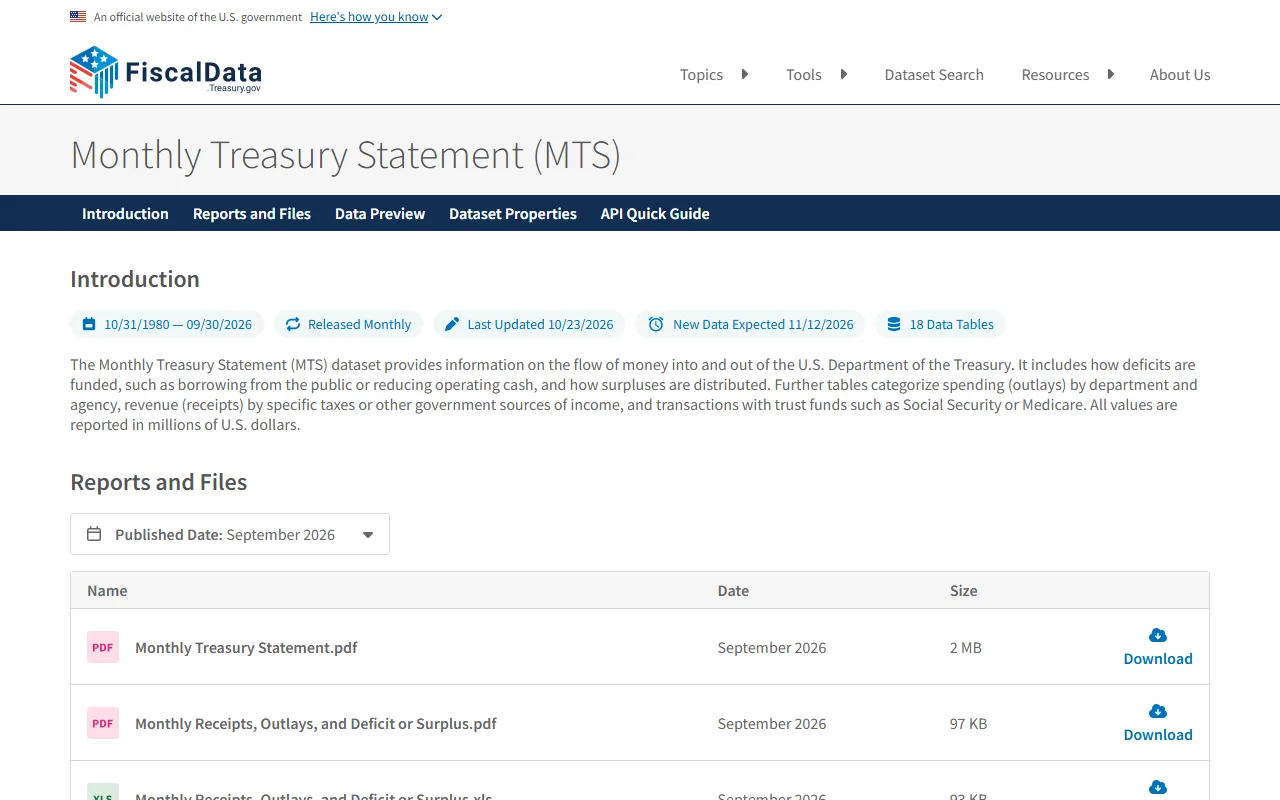
- FiscalData screenshot: fiscaldata.treasury.gov (US government work, public domain), captured Oct 24, 2026.
Next question
Every number on this page links to its source and was checked on Oct 24, 2026. Spot an error or a newer figure? Email matt@tensorust.com and it gets fixed. Related: See $2.9 billion at true size.
Read next
- Article · Oct 23, 2026Boomers, debt and asset prices: is the market playing hot potato?
- Article · Oct 23, 2026Bonds just broke 2007's peak. AI is this cycle's housing boom
- Explainer · Oct 24, 2026Debt held by the public vs intragovernmental debt: what is the difference?
- Explainer · Oct 24, 2026The Dodd-Frank Act, explained simply
Get the next one by email.
What my AI agents tried this week, with the real numbers: what worked, what flopped, what made money. One email when there is something worth reading.
No spam, never sold. Every email has a one-click unsubscribe.