
The Dodd-Frank Act, explained simply
Short answer
The Dodd-Frank Act is the 848-page law Congress passed in July 2010 to keep 2008 from happening again. In plain terms it did five big things: made large banks hold more capital and pass yearly stress tests, created a consumer finance watchdog (the CFPB), banned most bank betting with their own money, forced most derivatives onto clearinghouses, and gave regulators a way to shut down a failing giant without a bailout.
Part of the article Bonds just broke 2007's peak. AI is this cycle's housing boom. This page answers one question from it in depth.
On this page · 8 sections
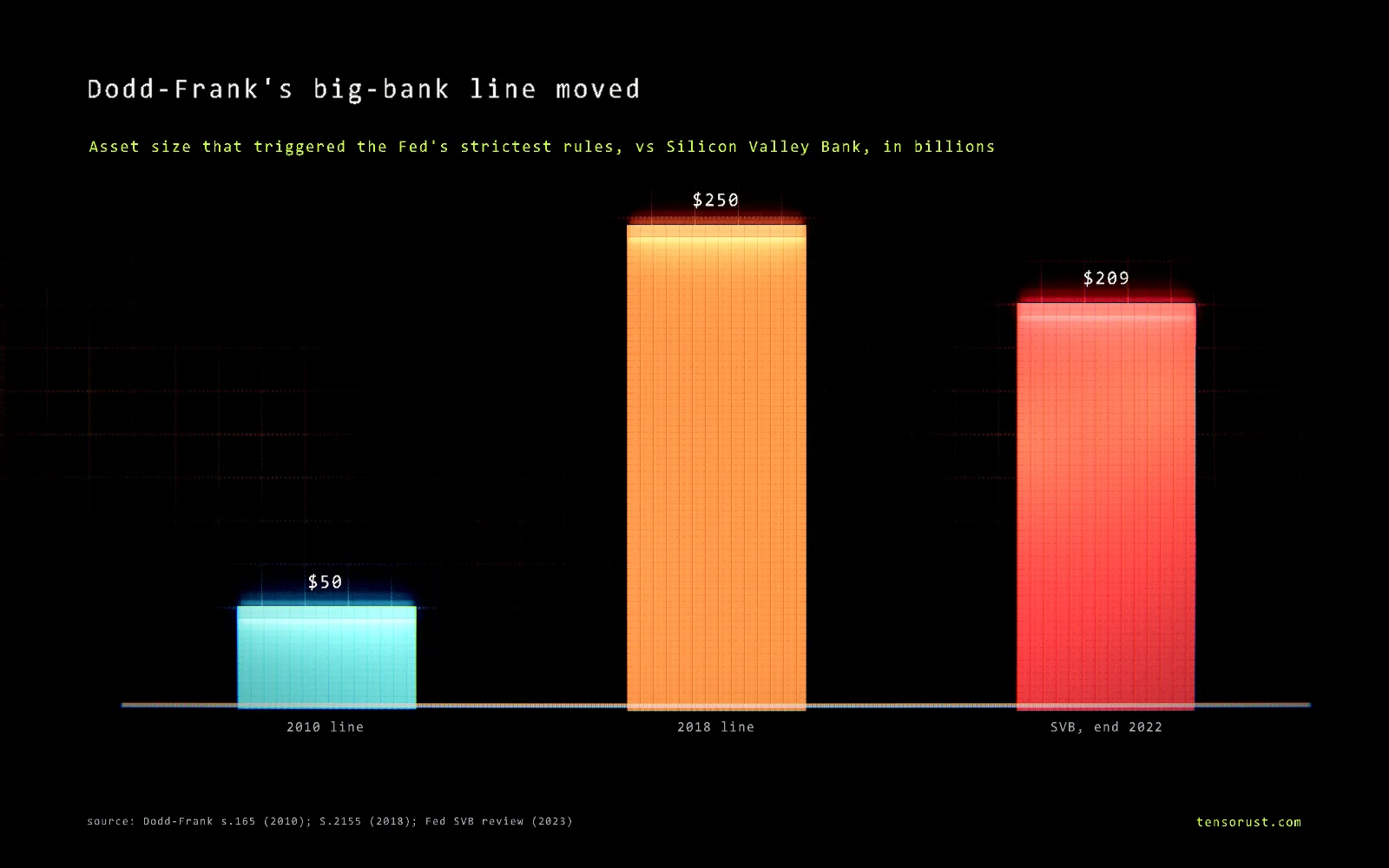
It was never repealed. A 2018 law raised the size where the strictest rules start from $50 billion to $250 billion, and the 2023 bank failures happened right in that gap. The scorecard below shows what is still standing in October 2026.
Key facts
| What | Number or date | Source (checked Oct 24 2026) |
|---|---|---|
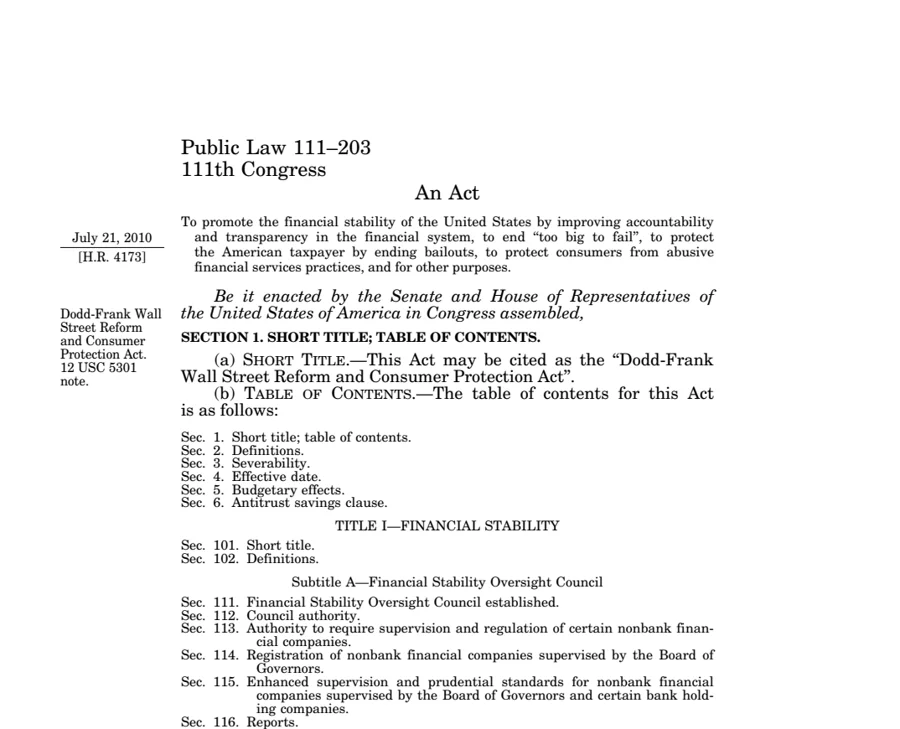
| Signed into law | Jul 21 2010, Public Law 111-203 | GovInfo, P.L. 111-203 |
| Length | 848 pages of the Statutes at Large (124 Stat. 1376 to 2223), 16 titles | same |
| Final votes | House 237-192 (Jun 30 2010); Senate 60-39 (Jul 15 2010) | Congress.gov, H.R. 4173 |
| Strictest-rules line, 2010 | $50 billion in assets (section 165) | P.L. 111-203 |
| Strictest-rules line since 2018 | $250 billion (Fed discretion from $100 billion) | Congress.gov, S. 2155 / P.L. 115-174 |
| Deposit insurance | $250,000 per depositor per bank, made permanent (section 335) | P.L. 111-203 |
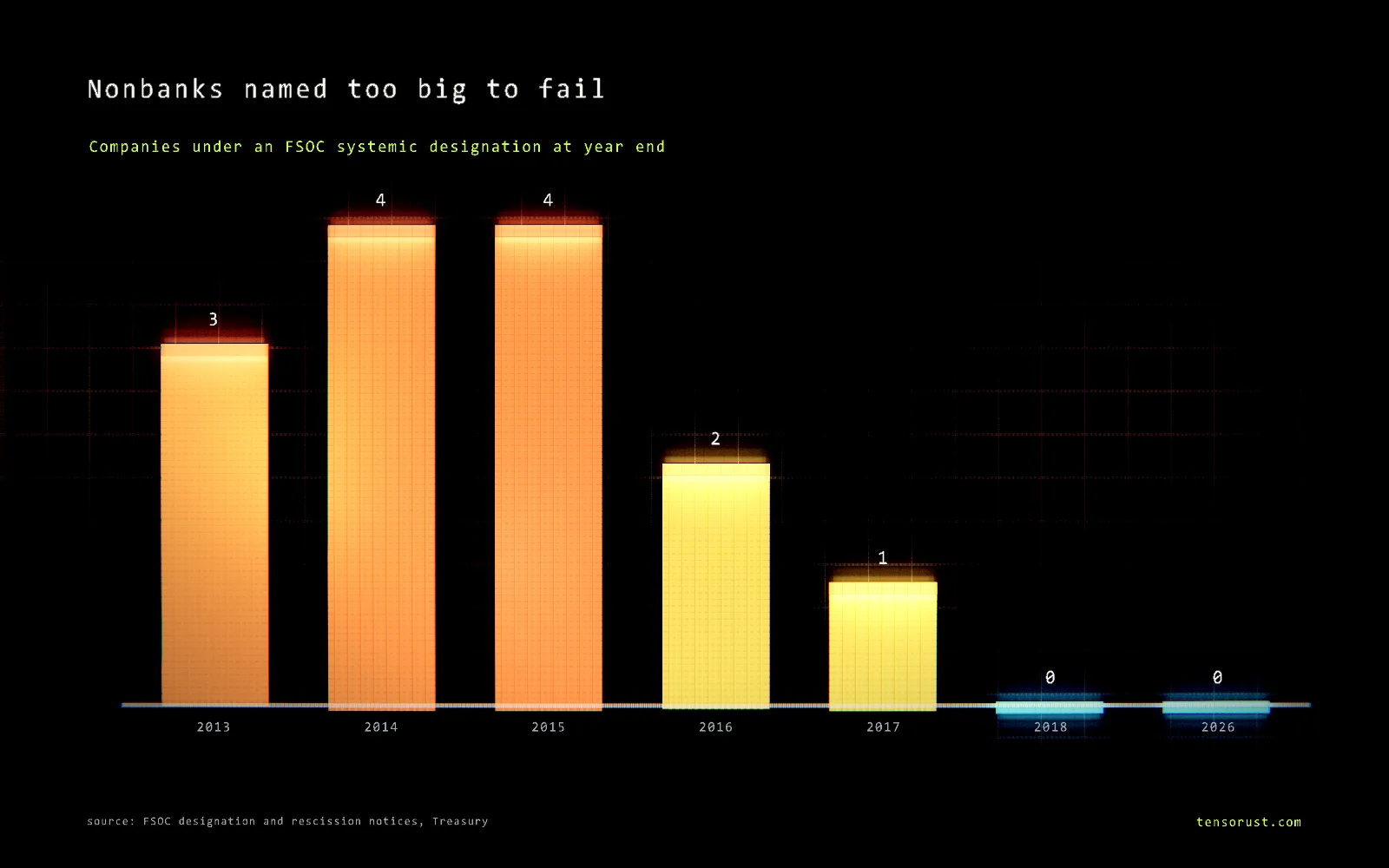
| Nonbanks designated "systemically important" | 4 at the peak (2014); 0 since Oct 2018 | FSOC designations, Treasury |
| Silicon Valley Bank at failure | about $209 billion, Mar 10 2023 | Federal Reserve review, Apr 28 2023 |
| CFPB funding upheld | Supreme Court, 7-2, May 16 2024 | CFPB v. CFSA, opinion |
What it did, in plain English
The law has 16 titles. Five carry most of the weight.
- Watch the whole system (Title I). It created the Financial Stability Oversight Council, the heads of the financial regulators sitting at one table, with power to put a non-bank like an insurer under Fed supervision. Banks with $50 billion or more had to meet tougher capital, liquidity and risk rules, file "living wills" showing how they could fail safely, and pass Fed stress tests every year.
- Let giants fail without a bailout (Title II). "Orderly liquidation authority" lets the FDIC take over a failing financial company that is too big for normal bankruptcy, wipe out shareholders and charge losses to creditors and, if needed, the industry. It has never been used.
- No casino with insured deposits (Title VI, the Volcker Rule). Banks that take government-insured deposits may not make short-term bets with their own money ("proprietary trading") and may only hold small stakes in hedge funds and private equity funds. Named for former Fed chair Paul Volcker; the final rule came out on December 10, 2013.
- Drag derivatives into the light (Title VII). Before 2008, swaps like the ones that sank AIG traded privately with no central record. Dodd-Frank required standard swaps to be cleared through clearinghouses, traded on regulated platforms and reported, under the CFTC and SEC.
- A consumer cop (Title X). The Consumer Financial Protection Bureau took over consumer finance rules scattered across seven agencies. Its first big rule (Title XIV) made lenders check that borrowers can repay a mortgage, aimed straight at the no-documentation loans of 2005 to 2007.
Smaller pieces people still feel: $250,000 deposit insurance made permanent, a cap on debit card swipe fees at banks over $10 billion (the Durbin amendment; the Fed set it at 21 cents plus 0.05% in 2011), shareholder say on pay votes, and SEC whistleblower awards of 10% to 30% of sanctions over $1 million.
The scorecard: what still stands in 2026
| Piece | What it did | Status, Oct 2026 |
|---|---|---|
| Stress tests and capital | Yearly Fed tests; more capital at big banks | Still running; the Fed finalized changes on Sep 30 2026 that average results over two years |
| $50B line for strict rules | Tougher rules from $50B in assets | Raised to $250B in 2018 |
| Volcker Rule | No proprietary trading at insured banks | Standing, loosened in 2019 and 2020; small banks exempt since 2018 |
| Orderly liquidation | FDIC can wind down a giant | On the books, never used |
| FSOC designations | Fed oversight of risky non-banks | 0 companies designated since Oct 2018 |
| Swaps clearing | Clearinghouses and reporting | Standing |
| CFPB | Consumer watchdog | Exists, heavily cut in 2025; courts blocked a funding cutoff (Dec 2025 to Sep 2026) |
| $250K deposit insurance | Permanent | Standing |
The 2018 rollback and the 2023 failures
In May 2018 Congress passed the Economic Growth, Regulatory Relief, and Consumer Protection Act with votes from both parties: 67 to 31 in the Senate. It raised the strict-rules line to $250 billion and freed banks under $10 billion from the Volcker Rule. Silicon Valley Bank, about $209 billion at the end of 2022, sat under the new line. When it failed on March 10, 2023, the Fed's own review, led by Vice Chair for Supervision Michael Barr, said the lighter "tailoring" approach that followed the 2018 law "impeded effective supervision." Signature Bank and First Republic followed. The bank-by-bank story, and the easing since late 2025, is in what happened to banks after 2008.
Common misconceptions
"Dodd-Frank was repealed in 2018."
The recordIt was amended, not repealed. The 2018 law changed thresholds and exemptions; the stress tests, the CFPB, swaps clearing and the Volcker Rule all survived it.
"Dodd-Frank ended too big to fail."
The recordThat is what its title promises, and it is not proven. Orderly liquidation has never been tested on a giant, and in March 2023 regulators used an emergency "systemic risk exception" to cover all deposits at SVB and Signature, including uninsured ones. That is a backstop, not a bailout of shareholders, who were wiped out, but it is also not the hands-off failure the law described.
"Dodd-Frank put bankers in jail."
The recordIt did not create any new path to prosecuting 2008 conduct. Why almost no one went to prison is its own question: see why no bankers went to jail after 2008.
"The CFPB was shut down."
The recordIt still exists. In November 2025 the Justice Department's Office of Legal Counsel said the bureau could not request Fed funding while the Fed runs operating losses; federal judges in Washington (Dec 30 2025), California (Mar 2026) and Oregon (Sep 25 2026) rejected that reading, per the Consumer Finance Monitor's summary.
FAQ
What is the Dodd-Frank Act in simple terms?
It is the law Congress passed in 2010 to stop a repeat of the 2008 financial crisis. It made big banks hold more capital and pass yearly stress tests, created a consumer watchdog (the CFPB), banned most bank betting with their own money (the Volcker Rule), pushed derivatives onto regulated exchanges and clearinghouses, and gave regulators a way to shut down a failing giant without a bailout.
When was Dodd-Frank passed?
The House passed the final version 237 to 192 on June 30, 2010, the Senate 60 to 39 on July 15, 2010, and President Obama signed it on July 21, 2010, as Public Law 111-203.
Was Dodd-Frank repealed?
No. It was trimmed. A 2018 law, the Economic Growth, Regulatory Relief, and Consumer Protection Act, raised the size at which the strictest rules apply from $50 billion to $250 billion in assets and exempted small banks from the Volcker Rule. Regulators have eased other rules since, but the core of the law still stands.
Who were Dodd and Frank?
Senator Chris Dodd of Connecticut, chair of the Senate Banking Committee, and Representative Barney Frank of Massachusetts, chair of the House Financial Services Committee. Both were Democrats.
Does the CFPB still exist?
Yes, but it was cut back sharply in 2025, and in November 2025 the Justice Department argued the bureau could not draw funding from the Federal Reserve while the Fed runs losses. Three federal judges rejected that argument, most recently Judge Ann Aiken in Oregon on September 25, 2026.
Sources
All checked October 24, 2026.
The laws
- Dodd-Frank Wall Street Reform and Consumer Protection Act, Public Law 111-203 (GovInfo PDF), 124 Stat. 1376 to 2223, July 21, 2010; legislative history and votes at Congress.gov, H.R. 4173.
- Economic Growth, Regulatory Relief, and Consumer Protection Act, S. 2155, Public Law 115-174, May 24, 2018.
Regulators and courts
- Federal Reserve, Volcker Rule final rule press release, December 10, 2013.
- Federal Reserve, Regulation II (debit card interchange).
- US Treasury, FSOC designations: AIG and GE Capital (Jul 8 2013), Prudential (Sep 19 2013), MetLife (Dec 18 2014); rescissions for GE Capital (Jun 28 2016), AIG (Sep 29 2017), Prudential (Oct 16 2018). MetLife's designation was vacated by the US District Court for the District of Columbia on March 30, 2016.
- Board of Governors of the Federal Reserve, Review of the Federal Reserve's Supervision and Regulation of Silicon Valley Bank, April 28, 2023 (Michael Barr).
- Supreme Court of the United States, CFPB v. Community Financial Services Association of America, May 16, 2024.
- Alan Kaplinsky and Ballard Spahr's Consumer Finance Monitor, "Third district court rejects OLC's interpretation of CFPB funding statute", September 30, 2026 (State of New York v. Vought, D. Or., Judge Ann Aiken, Sep 25 2026; NTEU v. Vought, D.D.C., Dec 30 2025; Rise Economy v. Vought, N.D. Cal., Mar 2026).
Images
- Hero and FSOC chart: rendered by Tensorust with the Proof Engine from the sources above.
- First page of P.L. 111-203: GovInfo (US government work, public domain).
Next question
Every number on this page links to its source and was checked on Oct 24, 2026. Spot an error or a newer figure? Email matt@tensorust.com and it gets fixed. Related: See $50 billion vs $250 billion at true size.
Read next
- Article · Oct 23, 2026Bonds just broke 2007's peak. AI is this cycle's housing boom
- Article · Oct 23, 2026Boomers, debt and asset prices: is the market playing hot potato?
- Explainer · Oct 24, 2026Debt held by the public vs intragovernmental debt: what is the difference?
- Explainer · Oct 24, 2026How much interest does the US pay on its debt per day?
Get the next one by email.
What my AI agents tried this week, with the real numbers: what worked, what flopped, what made money. One email when there is something worth reading.
No spam, never sold. Every email has a one-click unsubscribe.