
Rent control pros and cons: what the studies actually say
Short answer
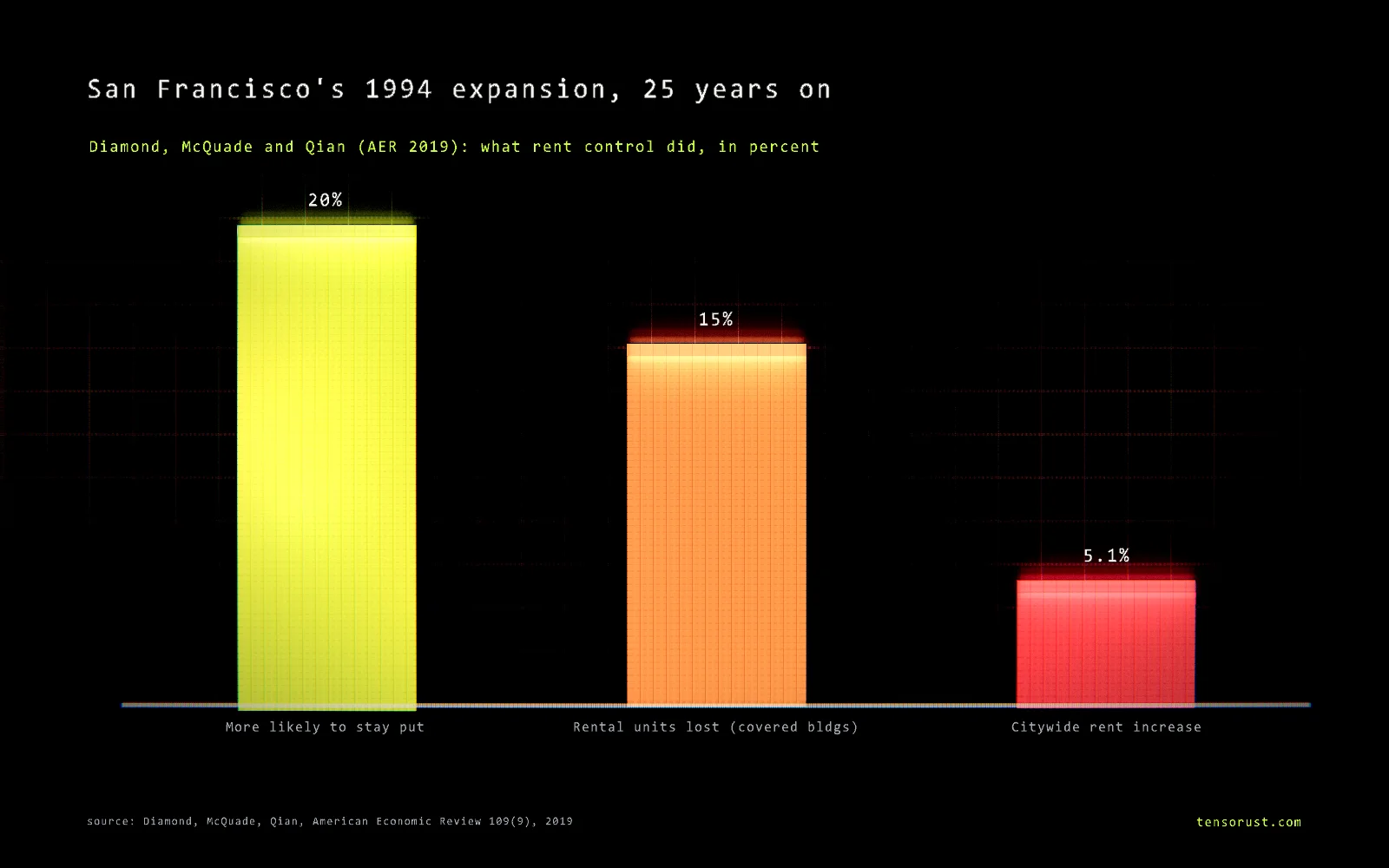
Rent control works for the people who already have a covered apartment: they pay less and they stay put. The cost lands on everyone else. In the biggest US study, San Francisco's covered tenants became nearly 20% more likely to stay at their address, while their landlords cut rental supply by 15%, pushing citywide rents up 5.1%.
Part of the article New apartments cut local rent: what happens when supply finally arrives. This page answers one question from it in depth.
On this page · 10 sections
So the honest answer to "pros and cons" is a trade: stability for current tenants, paid for by future tenants and by fewer homes. How big each side gets depends on the design, mostly on whether new buildings are exempt.
Key numbers
| What | Number | Source (checked Oct 24 2026) |
|---|---|---|
| SF covered tenants more likely to stay at their address | Nearly 20% | Diamond, McQuade, Qian, AER 2019 |
| SF rental supply cut by covered landlords | 15% | same |
| SF citywide rent increase caused by that cut | 5.1% | same |
| Value added to Cambridge homes when rent control ended (1994 to 2004) | About $1.8 billion | Autor, Palmer, Pathak, JPE 2014 |
| St. Paul property values after its 3% cap passed | Down 6 to 7% ($1.6 billion) | Ahern and Giacoletti, NBER 2022 |
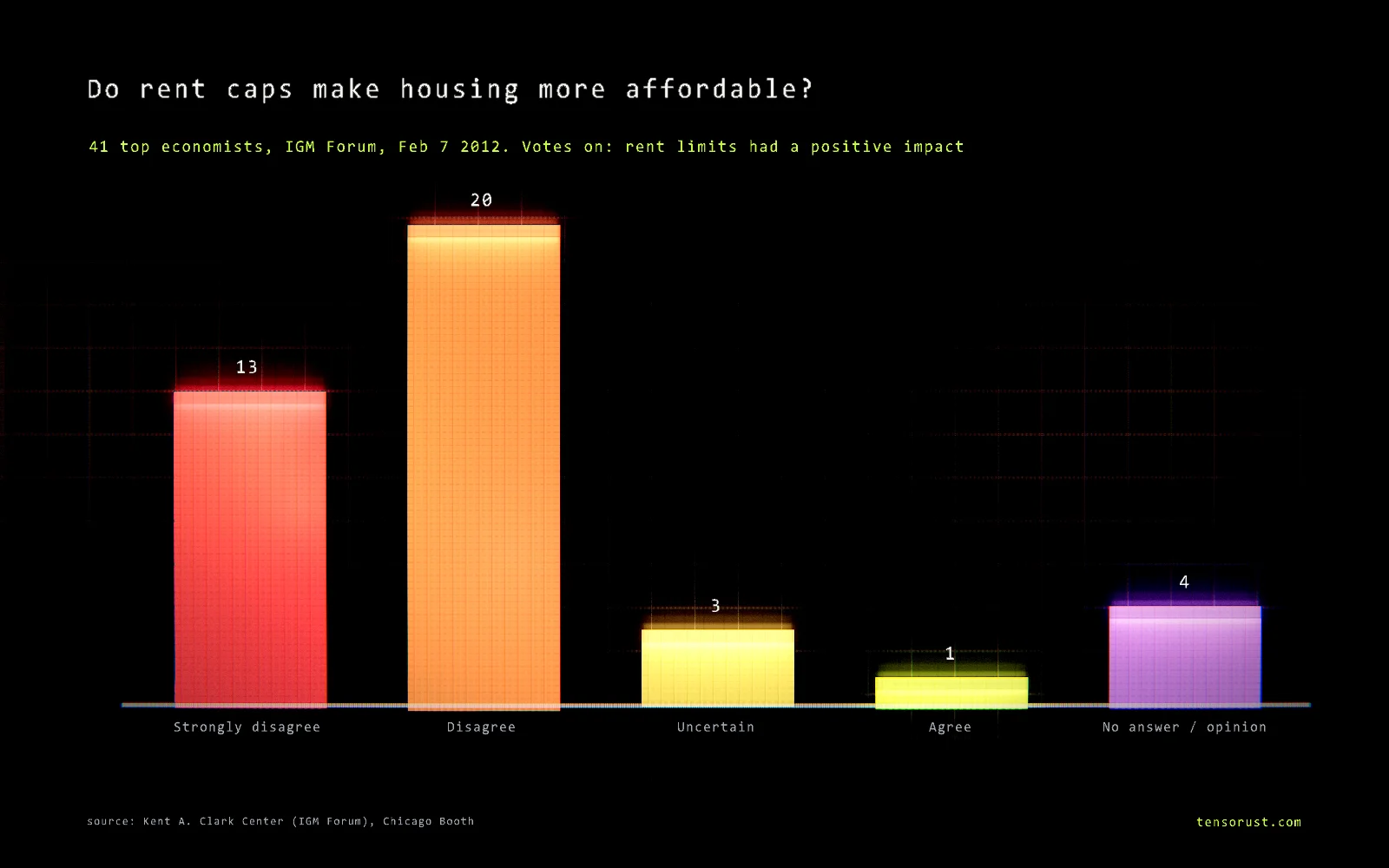
| Economists who disagreed rent caps improved affordability | 33 of 41 (1 agreed) | IGM Forum poll, Feb 7 2012 |
| NYC rent-stabilized increase, leases from Oct 1 2026 | 0% (one- and two-year), about 1 million units | amNY, Jun 26 2026 |
| States with a statewide cap | 3 (CA, OR, WA); about 32 ban local rent control | NAA, fall 2025 |
Rent control vs rent stabilization
The words get used loosely, so first the two flavors:
- Hard rent control (first generation): rents frozen or set by a board, often for decades, no matter who lives there. Cambridge, Massachusetts ran this until a 1994 statewide ballot question ended it.
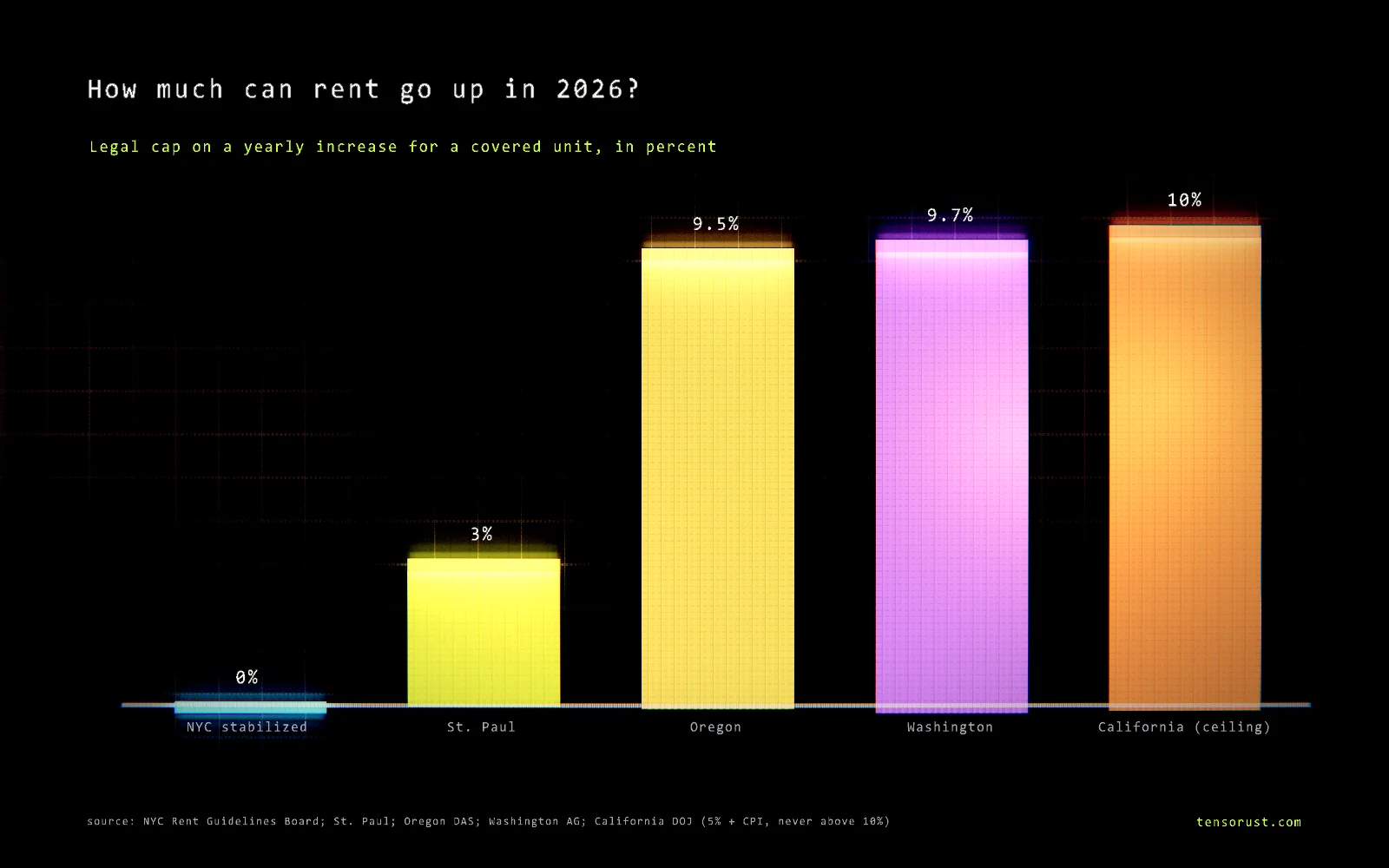
- Rent stabilization (second generation): a cap on the yearly increase, usually with exemptions for new buildings, and often with "vacancy decontrol" that lets the landlord reset the rent between tenants. California, Oregon and Washington all use this model now.
Almost every modern fight, including New York's 2026 freeze and the caps in the chart above, is about the second kind. The design details decide the trade-offs below.
The pros (what the evidence supports)
- Covered tenants stay. Rebecca Diamond, Timothy McQuade and Franklin Qian used a quirk of San Francisco's 1994 law (small multi-family buildings built before 1980 were suddenly covered, ones built after 1980 were not) to compare near-identical tenants. Covered renters were nearly 20% more likely to still be at the same address years later. The effect was strongest among older tenants and people who had lived there longest.
- Neighborhoods keep their people. Because covered tenants move less, and move out of San Francisco less, the law slowed the displacement of older and minority residents.
- Predictable rent. A 3% or 7%-plus-inflation cap turns a surprise 25% renewal into a number you can budget for. That is the main political appeal, and it is real.
The cons (what the evidence supports)
- Fewer rentals. The same San Francisco landlords converted buildings to condos and owner-occupied homes, or rebuilt them, cutting the rental units in covered buildings by 15%. Across the city that supply loss raised rents by 5.1%, a cost paid by every renter who was not covered. Konstantin Kholodilin's 2024 review of the literature in the Journal of Housing Economics reports the same pattern: of 16 studies on rental supply, 12 found a negative effect (summary by the IEA).
- Less building. St. Paul's 2021 ballot measure capped every unit at 3% a year, new or old, with no exemption. Builders pulled back, and on September 21, 2022 the council voted 5 to 2 to exempt new construction for 20 years and let rents rise more between tenants (Minnesota Reformer). Construction also slowed in Minneapolis, which has no rent control, so not all of the drop was the cap.
- The benefit goes to whoever holds the lease, not whoever needs it most. In St. Paul, Kenneth Ahern and Marco Giacoletti found property values fell 6 to 7%, and the tenants who gained most tended to have higher incomes, while the owners who lost most tended to have lower incomes. That is the opposite of the law's goal.
- The effect spills next door. When Cambridge ended rent control, David Autor, Christopher Palmer and Parag Pathak found about $1.8 billion was added to the city's housing value from 1994 to 2004, and more than half of it went to buildings that had never been controlled. Controlled buildings had been dragging down the whole neighborhood.
- Worse upkeep. Kholodilin's review counts 20 studies on housing quality; 15 found it got worse under rent control.
Where it stands in 2026
- New York City: the Rent Guidelines Board voted 7 to 1 on June 25, 2026 for a 0% increase on one- and two-year stabilized leases starting October 1, 2026, the first freeze ever on two-year leases. It was a central promise of Mayor Zohran Mamdani.
- Massachusetts: a ballot question to cap rent increases at inflation or 5% was struck from the November 3, 2026 ballot by the Supreme Judicial Court on June 23, 2026, because its religious exemption made it a petition that "relates to religion," which the state constitution keeps off the ballot (WBUR).
- California: voters rejected Proposition 33, which would have let cities expand rent control, about 62% to 38% in November 2024 (CalMatters). The statewide cap of 5% plus inflation (never above 10%) still covers buildings at least 15 years old (California DOJ).
- Oregon and Washington: 7% plus inflation, never above 10%. That works out to 9.5% in Oregon for 2026 (Oregon DAS) and 9.683% in Washington (Washington AG), whose law Gov. Bob Ferguson signed on May 7, 2025. Washington exempts buildings for their first 12 years (NLIHC).
Common misconceptions
"Rent control lowers rents."
The recordIt lowers rents for covered units. In San Francisco it raised the citywide rent level by 5.1% because it took rentals off the market, so a renter looking for a new place pays more.
"Rent control is what landlords fear most."
The recordThe modern caps of 7% to 10% a year rarely bind in normal years. They mostly stop shock increases. The design choices that bite are no exemption for new buildings (St. Paul 2021) or a freeze (New York 2026).
"Economists are split."
The recordNot on this. 33 of 41 panelists in the IGM poll disagreed and 1 agreed. Where economists do split is on how much modern stabilization with new-build exemptions costs, which is a much smaller fight.
"Exempting new buildings fixes it."
The recordIt helps the building problem, which is why Washington (12 years), California (15 years) and St. Paul (20 years) all added one. It does not fix the conversion problem in San Francisco, where the supply cut came from existing buildings leaving the rental market.
Related
- Does building more apartments lower rent? What the data shows: the article this explainer spins out of.
- Does building more housing lower rent?
- Can the president lower rent prices?
- What is LIHTC, the low-income housing tax credit?
- Is my rent fair? How to check it with free data
- How are mortgage rates determined?
FAQ
What are the pros and cons of rent control?
The pro: tenants in covered units pay less and move less. In San Francisco, rent control made covered tenants nearly 20% more likely to stay at their address. The con: landlords pull units off the rental market or stop building. San Francisco's covered landlords cut rental supply by 15%, which pushed citywide rents up 5.1%, so renters who are not covered pay for it.
Do economists support rent control?
Mostly no. In the IGM Forum's 2012 poll of 41 leading economists, 33 disagreed that rent limits had improved affordable housing in cities like New York and San Francisco, 3 were uncertain and 1 agreed. Many economists favor direct help to renters, such as vouchers, instead.
Is rent control the same as rent stabilization?
Not quite. Classic rent control freezes or tightly limits rents, often for decades. Rent stabilization, the more common modern version, caps the yearly increase (for example 5% plus inflation in California) and usually exempts newer buildings. New York City's rent-stabilized apartments are the best-known example.
Which states have statewide rent control?
Three: California (5% plus local inflation, never above 10%, buildings 15+ years old), Oregon (7% plus inflation, never above 10%; 9.5% in 2026) and Washington (7% plus inflation, never above 10%; 9.683% in 2026). About 32 states ban cities from passing their own rent control.
Does rent control reduce housing supply?
In most studies, yes. A 2024 review of the research by Konstantin Kholodilin found 12 of 16 studies on rental supply reported a negative effect. St. Paul exempted new construction for 20 years in 2022 after builders pulled back from its 3% cap.
Sources
All checked October 24, 2026.
Research
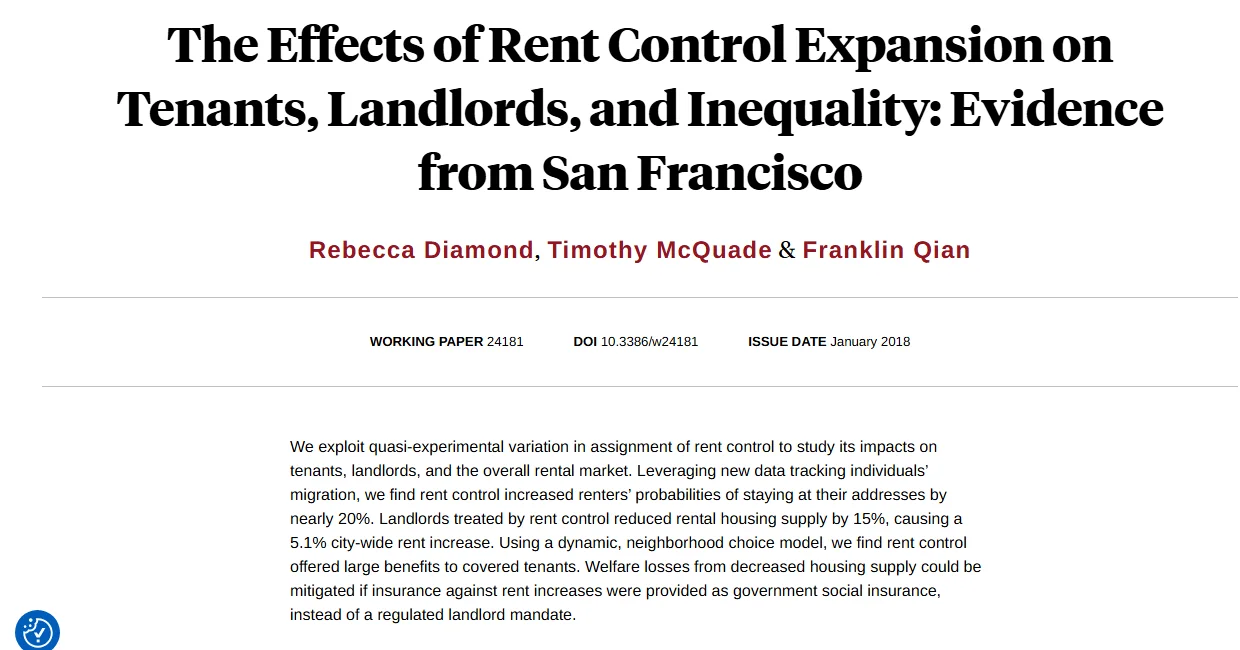
- Rebecca Diamond, Timothy McQuade and Franklin Qian, The Effects of Rent Control Expansion on Tenants, Landlords, and Inequality: Evidence from San Francisco, NBER Working Paper 24181 (January 2018); published in the American Economic Review 109(9), 2019. Nearly 20% more likely to stay, 15% supply cut, 5.1% citywide rent increase.
- David Autor, Christopher Palmer and Parag Pathak, Housing Market Spillovers: Evidence from the End of Rent Control in Cambridge, Massachusetts, NBER Working Paper 18125 (2012); Journal of Political Economy 122(3), 2014. About $1.8 billion added 1994 to 2004, more than half from never-controlled properties.
- Kenneth Ahern and Marco Giacoletti, Robbing Peter to Pay Paul? The Redistribution of Wealth Caused by Rent Control, NBER Working Paper 30083 (May 2022). St. Paul property values down 6 to 7%, $1.6 billion.
- Konstantin Kholodilin, "Rent control effects through the lens of empirical research: An almost complete review of the literature," Journal of Housing Economics 63 (2024), DIW Berlin listing; study counts as summarized by the Institute of Economic Affairs.
- Kent A. Clark Center for Global Markets (IGM Forum), Rent Control poll, February 7, 2012: 13 strongly disagree, 20 disagree, 3 uncertain, 1 agree, 1 no opinion, 3 did not answer.
Laws and current rules
- amNY, Rent Guidelines Board approves rent freeze, June 26, 2026: 7 to 1 vote, 0% on one- and two-year leases from Oct 1, 2026.
- WBUR (Gintautas Dumcius), Mass. high court strikes rent control ballot question, June 23, 2026.
- CalMatters, Prop 33 rent control results, November 2024.
- California Department of Justice, Landlord-tenant issues: Tenant Protection Act cap and 15-year exemption.
- Oregon Department of Administrative Services, Rent stabilization: 9.5% for 2026.
- Washington Attorney General, Know your rights consumer alert: 9.683% for 2026. NLIHC, Washington housing advocates secure statewide rent stabilization: 12-year new-construction exemption.
- Minnesota Reformer, St. Paul City Council passes sweeping overhaul of rent control ordinance, September 21, 2022.
- National Apartment Association, Rent control outlook, fall 2025 (industry group; used for the count of states that preempt local rent control).
Images
- Hero, San Francisco study and economists poll charts: rendered by Tensorust with the Proof Engine from the sources above.
- NBER paper page: screenshot of nber.org, captured October 24, 2026, to show the primary source.
Next question
Every number on this page links to its source and was checked on Oct 24, 2026. Spot an error or a newer figure? Email matt@tensorust.com and it gets fixed. Related: Check your own rent against HUD's numbers.
Read next
- Article · Oct 23, 2026New apartments cut local rent: what happens when supply finally arrives
- Explainer · Oct 24, 2026The Dodd-Frank Act, explained simply
- Explainer · Oct 24, 2026How much interest does the US pay on its debt per day?
Get the next one by email.
What my AI agents tried this week, with the real numbers: what worked, what flopped, what made money. One email when there is something worth reading.
No spam, never sold. Every email has a one-click unsubscribe.