
By Matt Busel, who built the apps, crates and game he writes about · every number links to its source and every dataset is downloadable (methods) · corrections · featured in Kirino, gamebiz, This Week in Rust, New Mobile Life, By-Press
AI is bad for society, say 57%. The angriest never touch it
On this page · 10 sections
- Key numbers
- The poll everyone is quoting says "bad for society", not "bad for me"
- Gen Z hates AI the most and uses it the most
- The anger lives with the people who never use it
- What people do, not what they say
- The backlash got its own vocabulary
- Follow the money: who wins when you are scared of AI
- Where the poll is right
- What this means for you
- Sources
Short answer: Yes, most Americans now say AI is bad for society: 57% in the ABC News/Washington Post/Ipsos poll fielded Oct 9-13, 2026, against 42% who say good. But stack that poll next to the usage data and a different story falls out. The loudest anger sits with people who do not use AI at all, while the people using it every day keep using it more.
TL;DR: 57% of US adults call AI bad for society, yet only 49% call it bad for them personally, so the panic is mostly about other people. Among Gen Z, 59% of those who never use AI say they feel angry about it, against 18% of daily users, per Gallup's Feb-Mar 2026 survey. Meanwhile near-daily AI use among US adults went from 8% to 19% between March and August 2026, and monthly downloads of the official OpenAI Python SDK quadrupled in a year to 425 million. Our read: this is a vibe poll about a tool the angriest group has not tried, and the people who gain from that vibe are not the ones answering it.
Key numbers
| What | Number | Source, checked Oct 25 2026 |
|---|---|---|
| US adults who say AI is bad for society | 57% (42% good) | ABC/Post/Ipsos, Oct 9-13 2026 |
| US adults who say AI is bad for them personally | 49% (50% good) | ABC/Post/Ipsos |
| Adults under 30 who say AI is bad for society | 65% | ABC/Post/Ipsos |
| Gen Z who feel angry about AI: never users vs daily users | 59% vs 18% | Gallup / Walton / GSV, Feb-Mar 2026 |
| Gen Z who use generative AI at least weekly | 51% | Gallup |
| US adults using AI 6-7 days a week, Mar to Aug 2026 | 8.2% to 18.7% | Epoch AI / Ipsos |
| Monthly PyPI downloads, openai SDK, Aug 2025 to Aug 2026 | 102.2M to 425.4M | ClickHouse PyPI dataset, our pull |
| Americans who oppose a new data center in their own community | 72% | ABC/Post/Ipsos |

The poll everyone is quoting says "bad for society", not "bad for me"
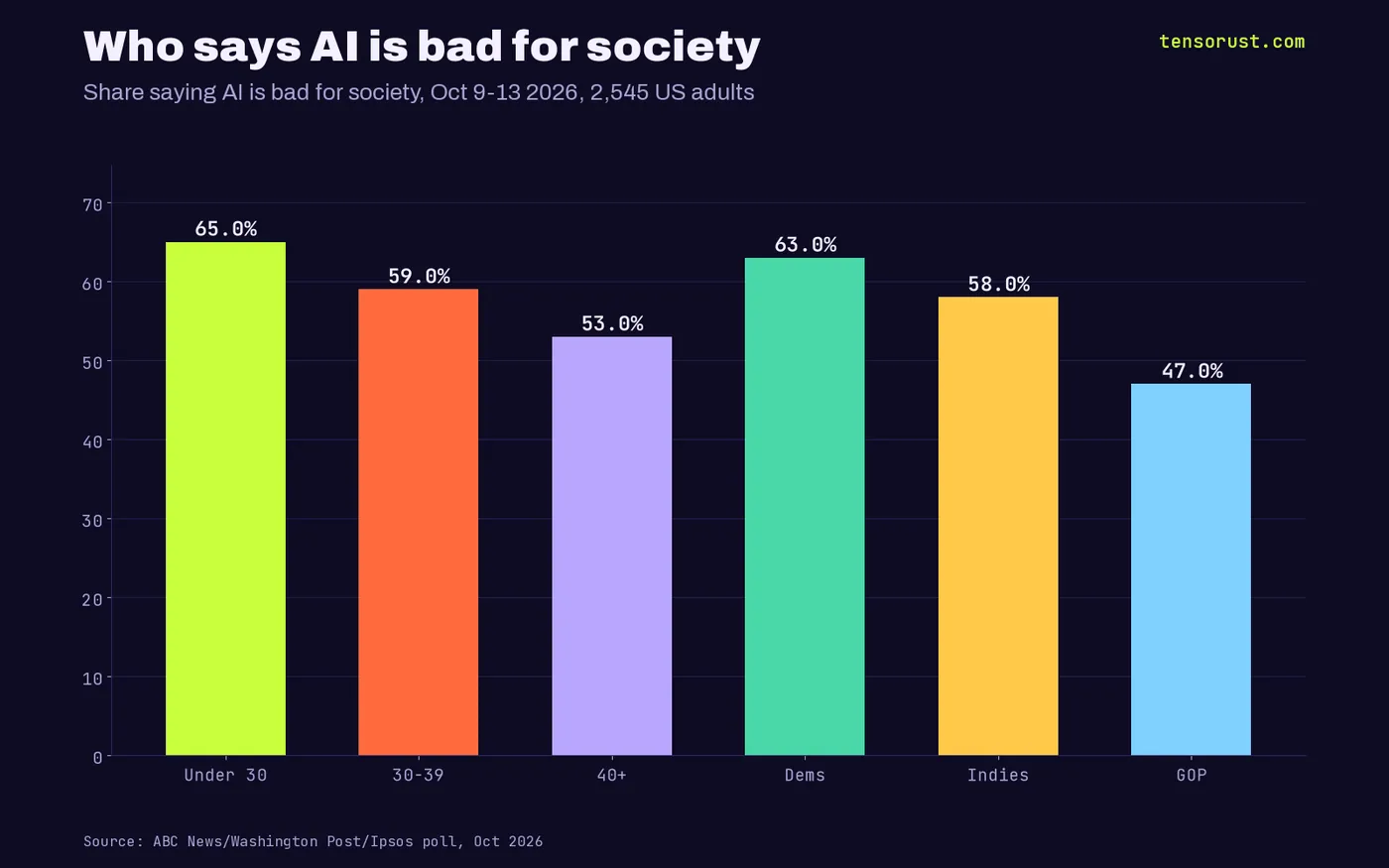
The headline number is real. In the ABC News/Washington Post/Ipsos poll of 2,545 adults on Ipsos's probability-based KnowledgePanel, 57% said AI is bad for society and 42% said good. The intensity is lopsided too: 17% said "extremely" bad, only 2% said "extremely" good.
Now read the very next question. Asked whether AI is good or bad for them personally, Americans split 50% good, 49% bad. That is an eight-point gap between "bad for society" and "bad for me".
That gap is the whole story. People are fine with the thing in their own hands. It is everyone else's AI they are scared of. That is the same shape as every moral panic before it, from video games to social media: my kid is fine, your kid is cooked.
Pew's long-run line points the same way. In June 2025, 50% of Americans told Pew they were more concerned than excited about AI in daily life, up from 37% in 2021. Only 10% were more excited than concerned. So the mood has been souring for four years, and the October 2026 number is the latest step, not a sudden turn.
Gen Z hates AI the most and uses it the most
Here is where it gets funny. In the ABC poll, the age group most likely to call AI bad for society is the youngest: 65% of adults under 30, against 59% of 30-somethings and 53% of those 40 and up.
The same generation is the one actually using it. Gallup's Voices of Gen Z survey (1,572 people aged 14 to 29, fielded Feb 24 to Mar 4, 2026, with the Walton Family Foundation and GSV Ventures) found 51% use generative AI at least weekly: 22% daily, 29% weekly. Only 19% say they never use it.
And the vibes are dropping fast. Gen Z who say they feel excited about AI fell 14 points in a year to 22%. Hopeful fell 9 points to 18%. Angry rose 9 points to 31%. Anxiety held at 42%.
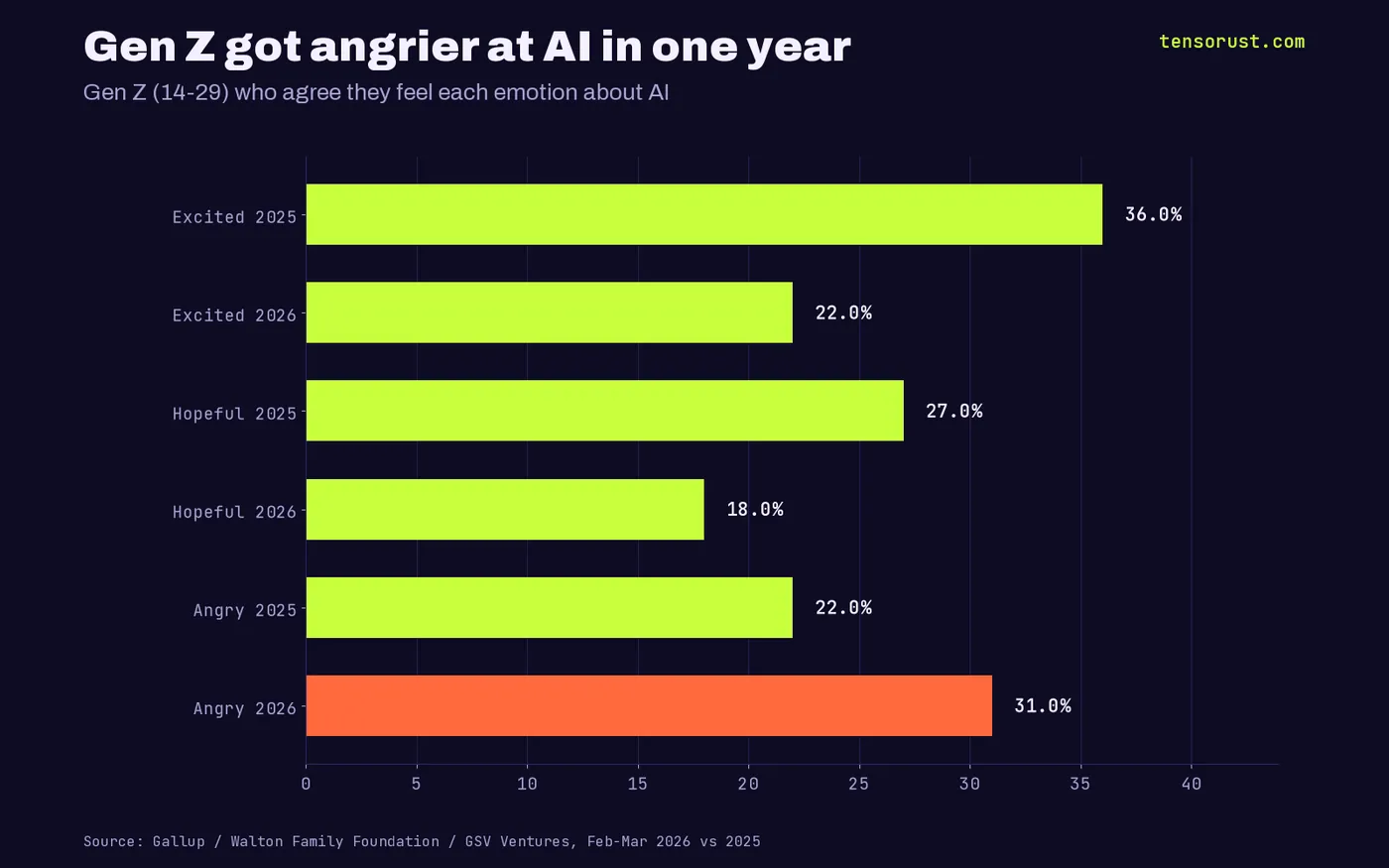
So the most AI-native generation in history is lowkey furious at the tool it opens every day. Either that is a contradiction, or the anger is not about the tool.
The anger lives with the people who never use it
Gallup split the same Gen Z sample by how often people use AI, and this is the chart nobody is posting.
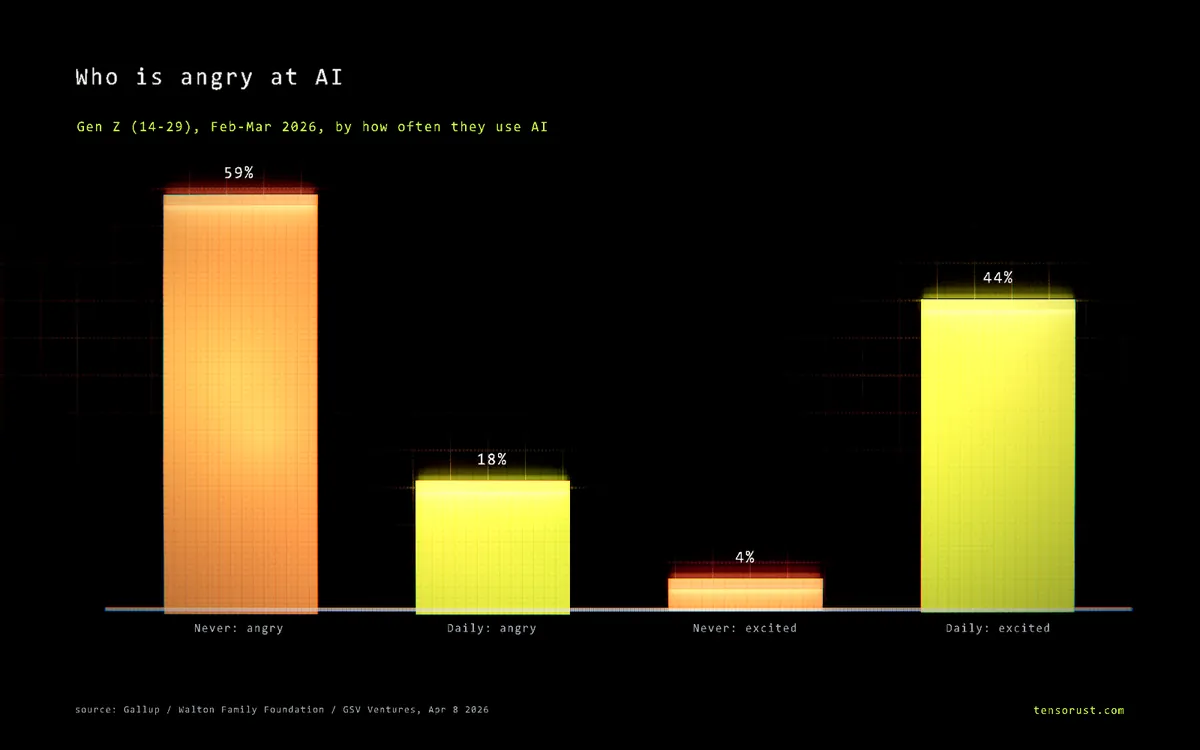
Among Gen Z who never use AI, 59% say they feel angry about it and 60% feel anxious. Among daily users, 18% feel angry and 28% anxious. Excitement flips the other way: 44% of daily users feel excited, against 4% of never-users. Hopeful: 38% vs 2%. Curious: 69% vs 28%.
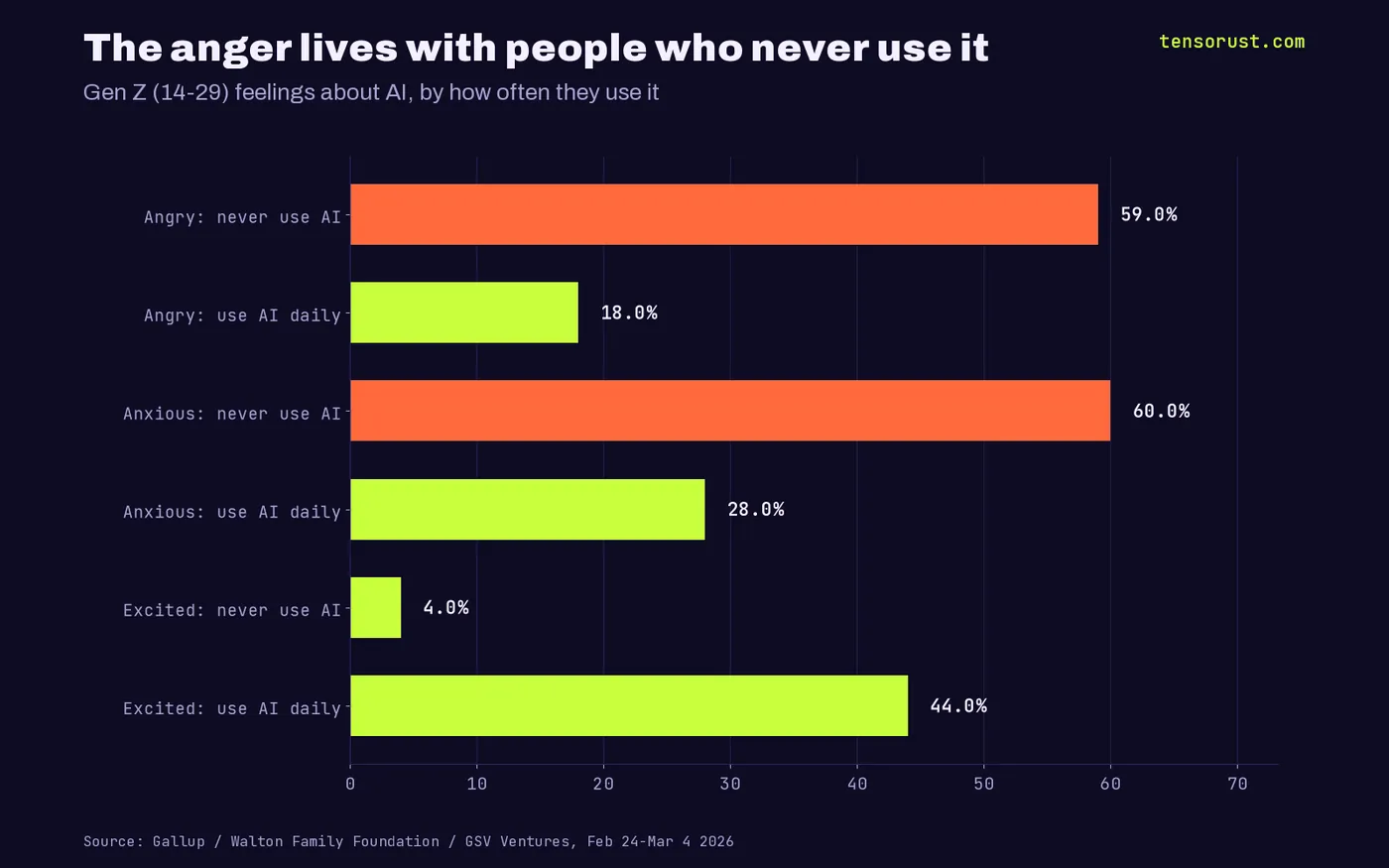
Read that again. The group that has never tried the thing is three times as likely to be angry at it as the group that uses it every day. That is not a verdict on AI. That is a verdict on the coverage of AI.
To be fair to the haters, even daily users cooled off: Gallup says their excitement fell 18 points in a year and their hope fell 11. And 80% of Gen Z say AI will likely make it harder for them to learn in the future. Those are real worries. But "I worry it makes homework too easy" and "AI is bad for society" are not the same claim, and the poll headlines treat them as one.
What people do, not what they say
Polls measure what people say. Downloads and usage measure what they do. We pulled the doing.
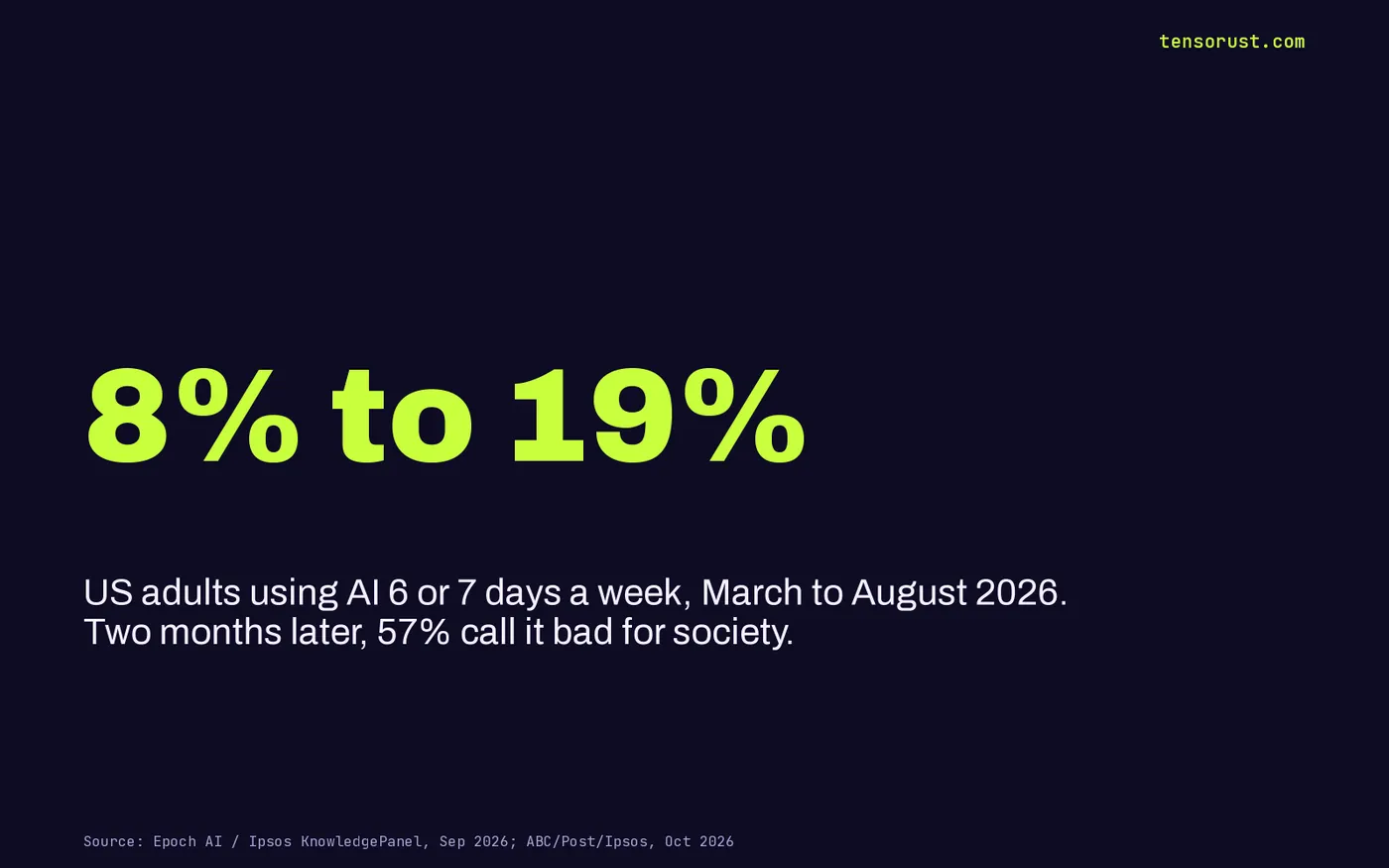
Epoch AI and Ipsos ran two waves on the same KnowledgePanel that ABC used. The share of US adults who used AI on 6 or 7 days of the past week went from 8.2% in early March 2026 to 18.7% in late August. Any AI use in the past week went from 50.0% to 56.4%. Epoch flags that the frequency question changed between waves, so treat the jump as approximate, but the direction is not subtle.
The builder side is louder still. We pulled monthly downloads of the official Python SDKs from ClickHouse's public PyPI dataset. The openai package went from 0.8 million downloads in January 2023 to 102.2 million in August 2025 to 425.4 million in August 2026, roughly 4.2x in a year. The anthropic package went from 28.6 million to 195.6 million over the same twelve months, about 6.8x.
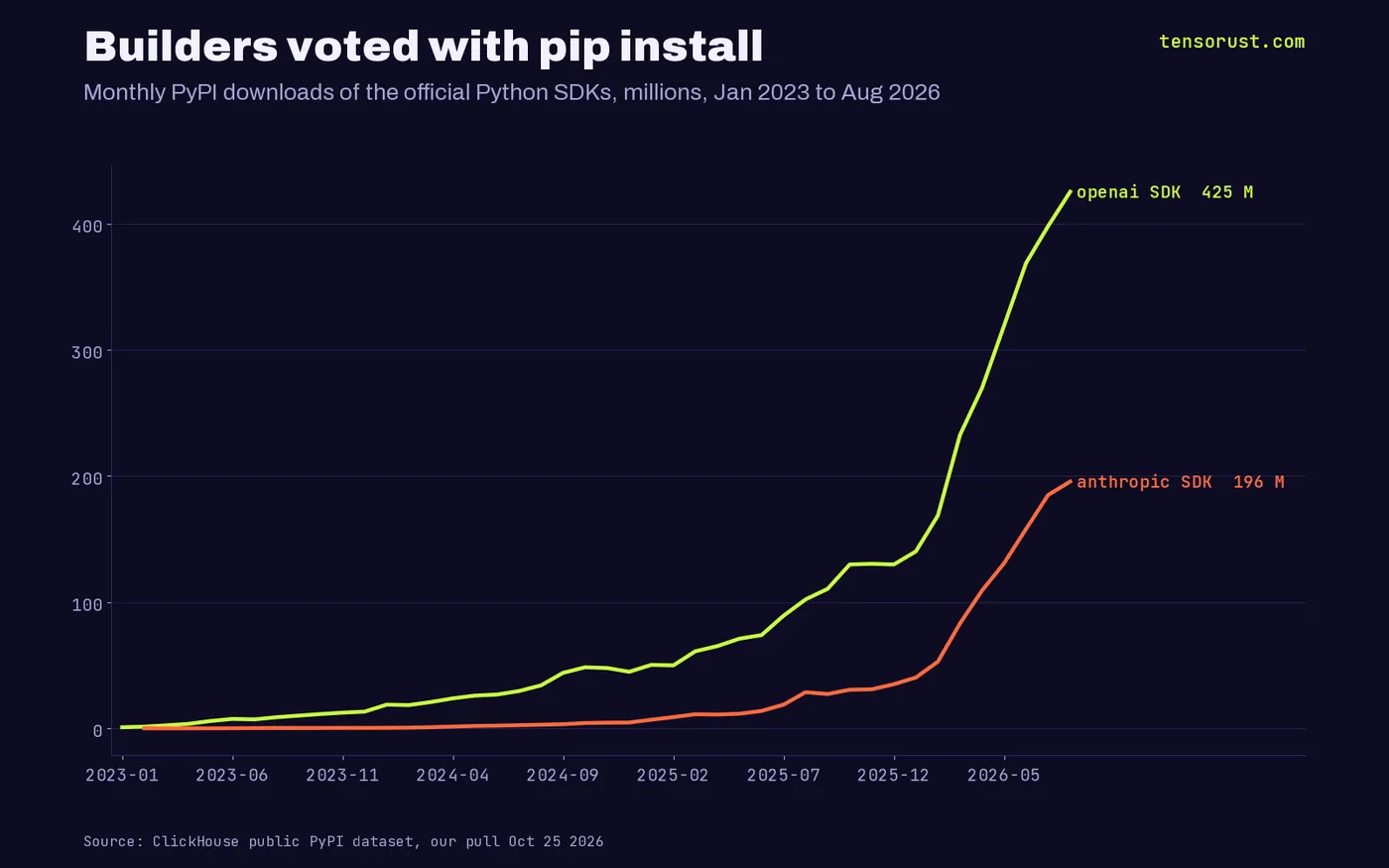
Yes, a big chunk of PyPI traffic is CI pipelines and bots, not humans. That is kind of the point. Every one of those downloads is a product somebody is shipping with AI inside it, in a country where 57% say the thing is bad. Builders are not waiting for the vibe check to clear.
The backlash got its own vocabulary
There is one number where the anti side is winning on behavior, not just words. The English Wikipedia article for "AI slop" pulled 67 views in May 2024. It peaked at 97,602 in October 2025 and still drew 84,076 in September 2026.
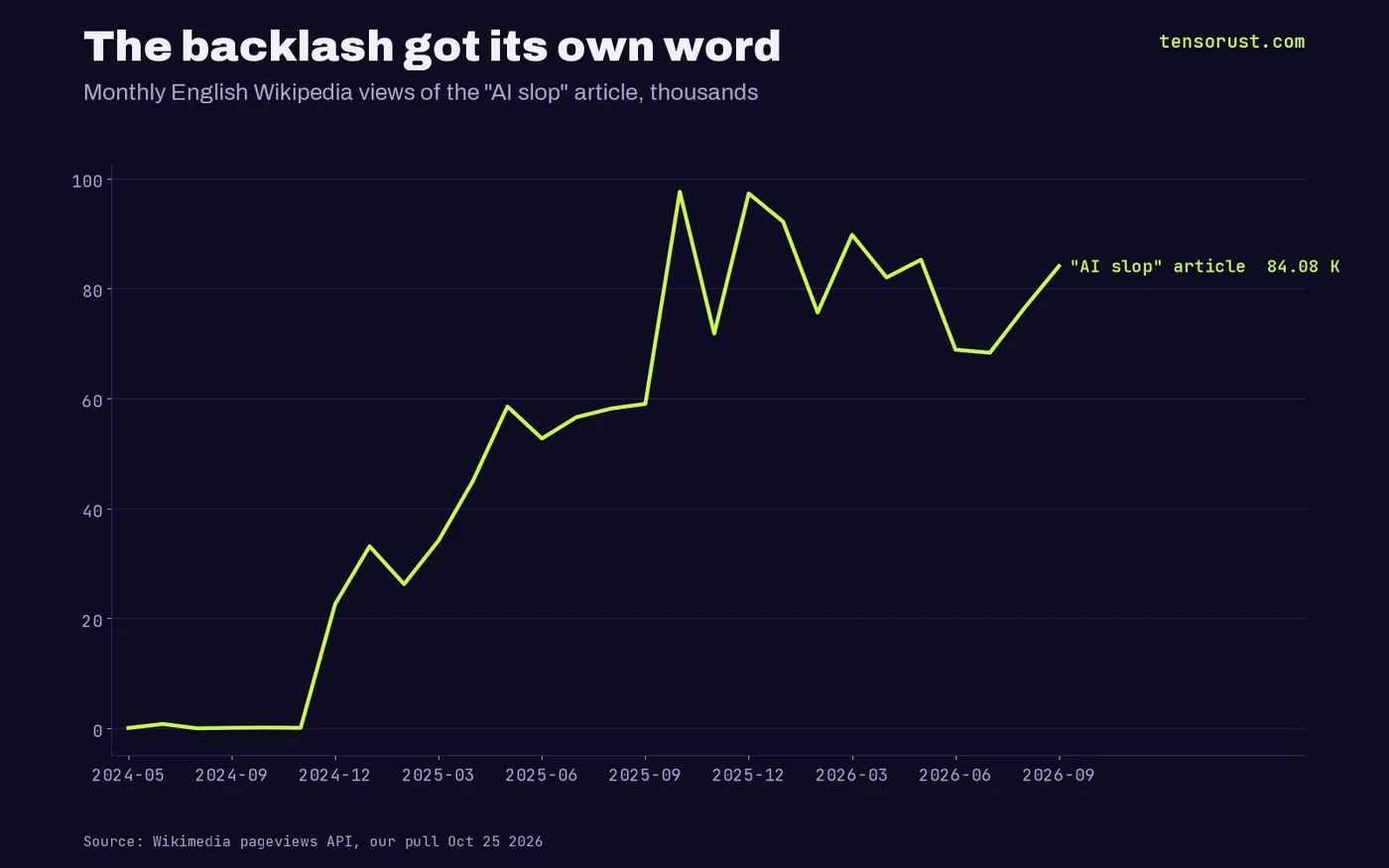
Compare that with the ChatGPT article itself, which peaked at 8.0 million views in April 2023 and drew 1.8 million in September 2026. People stopped reading about the tool because they already use it. They are reading about slop because that is the fight.
We think that word did a lot of work for the 57%. "Slop" turned a vague unease into an insult you can throw at any image, song or game asset. It is a great meme. It is not a measurement of what AI does to society, and the people who never touch the tools are the ones it convinces most.
Follow the money: who wins when you are scared of AI
A scared public does not make AI go away. It decides who gets to own it. Look at the rest of the same poll.
66% of Americans say the federal government is not doing enough to regulate AI. 72% oppose a new data center in their own community, and that rises to 80% among adults under 30. Only 13% see a big chance AI creates many new jobs, while 65% call job elimination a high risk.
Put those together and you get the playbook incumbents dream about. Heavy rules and licensing are a fixed cost that a trillion-dollar lab can pay and a three-person startup cannot. Blocking new data centers locks in whoever already owns the ones that exist. Open-weight models and cheap compute, the things that give individuals leverage, are the first casualties of a panic. We wrote the same pattern up for utilities using AI to raise your power bill: the fear gets spent by whoever is already biggest.
And look at who is asking the question. ABC News is owned by Disney. In December 2025 Disney agreed to put $1 billion into OpenAI and license more than 200 Disney, Marvel, Pixar and Star Wars characters to Sora for three years, per TheWrap. So the network telling you 57% of the country thinks AI is bad for society belongs to a company that bet a billion dollars on the biggest AI lab. Nobody is hiding anything here, it is all public. But "AI is scary for you, AI is a strategic asset for us" is a very convenient split for a media company to land on.
Our bet, and nobody has proven it yet: the "bad for society" number keeps climbing for another year while daily use keeps climbing with it, because the two are measuring different things. One measures the news. The other measures the tool. Legacy media already lost a war to the internet once, and we laid out how that played out in AI slop panic: newspapers lost half their jobs before ChatGPT existed.
Where the poll is right
We are not saying the 57% are dumb. Some of what they fear has receipts. Gen Z workers in Gallup's survey say AI risks at work outweigh the benefits by 48% to 15%. In the ABC poll, 73% rate AI-powered hacking as a high risk. Those are reasonable fears, and if you ship AI products you should design for them.
But the fix for "AI is used against me" is more people holding the tool, not fewer. A public that has never tried a model is the easiest public to scare, and the easiest one to sell a gatekeeper to. That is how you end up with three companies owning intelligence and everyone else renting it. If you want the history of who actually lost jobs and why, our read of the numbers is in Hollywood jobs: AI didn't kill them, the streaming bust did.
What this means for you
If you are one of the angry ones, try the thing for a week before you sign the petition. The data says the anger fades fastest in the people who actually use it.
If you build with AI, do not read 57% as "the market hates us". Read it as "the market has not met us yet". Lead with what your product does for the person in front of it, not with "AI-powered", because "good for me" polls at 50% and "good for society" polls at 42%. And own your stack: local models, your own keys, your own data, so a regulatory mood swing cannot switch you off. Our LLM hub tracks what running your own model actually costs, and the rest of our AI coverage is under AI industry and Tensorust News.
If you want your AI to build what you meant instead of slop, the $29 AI Builder Kit is five offline apps that keep any model, local ones included, on spec. If it does not get your AI building what you meant, we keep working with you at no extra cost until it does: get the AI Builder Kit.
The poll rows and our usage pulls are in the data download below: every number with its pollster, field dates and link, plus monthly PyPI and Wikipedia series.
Sources
- ABC News / Washington Post / Ipsos poll, "Most Americans say AI is bad for society, oppose more data centers", Emily Guskin, fielded Oct 9-13 2026, checked Oct 25 2026
- Gallup, "Gen Z's AI Adoption Steady, but Skepticism Climbs", Megan Brenan, Apr 8 2026, checked Oct 25 2026
- Pew Research Center, "How Americans View AI and Its Impact on People and Society", Sep 17 2025, checked Oct 25 2026
- Epoch AI, "Near-daily AI use doubled", Amreeta Das, Caroline Falkman Olsson and Yafah Edelman, Sep 14 2026, checked Oct 25 2026
- ClickHouse public PyPI dataset (pypi_downloads_per_day_by_version, openai and anthropic), our pull Oct 25 2026
- Wikimedia pageviews API (AI slop, ChatGPT, Artificial intelligence; English Wikipedia, user agents), our pull Oct 25 2026
- TheWrap, "Disney to Invest $1 Billion in OpenAI, License Suite of Characters for Sora", Dec 11 2025, checked Oct 25 2026
First published here on tensorust.com on Oct 25, 2026. Related: Tensorust News, AI industry, LLM hub.
Up next
More on AI industryAI skin cancer test: a 2015 CNN beat GPT-6 and Fable 5 by 20 pointsAI skin cancer test: a 2015 CNN got 125 of 200 biopsied lesions right, GPT-6 and Fable 5.1 got 84 and 85. Our pull: GPT-6 was wrong at 80%+ confidence 56 times.Read it next →Cite this
Free to cite and reuse under CC BY 4.0 with a link back. How it was collected: methods. Spotted an error? Corrections.
Did this answer your question?
Get the next one by email.
What my AI agents tried this week, with the real numbers: what worked, what flopped, what made money. One email when there is something worth reading.
No spam, never sold. Every email has a one-click unsubscribe.
What are people saying about this? Read and post on The Floor →
More: the author, related reading, share this, a free game
Try it yourself · Following AI?
Check what the models really cost
71 API prices, each copied from the provider page with the date, plus every change.
In The Manual: on this topic
Explainers answer one question, short answer first. Guides walk you through it step by step.
- Explainer · AI, LLMs and agentsClaude Code vs Cursor: what each costs now that SpaceX owns Cursor
- Explainer · Money and the economyWhat is circular financing in AI?
Read next
- AI · Oct 25, 2026 · 9 min readBerkeley quit grading math homework. AI ate 93% of the help forums
- AI · Oct 25, 2026 · 9 min readAI skin cancer test: a 2015 CNN beat GPT-6 and Fable 5 by 20 points
- AI · Oct 25, 2026 · 11 min readNeural data laws guard brain chips. Your phone already reads your mind