By Matt Busel, who built the apps, crates and game he writes about · every number links to its source and every dataset is downloadable (methods) · corrections · featured in Kirino, gamebiz, This Week in Rust, New Mobile Life, By-Press
The Fed is the real AI regulator: rates, not bills, picked who builds
On this page · 9 sections
- Key numbers
- The rate hike was an AI law, it just was not labelled one
- Follow the money: the giants never needed the door
- Who benefits from arguing about safety bills instead
- The cascade nobody filmed
- The steelman, and why it does not change the outcome
- How builders win when money is expensive
- What this means for you
- Sources
Short answer: The most powerful AI policy of the decade was never voted on. When the Federal Reserve took the effective fed funds rate from 0.08% in January 2022 to 4.33% by January 2023, US operating-company IPOs fell from 311 to 38, while five cash-rich giants kept raising capital spending and hit $411.5B in 2025. The price of money picked the AI winners before any safety bill got a hearing.
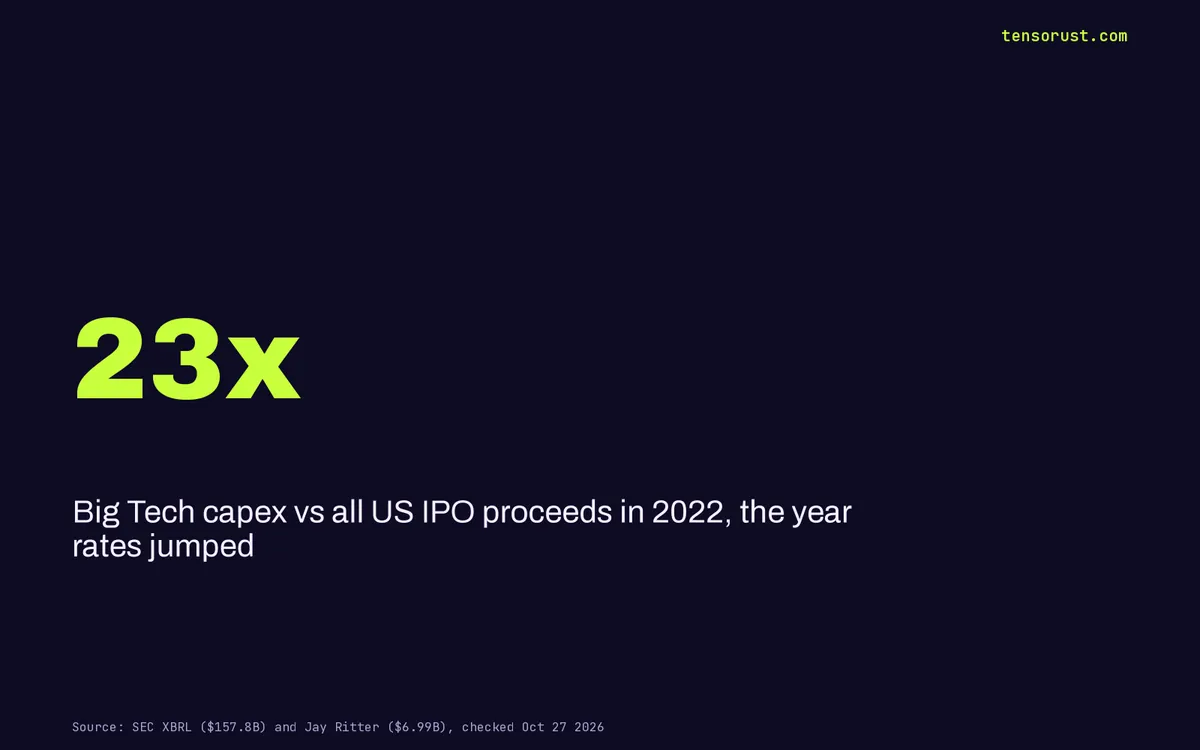
TL;DR: In 2022 every newcomer that went public in the US raised $6.99B combined, and Microsoft, Alphabet, Amazon, Meta and Oracle spent $157.8B on capex, about 23 times more. Those five generated $602.8B of operating cash in 2025, so they never needed the market the rate hikes closed. The fight over AI safety laws is the show; the rate path is the policy, and builders beat it by needing as little outside money as possible.
Key numbers
| What | Number | Source, checked Oct 27 2026 |
|---|---|---|
| Effective fed funds rate, Jan 2022 vs Jan 2023 | 0.08% to 4.33% | FRED FEDFUNDS |
| US operating-company IPOs, 2021 vs 2022 | 311 to 38 (minus 88%) | Jay Ritter, IPO Statistics |
| US IPO proceeds, 2021 vs 2022 | $119.36B to $6.99B | Jay Ritter, IPO Statistics |
| Capex of MSFT, GOOGL, AMZN, META, ORCL, 2022 | $157.8B | SEC XBRL filings |
| Same five, capex 2025 | $411.5B | SEC XBRL filings |
| Same five, operating cash flow 2025 | $602.8B | SEC XBRL filings |
| 10-year Treasury yield, Oct 23 2026 | 5.00% | FRED DGS10 |

The rate hike was an AI law, it just was not labelled one
Washington spent three years arguing about AI bills, model licenses and safety institutes. Meanwhile the one lever that actually decided who could afford to build AI moved without a single AI hearing.
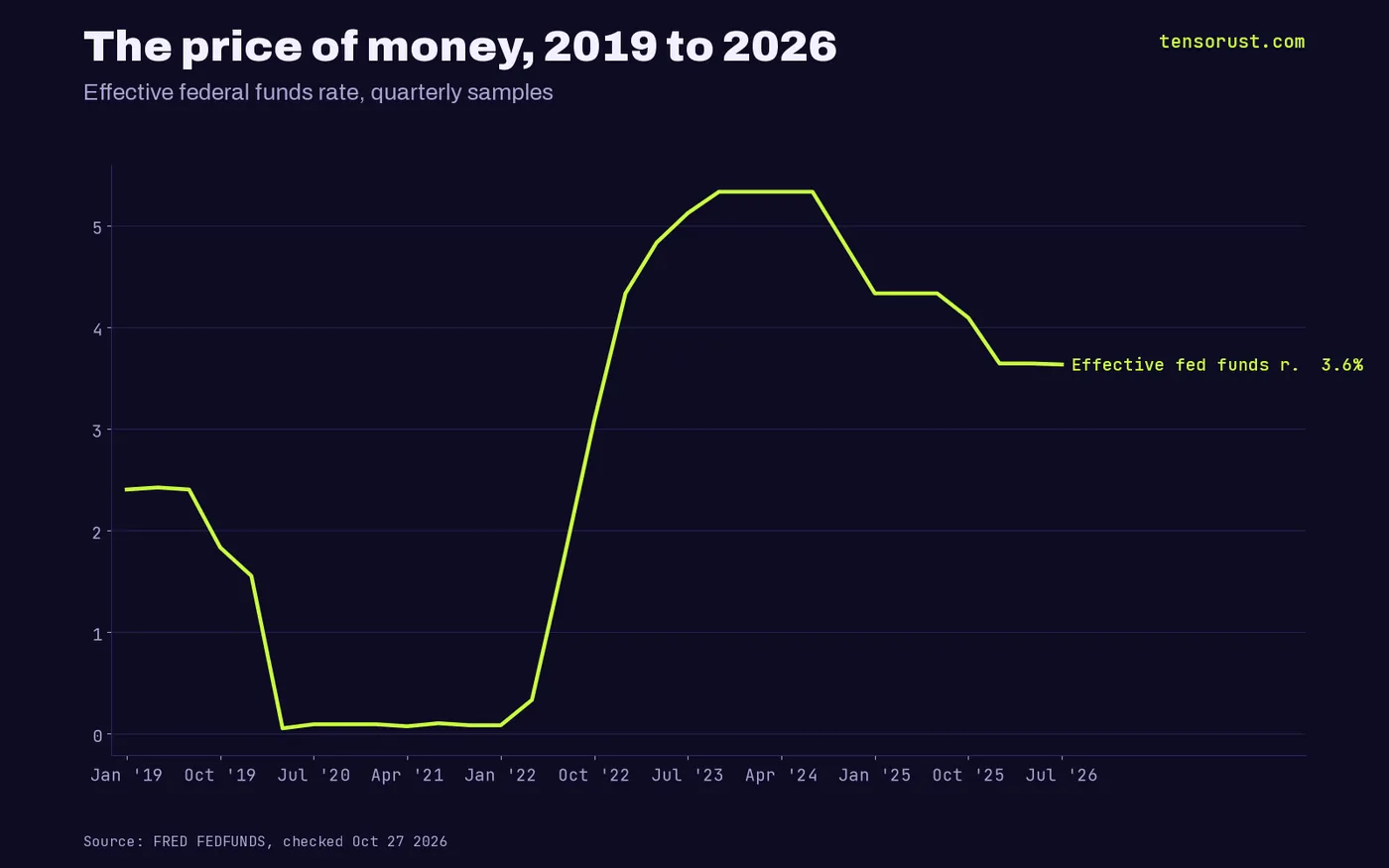
The effective fed funds rate sat at 0.08% in January 2022. By January 2023 it was 4.33%, and it held at 5.33% through mid 2024, per FRED. That is the rate that sets what every startup loan, venture fund return target and IPO valuation is measured against.
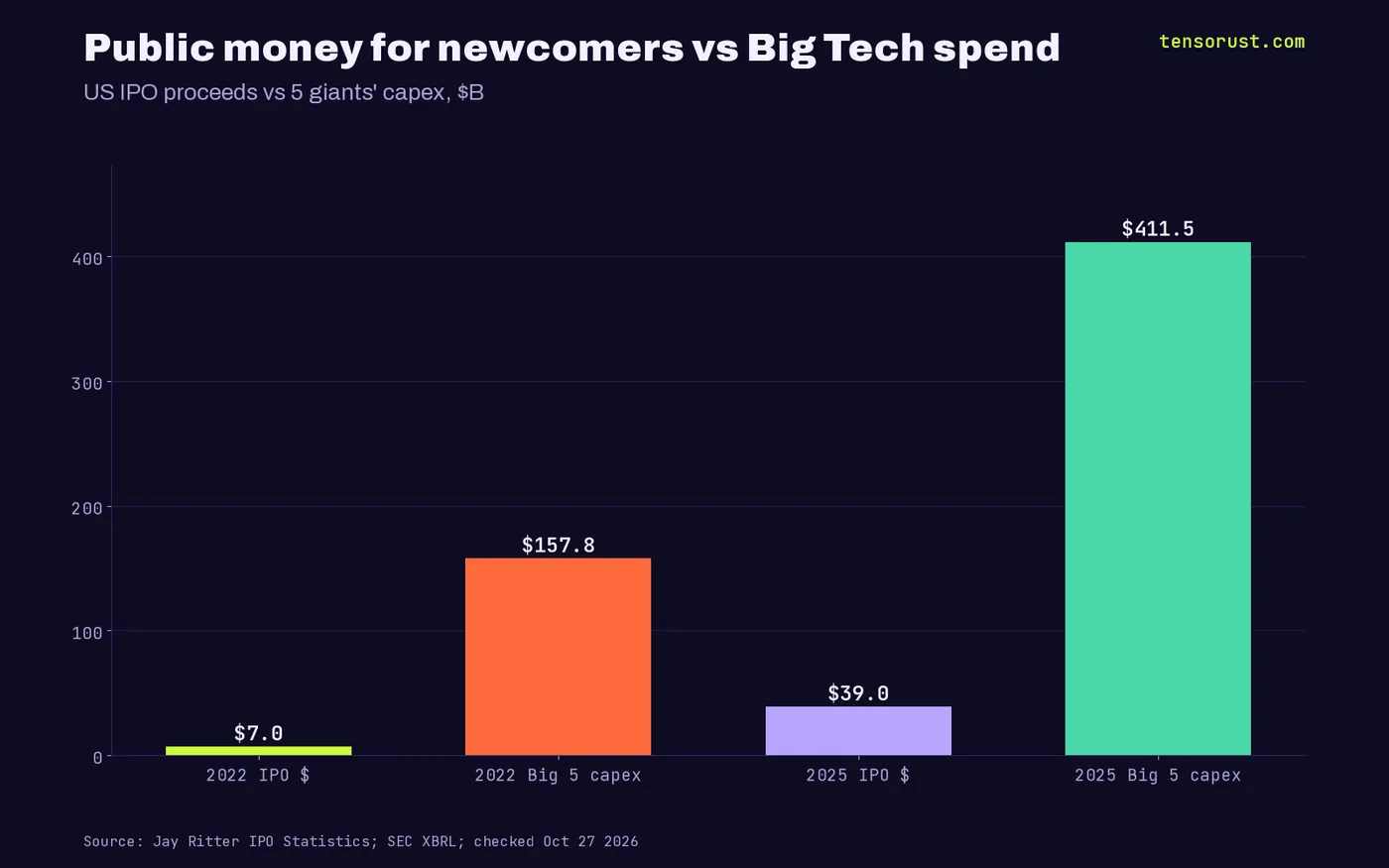
The effect on newcomers was instant. Jay Ritter's IPO data, the dataset finance professors use, counts 311 operating-company IPOs in 2021 and 38 in 2022. Proceeds went from $119.36B to $6.99B. The public door for new companies did not narrow, it shut.
Follow the money: the giants never needed the door
Here is the part nobody puts next to the rate chart. We summed the quarterly capex and operating cash flow of Microsoft, Alphabet, Amazon, Meta and Oracle straight from their SEC XBRL filings (the data is in the download below).
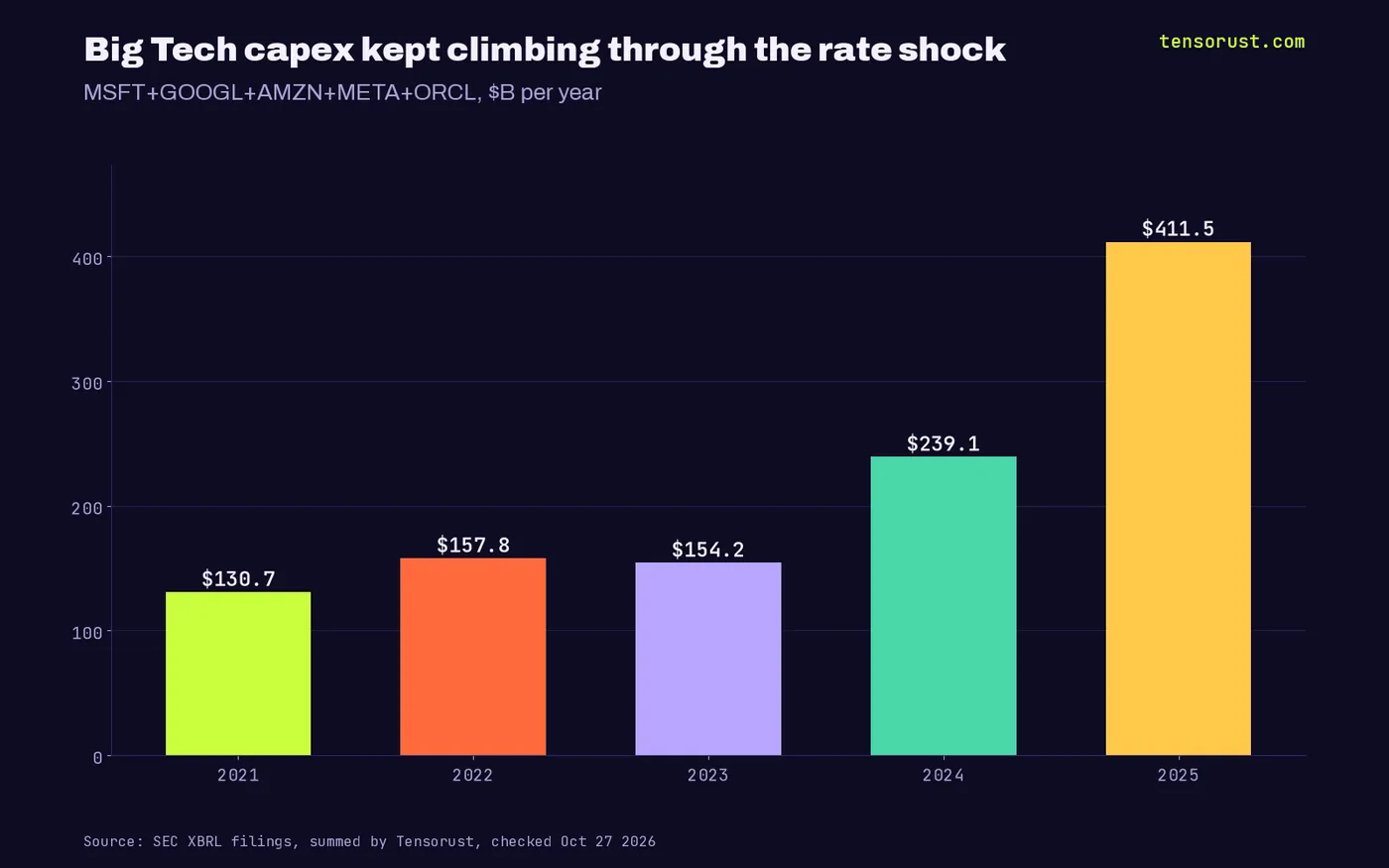
Their capex was $130.7B in 2021 and $157.8B in 2022, the year rates jumped. It dipped to $154.2B in 2023, then went to $239.1B in 2024 and $411.5B in 2025. Operating cash flow rose from $289.8B to $602.8B over the same years.
So the rate shock hit the two groups completely differently. A startup that needed outside money met a closed IPO window and repriced venture rounds. A giant that throws off hundreds of billions in cash paid for GPUs out of its own pocket. Same Fed, same rate, opposite outcome.
Who benefits from arguing about safety bills instead
Look at where the attention went. Safety bills, export rules and copyright suits are fights the incumbents can afford to win on any timeline, and we have tracked that pattern in how the AI safety push protects closed models. The rate path never gets that scrutiny because it looks like macroeconomics, not tech policy.
That is the hidden-in-plain-sight part. The mainstream frame says AI is regulated, or not, by Congress. The numbers say AI was regulated in 2022 by the price of money, and the regulation favored whoever already had cash. In 2022 the five giants spent about 23 times what every newly listed US company raised combined.
Our reading, which nobody has proven: the incumbents have no reason to fight this kind of regulation, because it fences off the market for them without a lobbying dollar. A safety law can be challenged in court. A high cost of capital cannot.
The cascade nobody filmed
The rate story has no villain on camera, which is why it works. No company was banned and no model was blocked. Founders simply found that the public market that bought 311 new companies in 2021 bought 38 in 2022, and every private round behind them was priced off that.
That is how a policy decides an industry without anyone noticing: the companies that would have competed just never show up in the data. You cannot count the labs that were not founded, but you can count the IPOs that did not happen, and that number is 273 fewer in 2022 than in 2021.
The steelman, and why it does not change the outcome
The best case for the Fed is simple: it raised rates to kill inflation, not startups, and it has no mandate to pick tech winners. That is true about intent.
It does not change the result. A policy that makes outside capital expensive is, by its arithmetic, a policy that favors whoever does not need outside capital. And the pressure is not over: the 10-year Treasury yield was 5.00% on October 23 2026 per FRED, even with the fed funds rate down to 3.75% in September. Long money is still expensive, and long money is what pays for data centers.
The quiet twist is in the 2025 numbers. IPOs crept back to 90 and $38.97B, and the five giants' capex was still about 10.6 times that. The window reopened, and the gap got wider anyway.

How builders win when money is expensive
If the rate is the gate, the move is to stop standing at the gate. The builders who did best since 2022 needed the least outside money: local and open-weight models instead of renting frontier APIs at scale, rented GPUs at falling prices (see our H100 rental price tracking), and revenue from day one instead of a valuation story.
That is not fatalism, it is a strategy. Every dollar of revenue you earn is a dollar the Fed cannot price you out of. Cheap compute plus open models means a small team can now ship what needed a funded lab in 2021.
And watch the rate like a product spec. When the 10-year moves, your competitors' runway moves with it. We put the bond market next to the AI boom in our 2008 comparison, and more on the opinion desk and the economics hub.
What this means for you
Do one thing today: download the data below, put the fed funds rate next to your own burn and runway, and work out how many months of compute your revenue already pays for. If the answer is zero, that is your first project, not your next round. This is not financial advice.
If you want the filings watched for you, Company Watch ($99/mo) watches the SEC filings, federal contracts and lobbying records of the companies you compete with or sell to and flags every change, so the numbers stay verified as conditions change. We keep fixing it at no extra cost until it does what it promises.
Sources
- Federal Reserve Bank of St. Louis, FRED, Effective Federal Funds Rate (FEDFUNDS), checked Oct 27 2026
- FRED, 10-Year Treasury Constant Maturity (DGS10), checked Oct 27 2026
- Jay R. Ritter, University of Florida, Initial Public Offerings: Updated Statistics, Oct 5 2026 edition, checked Oct 27 2026
- SEC EDGAR XBRL company facts for Microsoft, Alphabet, Amazon, Meta and Oracle (capex and operating cash flow), checked Oct 27 2026
First published here on tensorust.com on Oct 27, 2026. Related: Opinion, Economics.
Up next
More on OpinionAI data center water panic: US home leaks waste 53x moreUS data centers drank 17B gallons directly in 2023. Home leaks waste 900B, golf used 606B. The AI water panic is the cheapest misdirection in tech.Read it next →Cite this
Free to cite and reuse under CC BY 4.0 with a link back. How it was collected: methods. Spotted an error? Corrections.
Did this answer your question?
Get the next one by email.
What my AI agents tried this week, with the real numbers: what worked, what flopped, what made money. One email when there is something worth reading.
No spam, never sold. Every email has a one-click unsubscribe.
What are people saying about this? Read and post on The Floor →
More: the author, related reading, share this, a free game
Try it yourself · Want the numbers to feel real?
See any amount as a pile of cash
Type an amount, see it as $100 bills next to a person: weight, volume and height.
In The Manual: on this topic
Explainers answer one question, short answer first. Guides walk you through it step by step.
- Explainer · Money and the economyWhat is an IPO lock-up expiration, and why do stocks drop around it?
- Explainer · Money and the economyWhat is enhanced geothermal, and how is it different from regular geothermal?
- Explainer · Money and the economyWhat is a stock warrant? The AMD and OpenAI deal, explained
- Explainer · Money and the economyWhat is an at-the-market offering, and why is Meta planning a $60 billion one?
Read next
- Economics · Oct 26, 2026 · 5 min readAI data center water panic: US home leaks waste 53x more
- Economics · Oct 26, 2026 · 7 min readRealtor commission: NAR's lobby money says AI agents are the threat
- Economics · Oct 26, 2026 · 9 min readPrediction markets are more honest than the news: 92% right a week out