By Matt Busel, who built the apps, crates and game he writes about · every number links to its source and every dataset is downloadable (methods) · corrections · featured in Kirino, gamebiz, This Week in Rust, New Mobile Life, By-Press
Anthropic S-1: $11.6B quarter, first profit, founders keep 50.1%
On this page · 9 sections
- Key numbers
- A revenue line steeper than anything we have read in an S-1
- Revenue finally outran the compute bill
- The $80 billion loss is mostly the stock going up
- Follow the money: who funded this, and who gets paid
- Who controls Anthropic after the IPO
- Does the S-1 back our "safety is a moat" call?
- What this means for you
- Sources
Short answer: Anthropic filed its S-1 on October 26, 2026 to list Class A shares on Nasdaq as "ANT". The filing shows revenue of $11.56 billion in the June 2026 quarter, up 1,368% in a year, and the first quarterly operating profit in the company's history ($974 million). Public buyers get the economics, but the seven co-founders hold a single Class F share fixed at 50.1% of every stockholder vote, and a trust elects the majority of the board.
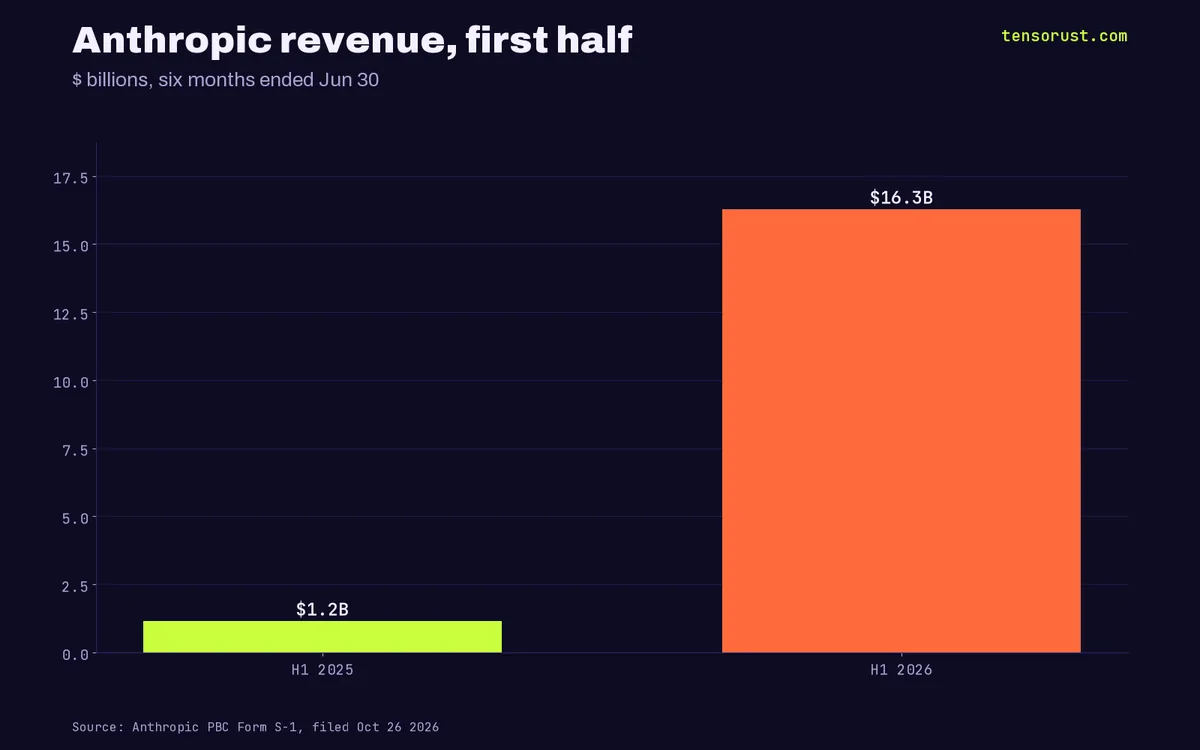
TL;DR: Revenue went from $41 million in 2023 to $4.59 billion in 2025 to $16.29 billion in just the first half of 2026. The headline net loss for that half is $80.7 billion, but $72.4 billion of it is a paper charge from revaluing convertible notes and SAFEs as the company's own valuation climbed; operating cash flow flipped to plus $3.93 billion. Amazon holds $6.2 billion of notes that convert at $2.09 and $5.05 a share into non-voting stock, capped at 12% of the company, so the IPO price will tell you how much of the upside already belongs to the cloud landlords.
Key numbers
| What | Number | Source, checked Oct 26 2026 |
|---|---|---|
| Revenue, Q2 2026 (three months to Jun 30) | $11.56B, up 1,368% year over year | Anthropic S-1 |
| Revenue, 2023 / 2024 / 2025 | $41M / $386M / $4.59B | S-1, summary financial data |
| Revenue, H1 2026 vs H1 2025 | $16.29B vs $1.16B (14x) | S-1, summary financial data |
| Operating income, Q2 2026 | $974M (first positive quarter) | S-1, quarterly results |
| Net loss, H1 2026 | $80.7B, of which $72.4B is note/SAFE revaluation | S-1, summary financial data |
| Compute and infrastructure, H1 2026 | $8.95B (55% of revenue) | S-1, summary financial data |
| Operating cash flow, H1 2026 | +$3.93B (vs -$1.51B in H1 2025) | S-1, cash flows |
| Cash and short-term investments, Jun 30 2026 | $131.65B | S-1, balance sheet |
| Founders' Class F voting power | Fixed 50.1% | S-1, voting rights |
| Amazon convertible notes outstanding | $6.20B, 1.84B Class N shares, 12% cap | S-1, convertible notes |
| Customers paying $100K+ a year | 11,900+ (vs 950+ a year earlier) | S-1, business |

A revenue line steeper than anything we have read in an S-1
Anthropic's own words: "the fastest enterprise adoption of any technology in history." The table backs the brag. Quarterly revenue went $376 million, $787 million, $1.38 billion, $2.04 billion, $4.73 billion, then $11.56 billion in the June 2026 quarter.
That last step is 144% growth in one quarter, at a $46 billion annualized pace. The S-1 leaves the September quarter revenue blank for now; it will be filled in an amendment before the roadshow.
Concentration is falling, not rising. About 79% of Q3 revenue came from outside the top five customers, up from about 64% in Q1, and no customer was more than 10% of revenue for the nine months. The count of customers paying $100,000 or more a year went from about 950 to more than 11,900 in twelve months.
There is one fragility the filing states plainly: model versions released in the six months to September 30 made up over 80% of Q3 revenue. The business is a treadmill. Ship a better model every few months, or the revenue walks to whoever did.
Revenue finally outran the compute bill
This is the number that decides whether frontier AI is a business or a subsidy. In Q1 2025, Anthropic spent $944 million on compute and infrastructure to earn $376 million. In Q2 2026, it spent $5.56 billion to earn $11.56 billion.
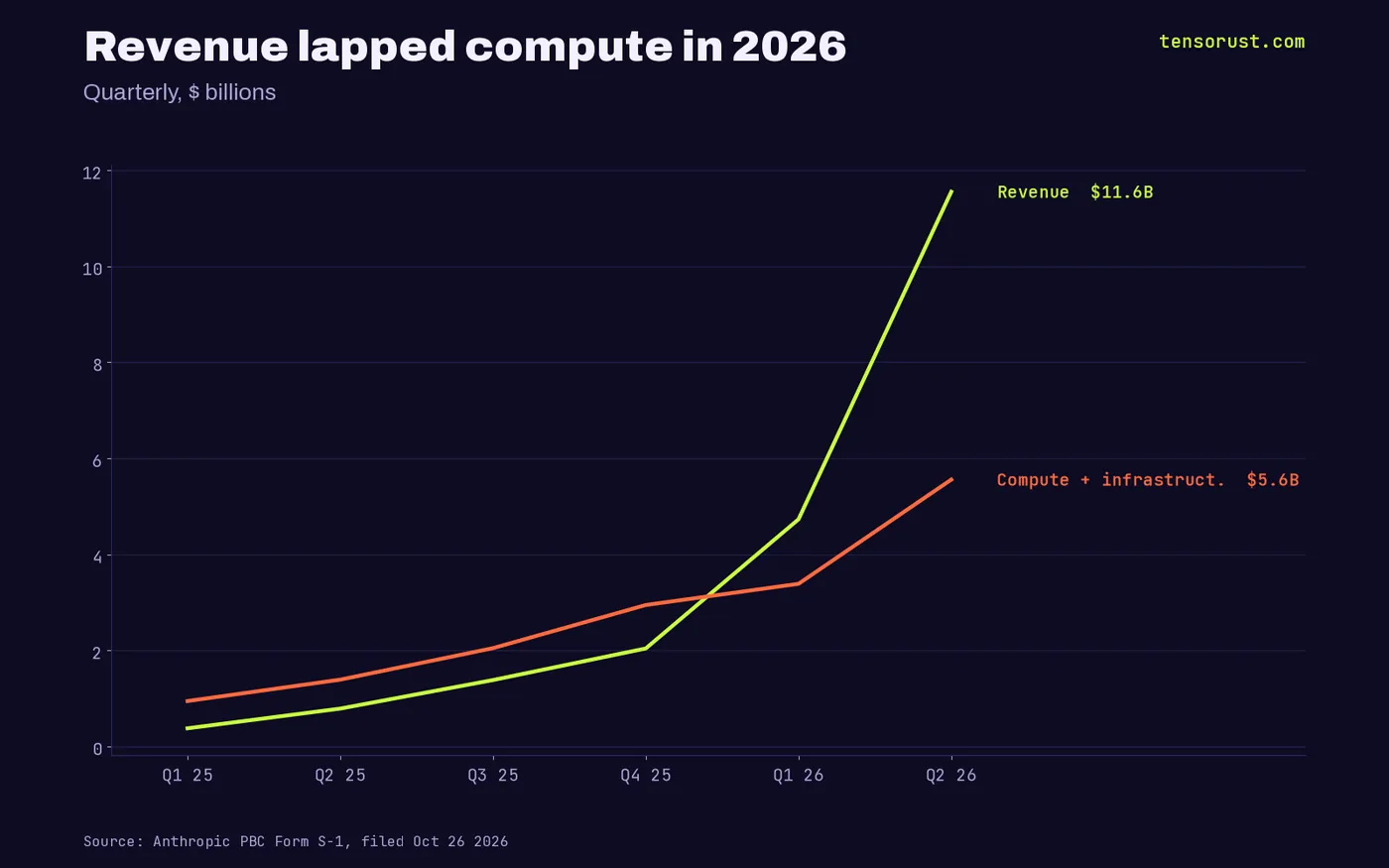
The S-1 frames it as "revenue per dollar of compute": revenue up 1,368% against compute expense up 300% in the same year. Compute fell from 251% of revenue to 48%. The company also says Claude Opus 5.5 cut customer cost per task by about 40% versus Opus 5 while "preserving our margins." Cheaper per task, more tasks, fatter spread.
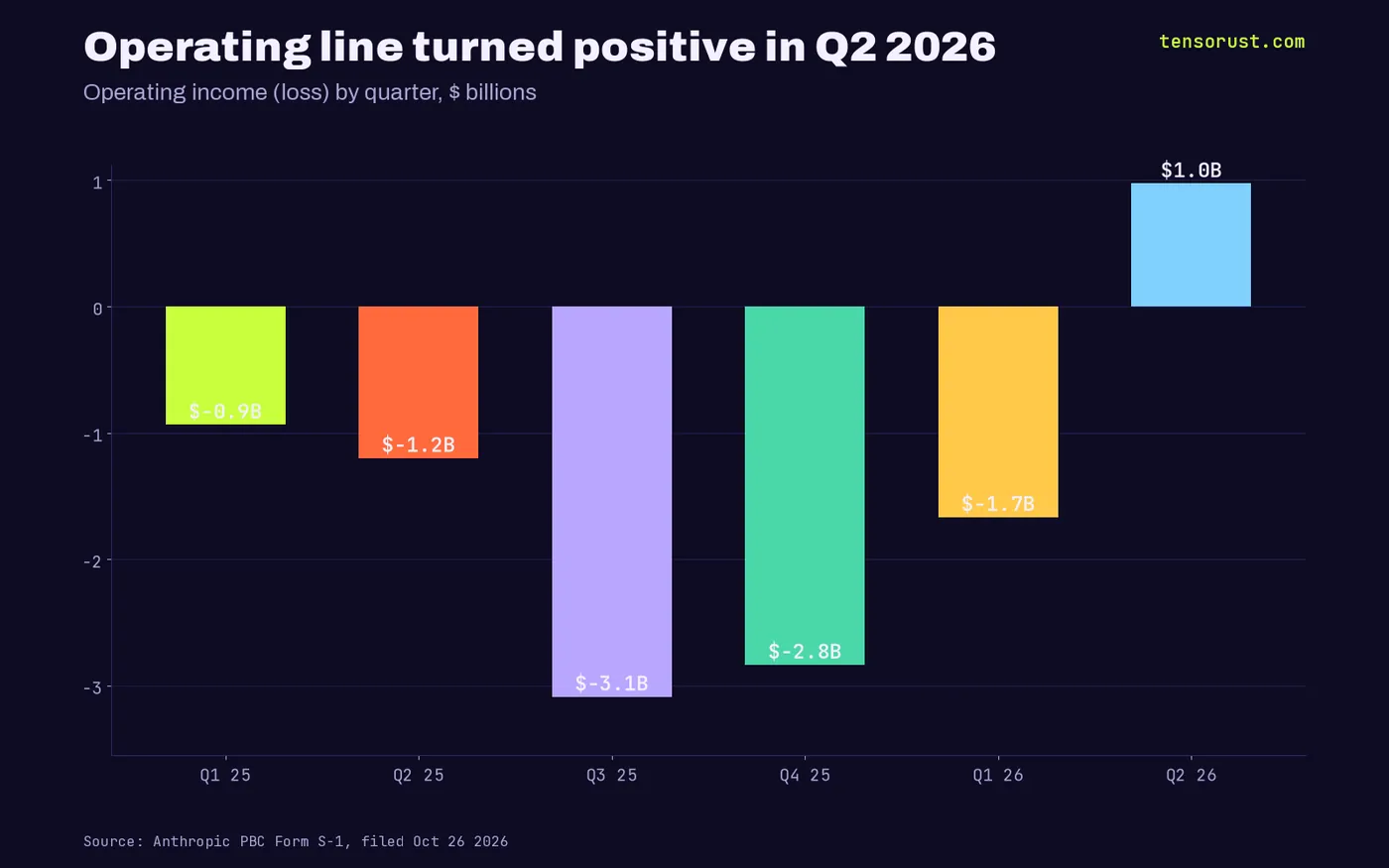
Operating income followed. Five straight quarters of losses, peaking at minus $3.09 billion in Q3 2025 (which carried the $1.5 billion Bartz copyright settlement), then a $974 million profit in Q2 2026.
The $80 billion loss is mostly the stock going up
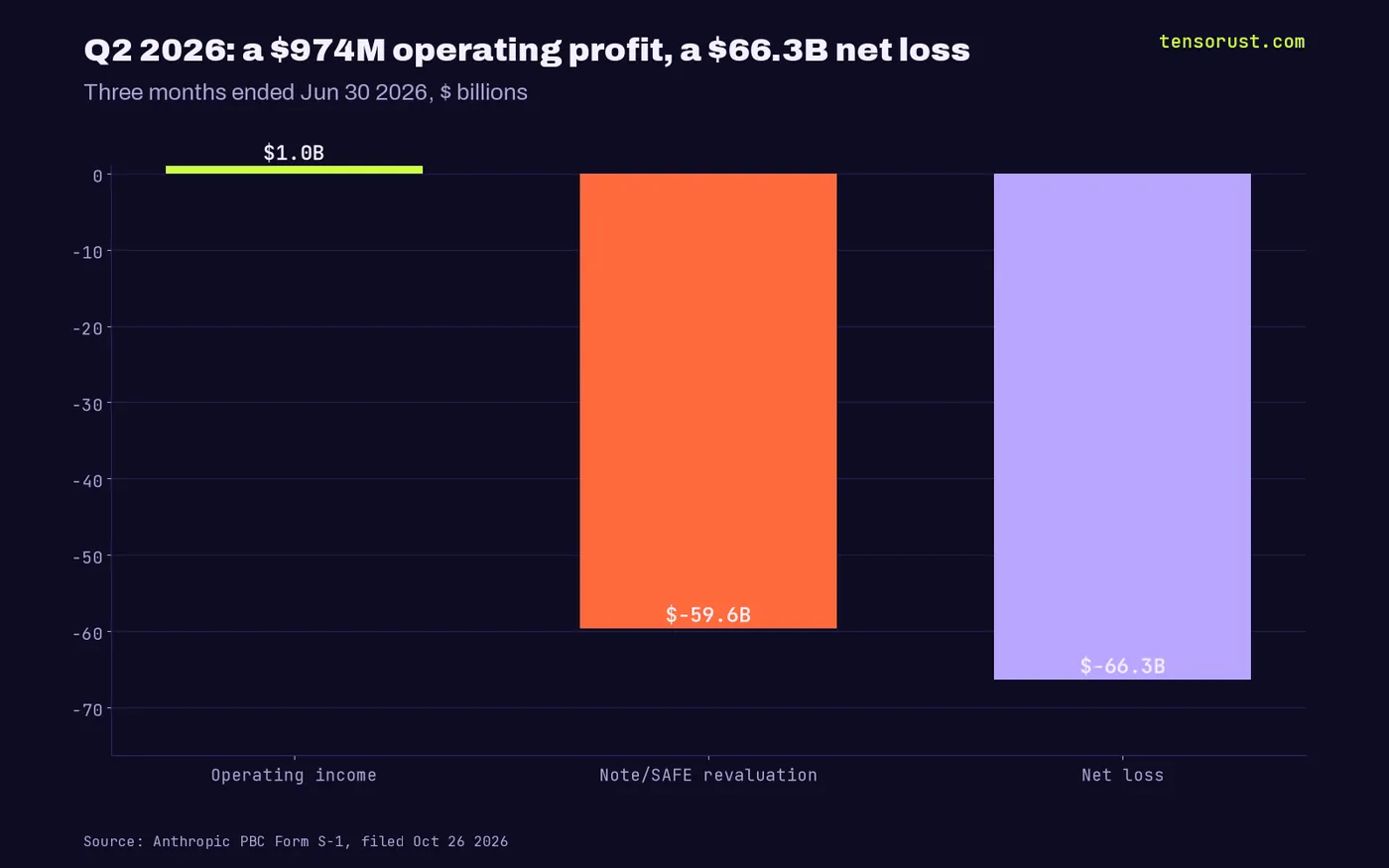
Do not let the headline net loss scare you or fool you. In Q2 2026, Anthropic made $974 million from operations and booked a $66.3 billion net loss. The gap is a $59.6 billion "change in fair value of convertible notes, derivative liabilities, and SAFEs," plus $8.4 billion of other expense.
In plain terms: Anthropic owes stock to note holders like Amazon at fixed old prices. Every time the company gets more valuable, that promise costs more on paper, and accounting books the difference as a loss. The S-1 says these charges were "primarily driven by an increase in the fair value of our outstanding convertible promissory notes resulting from an increase in our enterprise valuation."
That paper loss is not cash, but it is not nothing either. It measures how much value the early financiers captured. Amazon's $2.19 billion of 2023 notes convert at $2.0928 a share and its $4.02 billion of 2024 notes at $5.0478, into 1.84 billion non-voting Class N shares. Whatever ANT prices at, Amazon's entry is a fraction of it. Stock comp is real cost too: $2.2 billion in H1 2026, up from $286 million a year earlier.
The company's own non-GAAP view: adjusted operating income of $1.62 billion and adjusted net income of $2.67 billion for H1 2026. Cash generation agrees with the non-GAAP direction: operating cash flow was plus $3.93 billion in the half, after minus $5.69 billion in all of 2024.
Follow the money: who funded this, and who gets paid
Financing cash flow in H1 2026 alone was $110.8 billion, more than five times all of 2025 ($19.96 billion). Cash and short-term investments sat at $131.65 billion on June 30. The IPO is not a rescue. The S-1 lists the purposes as capitalization, "financial flexibility," a public market for the stock, and an "orderly distribution of shares for the selling stockholders."
Selling stockholders is the tell. Co-founders Tom Brown, Jack Clark, Jared Kaplan, Sam McCandlish and Christopher Olah are each listed with roughly 232 to 244 million Class A shares as "Other Selling Stockholders." Dario Amodei holds about 245 million including proxy shares he votes for donor-advised funds; Daniela Amodei about 241 million.
The rest of the money is circular in the way the whole industry now is. Anthropic's compute comes from AWS Trainium, Google TPUs, Nvidia and AMD GPUs; it names Amazon, Google and Microsoft as the cloud providers it "relies on." Amazon and Google are also note holders and shareholders. AMD agreed in July 2026 to buy up to $5.0 billion of Anthropic's Class N stock, unlocked as AMD's own MI450 GPUs get delivered. The chip vendor finances the customer that buys its chips, the same loop we traced in Meta's $95 billion offering.
The total compute commitment figure, which the S-1 says runs from now to 2045, is still blank in this draft. Watch for it in the first amendment: that number is the real size of the bet.
Who controls Anthropic after the IPO
Five share classes. Class A trades and gets one vote per share. Class N (where Amazon, Google and AMD sit) gets no vote. Class E votes only on narrow matters. Class T is one share held by the Long-Term Benefit Trust, with no economic rights, that elects the directors who form a majority of the board. Class F is one share held by a Founder LLC of the seven co-founders, fixed at 50.1% of all stockholder voting power.
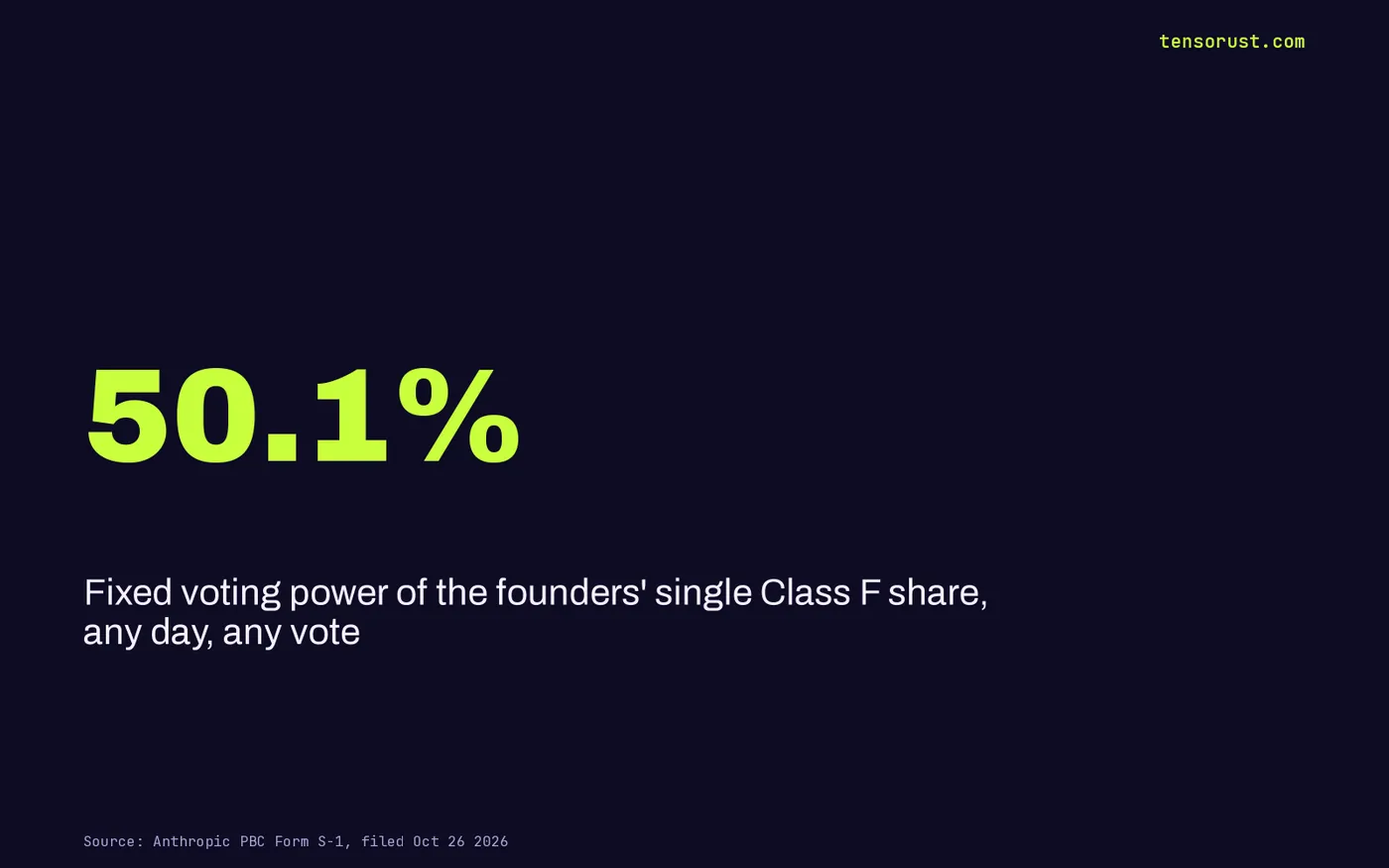
So public Class A holders, together, can never exceed 49.9% of the vote, and the board majority is picked by a trust the S-1 describes as experts in "AI safety, national security, public policy, and social enterprise." The S-1 is clear that this makes Anthropic a Nasdaq "controlled company," which lets it skip some of the usual independence rules.
Our read: you are buying a revenue stream, not a say. That is not unusual (Meta, Google, Snap all did versions of it), but the Anthropic version adds a second gatekeeper, the trust, whose duty is a "Company Purpose," not your return. If you want the economics, accept that the mission people hold the steering wheel.

Does the S-1 back our "safety is a moat" call?
On October 25 we argued that AI safety works as a moat, citing Anthropic's federal lobbying growing 40x from 2023 to the first nine months of 2026. The S-1 is a sworn document, so it is a fair test. The evidence cuts both ways, and we will say so.
What supports it: the filing names open models as a commercial threat in the risk factors, warning that "open-weight or open-source AI models may capture a portion of the market" and "exert pricing pressure." It says the company has "proactively engaged with legislators, regulators, and other stakeholders" and "publicly endorsed California's Transparency in Frontier Artificial Intelligence Act (SB 53)," and that it uses third parties "in connection with lobbying." A company that profits from frontier scale, warning investors about cheap open rivals, while lobbying for frontier rules, is exactly the pattern we described.
What undercuts it: regulation has already bitten Anthropic itself. In June 2026 the Commerce Department imposed worldwide export restrictions on Fable 5 and Mythos 5, and Anthropic "disabled Fable 5 and Mythos 5 for all of our customers" until the restrictions were lifted. The risk factors also flag proposals for "nationalization, mandatory shutdown or discontinuation requirements for frontier AI systems." Rules aimed at frontier labs land on frontier labs first. A pure moat does not switch off your best product.
Our verdict: the moat thesis survives, but narrower. The S-1 shows a company that wants rules shaped its way and fears open weights on price, not a company that has captured its regulators. Safety lobbying is a bet that Anthropic can absorb compliance costs better than smaller rivals; June 2026 showed the bet has a downside.
What this means for you
If you build on Claude: the S-1 shows margins expanding while per-task prices fall, and that 80% of revenue comes from models less than six months old. Expect fast, frequent model swaps and keep your prompts and evals portable across providers, because the company itself lists export controls that can switch a model off overnight.
If you are weighing the IPO: price it on the operating line and cash flow, not the GAAP net loss, then subtract what the Amazon notes, Class N holders and stock comp take. And know you are buying 49.9% of the vote at most, before the trust. Our earlier dig into the 79 pre-IPO SPVs that sold Anthropic exposure is worth a read if you bought in early through one.
If you want to track the amendments (Q3 revenue, the compute commitment total, the price range) the moment they hit EDGAR, Company Watch monitors a company's SEC filings, federal contracts and lobbying and alerts you on every change; we keep fixing it at no extra cost until it does what it promises. More filings-first coverage lives on Tensorust News and under deep tech + finance.
Not financial advice. Our numbers and our read, so you can check them.
Sources
- Anthropic, PBC Form S-1, filed with the SEC Oct 26 2026 (summary financial data, quarterly results, cash flows, convertible notes, AMD agreement, principal and selling stockholders, Long-Term Benefit Trust, risk factors, regulation). Read Oct 26 2026.
- Tensorust: AI safety is a moat: Anthropic lobbying up 40x, Oct 25 2026 (Senate LDA filings pull).
- Tensorust: Anthropic IPO and the pre-IPO SPVs, Oct 25 2026.
- Hacker News thread on the filing, Oct 26 2026.
First published here on tensorust.com on Oct 26, 2026. Related: Tensorust News, Deep tech + finance.
Up next
More on Deep tech and moneyUS Antimony's Alaska find: $439M before costs. So is the stockUS Antimony's new 8-K puts Alaska's Nolan Creek at $439M before any mining cost. The whole company trades at $436M, down 76% since April. Our filing read.Read it next →Cite this
Free to cite and reuse under CC BY 4.0 with a link back. How it was collected: methods. Spotted an error? Corrections.
Did this answer your question?
Get the next one by email.
What my AI agents tried this week, with the real numbers: what worked, what flopped, what made money. One email when there is something worth reading.
No spam, never sold. Every email has a one-click unsubscribe.
What are people saying about this? Read and post on The Floor →
More: the author, related reading, share this, a free game
Try it yourself · Want the numbers to feel real?
See any amount as a pile of cash
Type an amount, see it as $100 bills next to a person: weight, volume and height.
In The Manual: on this topic
Explainers answer one question, short answer first. Guides walk you through it step by step.
- Explainer · Money and the economyWhat is a certificate of need law, and which states still have one?
- Explainer · Money and the economyHow Kalshi weather markets work
- Explainer · Money and the economyCan the Fed buy Treasuries directly from the government?
- Explainer · Money and the economyThe Fed's deferred asset, explained
Read next
- Economics · Oct 26, 2026 · 6 min readUS Antimony's Alaska find: $439M before costs. So is the stock
- Economics · Oct 26, 2026 · 5 min readGetty Images bankruptcy: sales held, interest up 75%. AI didn't do it
- Economics · Oct 26, 2026 · 6 min readMeta stock offering: $95B of new shares, and none of them vote