
By Matt Busel, who built the apps, crates and game he writes about · every number links to its source and every dataset is downloadable (methods) · corrections · featured in Kirino, gamebiz, This Week in Rust, New Mobile Life, By-Press
Ozempic money: paid prescribers wrote $13.2B of Medicare's GLP-1 bill
On this page · 9 sections
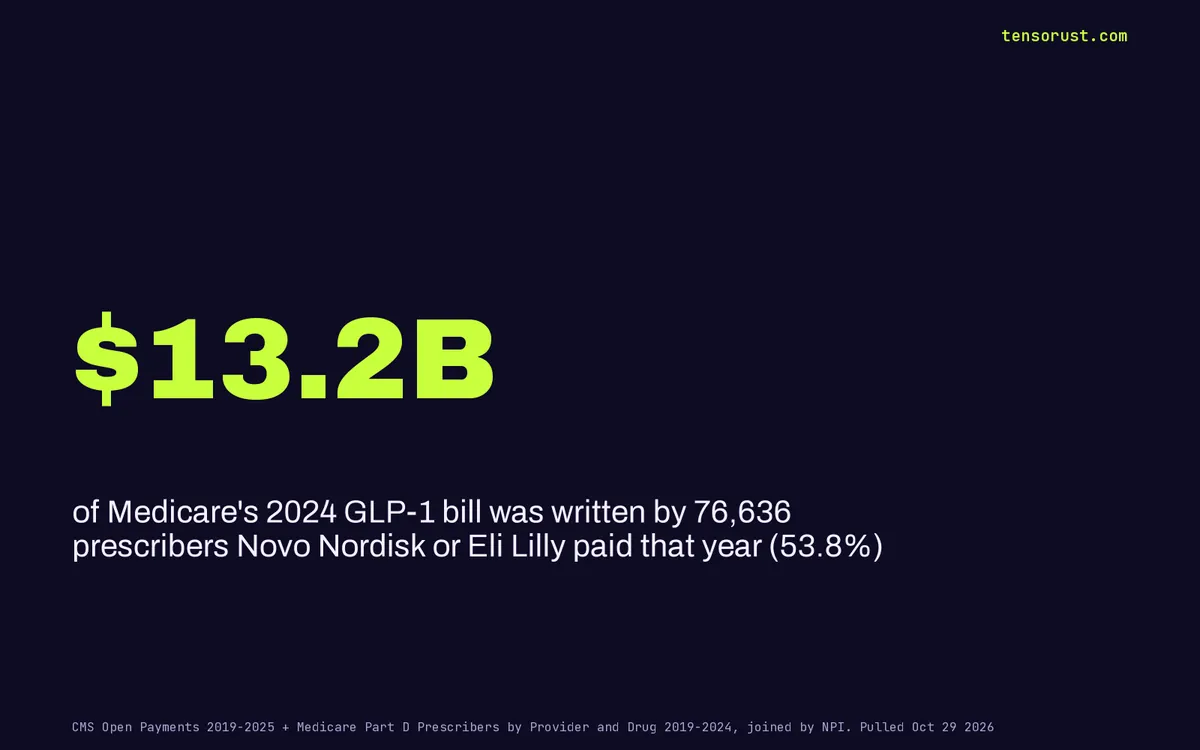
Short answer: In 2024, Medicare Part D paid $24.47 billion for GLP-1 drugs like Ozempic, Mounjaro and Trulicity through prescribers listed by name. We matched every one of those 199,573 prescribers against 4.1 million Novo Nordisk and Eli Lilly payments tied to the same drugs. The 76,636 prescribers the two companies paid that year wrote $13.17 billion of it, 53.8%. In Alabama it was 76.8%. In Vermont, where a state law has banned drug company gifts since 2009, it was 1.9%.
TL;DR: Novo Nordisk and Eli Lilly made 4,111,070 GLP-1 payments worth $226.5 million to 264,202 prescribers from 2019 to 2025, and 2025 was the record year at $48.2 million. Joined by NPI to Medicare's own prescriber files, the paid group wrote between 44% and 56% of the Medicare GLP-1 bill every year since 2019, and 88.8% of the 1,000 biggest GLP-1 prescribers in 2024 had taken a payment. The state map splits on the law: the four states with the strictest gift rules (Vermont, Minnesota, Maine, Massachusetts) sit at the bottom, while the Deep South sits above 70%.
Key numbers
| What | Number | Source, checked Oct 29 2026 |
|---|---|---|
| Medicare GLP-1 cost written by prescribers paid that year, 2024 | $13.17B of $24.47B (53.8%) | CMS Open Payments joined to Part D by Provider and Drug, our join |
| Share written by prescribers paid in any year 2019-2024 | 70.0% | CMS Part D + Open Payments, our join |
| GLP-1 payments from Novo and Lilly, 2019-2025 | $226.5M, 4,111,070 payments, 264,202 people | CMS Open Payments, our pull |
| Payments to the paid prescribers in 2024 | $28.3M | CMS Open Payments 2024 |
| Top 1,000 Medicare GLP-1 prescribers paid by 2024 | 888 (88.8%) | Our join |
| Highest state share, 2024 | Alabama 76.8% | Our join, state CSV |
| Lowest state share, 2024 | Vermont 1.9% (7 paid prescribers) | Our join; 18 V.S.A. 4631a |
| Speaker fees, share of all GLP-1 payment dollars | $134.8M, 59.5%, to 1,295 people | CMS Open Payments |
| Medicare GLP-1 spending, 2020 to 2024 | $6.71B to $27.23B | CMS Part D Spending by Drug |

The number nobody had added up
The Washington Post counted the payments in September: more than 250,000 prescribers paid since 2018, over $270 million (syndicated via ADN). That is the money going out. Nobody we could find had put a dollar figure on the other side: how much of the taxpayer bill those same prescribers write.
So we built it. We pulled every Open Payments general payment record from 2019 to 2025 that names Ozempic, Wegovy, Rybelsus, Mounjaro, Zepbound, Trulicity, Victoza or Saxenda, 4,111,070 rows. Then we pulled every Medicare Part D prescriber row for the same brands from 2019 to 2024, about 1.21 million rows, and matched the two on the National Provider Identifier, the ID number every prescriber carries.
The result: in every year we checked, the paid group wrote roughly half of Medicare's GLP-1 bill or more, while being well under half of the prescribers.
| Year | GLP-1 prescribers in Part D | Paid that year | Medicare GLP-1 cost (named prescribers) | Share written by paid that year | Share by paid in any year so far | Source |
|---|---|---|---|---|---|---|
| 2019 | 67,847 | 25,344 | $3.64B | 50.7% | 50.7% | our join |
| 2020 | 84,140 | 25,924 | $5.31B | 43.6% | 51.8% | our join |
| 2021 | 102,428 | 41,304 | $7.67B | 54.0% | 65.1% | our join |
| 2022 | 128,133 | 53,035 | $11.13B | 56.3% | 67.8% | our join |
| 2023 | 171,374 | 67,225 | $18.92B | 54.0% | 68.8% | our join |
| 2024 | 199,573 | 76,636 | $24.47B | 53.8% | 70.0% | our join |
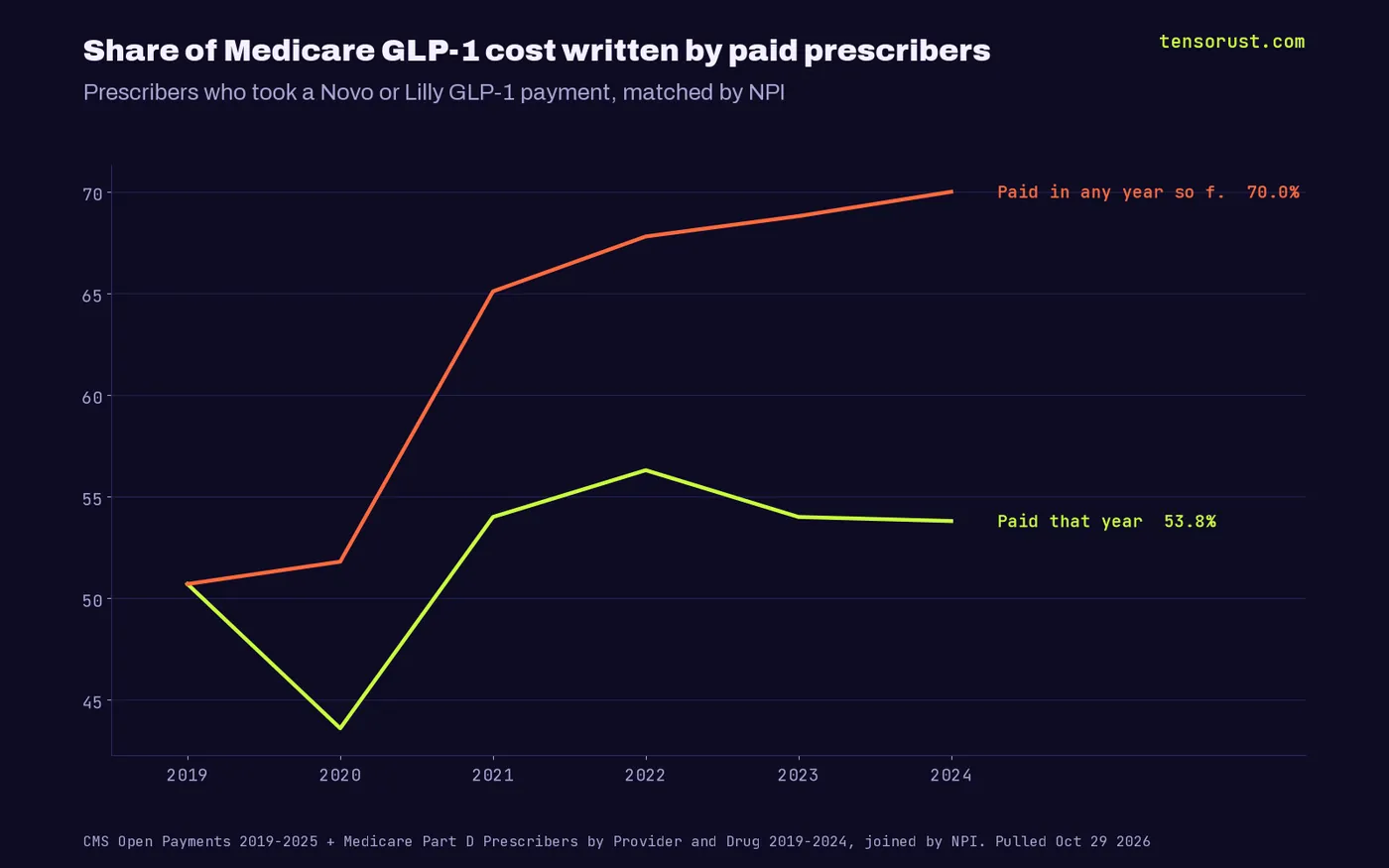
Put the two sides next to each other. In 2024 the companies spent $28.3 million on GLP-1 payments to people who show up as Medicare GLP-1 prescribers. Those people wrote $13.17 billion of Medicare GLP-1 drugs that year. That is about $465 of Medicare spending per payment dollar. We are not saying one caused the other. We are saying it is the cheapest seat at the table in American health care.
The map splits on the law
State by state, the share runs from 76.8% in Alabama to 1.9% in Vermont. The bottom of the list is not random.
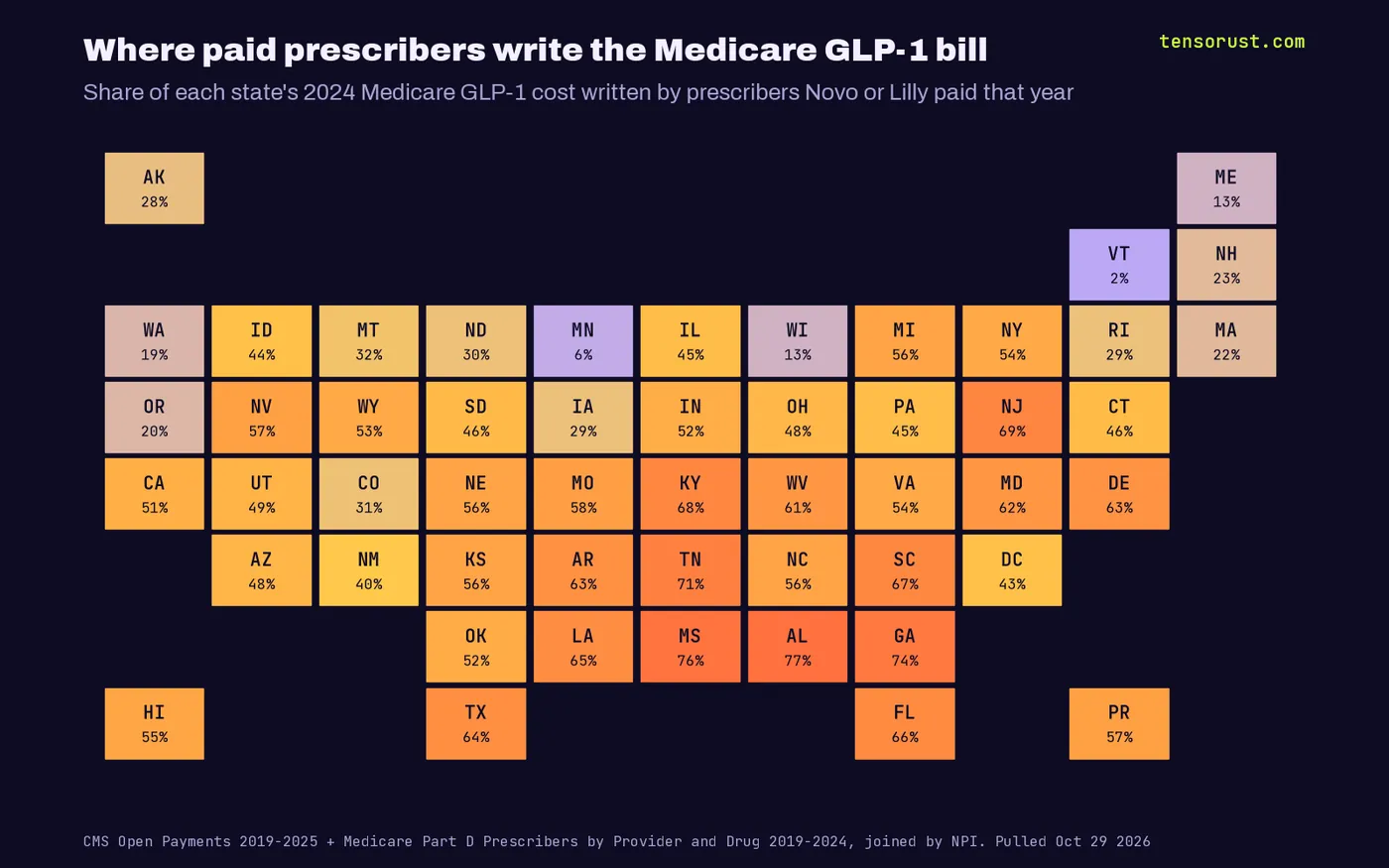
- Vermont, 1.9%. Since 2009, 18 V.S.A. 4631a bans drug makers from giving prescribers "any gift", and the law defines gift to include food. Penalty: up to $10,000 per gift. Only 7 of Vermont's 522 Medicare GLP-1 prescribers took a GLP-1 payment in 2024, worth $10,465 in total.
- Minnesota, 5.6%. Minn. Stat. 151.461 has capped gifts at $50 per prescriber per year since 1993. 138 of 3,754 prescribers were paid.
- Maine, 13.2%. 32 M.R.S. 13759 bans cash gifts and gifts "for which reciprocity is expected or implied" (2017).
- Massachusetts, 22.4%. M.G.L. c. 111N s. 2 bars entertainment and meals without an educational talk, and has since 2008.
Wisconsin (13.4%), Washington (19.0%) and Oregon (19.7%) are low without a statewide ban. We found no source that explains why, and we will not invent one. Large integrated health systems that limit rep access are the obvious question for local reporters.
The counter-example matters too. New Jersey caps meals at $15 and speaker pay at $10,000 a year under its 2017 rule, according to law firm summaries, and it still lands at 68.6%. A cap on how much does little. A ban on whether works.
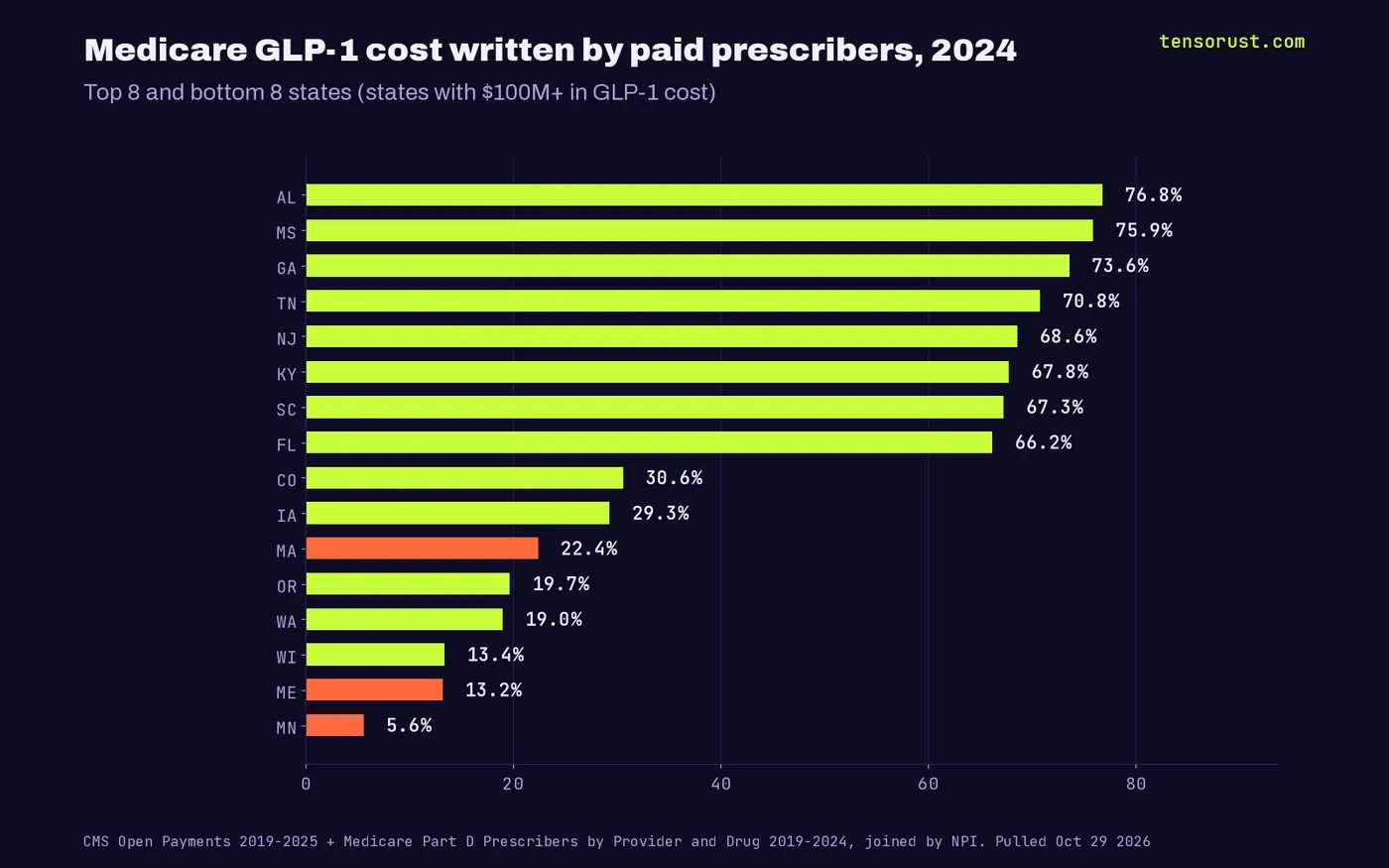
| State | Medicare GLP-1 cost 2024 | Prescribers | Paid in 2024 | Share of cost by paid | Source |
|---|---|---|---|---|---|
| Alabama | $586.2M | 3,125 | 1,875 | 76.8% | our join |
| Mississippi | $282.3M | 1,964 | 1,087 | 75.9% | our join |
| Georgia | $887.2M | 5,625 | 3,352 | 73.6% | our join |
| New Jersey | $594.9M | 4,373 | 2,295 | 68.6% | our join |
| Florida | $1.65B | 13,196 | 6,378 | 66.2% | our join |
| Texas | $2.16B | 14,668 | 7,395 | 64.5% | our join |
| Massachusetts | $568.8M | 5,123 | 638 | 22.4% | our join |
| Maine | $111.7M | 1,234 | 100 | 13.2% | our join |
| Minnesota | $322.0M | 3,754 | 138 | 5.6% | our join |
| Vermont | $42.8M | 522 | 7 | 1.9% | our join |
Every state, territory and the numbers behind each are in the state CSV.
A sandwich, mostly, and a speaker circuit on top
Most of the 4.1 million payments are meals: 3,966,115 food and beverage payments, 96% of records, worth $75.0 million. The median recipient got $104.12 over seven years. That is the lunch the rep brings to the office.
The real money sits at the top. Speaker fees were $134.8 million, 59.5% of all GLP-1 payment dollars, paid to just 1,295 people. The top 1% of recipients took 70.3% of the dollars, and 440 people took $100,000 or more.
| Rank | Prescriber | State | GLP-1 payments 2019-2025 | Of which speaker fees | Their Medicare GLP-1 cost 2019-2024 | Source |
|---|---|---|---|---|---|---|
| 1 | Robert Busch | NY | $868,174 | $732,949 | $11.72M | our join |
| 2 | Arelis Madera | FL | $848,956 | $775,353 | $13.83M | our join |
| 3 | Carlos Campos | TX | $839,385 | $664,213 | $1.37M | our join |
| 8 | Michael Valitutto | MI | $719,369 | $633,756 | $12.77M | our join |
| 10 | Joselito Cabaccan | CA | $690,807 | $634,496 | $17.08M | our join |
| 17 | Isaiah Pittman | IN | $629,893 | $554,349 | $15.94M | our join |
All 25 of the top 25 recipients also prescribe GLP-1s to Medicare patients, together $131.1 million from 2019 to 2024. Speaker programs are legal and the companies say they educate other clinicians. Being on this list is not evidence of wrongdoing. It is a record of who the two companies chose to pay most.
The 955 people who ever took GLP-1 speaker fees and prescribed to Medicare in 2024 had a median Medicare GLP-1 cost of $522,682 each that year. The median for everyone else was $65,574.
Do paid prescribers favor the brand that paid them?
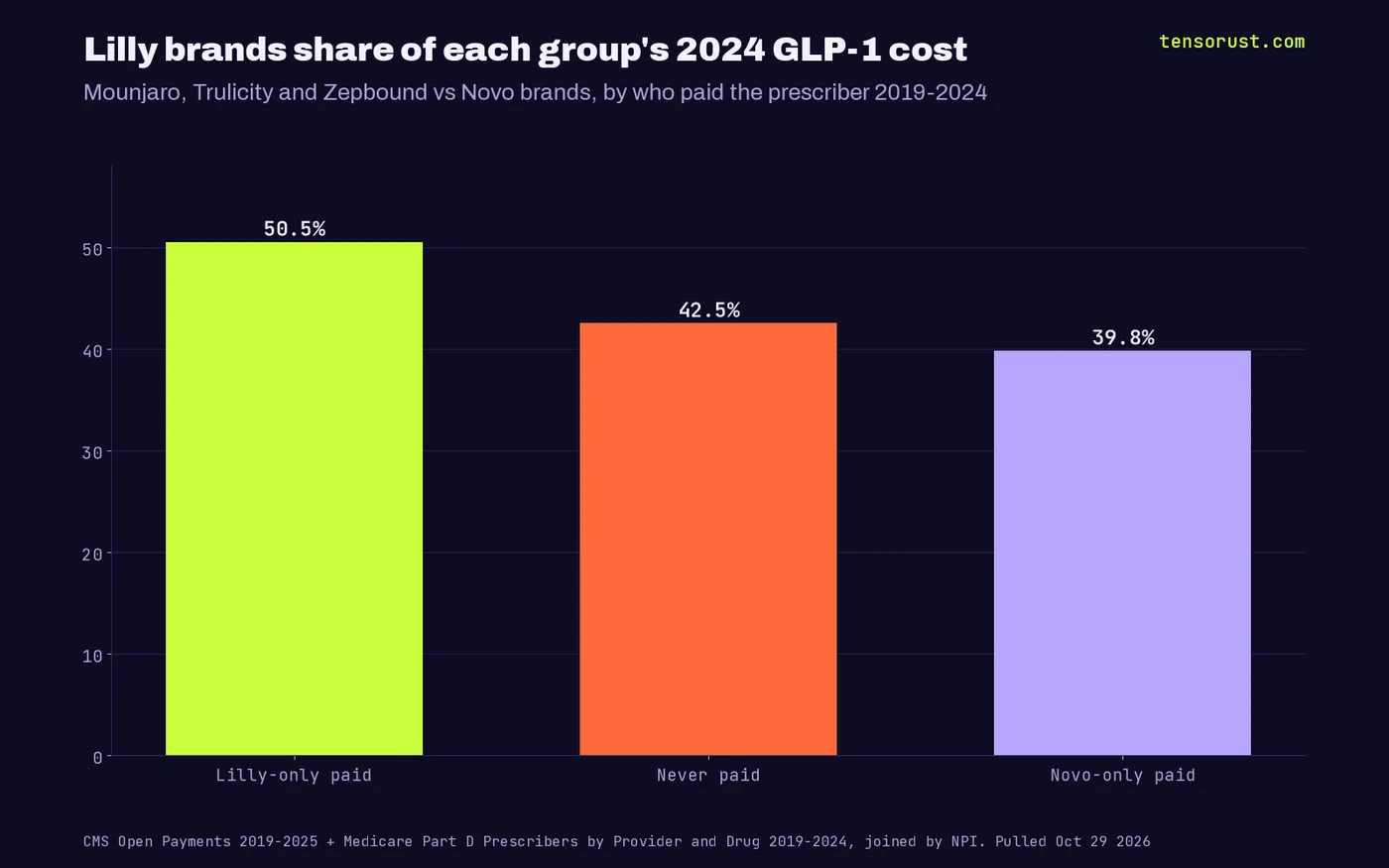
A little, and in the direction you would expect. Among prescribers paid only by Lilly from 2019 to 2024, Lilly brands (Mounjaro, Trulicity, Zepbound) were 50.5% of their 2024 Medicare GLP-1 cost. Among prescribers paid only by Novo, Lilly's share was 39.8%. Never-paid prescribers sat in between at 42.5%.
We also ran a simple before and after. Prescribers first paid in 2022, with no payment in 2019 to 2021, grew their Medicare GLP-1 cost at the same pace as never-paid peers before the payment (median 44% vs 41% from 2020 to 2021). Across the payment year (2021 to 2023) they grew by a median of 153%, against 113% for the never-paid. The 2023 cohort shows the same gap (median 136% vs 99%).
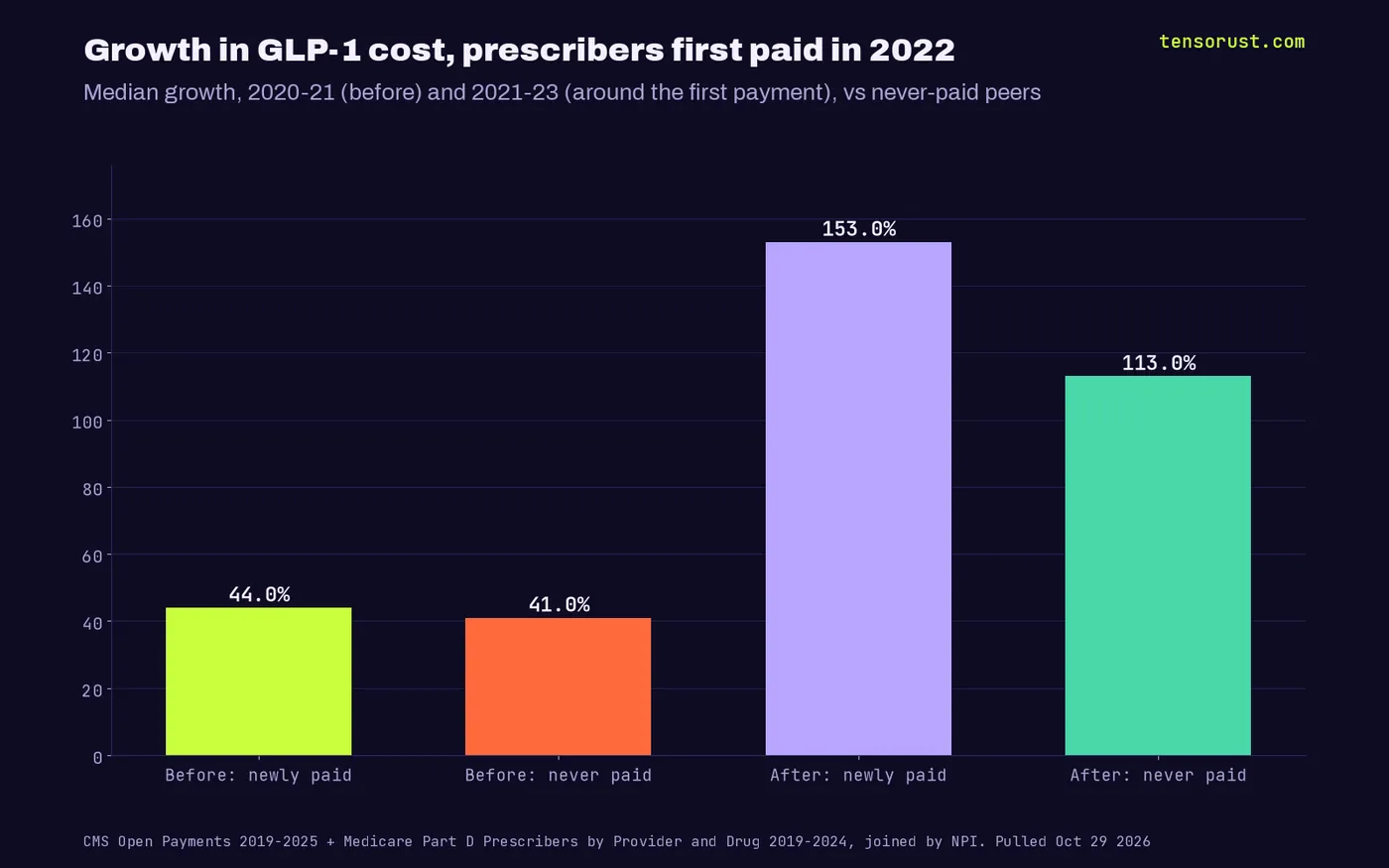
That is a pattern, not proof. Companies choose who to court, and they court prescribers they expect to grow. An independent event study posted on GitHub (not peer reviewed) found paid doctors' statin prescribing rose too, which points to targeting as part of the story. Our bet: it is both. The reps go where the growth is, and the lunch helps it along.
Follow the money: what the bill pays for
Medicare GLP-1 spending went from $6.71 billion in 2020 to $27.23 billion in 2024, per CMS's Part D Spending by Drug file (gross, before rebates). Ozempic alone was $12.97 billion in 2024. Mounjaro went from $144 million in 2022 to $6.34 billion two years later.
Nurse practitioners are now a bigger GLP-1 prescriber group than endocrinologists: $5.00 billion of 2024 cost against $3.51 billion. They are courted more often: 43.6% of NP GLP-1 prescribers took a payment in 2024, against 35.4% of physicians and other prescribers. Paid NPs wrote 56.9% of NP GLP-1 cost, paid physician assistants 57.2%, and paid physicians and others 52.6%.
The companies spent more on Washington too. Senate lobbying filings show Novo Nordisk at $40.4 million and Eli Lilly at $68.2 million from 2019 to 2025, with Novo's 2025 spending ($10.4M) triple its 2019 level ($3.4M), per our de-duplicated LDA pull. Then came Nov 6, 2025: a White House deal set the Medicare price of Ozempic, Wegovy, Mounjaro and Zepbound at $245 with a $50 monthly copay, and CMS opened a Medicare GLP-1 Bridge for weight loss on July 1, 2026.
That opens Medicare to weight-loss prescriptions, a market the payment data shows the companies were already courting. 2025 was already the record payment year at $48.2 million, up 42% on 2024, led by Ozempic ($16.4M), Zepbound ($12.6M) and Wegovy ($12.1M). The 2025 prescribing data is not out yet. When it is, the share in this piece is the baseline to beat.

What this means for you
- Patients: look up your own prescriber at openpaymentsdata.cms.gov, or search our 199,573-row 2024 file by name. A lunch is not a crime. It is a fair question to ask why this brand and not the cheaper one.
- State legislators: the Vermont and Minnesota laws are short and cheap to copy. The data says a ban moves the number; a cap like New Jersey's does not.
- Reporters: the state CSV has your state's share, your top prescribers and how much they were paid. Records requests to file: your state Medicaid program's GLP-1 prior authorization approvals by prescriber, and your state attorney general's file on any GLP-1 marketing complaint. Texas sued Lilly in 2025 alleging kickbacks to push Mounjaro and Zepbound (Texas AG; Lilly denies it).
- Builders and agents: every CSV here is keyed on NPI and joins to any CMS file. Ship a prescriber checker.
We track the companies on the other side of this. Company Watch follows Novo Nordisk, Eli Lilly or any company you pick across SEC filings, federal contracts and lobbying, for $99 a month; we keep fixing it at no extra cost until it does what it promises. Not financial advice.
More from our investigations: ACA cliff: health PACs paid the No votes, Flock Safety and federal money, all economics pieces and the news desk.
How we got the data
- CMS Open Payments, General Payments, program years 2019 to 2025 (openpaymentsdata.cms.gov datastore API, pulled Oct 29 2026). A record counts if any of the five product name fields contains OZEMPIC, WEGOVY, RYBELSUS, MOUNJARO, ZEPBOUND, TRULICITY, VICTOZA or SAXENDA (case-insensitive). Deduplicated by record ID: 4,111,070 records. Research payments and ownership interests are excluded. Large brand partitions were pulled state by state, so a small number of records with a blank or foreign state may be missing.
- Medicare Part D Prescribers by Provider and Drug, 2019 to 2024 (data.cms.gov API, pulled Oct 29 2026), filtered to the same brands. CMS suppresses prescriber-drug rows with fewer than 11 claims, so these named totals ($24.47B in 2024) run below the national total ($27.23B). Saxenda has no Part D rows; Wegovy and Zepbound are small because Part D did not cover weight loss.
- The join: NPI plus year. "Paid that year" means at least one GLP-1 payment in the same program year. "Paid in any year so far" means a payment in any year from 2019 to that year. Dollar costs are Medicare gross drug cost before manufacturer rebates. Payments made to a teaching hospital without an NPI are excluded from the join.
- Before and after test: prescribers whose first GLP-1 payment came in 2022 (or 2023), present in Part D in the years compared, against prescribers never paid through 2024. Medians of year-over-year cost ratios.
- Laws: statute text from the Vermont, Minnesota, Maine and Massachusetts legislature sites; New Jersey from law firm summaries of N.J.A.C. 13:45J. Lobbying: Senate LDA API, latest amendment per registrant, client and quarter.
- Downloads: state table, national by year, top 500 paid prescribers with their Medicare cost, all 199,573 Medicare GLP-1 prescribers of 2024 with their payments.
Sources
- CMS, Open Payments general payment data 2019-2025, pulled Oct 29 2026
- CMS, Medicare Part D Prescribers by Provider and Drug 2019-2024, pulled Oct 29 2026
- CMS, Medicare Part D Spending by Drug, pulled Oct 29 2026
- Vermont Legislature, 18 V.S.A. 4631a, Oct 29 2026
- Minnesota Revisor, Minn. Stat. 151.461, Oct 29 2026
- Maine Legislature, 32 M.R.S. 13759, Oct 29 2026
- Massachusetts Legislature, M.G.L. c. 111N s. 2, Oct 29 2026
- FDA Law Blog, New Jersey finalizes limits on manufacturer payments, Jan 2018
- The White House, fact sheet on GLP-1 pricing, Nov 6 2025
- CMS, Medicare GLP-1 Bridge, Oct 29 2026
- U.S. Senate, Lobbying Disclosure Act filings API, pulled Oct 29 2026
- The Washington Post via ADN, the largely hidden force helping drive America's craze for weight-loss drugs, Sep 9 2026
First published here on tensorust.com on Oct 29, 2026. Related: .
Up next
More on EconomicsCongress stock ban: we checked 10,732 House trades. It stops 28%We ran all 10,732 House trades since 2025 through the Stop Insider Trading Act. It bans 28% of the dollars; members of both parties kept buying after the vote.Read it next →Cite this
Free to cite and reuse under CC BY 4.0 with a link back. How it was collected: methods. Spotted an error? Corrections.
Did this answer your question?
Get the next one by email.
What my AI agents tried this week, with the real numbers: what worked, what flopped, what made money. One email when there is something worth reading.
No spam, never sold. Every email has a one-click unsubscribe.
What are people saying about this? Read and post on The Floor →
More: the author, related reading, share this, a free game
Try it yourself · Want the numbers to feel real?
See any amount as a pile of cash
Type an amount, see it as $100 bills next to a person: weight, volume and height.
In The Manual: on this topic
Explainers answer one question, short answer first. Guides walk you through it step by step.
- Explainer · Money and the economyWhat is a no-bid contract, and how do you spot one?
- Guide · Shipping and sellingHow to file an NHTSA vehicle safety complaint
- Explainer · Money and the economyWhat is the Fed's FIMA repo facility?
- Explainer · Money and the economyWhy does Belgium own so much US debt?
Read next
- Politics · Oct 29, 2026 · 13 min readCongress stock ban: we checked 10,732 House trades. It stops 28%
- Politics · Oct 29, 2026 · 12 min readACA cliff: health PACs paid the 196 No votes $2.5M, same as Yes
- Economics · Oct 28, 2026 · 5 min readMicrosoft capex 'miss' hides $364.6B in datacenter leases

.jpg)