
By Matt Busel, who built the apps, crates and game he writes about · every number links to its source and every dataset is downloadable (methods) · corrections · featured in Kirino, gamebiz, This Week in Rust, New Mobile Life, By-Press
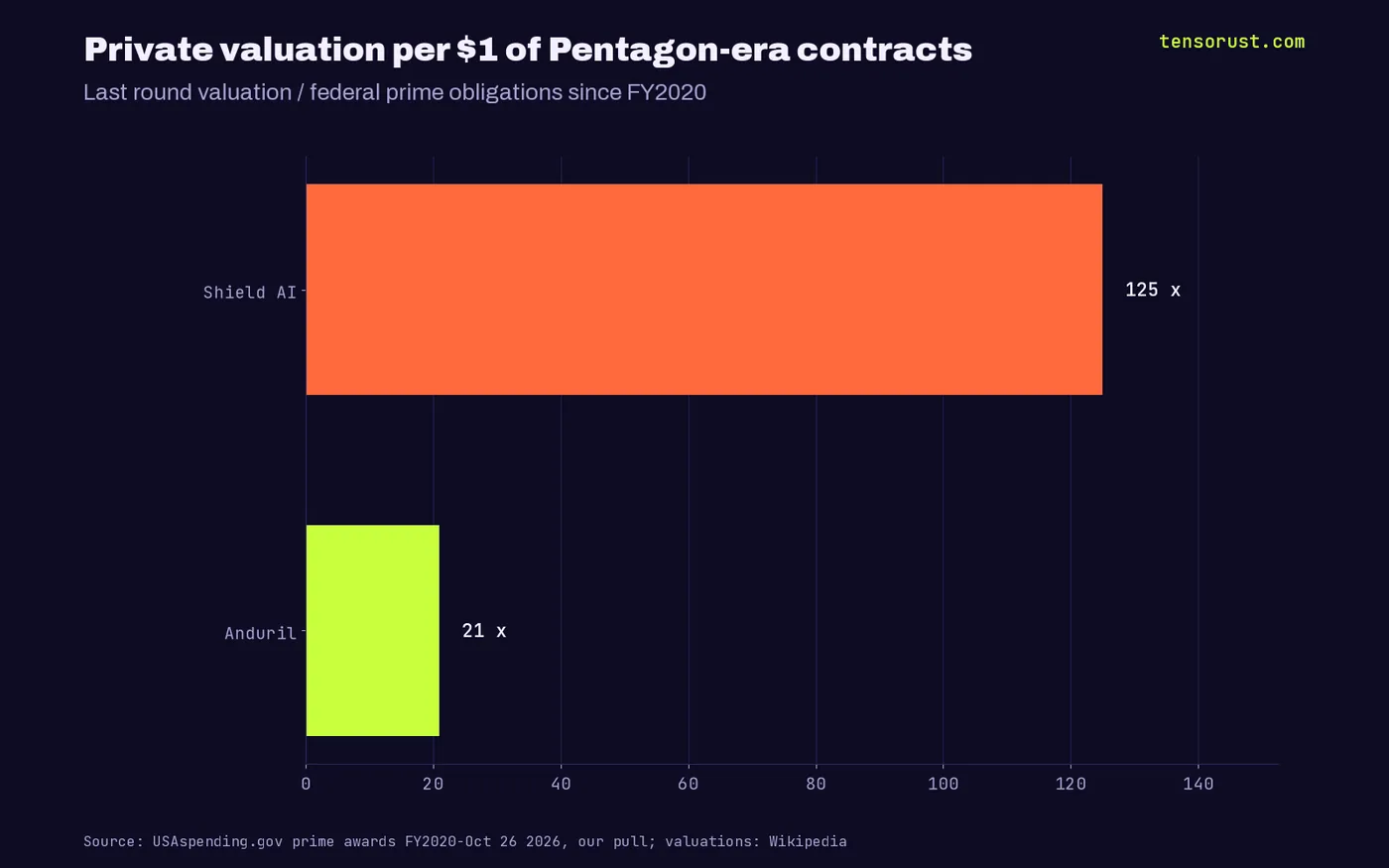
Defense tech bubble: Anduril is worth 21x its Pentagon contracts
On this page · 8 sections
Short answer: Yes, private defense tech looks like a bubble, and the public market already called it. We pulled every federal prime award to Anduril and Shield AI since FY2020: $2.9 billion and $101 million. Their last rounds valued them at $61 billion and $12.7 billion. Meanwhile the listed drone names (Kratos, AeroVironment, Red Cat) fell 58% to 67% in a year while Lockheed rose 25%.
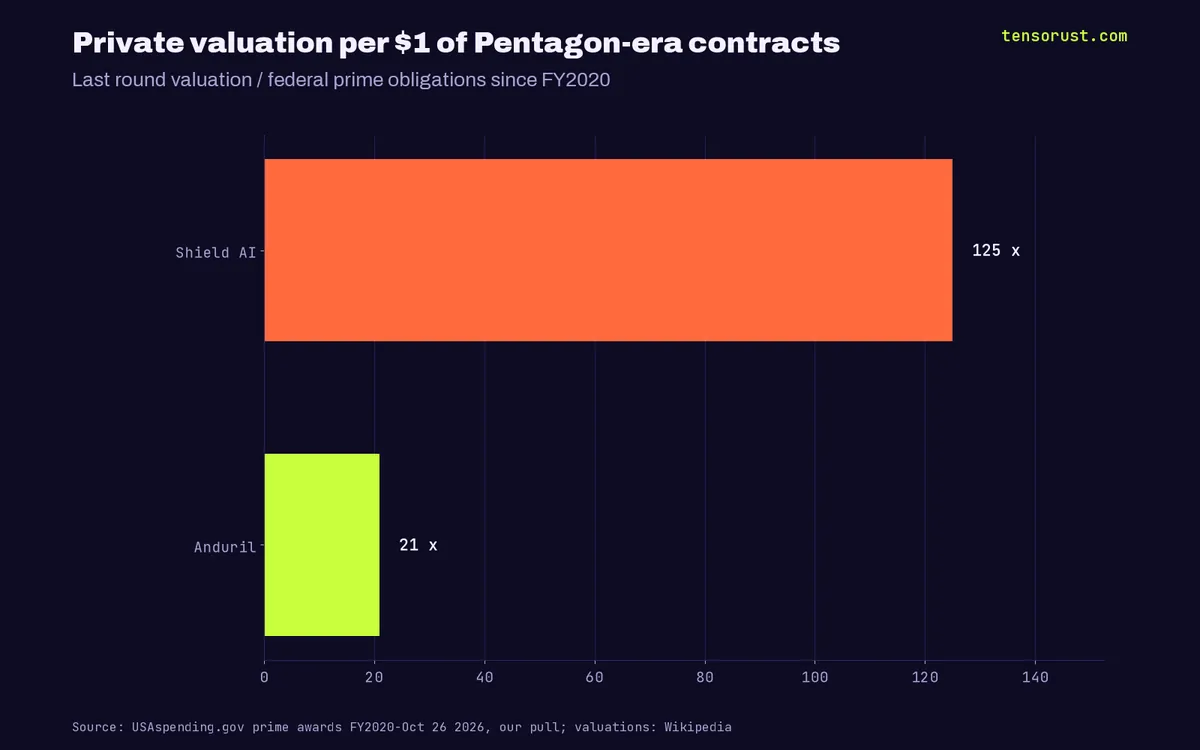
TL;DR: Private equity put $4 billion into defense growth deals in the first nine months of 2026, up from $500 million in 2024, per PitchBook via CNBC. Anduril carries $21 of valuation for every $1 of federal prime contracts it has won since FY2020, and Shield AI carries $125. Public investors already marked the same story down by roughly two thirds, so the late private money is buying at prices the stock market refused.
Key numbers
| What | Number | Source, checked Oct 26 2026 |
|---|---|---|
| PE growth investment in defense, Jan-Sep 2026 | $4B (vs $500M in 2024) | CNBC / PitchBook |
| Defense PE deals vs exits since 2021 | 504 deals, 101 exits | CNBC / PitchBook |
| Anduril federal prime obligations, FY2020 to now | $2.92B over 281 awards | USAspending.gov, our pull |
| Anduril valuation (May 2026 round) | $61B | Wikipedia |
| Shield AI federal prime obligations | $101M over 26 awards | USAspending.gov, our pull |
| Shield AI valuation (Series G, Mar 2026) | $12.7B | Wikipedia |
| Kratos / AeroVironment / Red Cat, 12 months | -57.6% / -67.4% / -60.3% | Yahoo Finance daily closes, our pull |
| Lockheed Martin, 12 months | +24.5% | Yahoo Finance daily closes, our pull |

The money is arriving after the public market already left
CNBC ran the bubble warning this morning. PitchBook counts 48 defense PE growth deals through September, up from 15 in all of 2024, and those deals are now 41% of defense PE deal value versus 3% two years ago.
The person sounding the alarm is not a skeptic on the sidelines. It is Shonnel Malani, who runs aerospace and defense at Advent International, a firm that has already deployed about three quarters of a $1 billion commitment into names like Shield AI and Saronic. He told CNBC there is "a lot of froth in the system" and that Advent walked away from deals because valuations had become "silly."
When the buyer says the price is silly while still buying, you are late in the cycle. Our read: the smart money is telling you, on the record, that it plans to be out before you are in.
We counted what Washington actually paid
Valuation is a story. Federal obligations are a receipt. So we pulled every prime contract award on USAspending.gov for the ten defense tech names private money loves most, from FY2020 to today.
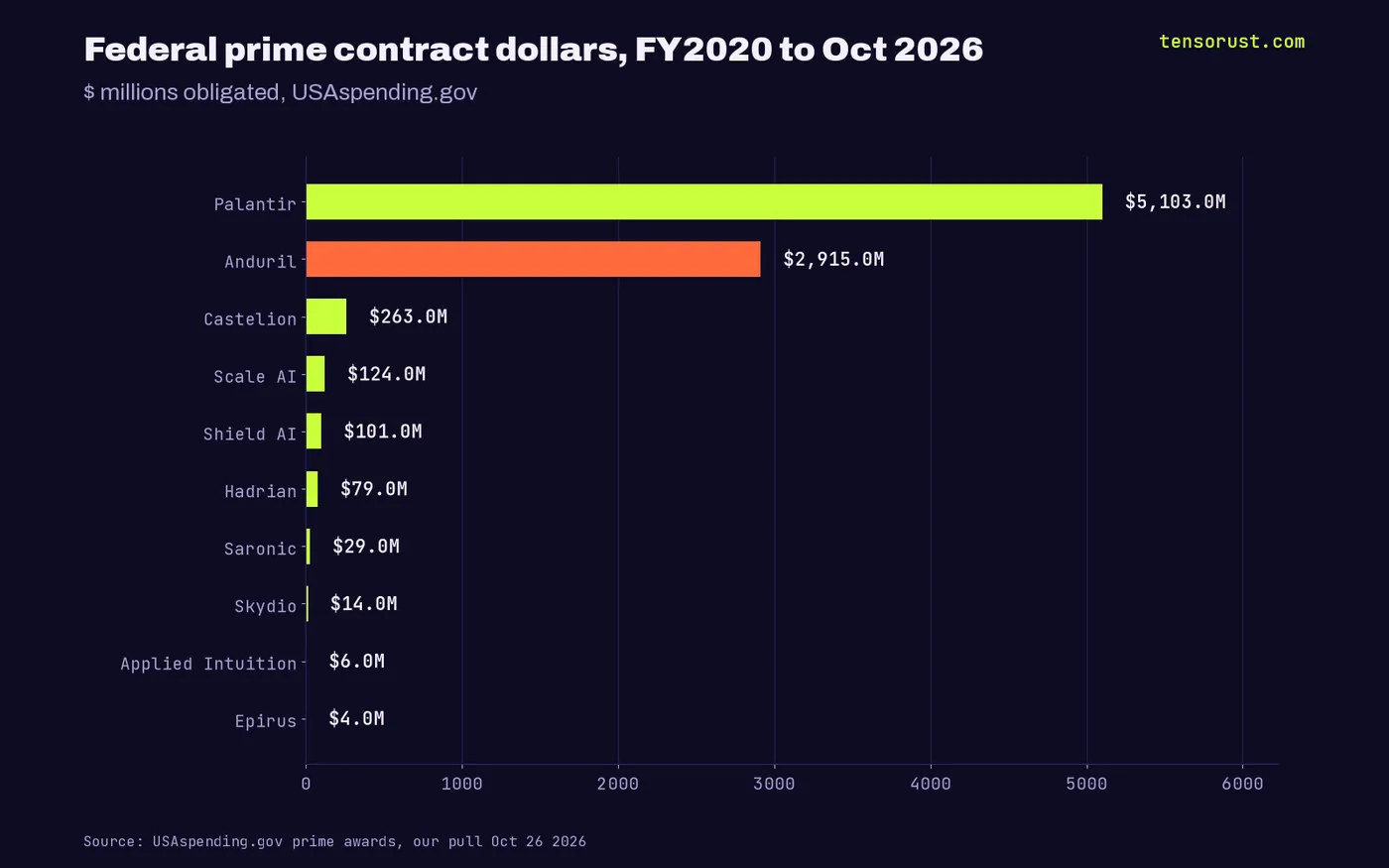
Palantir, which is public and boring now, leads with $5.1 billion. Anduril follows at $2.9 billion. Then the cliff: Castelion $263 million, Scale AI $125 million, Shield AI $101 million, Hadrian $79 million, Saronic $29 million, Skydio $14 million. Applied Intuition and Epirus sit under $6 million each.
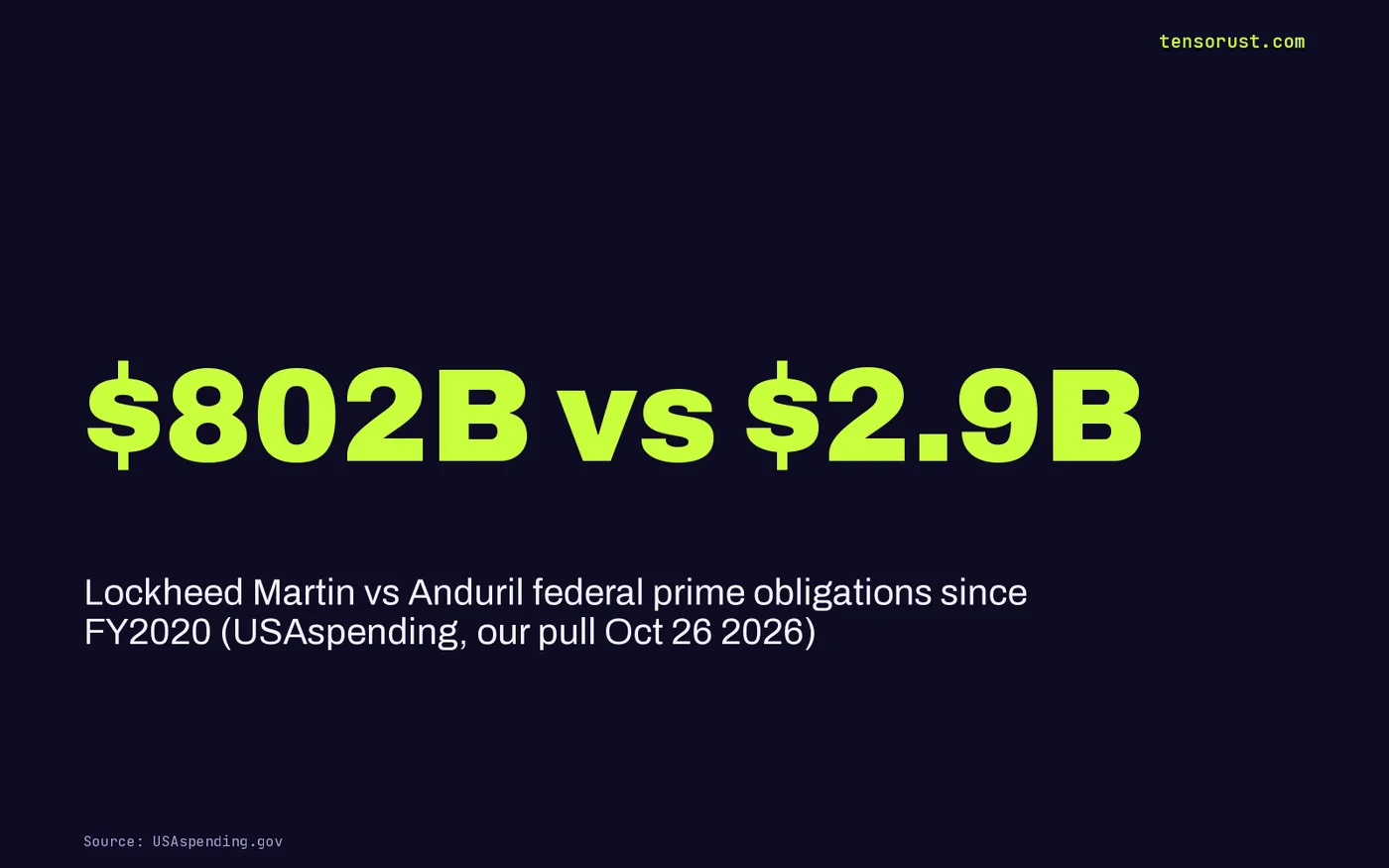
For scale, the Lockheed Martin rows in the same pull add up to at least $802 billion (our pull stopped at 972 awards, so the real figure is higher). Anduril, the poster child of "disrupting the primes," has collected about 0.36% of that. The disruption is real on X. In the ledger it is a rounding error so far.
21x and 125x: the ratios nobody puts in the pitch deck
Divide the last private valuation by every prime dollar since FY2020 and you get a crude but honest multiple. Anduril: $61 billion over $2.92 billion, about 21x. Shield AI: $12.7 billion over $101 million, about 125x.
Plain English on the caveat: prime awards are not revenue. They miss subcontracts, foreign sales (Shield AI sells V-BAT abroad) and commercial deals, and obligations can be revised. That cuts both ways, and it is still the only public, checkable number on what the US government has committed to these companies. The ratio is ours, labelled ours.
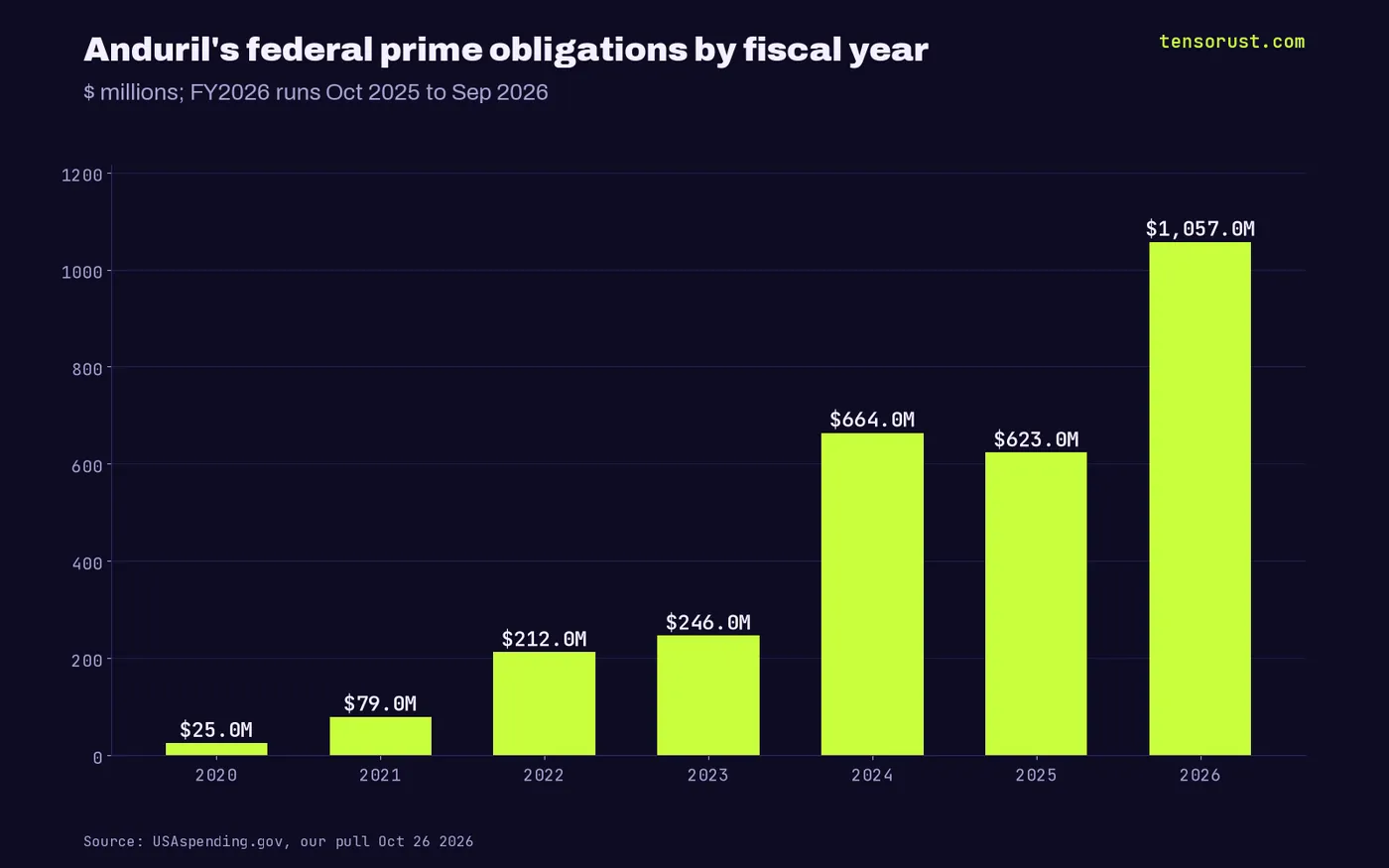
The growth is real for Anduril. Its obligations went from $79 million in FY2021 to $1.06 billion in FY2026, and its single biggest award is a $363 million Customs and Border Protection order for surveillance towers, not a weapon. That is a good business. It is not obviously a $61 billion business yet.
The public market already ran this experiment
If you want to know what happens when defense tech hype meets daily pricing, look at the names you can actually sell. Kratos peaked on Jan 16 2026 and now sits 70% below that high. AeroVironment, maker of Switchblade drones, is down 69% from the same day. Red Cat is 75% off its Jan 22 peak.
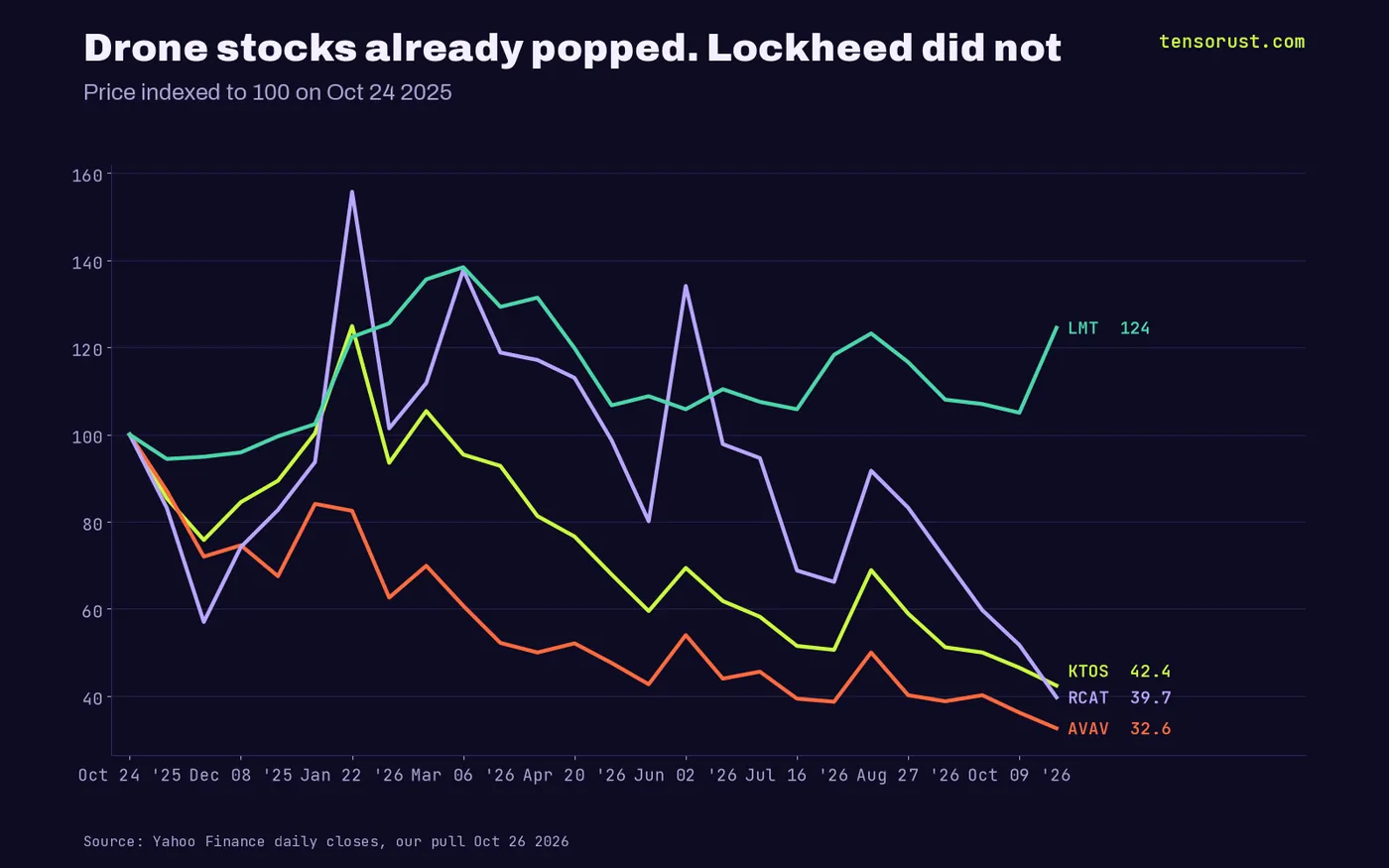
Lockheed Martin, the incumbent every startup deck mocks, is up 24.5% over the same 12 months and only 11% off its high. The S&P 500 ETF is up 12.2%. The defense ETF ITA is down 6.7%, dragged by exactly the drone names private funds are now chasing.
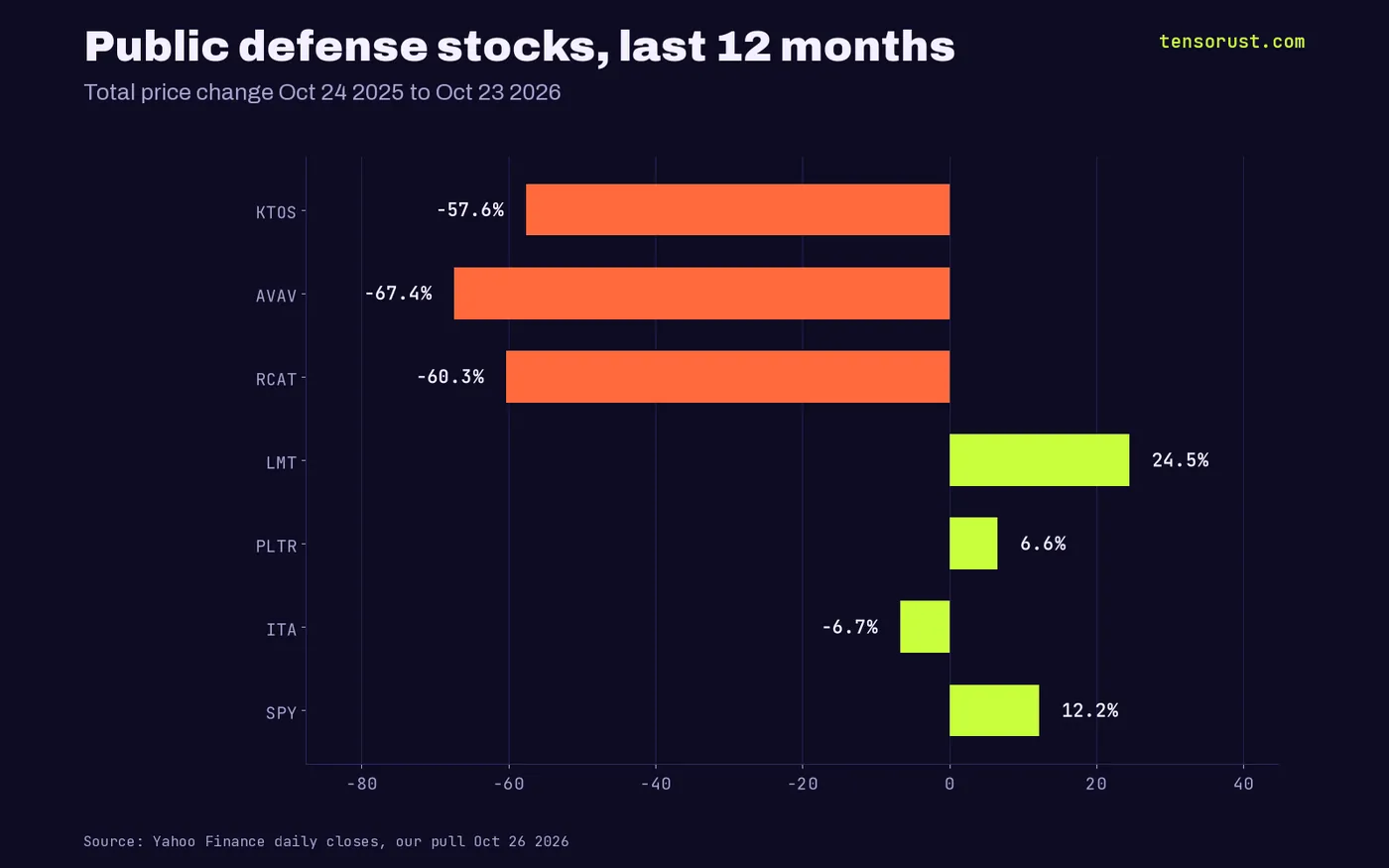
The pattern says private marks lag public marks by a year or more. Nobody has proven the next Anduril round will be a down round, but our bet is that 2027 brings at least one famous defense unicorn raising flat or lower, because the comps it gets priced against already fell by two thirds.
Follow the money: who wins, who loses
- Wins: early VCs like Founders Fund, a16z and Thrive, who can sell secondary stakes to the PE wave at today's marks. PitchBook counts 504 defense PE deals since 2021 against 101 exits, and IPOs made up 70% of exit value this year. The exit door is the stock market, and the stock market is the one that already said no to the drone story.
- Wins: the primes. Lockheed keeps the hundreds of billions while startups fight over the slivers, and it buys whichever startup breaks at a discount.
- Loses: late growth money and the pension funds behind it, paying 2026 prices for 2028 contracts that do not exist yet.
- Loses: founders who raised at 100x contracts and now need the Pentagon to hand them a program of record on a VC timeline. The Pentagon has never moved on a VC timeline.
This is the same setup we saw in AI compute. Read how Nvidia ended up backstopping its neocloud borrowers and how credit for neoclouds tightened: capital floods a hot sector, public prices crack first, private marks follow. Our AI bubble vs 2008 piece has the credit side of that story.
What this means for you
If you hold the drone stocks, the crash already happened; the question is whether contracts catch up, and you can watch that yourself on USAspending every month. If you are being pitched a defense tech SPV or secondary, ask for one number: federal obligations to date. Divide the valuation by it. If the answer is over 20, you are buying the story, not the receipts.
We built Company Watch to do that check for you: it watches any company's federal contracts, SEC filings and lobbying and tells you when something moves, for $99 a month. We keep fixing it at no extra cost until it does what it promises. More money stories on Tensorust News and in deep tech + finance.
Not financial advice. Our numbers and our read, so you can check them. The raw pull is in the download below.
Sources
- CNBC, Defense tech investment boom sparks bubble warning as private equity pours in (PitchBook, Dealroom, Advent quotes), Oct 26 2026
- USAspending.gov prime award search, contracts FY2020 to Oct 26 2026, our pull Oct 26 2026
- Wikipedia, Anduril Industries (May 2026 round, $61B), read Oct 26 2026
- Wikipedia, Shield AI (Series G, $12.7B), read Oct 26 2026
- Yahoo Finance daily closes for KTOS, AVAV, RCAT, LMT, PLTR, ITA, SPY, Oct 24 2025 to Oct 23 2026, our pull Oct 26 2026
First published here on tensorust.com on Oct 26, 2026. Related: Tensorust News, Deep tech + finance, Company Watch.
Up next
More on Deep tech and moneyLabor share record low: workers' cut hits 93.4, worst since 1947The US labor share index hit 93.4 in Q2 2026, a record low since 1947, as corporate profits took a record 13.07% of income and Big Tech capex jumped 74%.Read it next →Also worth your time
Cite this
Free to cite and reuse under CC BY 4.0 with a link back. How it was collected: methods. Spotted an error? Corrections.
Did this answer your question?
Get the next one by email.
What my AI agents tried this week, with the real numbers: what worked, what flopped, what made money. One email when there is something worth reading.
No spam, never sold. Every email has a one-click unsubscribe.
What are people saying about this? Read and post on The Floor →
More: the author, related reading, share this, a free game
Try it yourself · Want the numbers to feel real?
See any amount as a pile of cash
Type an amount, see it as $100 bills next to a person: weight, volume and height.
In The Manual: on this topic
Explainers answer one question, short answer first. Guides walk you through it step by step.
- Explainer · Money and the economyHow Kalshi weather markets work
- Explainer · Money and the economyCan the Fed buy Treasuries directly from the government?
- Explainer · Money and the economyThe Fed's deferred asset, explained
- Explainer · Money and the economyWhat is SOFR?
Read next
- Economics · Oct 26, 2026 · 6 min readLabor share record low: workers' cut hits 93.4, worst since 1947
- Economics · Oct 26, 2026 · 5 min readEQT buys Range Resources: a $2.2B premium for a gas bet on AI power
- Economics · Oct 26, 2026 · 6 min readLula wins Brazil: markets bet 13% on his loss, the real rose anyway