
Why did no bankers go to jail after 2008?
Short answer
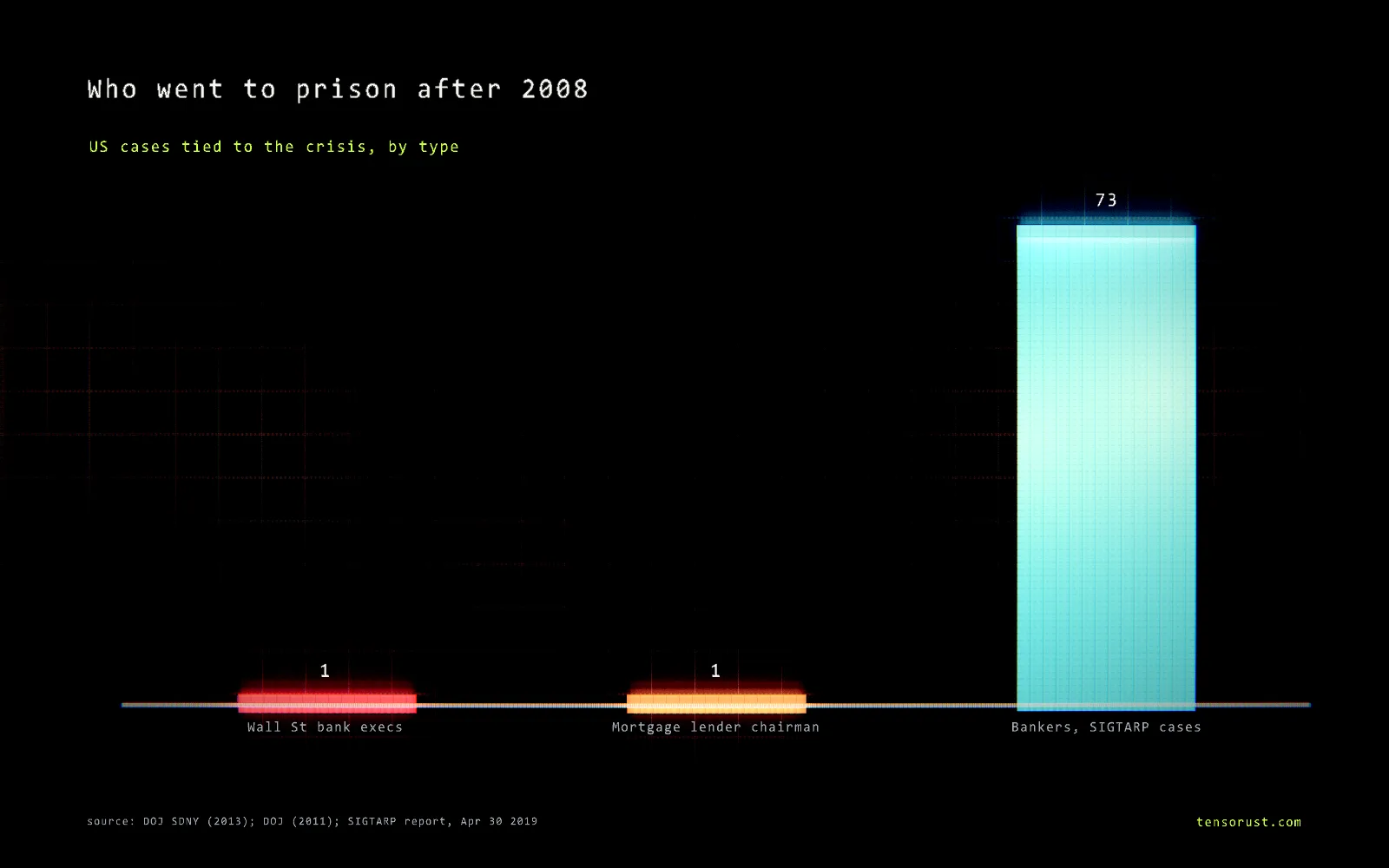
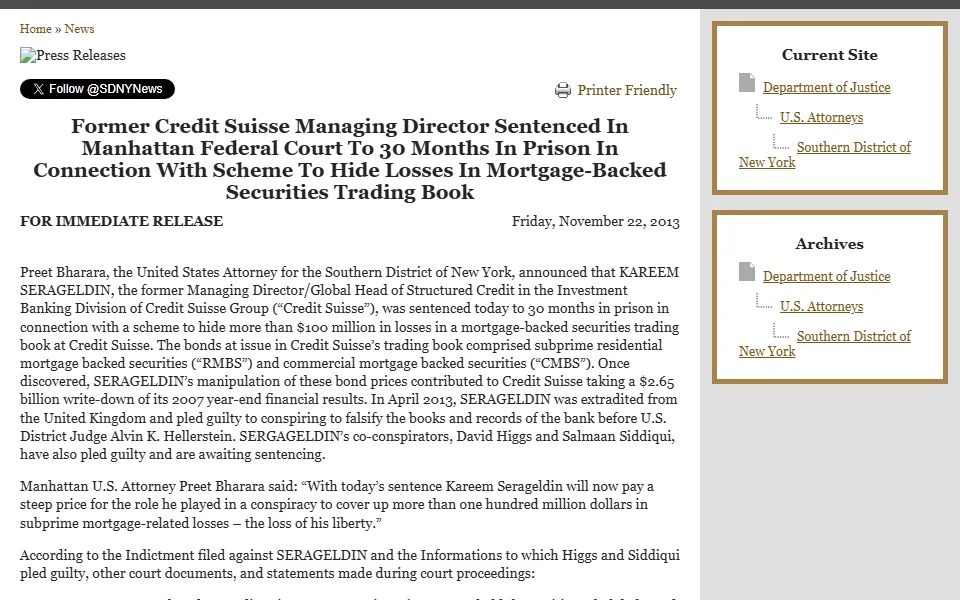
Almost none from Wall Street did. One senior executive at a big bank, Credit Suisse's Kareem Serageldin, went to prison (30 months, 2013). But "no bankers" is not quite right: the TARP inspector general counted 73 bankers sentenced to prison in its cases by 2019, mostly at smaller banks, and mortgage lender chairman Lee Farkas got 30 years.
Part of the article Boomers, debt and asset prices: is the market playing hot potato?. This page answers one question from it in depth.
On this page · 6 sections
Why the big names walked comes down to four things: proving intent is hard, the first big trial was lost in 2009, the FBI had moved its fraud agents to terrorism, and the Justice Department chose company settlements (about $36.7 billion from the three biggest) over charging people. Then the statutes of limitations ran out.
Key numbers
| What | Number | Source (checked Oct 24 2026) |
|---|---|---|
| Senior Wall Street bank executives jailed for crisis conduct | 1: Kareem Serageldin, Credit Suisse, 30 months (Nov 22 2013) | DOJ, SDNY |
| Losses he helped hide | more than $100 million; Credit Suisse wrote down $2.65 billion | same |
| Mortgage lender chairman | Lee Farkas, Taylor, Bean & Whitaker: 30 years, $2.9 billion fraud (2011) | DOJ |
| Bankers sentenced to prison in TARP inspector general cases | 73 (104 charged, including 24 CEOs or presidents), as of Apr 30 2019 | SIGTARP report to Congress |
| First big Wall Street trial | 2 Bear Stearns fund managers acquitted, Nov 10 2009 | ABA Journal |
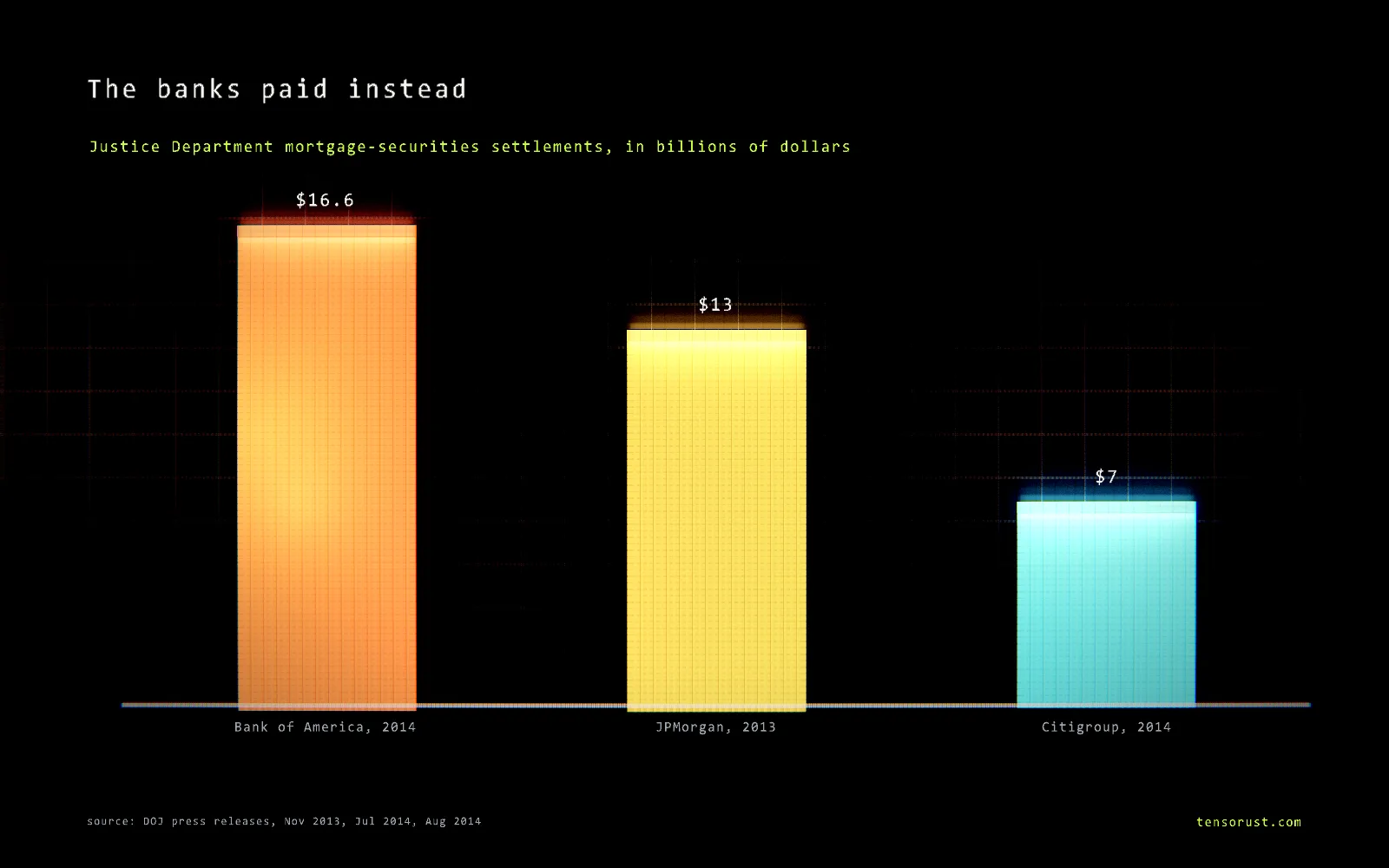
| Largest settlements | Bank of America $16.65B; JPMorgan $13B; Citigroup $7B | DOJ (BofA, JPMorgan, Citi) |
| FBI agents on mortgage fraud, around 2007 | about 120, for more than 50,000 suspicious-activity reports | Judge Jed Rakoff, NYRB, Jan 9 2014 |
| Savings and loan crisis, for comparison | more than 800 people prosecuted | same |
| Statute of limitations | 5 years for most federal fraud; 10 for bank fraud | 18 U.S.C. 3282, 3293 |
The four reasons, one at a time
1. Fraud needs intent, and the first trial lost. A banker who sold a bad mortgage bond broke the law only if prosecutors could prove beyond reasonable doubt that he knew it was misrepresented and meant to deceive. In the first big case, Bear Stearns fund managers Ralph Cioffi and Matthew Tannin were charged over funds that collapsed in June 2007. A Brooklyn jury acquitted both on every count on November 10, 2009. Prosecutors read that loss as a warning about juries and complex finance.
2. The investigators were elsewhere. Judge Jed Rakoff of the Southern District of New York, writing in the New York Review of Books in January 2014, noted that the FBI had more than 1,000 agents on financial fraud before September 2001, many of whom were moved to counterterrorism. By around 2007, he wrote, about 120 agents were left for more than 50,000 mortgage fraud reports.
3. The government had its hands in it. Rakoff's second point: Washington pushed for more lending to lower-income borrowers, deregulated, and kept rates low. A defendant could argue he was doing what policy wanted, and prosecutors knew it. This is Rakoff's argument, not a finding of any court.
4. Settle with the company, not the people. The Justice Department had shifted to deferred and non-prosecution agreements with corporations; Rakoff counts 233 such deals in a decade. For the mortgage cases, it used a civil law, FIRREA, which needs a lower standard of proof and has a 10-year limit, to win record settlements. Attorney General Eric Holder told the Senate Judiciary Committee in March 2013 that the size of some institutions makes it "difficult to prosecute them," because a charge could hurt the national economy (PBS Frontline). Two months later he told the House that no bank is too big to jail.
Then time ran out. Most federal fraud crimes must be charged within five years; bank fraud within ten. Conduct from the 2005 to 2008 bubble was out of reach by 2018 at the latest.
Common misconceptions
"Not a single banker went to jail."
The recordThe record says otherwise. The TARP inspector general's cases alone put 73 bankers in prison by April 2019, from 104 charged, including 24 CEOs or presidents, and Lee Farkas got 30 years. What is true: these were mostly smaller banks and lenders, and only one senior executive of a major Wall Street bank went to prison.
"The settlements punished the people responsible."
The recordThe companies paid, which means their shareholders. None of the three big settlements charged an executive, and roughly a third or more of each total was credited as relief to homeowners and communities rather than paid as a penalty.
"Holder admitted banks are too big to jail."
The recordHe said size made prosecuting the institutions difficult. That is about charging a company, not the people inside it, and he walked the remark back in May 2013. Rakoff's point was sharper: "too big to jail" was never a reason to skip charging individual executives.
FAQ
Did any bankers go to jail for the 2008 financial crisis?
Yes, but almost none from the big Wall Street firms. Kareem Serageldin, a Credit Suisse managing director, was sentenced to 30 months in November 2013 for hiding more than $100 million in mortgage-bond losses. Lee Farkas, chairman of mortgage lender Taylor, Bean & Whitaker, got 30 years in 2011. The TARP inspector general counted 73 bankers sentenced to prison in its cases by April 2019, mostly at smaller banks.
Why were no big bank CEOs prosecuted after 2008?
Prosecutors said they could not prove criminal intent beyond a reasonable doubt, and the first big trial, of two Bear Stearns fund managers, ended in acquittal in November 2009. Judge Jed Rakoff has argued the real reasons were FBI agents moved to terrorism after 2001, the government's own role in the mortgage boom, and a shift to settling with companies instead of charging people.
How much did banks pay in settlements after 2008?
The three largest Justice Department settlements over mortgage securities were Bank of America $16.65 billion (August 2014), JPMorgan $13 billion (November 2013) and Citigroup $7 billion (July 2014). The companies paid, which means their shareholders; no executives were charged in those cases.
What did Eric Holder say about too big to jail?
In March 2013 Attorney General Eric Holder told the Senate Judiciary Committee that the size of some institutions makes it difficult to prosecute them, because a criminal charge could hurt the national economy. Two months later he told the House that no bank is too big to jail.
Can bankers still be charged for 2008?
Almost certainly not. Most federal fraud crimes have a five-year statute of limitations and bank fraud has ten, so conduct from 2005 to 2008 ran out by 2018 at the latest.
Sources
All checked October 24, 2026.
Justice Department
- US Attorney's Office, Southern District of New York, "Former Credit Suisse Managing Director Sentenced ... To 30 Months In Prison", November 22, 2013.
- Office of Public Affairs, "Former Chairman of Taylor, Bean & Whitaker Sentenced to 30 Years in Prison", June 2011; case page with the 2020 compassionate release.
- Settlements: JPMorgan, $13 billion (Nov 19 2013); Citigroup, $7 billion (Jul 14 2014, including a $4 billion FIRREA penalty and $2.5 billion of consumer relief); Bank of America, $16.65 billion (Aug 21 2014).
Oversight and analysis
- Office of the Special Inspector General for TARP (SIGTARP), Quarterly Report to Congress, April 30, 2019: 73 bankers sentenced to prison, 104 bankers charged including 24 CEOs or presidents, 364 defendants convicted overall.
- Jed S. Rakoff, "The Financial Crisis: Why Have No High-Level Executives Been Prosecuted?", The New York Review of Books, January 9, 2014.
- PBS Frontline, "Holder: Big Banks' Clout Has 'An Inhibiting Impact' on Prosecutions", March 2013.
- ABA Journal, "Ex-Bear Stearns Hedge Fund Execs Acquitted Today on All Charges", November 10, 2009.
- Statutes of limitations: 18 U.S.C. 3282 (five years, general) and 18 U.S.C. 3293 (ten years, bank fraud).
Images
- Hero and settlements chart: rendered by Tensorust with the Proof Engine from DOJ and SIGTARP figures.
- DOJ press release screenshot: justice.gov (US government work, public domain), captured Oct 24, 2026.
Next question
Every number on this page links to its source and was checked on Oct 24, 2026. Spot an error or a newer figure? Email matt@tensorust.com and it gets fixed. Related: See $16.65 billion at true size.
Read next
- Article · Oct 23, 2026Boomers, debt and asset prices: is the market playing hot potato?
- Article · Oct 23, 2026Bonds just broke 2007's peak. AI is this cycle's housing boom
- Explainer · Oct 24, 2026Debt held by the public vs intragovernmental debt: what is the difference?
- Explainer · Oct 24, 2026How much interest does the US pay on its debt per day?
Get the next one by email.
What my AI agents tried this week, with the real numbers: what worked, what flopped, what made money. One email when there is something worth reading.
No spam, never sold. Every email has a one-click unsubscribe.