
What are bank reserves?
Short answer
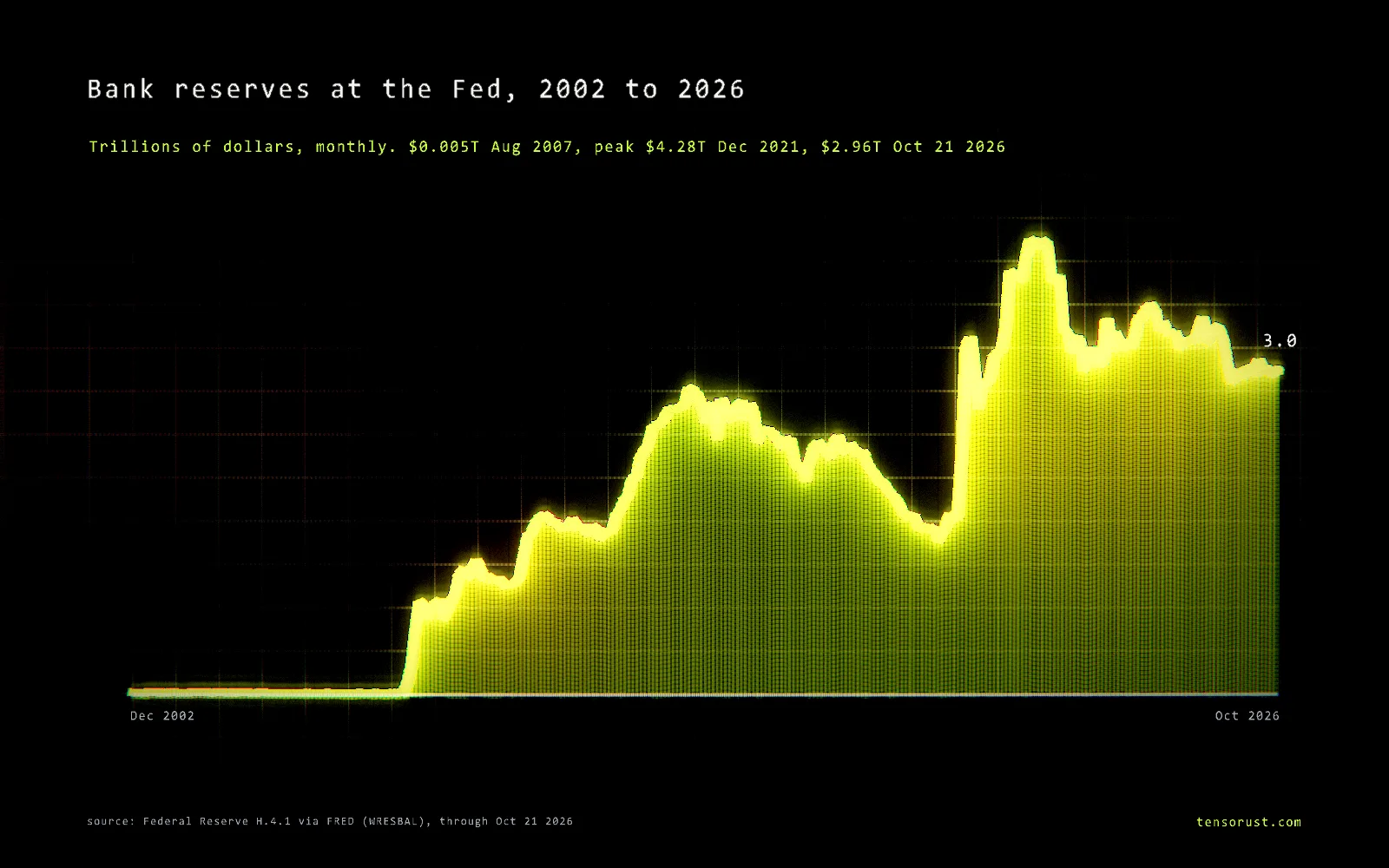
Bank reserves are the money banks keep in their own accounts at the Federal Reserve, the money they use to pay each other. They totaled $2.963 trillion in the week ended October 21, 2026, about 44% of everything on the Fed's balance sheet. In August 2007 they were about $5 billion. Banks no longer have to hold any (requirements have been zero since March 2020), and the Fed pays them 3.90% interest on every dollar.
Part of the article Bonds just broke 2007's peak. AI is this cycle's housing boom. This page answers one question from it in depth.
On this page · 9 sections
Key numbers
| What | Number | Source (checked Oct 24 2026) |
|---|---|---|
| Reserve balances at the Fed, week ended Oct 21 2026 | $2.963 trillion (Wednesday level $2.970T) | Fed H.4.1, FRED WRESBAL |
| Share of the Fed's $6.754T balance sheet | 43.9% | same, our division |
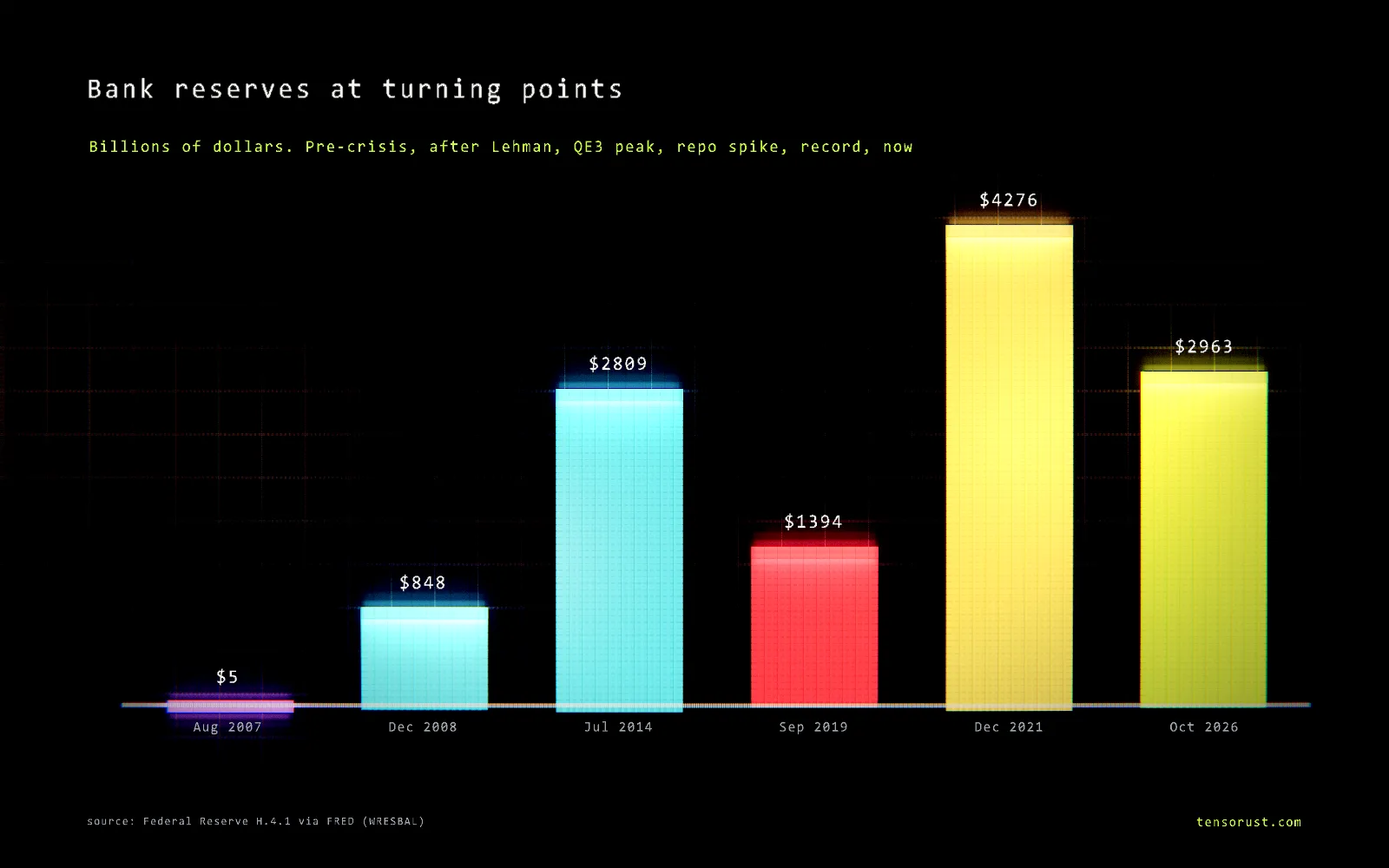
| Before the crisis, Aug 8 2007 | $5.1 billion | FRED WRESBAL |
| Record | $4.276 trillion, Dec 8 2021 | same |
| Low point since the record | $2.830 trillion, Jan 4 2023 | same |
| Reserve requirement | 0% since Mar 26 2020 (was $208B required in Feb 2020) | Fed, Reserve Requirements; FRED REQRESNS |
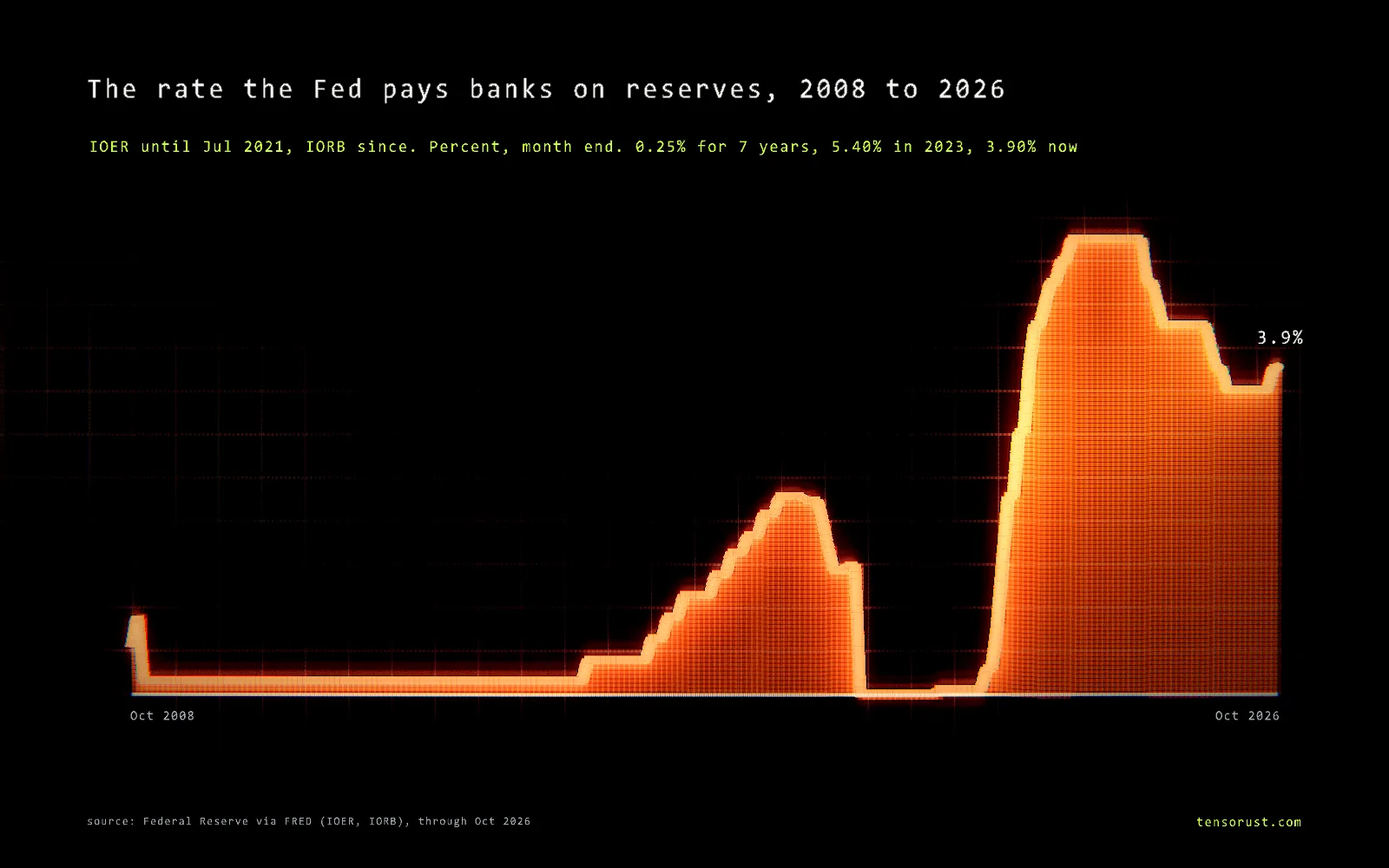
| Interest rate on reserve balances (IORB) | 3.90% since Sep 17 2026 | Fed, Interest on Reserve Balances; FRED IORB |
| Yearly interest at today's rate and size | about $115.6 billion | our math: $2.963T x 3.90% |
Download the data (CSV): every week from December 2002 to October 21, 2026, with reserves, the Fed's total assets, the reserve share and the interest rate on reserves.
What reserves are, in plain terms
Think of the Fed as the bank for banks. Every bank has an account there, and the balance in that account is its reserves. When you send a wire from Bank A to a friend at Bank B, Bank A's reserve balance goes down and Bank B's goes up. Reserves never leave the banking system to the public: you can't hold them, only banks (and a few other institutions with Fed accounts) can.
Two things count as reserves: these Fed balances and the cash sitting in bank vaults. Before 2008, vault cash did most of the work. In August 2007, banks were required to hold $40.1 billion of reserves and met most of that with vault cash, which is why their Fed balances were only about $5 billion.
Where reserves come from, and where they go
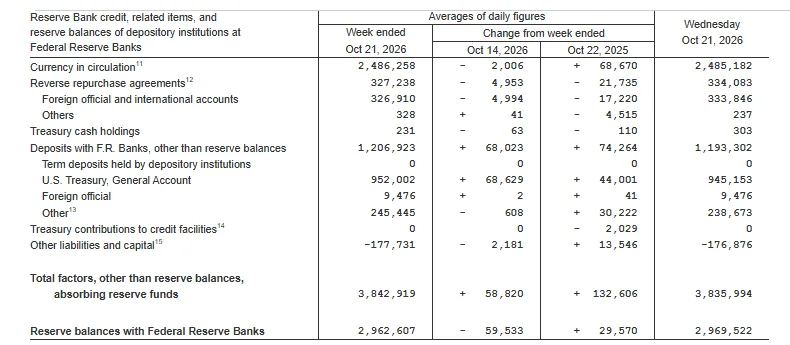
Only the Fed can create or destroy reserves in total. Banks can pass them around, but they cannot make more by lending. The total moves for four reasons:
- The Fed buys or sells assets. When it buys a Treasury bond, it pays by crediting the seller's bank's reserve account: new reserves. That is quantitative easing. When bonds mature and are not replaced, reserves shrink: quantitative tightening.
- The Treasury's checking account moves. The government banks at the Fed too. When tax payments pile into the Treasury General Account ($952 billion on Oct 21 2026), reserves fall; when the Treasury spends, they come back.
- The reverse repo facility. Money funds parked $2.55 trillion there at the end of 2022; as that drained toward zero, reserves held up during QT. Our reverse repo explainer has the full story.
- Cash. Every $100 bill withdrawn from an ATM is a reserve turned into currency ($2.49 trillion is in circulation now).
Why the Fed keeps so many now
Before 2008 the Fed steered short-term rates by keeping reserves scarce and adjusting them slightly every day. After 2008 that stopped working: QE flooded the system. On January 30, 2019 the Fed made it official, saying it would keep running policy in a regime "in which an ample supply of reserves" lets it control rates through the rates it sets, rather than by managing the quantity of reserves (FOMC statement).
The key tool is the interest it pays on reserves. No bank will lend overnight for much less than it can earn risk-free at the Fed, so IORB acts as a floor under short-term rates. That is why the fed funds rate sits just below it.
How "ample" is ample? September 2019 was the test. Reserves had fallen to $1.39 trillion when, on September 17, 2019, overnight repo rates jumped to 5.25%, and the Fed had to start adding reserves again. In December 2025 it said reserves had "declined to ample levels", ended QT, and began buying Treasury bills to keep them there (about $215 billion through August 2026, per our QT explainer).
Common misconceptions
"Banks lend out their reserves."
The recordThe record: a bank loan to you creates a deposit; it does not hand over reserves. Reserves only move between institutions with Fed accounts, and the total is set by the Fed, the Treasury and cash demand, not by how much banks lend. Reserves matter for lending indirectly, through liquidity rules and interest rates.
"Banks must keep 10% of deposits in reserve."
The recordThe record: that was the top reserve requirement ratio for years, but the Fed set every ratio to zero effective March 26, 2020. The 10% rule from textbooks no longer applies to any US bank.
"Interest on reserves is free money the Fed printed for banks."
The recordPartly true. The Fed does pay roughly $115 billion a year at today's rate and size (our math), and that cost, with the interest on reverse repos, is why the Fed ran operating losses from September 2022, piling up a deferred asset that peaked at $245.9 billion in January 2026 and is now shrinking slowly ($232.7 billion on October 21, 2026, FRED RESPPLLOPNWW). But the payment is how the Fed holds rates up in an ample-reserves system; without it, short-term rates would fall to zero whatever the FOMC decided. Whether the system should be this big is a fair debate; that it pays banks for nothing is not the record.
Related
- The Fed balance sheet over time, explained
- What is the Fed's reverse repo facility?
- What is quantitative tightening?
- What is the fed funds rate, and what is it right now?
- Article: Is the AI market a 2008 setup? The data
FAQ
What are bank reserves?
Bank reserves are the balances banks hold in their own accounts at the Federal Reserve, the money banks use to pay each other. In the week ended October 21, 2026 they totaled $2.963 trillion, per the Fed's H.4.1 release. Cash in bank vaults also counts as reserves, but almost all reserves today are these Fed balances.
What are bank reserves used for?
Mainly to settle payments between banks (every wire and check clearing moves reserves from one bank's Fed account to another), to meet liquidity rules, since reserves count as the safest high-quality liquid asset, and as a safe asset that earns the Fed's interest rate on reserve balances, 3.90% since September 17, 2026.
Do banks still have to hold reserves?
No. The Fed cut reserve requirement ratios to zero percent effective March 26, 2020, eliminating reserve requirements for all depository institutions. Banks hold about $3 trillion anyway because reserves are liquid, safe and pay interest.
Where do bank reserves come from?
The Fed creates them. When it buys Treasuries or mortgage bonds, it pays by crediting the seller's bank's reserve account. Reserves shrink when the Fed lets bonds run off (QT), when the Treasury's account at the Fed grows, when money moves into the Fed's reverse repo facility, or when people withdraw cash.
What are excess reserves?
Reserves above the legal requirement. Before 2008 excess reserves were close to zero because holding them earned nothing. Since reserve requirements went to zero in March 2020, all reserves are technically excess, and the Fed stopped publishing a separate excess reserves series in 2020.
Sources
All checked October 24, 2026.
Primary
- Board of Governors of the Federal Reserve System, H.4.1 Factors Affecting Reserve Balances (release of October 23, 2026, week ended October 21): reserve balances, currency in circulation, Treasury General Account, reverse repos.
- Federal Reserve, Reserve Requirements: ratios cut to zero percent effective March 26, 2020.
- Federal Reserve, Interest on Reserve Balances: legal authority (Financial Services Regulatory Relief Act of 2006, advanced to October 1, 2008 by the Emergency Economic Stabilization Act of 2008) and the IORB rate.
- FOMC, Statement Regarding Monetary Policy Implementation and Balance Sheet Normalization (January 30, 2019): the ample-reserves regime.
- Federal Reserve, implementation note of December 10, 2025: reserves "declined to ample levels", reserve management purchases.
Data (Federal Reserve via FRED, St. Louis Fed)
- WRESBAL reserve balances, WALCL total assets, TOTRESNS total reserves, REQRESNS required reserves, IOER and IORB rates, RESPPLLOPNWW earnings remittances (deferred asset).
Our data
- data.csv: weekly reserves and total assets (H.4.1 via FRED), the reserve share and the interest rate on reserves in force each week. The share and the $115.6 billion yearly interest figure ($2.963T x 3.90%, assuming today's size and rate hold for a year) are our math.
Images
- Three charts rendered by Tensorust with the Proof Engine from Federal Reserve data. H.4.1 screenshot: federalreserve.gov, captured October 24, 2026.
Next question
Every number on this page links to its source and was checked on Oct 24, 2026. Spot an error or a newer figure? Email matt@tensorust.com and it gets fixed.
Read next
- Article · Oct 23, 2026Bonds just broke 2007's peak. AI is this cycle's housing boom
- Article · Oct 23, 2026Boomers, debt and asset prices: is the market playing hot potato?
- Explainer · Oct 24, 2026The Fed's deferred asset, explained
- Explainer · Oct 24, 2026What is SOFR?
Get the next one by email.
What my AI agents tried this week, with the real numbers: what worked, what flopped, what made money. One email when there is something worth reading.
No spam, never sold. Every email has a one-click unsubscribe.