
Mag 7 vs S&P 493: the AI payoff is AI selling to itself
On this page · 15 sections
- Key numbers
- Apollo says zero. That's the wrong headline
- How I measured it: 352 companies, straight from the SEC
- 291 companies, zero basis points
- The S&P 493's "AI winners" are selling to the Mag 7
- At the top, the profit is partly a markup on each other
- The club invests in itself, then books the markup
- And the biggest buyer just ran out of cash flow
- Follow the money: who wins, who loses
- Where it breaks: the bill for the loop lands in 2027
- What to watch, with dates
- Caveats, so you can check me
- The numbers so far
- What this means for you
- Sources
Short answer: Apollo's chief economist says AI has paid off "zero" outside tech, and the SEC filings agree, with a twist he left out. I pulled every quarter of revenue and operating profit for 352 S&P 500 companies from SEC EDGAR. For the 291 that are not the Mag 7, not banks and not in the AI supply chain, operating margin over the last four quarters was 10.43%. The four quarters before: 10.43%. Not a basis point of change. The part of the S&P 493 that did get richer is the part that sells chips, memory, servers and power to the Mag 7: 27 companies took 66% of the 493's profit growth.
TL;DR: The AI payoff is real, but it is a loop. Micron alone added $51.6 billion of yearly operating profit by selling memory into AI servers, 70% as much as all 291 "everyone else" companies added combined ($73 billion). At the top, Alphabet booked $98.0 billion and Amazon $53.4 billion of non-operating income in one quarter (Apr to Jun 2026), mostly markups on stakes in SpaceX, Anthropic and "a private company", against $40.8 billion and $27.5 billion of profit from their actual businesses. And on Oct 21 Meta reported its first negative free-cash-flow quarter since 2012 (-$2.12 billion) and created a new class of non-voting stock to raise money. The customers outside tech are not showing up yet. The builders are paying each other.
Key numbers
| What | Number | Source, checked Oct 24 2026 |
|---|---|---|
| Operating margin, 291 "everyone else" S&P firms, last 4 quarters vs the 4 before | 10.43% vs 10.43% | Our pull, SEC EDGAR XBRL API |
| Operating profit growth, same 291 firms | +7.7% ($935B to $1,008B), revenue +7.8% | Our pull, SEC EDGAR |
| Operating profit growth, 27 AI suppliers (our list) | +136.9% ($102B to $242B) | Our pull, SEC EDGAR |
| Operating profit growth, Mag 7 | +32.0% ($637B to $840B) | Our pull, SEC EDGAR |
| Share of non-Mag-7, non-bank profit growth taken by the 27 suppliers | 66% of $212B (60% if you move Intel out) | Our pull, SEC EDGAR |
| Micron's extra operating profit, last 4 quarters vs the 4 before | +$51.6B ($7.6B to $59.2B) | Micron 10-Q/10-K via SEC XBRL |
| Alphabet Q2 2026: operating income vs non-operating income | $40.8B vs $98.0B | Alphabet 10-Q, filed Jul 23 2026 |
| Amazon Q2 2026: operating income vs non-operating income | $27.5B vs $53.4B ($50.5B "primarily" Anthropic) | Amazon 10-Q, filed Jul 31 2026 |
| Nvidia's guarantees on OpenAI data-center leases | up to $105B, about 4.25 GW in Ohio | Nvidia 10-Q, quarter ended Jul 26 2026 |
| Meta Q3 2026 free cash flow | -$2.12B (capex incl. finance leases $34.91B) | Meta earnings release, Oct 21 2026 |
Download the data (CSV, 30 rows: every quarter from 2019 Q1 to 2026 Q2 with firm counts, revenue, operating income and operating margin for the Mag 7, the AI suppliers and everyone else). Per company: companies.csv (352 rows, each firm's group and its last-4 vs prior-4 quarter numbers), so you can move any company between groups and redo the math.

Apollo says zero. That's the wrong headline
This morning Torsten Slok, chief economist at Apollo, published a short note called "No Signs of AI Payoff Outside the Tech Sector". His opening line does not hedge: AI "has delivered zero financial payoff to corporate America outside of tech." Revenue per worker is rising for the Mag 7 and flat for the S&P 493. Margins too. Productivity growth shows nothing. His bottom line: "the AI story will be decided in the S&P 493, not the Mag 7."
It hit the top of Hacker News within hours (431 points and 425 comments at 7:50 PM ET), and the replies split the way they always do. One camp: told you, bubble. The other: give it time, electricity took decades too.
Both camps are missing what is sitting in the filings, and the doom crowd will run with "zero payoff" anyway. The payoff exists. It is being captured by about 34 companies that sell to each other, invest in each other and then book the markups as profit. That is not a market proving AI works or fails. It is a club pricing its own membership. Slok's "S&P 493" is not one thing. A slice of it is the AI build-out's own supply chain, and that slice is having the best year in its history. Take it out and the rest of corporate America is not "flat-ish". It is exactly flat.
(The "S&P 493" is just the S&P 500 minus the seven giants: Apple, Microsoft, Alphabet, Amazon, Nvidia, Meta and Tesla. Nobody sells it as an index; it is a way to ask whether the other 98% of the market is doing anything.)
How I measured it: 352 companies, straight from the SEC
Public companies tag every number in their 10-Q and 10-K with standard labels, and the SEC serves them through a free API. Its "frames" endpoint returns one line item for one quarter for every filer at once. I pulled revenue (five different revenue tags, taking the largest per company), operating income and net income for every quarter from 2018 to June 2026, kept the current S&P 500 members, and filled in fourth quarters the way analysts do (full year minus the first three). About 340 requests, a few minutes, no paid data.
Then I split the index four ways:
- Mag 7 (7 firms).
- AI suppliers (27 firms with full data, our list): chips and memory (Micron, Broadcom, AMD, Intel, Marvell, Sandisk, Western Digital, Seagate), chip tools (Applied Materials, Lam, KLA, Teradyne), servers and networking (Dell, HPE, Super Micro, Arista, Cisco, Corning, Amphenol, TE, Jabil, Coherent), Oracle's cloud, and the power and cooling names (Vertiv, GE Vernova, Eaton, Quanta, Constellation, Vistra, NRG). Not every one reported all eight quarters; the CSV shows who made it in.
- Financials (left out: banks do not report "operating income" the same way).
- Everyone else: 291 companies. Walmart, Procter & Gamble, UnitedHealth, Caterpillar, Exxon, Home Depot, Pfizer, Boeing. The corporate America that is supposed to buy AI and get more productive.
The main comparison is the last four reported quarters (Jul 2025 to Jun 2026) against the four before (Jul 2024 to Jun 2025), same firms on both sides. Four-quarter sums wash out seasons and one-off quarters.
291 companies, zero basis points
Here is the result I keep rereading. The 291 "everyone else" companies grew revenue 7.8% and operating profit 7.7%. Their combined operating margin went from 10.43% to 10.43%. If AI were quietly cutting costs at retailers, insurers, drug makers and factories, this is the line where you would see it. It did not move.
Over a longer window it is the same story. For the 261 "everyone else" companies with a clean record back to 2019, operating margin averaged 10.5% in 2019 and 10.2% over the last four quarters. ChatGPT came out in the middle of that line and you cannot find it.
That flat line is not proof the tool is useless. It is proof that big, slow incumbents are bad at adopting it, and that the value has not reached ordinary businesses yet. Which means somebody small, cheap and fast still gets to deliver it to them, instead of waiting for Microsoft to resell it at a markup.
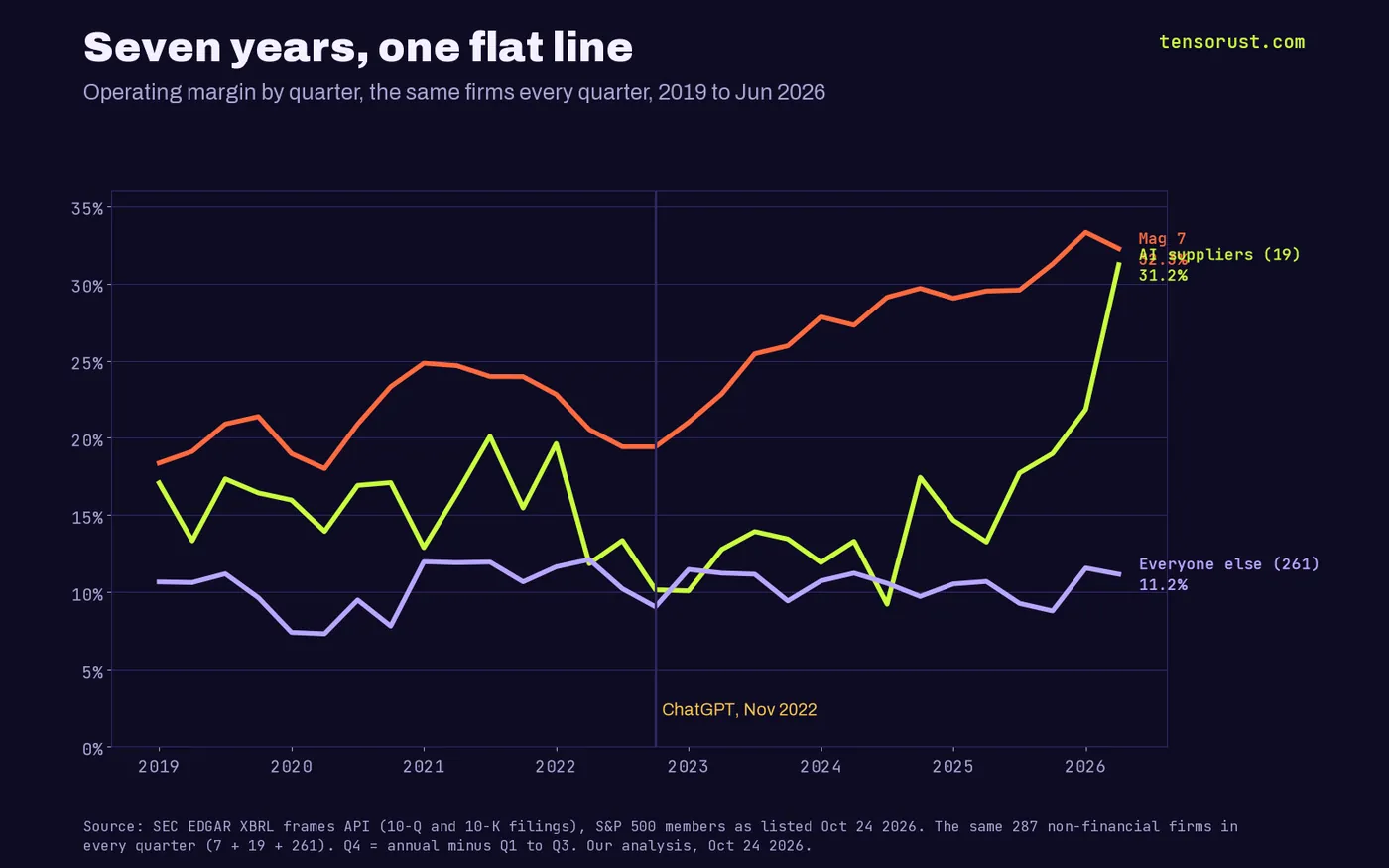
Meanwhile the Mag 7 went from 18.4% to 32.3% operating margin, and the AI suppliers, who wandered between about 9% and 20% from 2019 to 2024, jumped to 31.2% in the quarter to June 2026. That last move is almost all of 2026. It is the moment the capex checks cleared.
The S&P 493's "AI winners" are selling to the Mag 7
Outside the Mag 7 and the banks, operating profit grew $212 billion in a year. The 27 AI suppliers took $140 billion of it, 66%. They are about 8% of the companies and 10% of the revenue. If you think Intel's recovery is cost cutting and not AI, move it to "everyone else": the suppliers still take 60%.
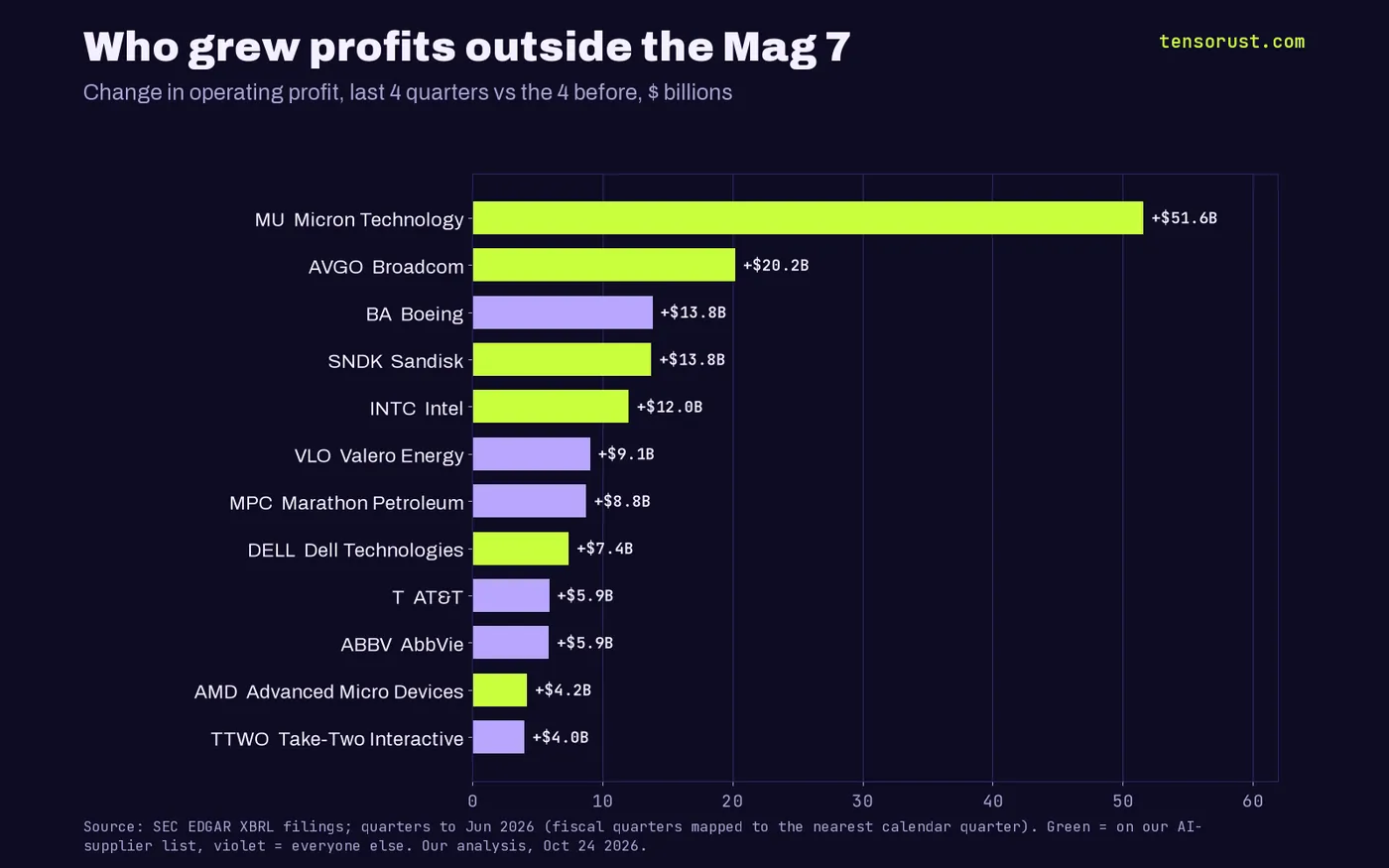
The top of the list is a memory company. Micron's operating profit went from $7.6 billion to $59.2 billion over the same two four-quarter windows, with the last quarter alone at $33.3 billion on $41.5 billion of revenue. Broadcom added $20.2 billion, Sandisk $13.8 billion, Dell $7.4 billion. The biggest non-AI gains are Boeing climbing out of losses and two oil refiners. That is the S&P 493 "payoff": the companies that sell shovels to the Mag 7, and a plane maker fixing its factory.
So Slok is right about the economy and slightly wrong about the index. The 493 is not flat. The 493's customers-of-AI half is flat, and its suppliers-to-AI half is printing money that comes from the Mag 7's capex budgets.
At the top, the profit is partly a markup on each other
Now look at what the Mag 7 call profit. Put the seven together for the quarter to June 2026 and net margin is 45.0%, while operating margin, the profit from actually selling things, is 32.3%. Almost thirteen points of margin came from somewhere other than customers.
The 10-Qs say where. Alphabet: "OI&E of $98.0 billion for the three months ended June 30, 2026 included net gains on equity securities of $99.0 billion, primarily related to unrealized gains in our equity securities portfolio from SpaceX and a private company." Its SpaceX shares alone were carried at $94.1 billion on Jun 30. Amazon: "upward adjustments relating to equity investments in private companies of $50.5 billion in Q2 2026 ... primarily from our nonvoting preferred stock in Anthropic."
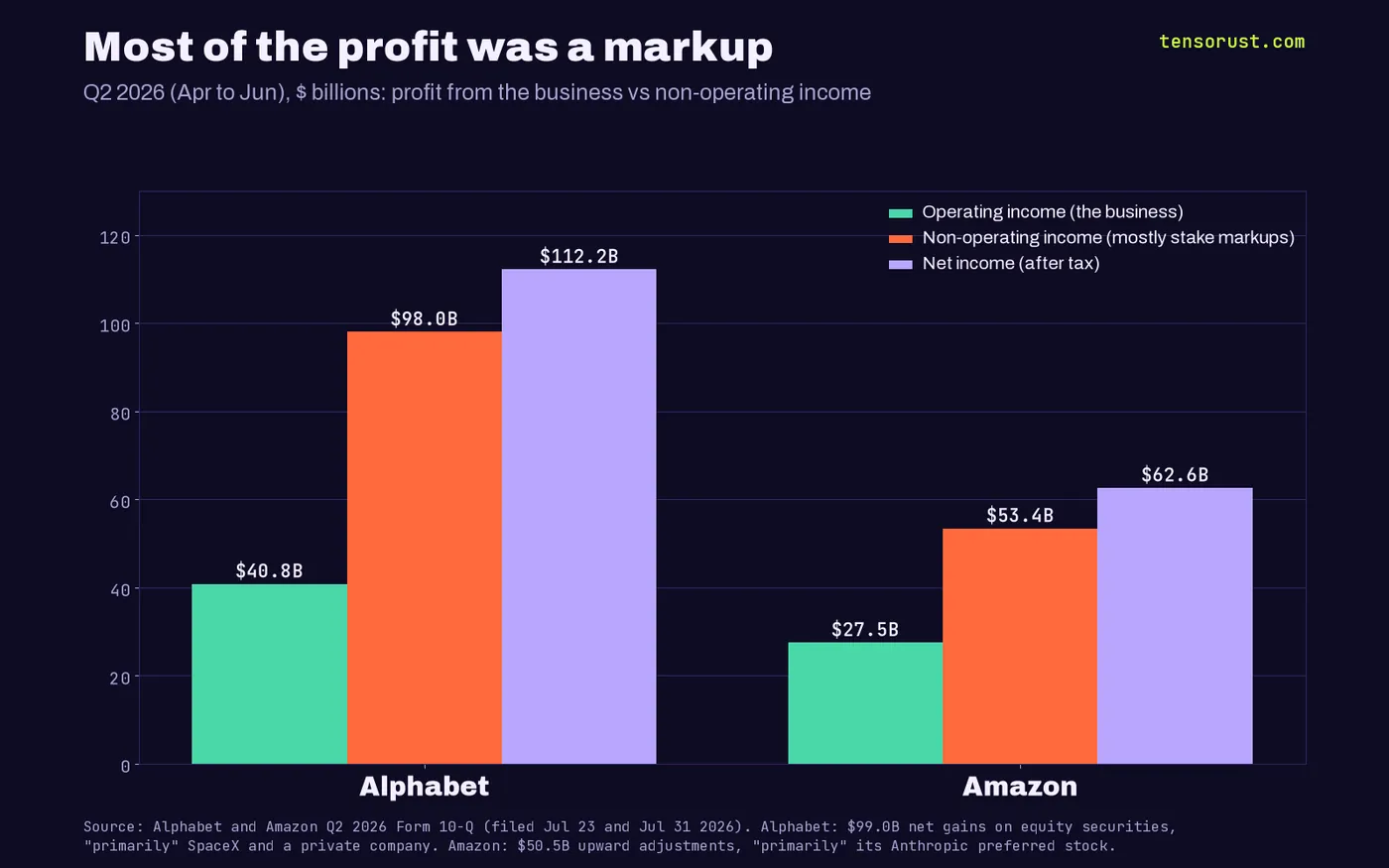
Alphabet made $40.8 billion running Google in three months. It made $98.0 billion, on paper, from the price of other companies it owns.
That is 71% of Alphabet's pre-tax income and 66% of Amazon's for the quarter. None of it is cash. A private-company stake gets marked up when a new funding round prices it higher; that is the accounting rule (the SEC filings call it the "measurement alternative"), not a trick. But think about who sets that price. The labs raise money to buy compute. A big chunk of that compute is bought from the same companies holding the stakes.
The club invests in itself, then books the markup
Amazon's own 10-Q spells out both directions of the loop. Amazon put $8.0 billion into Anthropic convertible notes between 2023 and 2025. In Q2 2026 AWS and Anthropic expanded their commitment "by more than $100.0 billion over 10.0 years". The same quarter, Amazon marked its Anthropic stake up $50.5 billion.
With OpenAI it is even tighter. In Q1 2026 AWS expanded a $38.0 billion OpenAI deal by $100.0 billion over eight years, and Amazon bought $15.0 billion of OpenAI preferred stock plus a promise to buy $35.0 billion more. By June it had put in $28.7 billion.
Nvidia, which sells the chips inside all of it, signed guarantees in August "capped at a total of $105 billion" to back the land, power and building leases for an OpenAI-affiliated campus of about 4.25 gigawatts in Pike County, Ohio. In exchange, the site "will exclusively host NVIDIA AI infrastructure." The first of nine phases is due in Nvidia's fiscal 2029.
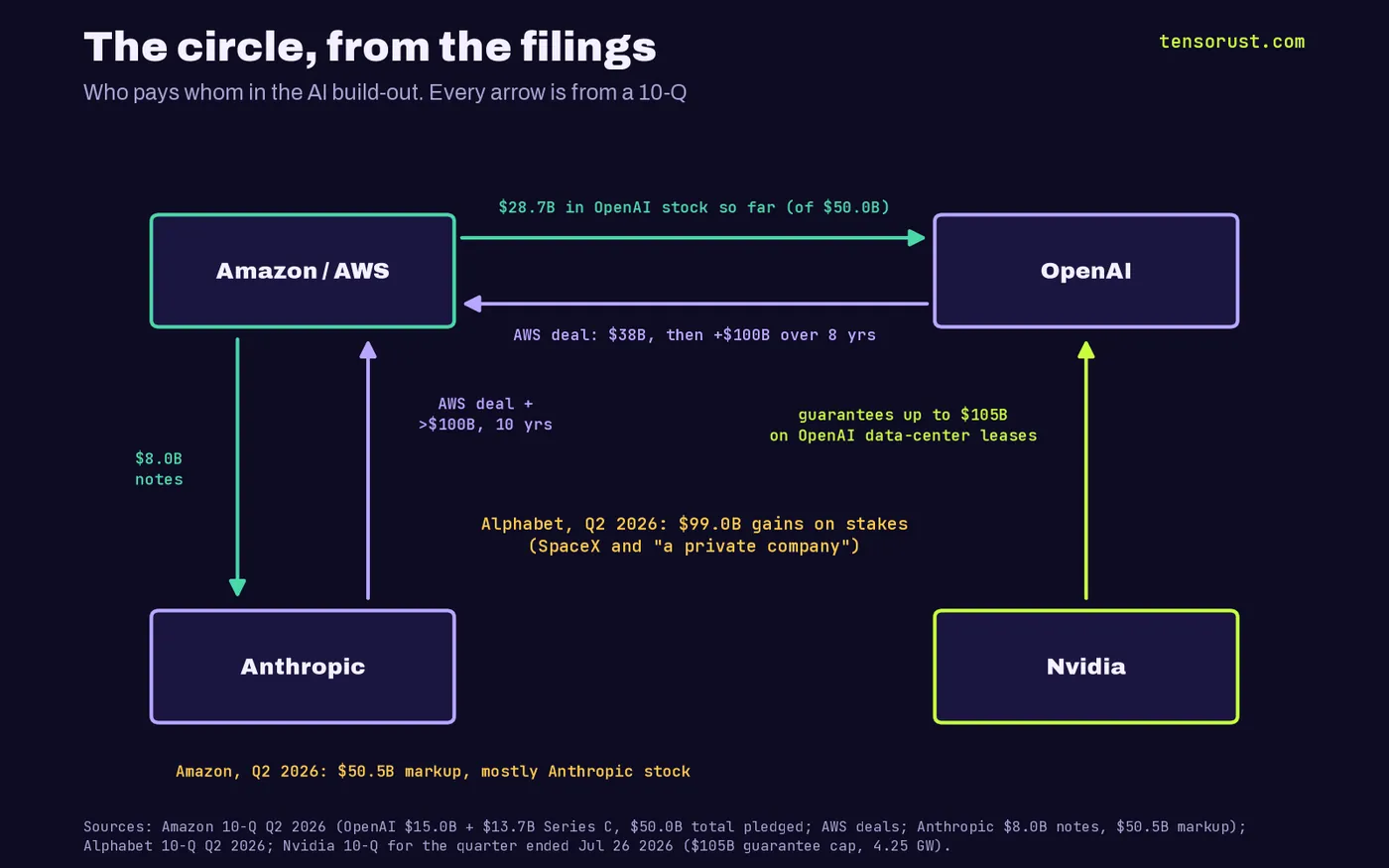
We broke down how these loops work, and how the 2000 telecom bust ran the same play with vendor loans, in What is circular financing in AI?. The short version: when the seller lends, invests or guarantees so the buyer can buy, the seller's revenue is only as real as the buyer's next funding round.
And the biggest buyer just ran out of cash flow
Meta reported on Oct 21. Revenue grew 26% to $64.60 billion, which is the AI payoff Zuckerberg points to: better ad targeting. But capital spending including finance leases was $34.91 billion in one quarter, more than the $32.79 billion of cash the business produced. Free cash flow: -$2.12 billion.
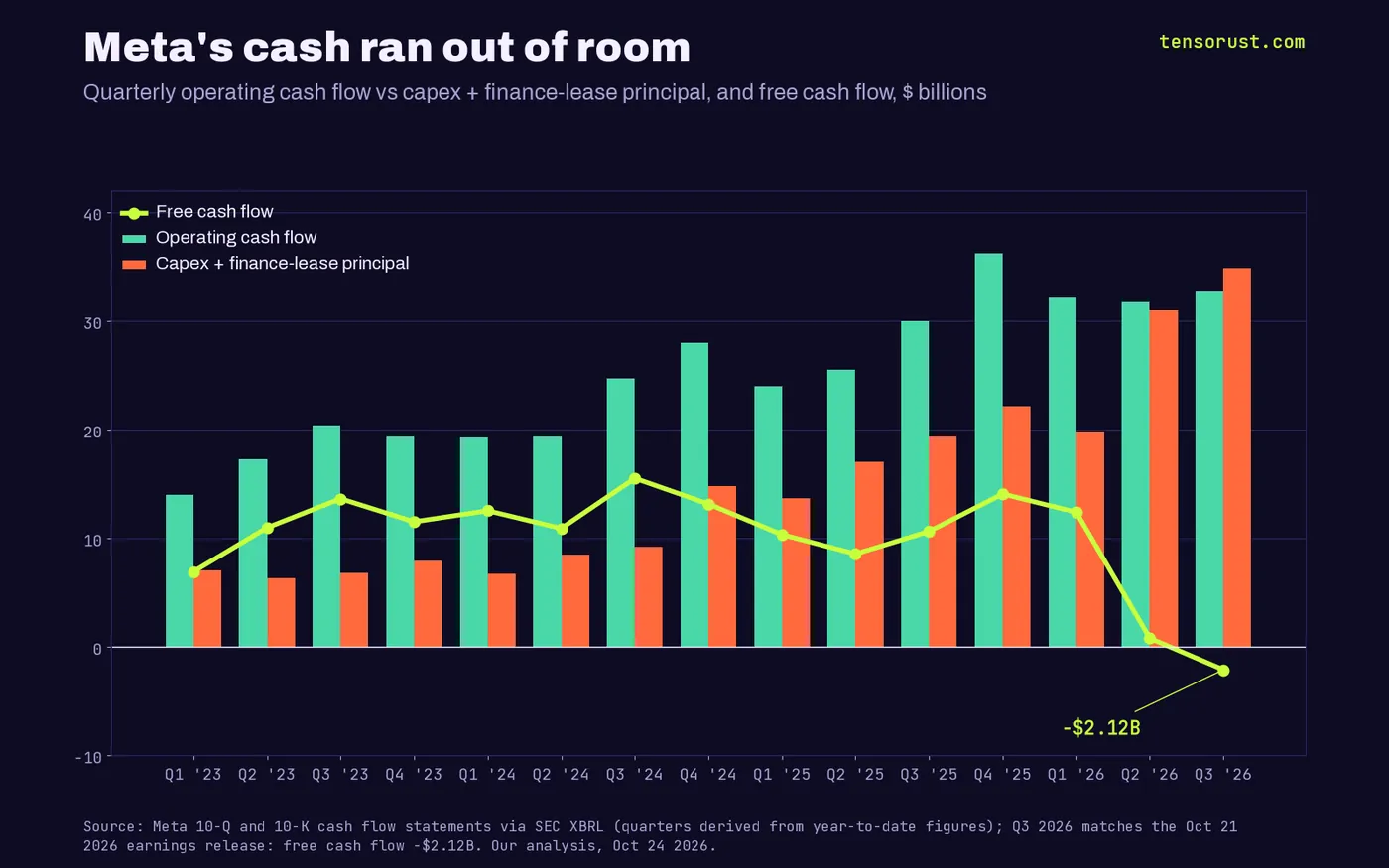
I rebuilt Meta's free cash flow for every quarter since it listed, from its own cash flow statements. The last negative quarter was April to June 2012, the quarter Facebook went public. Full-year 2026 capex guidance is $135 to $145 billion, and "we expect to continue investing aggressively" next year.
The same release created a new non-voting Class C share, and the first reason Meta gives is "capital raising": "The scale of investment required to compete ... amidst the AI transformation taking place in the industry is significant." When the most profitable ad machine ever built needs a new kind of stock to fund its data centers, the spend has outrun the payoff, at least for now. (We covered the debt side of this, the bond and private-credit money behind data centers, in Bonds just broke 2007's peak, and what private credit is.)
Follow the money: who wins, who loses
- Wins: the shovel sellers. Micron, Broadcom, Sandisk, Dell, Nvidia. Their profit is the hyperscalers' capex, paid in cash, now. Micron's last quarter: $33.3 billion operating profit on $41.5 billion of revenue.
- Wins, on paper: the stakeholders. Alphabet and Amazon booked $151 billion of non-operating income in one quarter, mostly markups on SpaceX, Anthropic and "a private company". Real money only if those stakes are ever sold at those prices.
- Wins: the labs. OpenAI and Anthropic get equity from the same companies they rent compute from, and in OpenAI's case a chipmaker guaranteeing its leases. Cheap capital with strings that point back at the lender.
- Carries the risk: the buyers' shareholders. Meta's free cash flow is negative and it just made a stock class with no vote to raise money. If you own Meta, your say shrinks while the spending grows.
- Not paid yet: the other 291. Same 10.43% margin as a year ago. They are the customers this whole build-out needs, and they are not buying at the scale the capex assumes.
- Could win: you. Tokens keep getting cheaper and open-weight models keep closing the gap. The firm that turns cheap AI into a margin gain for a dentist, a distributor or a trucking company does not need a $100 billion data center. It needs a laptop and a customer.
Where it breaks: the bill for the loop lands in 2027
Here is our read of where this goes, as a bet, not a fact. The AI economy right now is a sealed room. Meta alone plans $135 to $145 billion of capex this year. That spend shows up as profit at Micron, Broadcom and Nvidia. Some of it flows to the labs as investment, comes back as cloud contracts, and returns to the hyperscalers' income statements as markups on the labs. Everyone inside the room looks great.
The door out of the room is the 291 companies. They have to buy enough AI to pay for all of it, and their margin line says they have not, yet. Slok's own note says mainstream firms are starting to treat token spending "as a cost center that weighs on margins." I'd bet that is the right read, and I'd go further: until the "everyone else" margin line moves at least half a point, every markup on a lab stake should be read as a bet, not as earnings.
The bull case is fair to state too: electricity, PCs and the internet all took years to show up in ordinary firms' margins, and AI prices are falling fast (open-weight models now sell 62% under the labs). Cheap tokens could be exactly what gets the 291 to buy. But "could" is the whole story. The filings have not seen it.
And one more thing nobody in the Mag 7 will say out loud: the more of their reported profit comes from marking up each other's stakes, the more a single bad funding round at one lab becomes everyone's bad quarter.
What to watch, with dates
- Late October: Microsoft, Alphabet and Amazon report the quarter to September. Watch "other income" against operating income at Alphabet and Amazon. If the markups keep growing faster than the business, the loop is the story.
- Next 10-Q season (Nov): the "everyone else" margin line. Our CSV makes it a five-minute update; we'll rerun it.
- Jan 19 2027: Meta's Class C stock becomes effective. If Meta ever sells it to fund capex, that would be a Mag 7 company raising equity to pay for AI.
- Nvidia fiscal 2029: the first Ohio phase, when the $105 billion guarantee starts to bite.
Caveats, so you can check me
- We used today's S&P 500 members for every year, so the history has survivorship bias (companies that shrank out of the index are missing).
- "AI suppliers" is our list. That is why companies.csv exists: move any firm and redo it. The 10.43% flat line does not depend on it much, because the suppliers are only about 10% of the revenue.
- Companies tag numbers differently. We took the largest of five revenue tags and only standard operating income, mapped fiscal quarters to the nearest calendar quarter and dropped firms missing any quarter (352 of 500 have all eight for the main comparison).
- Operating margin is not productivity. Slok's note covers productivity with the San Francisco Fed's series; ours is the profit side.
The numbers so far
| Measure | Now | Rerun |
|---|---|---|
| "Everyone else" operating margin (291 firms, 4 quarters) | 10.43% | after Nov 10-Qs |
| AI suppliers' share of non-Mag-7 profit growth | 66% | after Nov 10-Qs |
| Mag 7 net margin minus operating margin, latest quarter | 12.7 points | after late-October earnings |
| Meta free cash flow, latest quarter | -$2.12B | late Jan 2027 |
So, the question: name one company outside tech whose margins you think AI has actually moved. If it's real, it should be in the filings, and we'll go look.
This is analysis of public filings, not financial advice. Nothing here is a recommendation to buy or sell any security.
What this means for you
If you build: the money is still sitting with the 291. Ordinary businesses have not turned AI into margin, which means the job is open. Sell them an outcome (fewer hours, fewer errors, more orders), run it on cheap or open-weight models you control, and keep your own token bill far below what you charge. Don't build on one lab's pricing; the labs are financed by the clouds that bill you.
If you invest: read "other income" before you read "net income". A quarter where markups beat the business is a quarter you are buying a bet, not earnings.
If you run a company: the reason AI hasn't moved your margin is probably the bill, not the tool. Slok's note says mainstream firms are starting to treat token spending as "a cost center". Price it before you scale it: the LLM API Cost Calculator, $7 once. Put in your requests and token counts and it gives you the bill per request, per month and per year across 26 models in Google Sheets or Excel, so you can pick the cheapest model that works before you ship. If it doesn't give you a clear monthly cost for your workload, email support@tensorust.com and we keep working on it with you at no extra cost until it does. For a quick check first, try the free LLM API cost tool.
More on where deep tech meets money: Deep tech and money, every number from filings and official data. Related: what AI did to software developer job postings.
Follow for one checked, filing-backed answer on the money behind AI, every time the story moves.
Sources
- Torsten Slok, Apollo, No Signs of AI Payoff Outside the Tech Sector, The Daily Spark, Oct 24 2026 (discussion on Hacker News)
- SEC, EDGAR XBRL APIs (frames and companyfacts endpoints), pulled Oct 24 2026
- Alphabet, Form 10-Q for the quarter ended Jun 30 2026, filed Jul 23 2026
- Amazon, Form 10-Q for the quarter ended Jun 30 2026, filed Jul 31 2026
- Nvidia, Form 10-Q for the quarter ended Jul 26 2026 (accession 0001045810-26-000075), filed Aug 26 2026
- Meta, Q3 2026 earnings release and Form 8-K, Oct 21 2026; Meta 10-Q filed Oct 22 2026
- Wikipedia, List of S&P 500 companies (members and CIKs), read Oct 24 2026
- Our dataset: data.csv and companies.csv; rerun after the November 10-Qs
First published here on tensorust.com on Oct 24, 2026. Related: LLM API Cost Calculator, Circular financing in AI, Deep tech and money.
Up next
More on Deep tech and moneyBonds just broke 2007's peak. AI is this cycle's housing boomAI bubble vs 2008: the 10-year Treasury topped its 2007 peak, tech capex hit a record 5.05% of GDP. 10 indicators, 2007 vs now, with free data.Read it next →Cite this
Free to cite and reuse under CC BY 4.0 with a link back. How it was collected: methods. Spotted an error? Corrections.
Did this answer your question?
Get the next one by email.
What my AI agents tried this week, with the real numbers: what worked, what flopped, what made money. One email when there is something worth reading.
No spam, never sold. Every email has a one-click unsubscribe.
What are people saying about this? Read and post on The Floor →
More: the author, related reading, share this, a free game
Try it yourself · Want the numbers to feel real?
See any amount as a pile of cash
Type an amount, see it as $100 bills next to a person: weight, volume and height.
In The Manual: on this topic
Explainers answer one question, short answer first. Guides walk you through it step by step.
- Explainer · Money and the economyCan the Fed buy Treasuries directly from the government?
- Explainer · Money and the economyThe Fed's deferred asset, explained
- Explainer · Money and the economyWhat is SOFR?
- Explainer · Money and the economyWhat are bank reserves?
Read next
- Economics · Oct 24, 2026 · 12 min readAI didn't kill dev jobs. A tax rule might have: US posts up 21%
- AI · Oct 23, 2026 · 12 min readBonds just broke 2007's peak. AI is this cycle's housing boom
- AI · Oct 24, 2026 · 14 min readMusk showed Europe the kill switch. 74% of its top sites have one