
By Matt Busel, who built the apps, crates and game he writes about · every number links to its source and every dataset is downloadable (methods) · corrections · featured in Kirino, gamebiz, This Week in Rust, New Mobile Life, By-Press
Longevity drugs: GLP-1 trials grew 14x, anti-aging pills flatlined
On this page · 8 sections
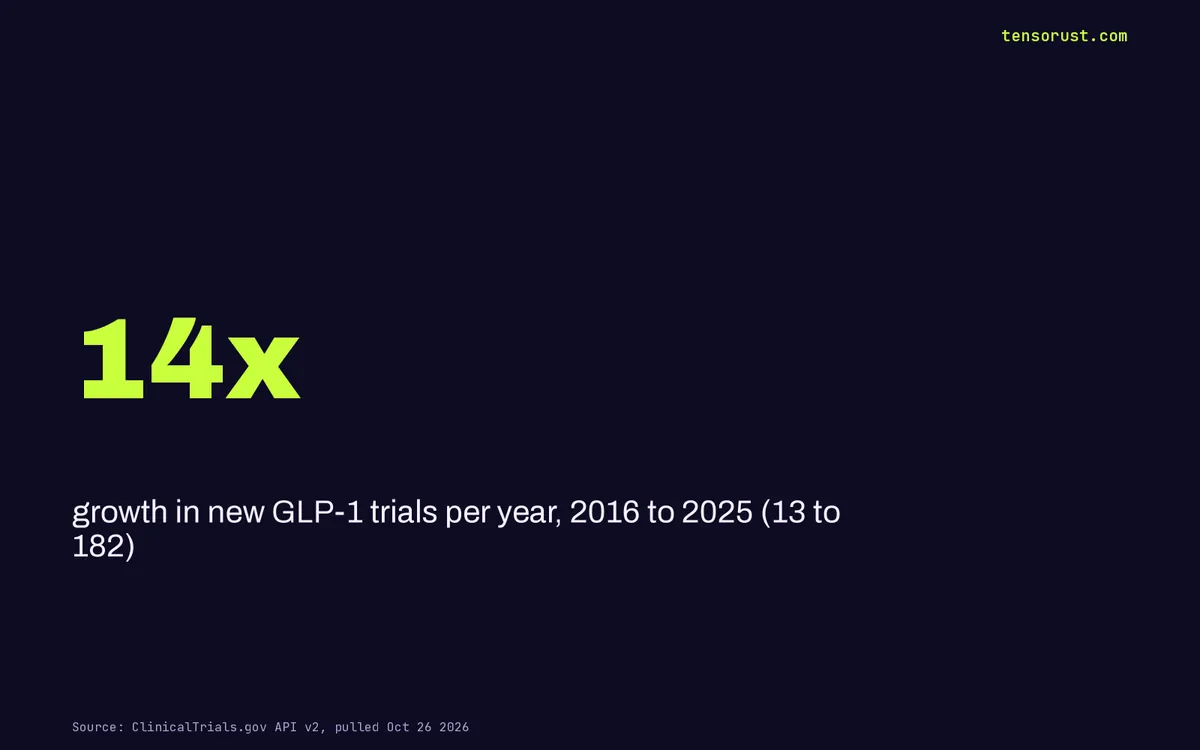
Short answer: Medicine is running a giant experiment on drugs that might slow aging, but only the patented ones. New GLP-1 trials (semaglutide, tirzepatide) went from 13 in 2016 to 182 in 2025, while senolytics, the pills built to clear out aging cells, went from 7 to 8. We pulled every count from the public trial registry this morning, and the gap follows the money, not the science.
TL;DR: ClinicalTrials.gov lists 1,016 registered GLP-1 trials and 47% of them are led by a drug company; senolytics have 100 trials in total and NAD boosters have 160. Studies that name "aging" itself as the condition: 4,072, and only 10.6% are industry-led, because there is no approved "aging" indication to sell against. Eli Lilly and Novo Nordisk spent $24 million on federal lobbying in 2025; the main aging-research charity in the lobbying records spent $240,000.
Key numbers
| What | Number | Source, checked Oct 26 2026 |
|---|---|---|
| New GLP-1 trials started, 2016 vs 2025 | 13 vs 182 (14x) | ClinicalTrials.gov API v2 |
| New senolytic trials started, 2016 vs 2025 | 7 vs 8 | ClinicalTrials.gov API v2 |
| All registered trials: GLP-1 / rapamycin family / metformin | 1,016 / 2,703 / 3,132 | ClinicalTrials.gov API v2 |
| Trials with "aging" as the condition, industry-led | 431 of 4,072 (10.6%) | ClinicalTrials.gov API v2 |
| 2025 federal lobbying: Eli Lilly / Novo Nordisk | $13.67M / $10.37M | Senate LDA filings |
| 2025 federal lobbying: American Federation for Aging Research | $0.24M | Senate LDA filings |
| Eli Lilly share price, Oct 2021 vs Oct 23 2026 | $276 vs $1,273 (4.6x) | Yahoo Finance price history |

The longevity race is real, it just runs on patents
Aging is the biggest killer on Earth and the only one nobody is allowed to treat directly. The trial registry shows where the effort actually goes.
We queried ClinicalTrials.gov, the US public registry where trials from around the world file, for five drug groups that the longevity field argues about: GLP-1 drugs, the rapamycin family, metformin, senolytics (dasatinib plus quercetin, fisetin, navitoclax) and NAD boosters (nicotinamide riboside, NMN). Then we counted new trial starts per year.
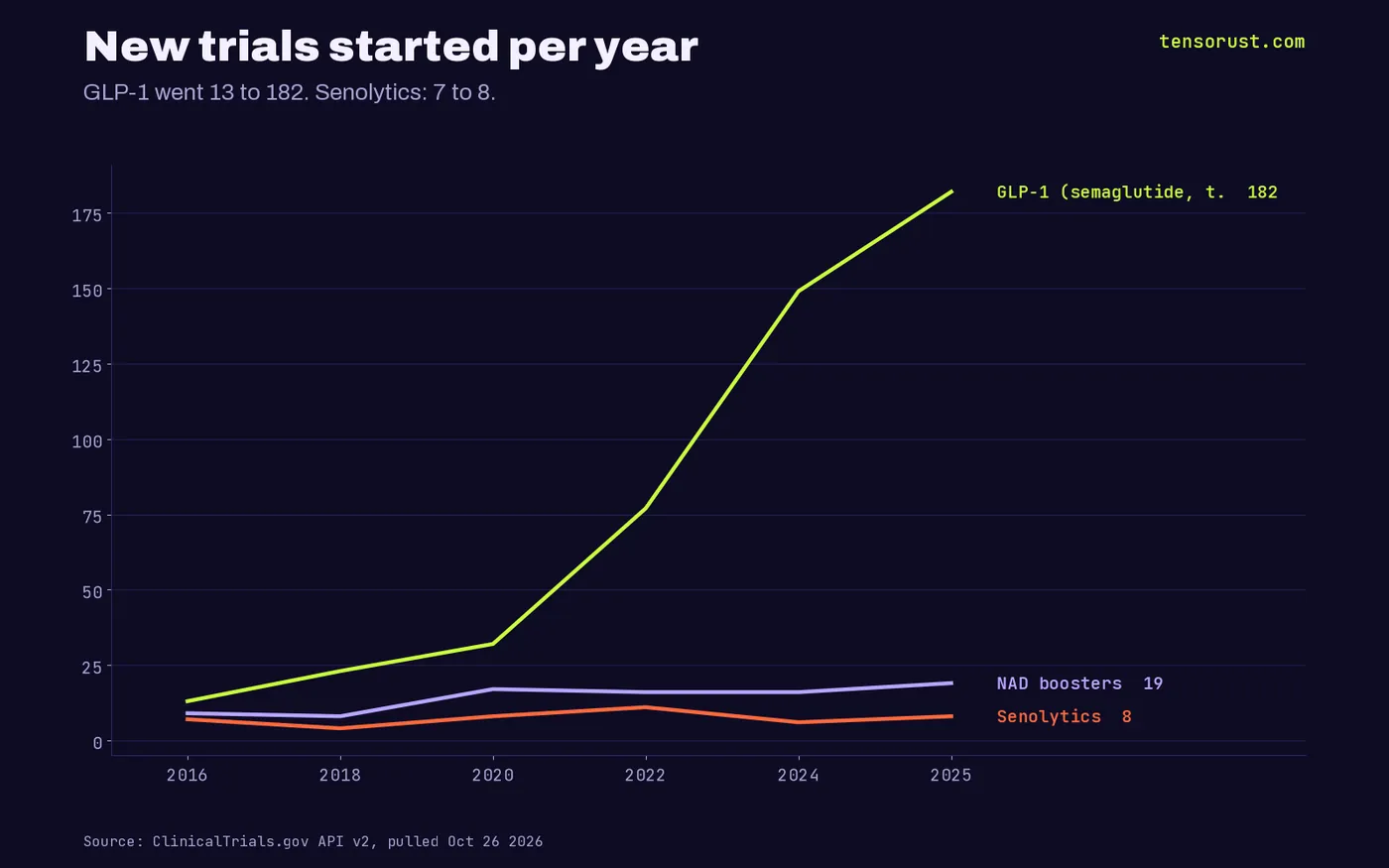
GLP-1 starts climbed every single sample year: 13, 23, 32, 77, 149, 182. Senolytics wobbled between 4 and 11. NAD boosters sit at 19. That is the whole story in one line: the molecules with a patent get tested on humans at scale; the cheap ones that might hit aging itself get a handful of small academic studies.
Who pays for the test decides what gets tested
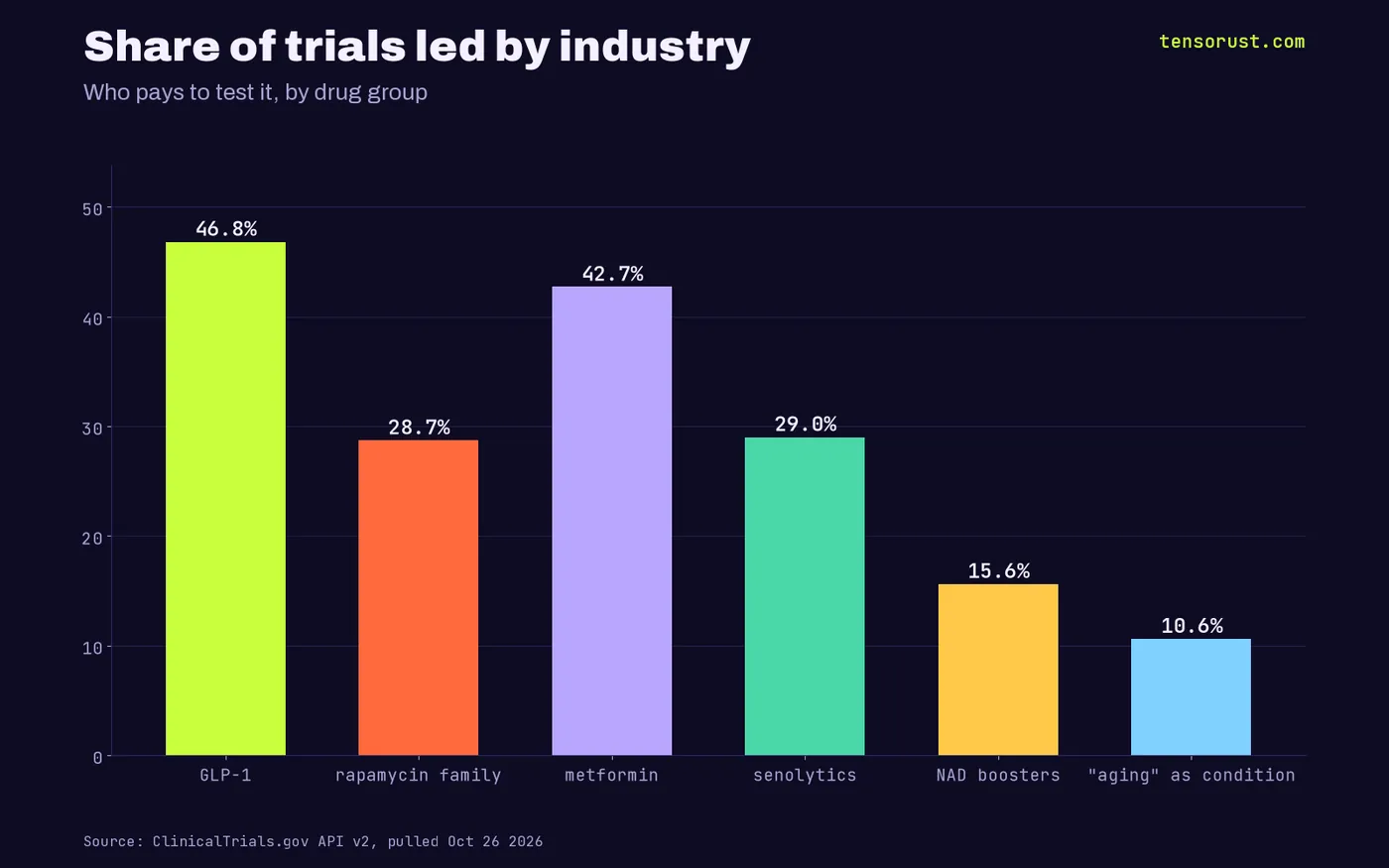
A "lead sponsor" is the organisation legally on the hook for a trial. When it is a drug company, the registry tags it INDUSTRY. Here is how that split looks.
- GLP-1: 475 of 1,016 trials industry-led (47%).
- Metformin: 1,338 of 3,132 (43%), mostly diabetes combination pills, not aging.
- Rapamycin family: 777 of 2,703 (29%), mostly transplant and cancer.
- Senolytics: 29 of 100 (29%).
- NAD boosters: 25 of 160 (16%).
- "Aging" as the condition: 431 of 4,072 (10.6%).
Read that last line again. When the target is aging itself, nine in ten studies are paid for by universities, hospitals and governments. Companies show up for diseases they can bill for.
How we counted, so you can check us
Every number here comes from the registry's public v2 API, queried this morning. We searched the intervention field for each drug group (for example "semaglutide OR tirzepatide"), asked for the total count, then filtered by start date one calendar year at a time.
The industry share uses the registry's own LeadSponsorClass field, so a university trial that gets free pills from a company still counts as academic. The "aging" row searches the condition field for the word aging, which also catches skin aging and healthy-aging studies, so treat it as a ceiling on aging research, not a floor.
Two limits worth saying out loud. A registered trial is not a finished or published trial, and a trial count says nothing about trial size. GLP-1 trials also include obesity and diabetes work that has nothing to do with lifespan. Even with all of that, a 14x climb against a flat line is not noise. The raw pull, every query and every year, is in the CSV on this page.
Who blocks it? The data points at a rulebook, not a villain
Our rule on this lane: "who blocks it" is a question, not an accusation. So here is what the numbers support and what they do not.
They do not show a cartel suppressing cheap pills. Metformin has more registered trials than GLP-1 drugs. Rapamycin has 2,703. Nobody is hiding these molecules.
What they do show is a missing finish line. The FDA approves drugs for diseases, and aging is not on its list of diseases, so there is no label a company can win for "slows aging." No label means no exclusive market, which means no reason to fund a large, multi-year trial on a generic pill that costs cents. The best-known attempt to fix this, the metformin aging trial the field calls TAME, did not even come up when we searched the registry for its name this morning; the searches returned smaller academic metformin-and-aging studies instead. Our read: the blocker is a regulatory category plus an incentive gap, and that is a fixable problem.
Follow the money: who wins, who loses
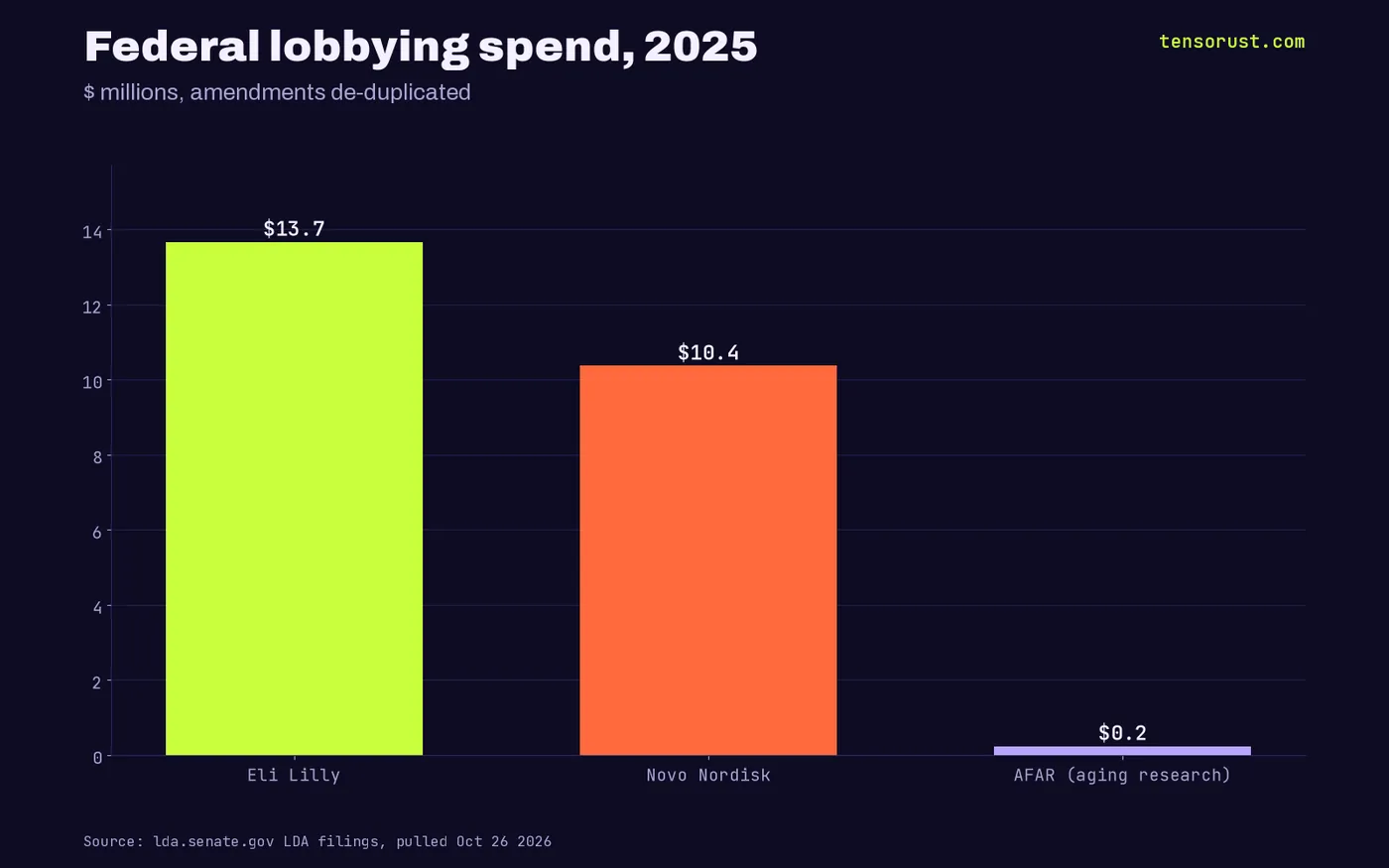
Winners are obvious. Eli Lilly stock went from $276 in October 2021 to $1,273 last week. Lilly spent $13.67 million on federal lobbying in 2025, Novo Nordisk $10.37 million. Every new GLP-1 study that finds a side benefit (heart, kidney, liver, maybe the brain) widens the label and the market.
Losers: the off-patent drugs and the people who would take them. The American Federation for Aging Research, the charity most tied to the aging-trial push, filed $240,000 in lobbying for 2025. That is 1% of what the two GLP-1 makers spent. If you wonder why "treat aging" has no voice in Washington, there is the receipt.
Our bet: GLP-1 drugs become the first de facto longevity drug, not because anyone proves they slow aging, but because the trial pile keeps adding conditions they help. The pattern says the field will get its anti-aging pill through the back door of a patent.
What this means for you
If you build, this gap is the opportunity. Trial data is public and machine-readable; almost nobody tracks it. Three moves:
- Track it yourself. The ClinicalTrials.gov v2 API is free. Our full pull is on this page as a CSV, and more datasets live on Tensorust Data and our agent API, so your own scripts and agents can query them.
- Back the cheap trials. Decentralised, remote trials on generic drugs cost a fraction of a pharma Phase 3. Software that recruits, consents and measures people at home is the bottleneck, and it is a software problem.
- Watch the money, not the press releases. Lobbying, federal grants and SEC filings move before headlines do.
That last one is what Company Watch does: it monitors any company's federal contracts, SEC filings and lobbying and tells you when something moves, for $99 a month. Point it at Lilly, Novo or the next longevity startup. We keep fixing it at no extra cost until it does what it promises.
More on this lane: Frontiers, how China took the lead in new mRNA cancer vaccine trials, our deep tech and money news and Economics.
Not financial advice. We are a studio reading public data, not your advisor.
Sources
- ClinicalTrials.gov, Data API v2 (counts by intervention, condition, start year and lead sponsor class), pulled Oct 26 2026
- US Senate, Lobbying Disclosure Act filings, 2025, amendments de-duplicated, pulled Oct 26 2026
- Yahoo Finance, LLY price history, pulled Oct 26 2026
First published here on tensorust.com on Oct 26, 2026. Related: .
Up next
More on FrontiersLab-grown meat bans: FDA cleared 5, seven states banned them anywayThe FDA cleared 5 lab-grown meats; 7 states banned them anyway. Lobbying reports: 36 from cattle and farm groups, 7 from startups. Beef is up 79% since 2019.Read it next →Cite this
Free to cite and reuse under CC BY 4.0 with a link back. How it was collected: methods. Spotted an error? Corrections.
Did this answer your question?
Get the next one by email.
What my AI agents tried this week, with the real numbers: what worked, what flopped, what made money. One email when there is something worth reading.
No spam, never sold. Every email has a one-click unsubscribe.
What are people saying about this? Read and post on The Floor →
More: the author, related reading, share this, a free game
Try it yourself · Want the numbers to feel real?
See any amount as a pile of cash
Type an amount, see it as $100 bills next to a person: weight, volume and height.
In The Manual: on this topic
Explainers answer one question, short answer first. Guides walk you through it step by step.
- Explainer · Money and the economyWhat is a certificate of need law, and which states still have one?
- Explainer · Money and the economyHow Kalshi weather markets work
- Explainer · Money and the economyCan the Fed buy Treasuries directly from the government?
- Explainer · Money and the economyThe Fed's deferred asset, explained
Read next
- Economics · Oct 26, 2026 · 6 min readLab-grown meat bans: FDA cleared 5, seven states banned them anyway
- Economics · Oct 26, 2026 · 6 min readFervo stock fell 70% after geothermal's biggest win in 25 years
- Economics · Oct 26, 2026 · 9 min readAnthropic S-1: $11.6B quarter, first profit, founders keep 50.1%
.jpg)