By Matt Busel, who built the apps, crates and game he writes about · every number links to its source and every dataset is downloadable (methods) · corrections · featured in Kirino, gamebiz, This Week in Rust, New Mobile Life, By-Press
Lab-grown meat bans: FDA cleared 5, seven states banned them anyway
On this page · 9 sections
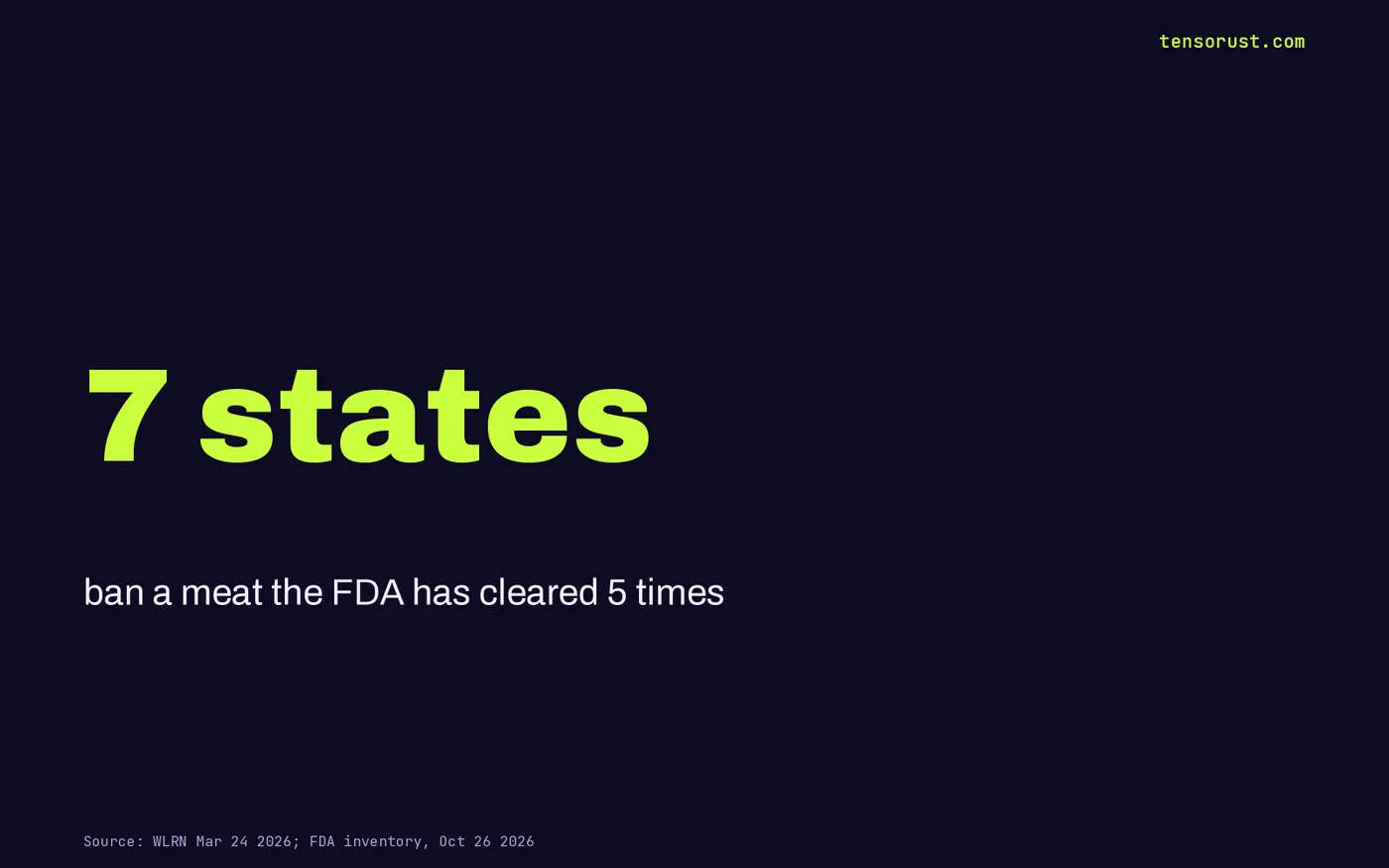
Short answer: Lab-grown (cultivated) meat is legal under federal law: the FDA has completed safety consultations on at least 5 cultivated meat and seafood products. Seven states ban it anyway: Florida, Alabama, Indiana, Mississippi, Montana, Nebraska and Texas. In March 2026 a federal appeals court let Florida's ban stand. Our read: this is not a safety fight, it is an incumbency fight, and the lobbying record shows who showed up.
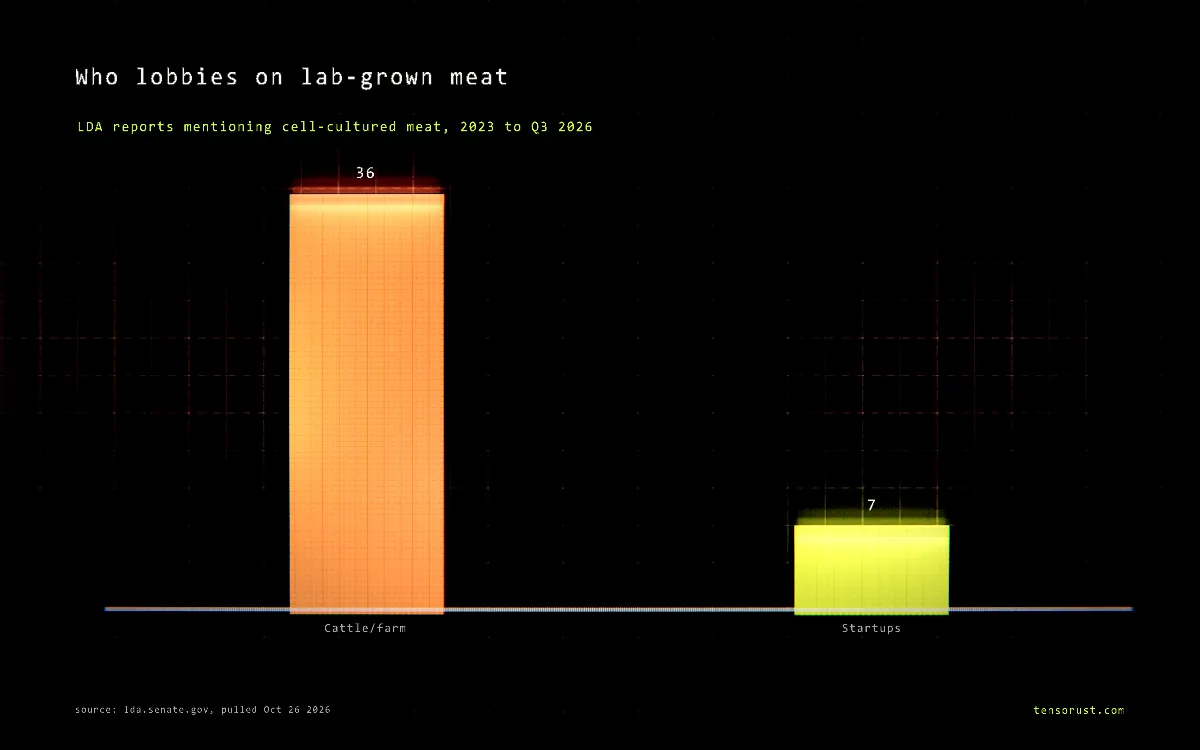
TL;DR: We pulled every federal lobbying report from 2023 to Q3 2026 that mentions cell-cultured or lab-grown meat: 36 quarterly reports came from cattle and farm groups, 7 from cultivated meat startups. Those reports carried $1.54 million in declared lobbying spend on the incumbent side versus $260,000 for the startups, a 5.9x gap. Meanwhile US ground beef went from $3.80 a pound in January 2019 to $6.79 in September 2026, up 79%, and the states are banning the competitor instead of the price.
Key numbers
| What | Number | Source, checked Oct 26 2026 |
|---|---|---|
| FDA completed pre-market consultations on cultivated meat/seafood (listed) | 5 | FDA inventory |
| States that ban cultivated meat | 7 | WLRN, Mar 24 2026 |
| Lobbying reports mentioning it: cattle/farm groups vs startups | 36 vs 7 | Senate LDA API, our pull |
| Declared spend on those reports (all issues): incumbents vs startups | $1.54M vs $0.26M | Senate LDA API, our pull |
| US ground beef, Jan 2019 to Sep 2026 | $3.80 to $6.79 per lb (+79%) | BLS via FRED |
| Ground beef since Florida's ban took effect (Jul 2024 to Sep 2026) | $5.50 to $6.79 (+24%) | BLS via FRED |

The federal government said yes. The states said no.
Cultivated meat is animal cells grown in a tank instead of inside an animal. Same cells, no slaughter, no feedlot.
The FDA's inventory lists 5 completed consultations: chicken from GOOD Meat (March 2023), chicken file 000002 (first response November 2022), salmon (May 2025), pork fat (March 2025) and a second chicken file, 000039 (July 2025). A completed consultation means the agency has "no questions" about the maker's safety conclusion. USDA then inspects the plant and the label.
That is the federal system working as designed. Then Florida passed SB 1084, signed May 1 2024, effective July 2024. Alabama, Indiana, Mississippi, Montana, Nebraska and Texas followed, per WLRN.
The court did not say it was unsafe. It said states can ban it.
Upside Foods sued Florida, arguing federal poultry law preempts a state ban. The 11th Circuit disagreed in March 2026: Judge Andrew Brasher wrote that "federal law does not preempt SB 1084," because a ban on selling a product is not a rule about its ingredients or its plant.
Read that carefully. Nobody on that panel ruled cultivated chicken dangerous. The court ruled that a state may outlaw a federally cleared food. The case continues in the trial court, so this is round one, not the last word.
That is the precedent every builder in food tech should care about: federal clearance is necessary and no longer sufficient.
Follow the money: who lobbies on lab-grown meat
We pulled every Lobbying Disclosure Act report from 2023 through Q3 2026 whose issue text mentions "cell-cultured" or "lab-grown meat", de-duplicated amendments, and split the filers into two sides. The full list is in the download below.
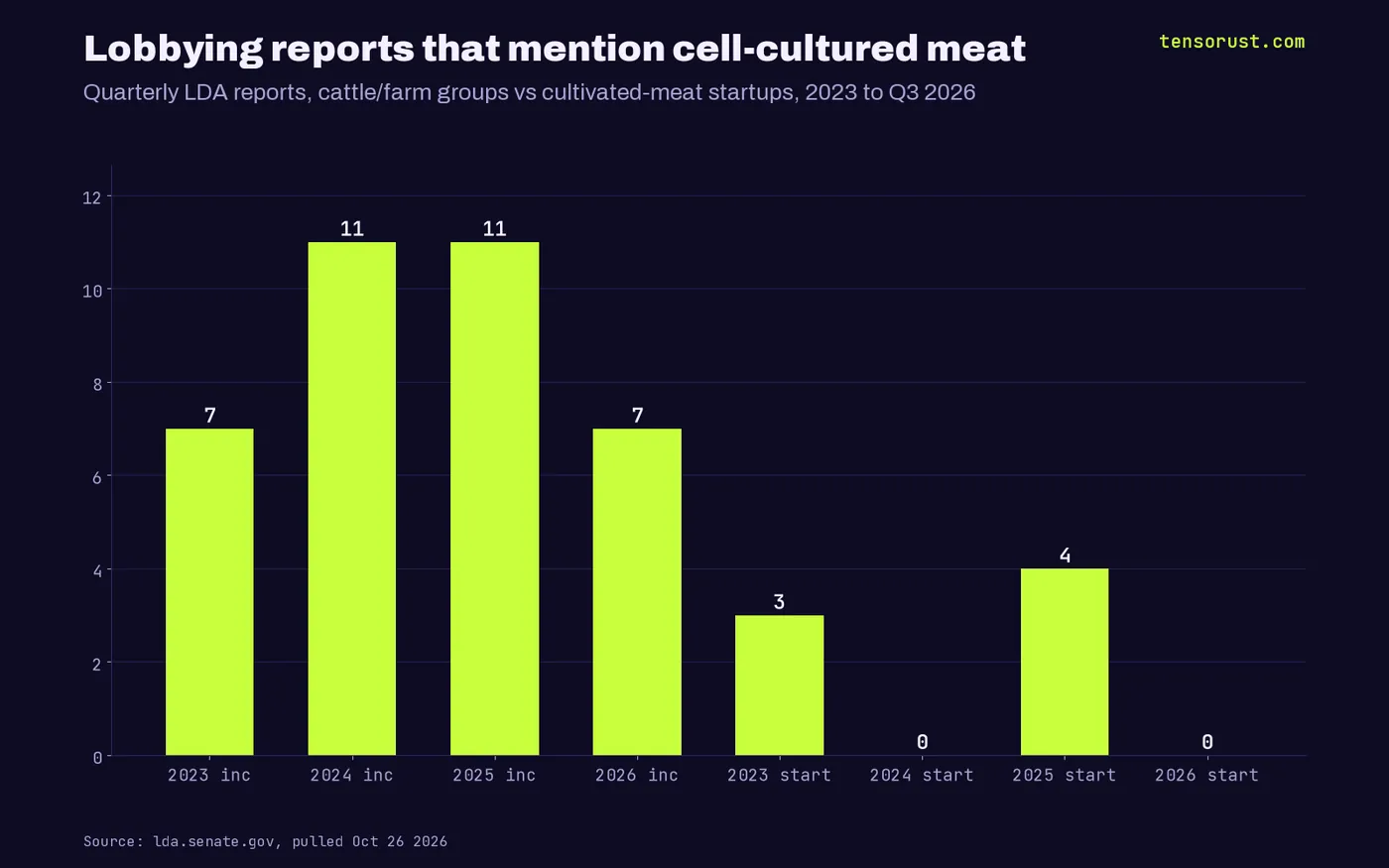
Incumbent side: the National Cattlemen's Beef Association, the Texas Cattle Feeders Association, the US Cattlemen's Association and the Pennsylvania Farm Bureau. 36 reports. Startup side: Finless Foods, BlueNalu and Upside Foods. 7 reports, and none after Q3 2025.
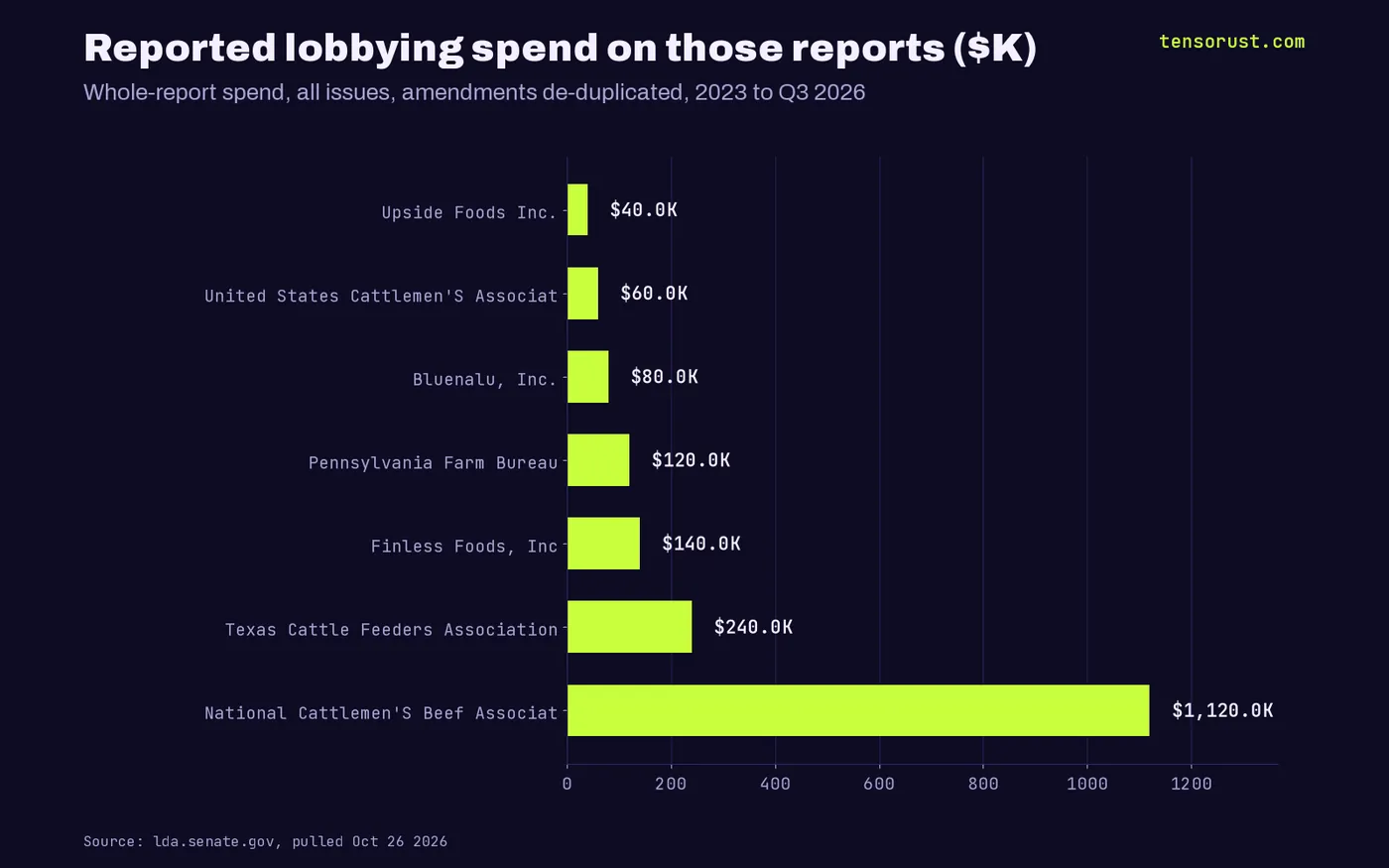
A fair caveat, stated plainly: the spend on a lobbying report covers every issue on it, not only cultivated meat. NCBA also lobbies on estate tax and water rules. So $1.54M is not "money spent to kill lab meat". It is the weight of the organizations in the room when it came up, and the startups brought one sixth of it, then stopped filing.
Is the cattle lobby the reason seven states acted? Nobody has proven that, and we will not pretend the federal reports capture state capitols, where these bans were actually written. But the pattern says the people with the most to lose from a cheaper protein showed up, and the people with the most to gain mostly did not.
Meanwhile, beef got 79% more expensive
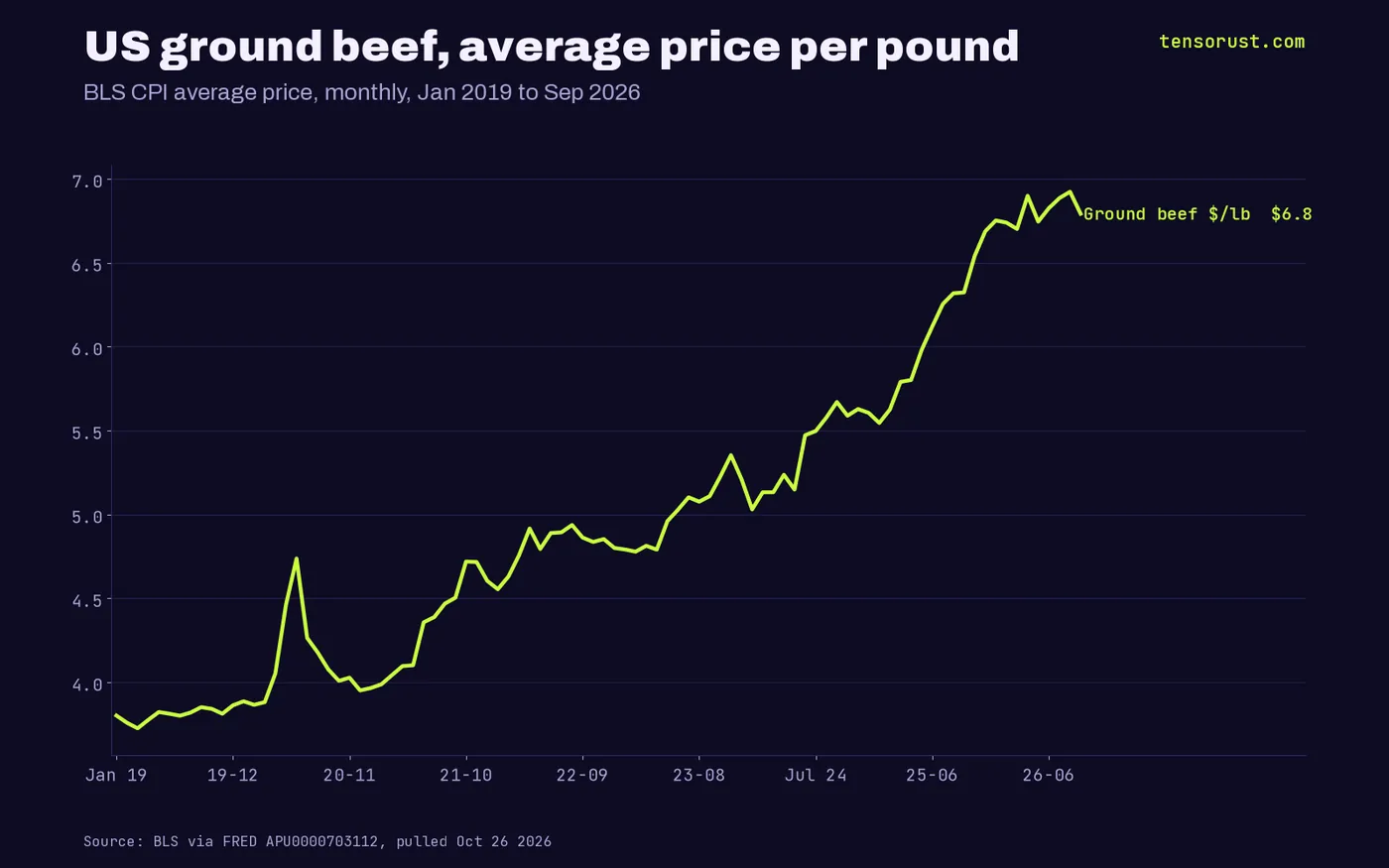
The official BLS average price for a pound of ground beef was $3.80 in January 2019 and $6.79 in September 2026. It peaked at $6.92 in August 2026. Since Florida's ban took effect in July 2024 it is up 24%.
Cultivated meat is not price-competitive today, so the ban is not what keeps beef expensive. The point is the direction of policy: when a staple gets more expensive, the response in seven states was to make one future source of competition illegal before it ever reached a shelf.
That is the scarcity mindset written into law. Food is one of the oldest limits humans have, and a tank that grows meat without land, feed cycles or slaughter is one of the few tools that could move it. Banning the tool locks in the limit.
Who wins and who loses
- Wins: incumbent producers in the seven states, who face zero cultivated competition there no matter what it costs in ten years.
- Loses: startups, who now need 50 legal strategies instead of one federal one, and investors pricing that risk.
- Loses: shoppers in those states, who lose an option before they ever got to decide on it.
- Open question: interest is cooling. The Wikipedia article on cultured meat drew 39,017 views in June 2023 and 11,366 in September 2026. Bans plus fading attention is how a technology gets frozen.

What builders can do about it
Bans are written by people who expect nobody to check. Checking is cheap now.
- Watch the filings. The Senate LDA API is free and public. A ten-line script that searches issue text for your technology every quarter tells you who is lobbying on it before a bill moves. Our data.csv shows the exact fields we used.
- Pick your states. Forty-three states have no ban on this list. Plants, pilots and tastings go where the law says yes, and that map is now a business input, like power prices.
- Show up early. The startup side filed 7 reports in almost four years and none after Q3 2025. Silence in the record reads as consent. Small companies can join a trade group or file comments for almost nothing.
- Win on price, then on law. Bans get hard to defend once a product is cheaper and people want it. Every cost curve the industry bends makes the next ban harder to pass.
What this means for you
If you build in food, biotech or any regulated frontier, stop treating federal approval as the finish line. Track the state bills and the lobbying reports yourself: every LDA filing is public, and our open datasets show how we pull them. More frontier pieces live at Frontiers, money pieces at Economics and daily coverage at News.
If you want this done for you, Company Watch monitors any company or trade group across lobbying reports, federal contracts and SEC filings and emails you when something moves. We keep fixing it at no extra cost until it does what it promises.
Not financial advice. This is our reading of public records, not investment guidance.
Sources
- FDA, Inventory of completed pre-market consultations for human food made with cultured animal cells, checked Oct 26 2026
- WLRN, Appeals court upholds Florida's ban on lab-grown meat, Mar 24 2026
- US Senate, Lobbying Disclosure Act filings API, pulled Oct 26 2026
- BLS average price, ground beef 100% beef, via FRED, pulled Oct 26 2026
- Wikipedia, Cultured meat and Wikimedia pageviews API, pulled Oct 26 2026
First published here on tensorust.com on Oct 26, 2026. Related: .
Up next
More on FrontiersUS grid batteries hit 54 GW, 37x 2020. Texas built the mostWe counted all 1,108 grid batteries in the federal inventory: 54 GW, up 37x since 2020. Texas out-built California, and 87% is not owned by utilities.Read it next →Cite this
Free to cite and reuse under CC BY 4.0 with a link back. How it was collected: methods. Spotted an error? Corrections.
Did this answer your question?
Get the next one by email.
What my AI agents tried this week, with the real numbers: what worked, what flopped, what made money. One email when there is something worth reading.
No spam, never sold. Every email has a one-click unsubscribe.
What are people saying about this? Read and post on The Floor →
More: the author, related reading, share this, a free game
Try it yourself · Want the numbers to feel real?
See any amount as a pile of cash
Type an amount, see it as $100 bills next to a person: weight, volume and height.
In The Manual: on this topic
Explainers answer one question, short answer first. Guides walk you through it step by step.
- Explainer · Money and the economyWhat is a certificate of need law, and which states still have one?
- Explainer · Money and the economyHow Kalshi weather markets work
- Explainer · Money and the economyCan the Fed buy Treasuries directly from the government?
- Explainer · Money and the economyThe Fed's deferred asset, explained
Read next
- Economics · Oct 26, 2026 · 6 min readUS Antimony's Alaska find: $439M before costs. So is the stock
- Economics · Oct 26, 2026 · 6 min readUS grid batteries hit 54 GW, 37x 2020. Texas built the most
- Story chapters · Oct 26, 2026 · 6 min readLongevity drugs: GLP-1 trials grew 14x, anti-aging pills flatlined