
By Matt Busel, who built the apps, crates and game he writes about · every number links to its source and every dataset is downloadable (methods) · corrections · featured in Kirino, gamebiz, This Week in Rust, New Mobile Life, By-Press
Microsoft buyouts: 60,000 offers cost less than 3 days of AI capex
On this page · 8 sections
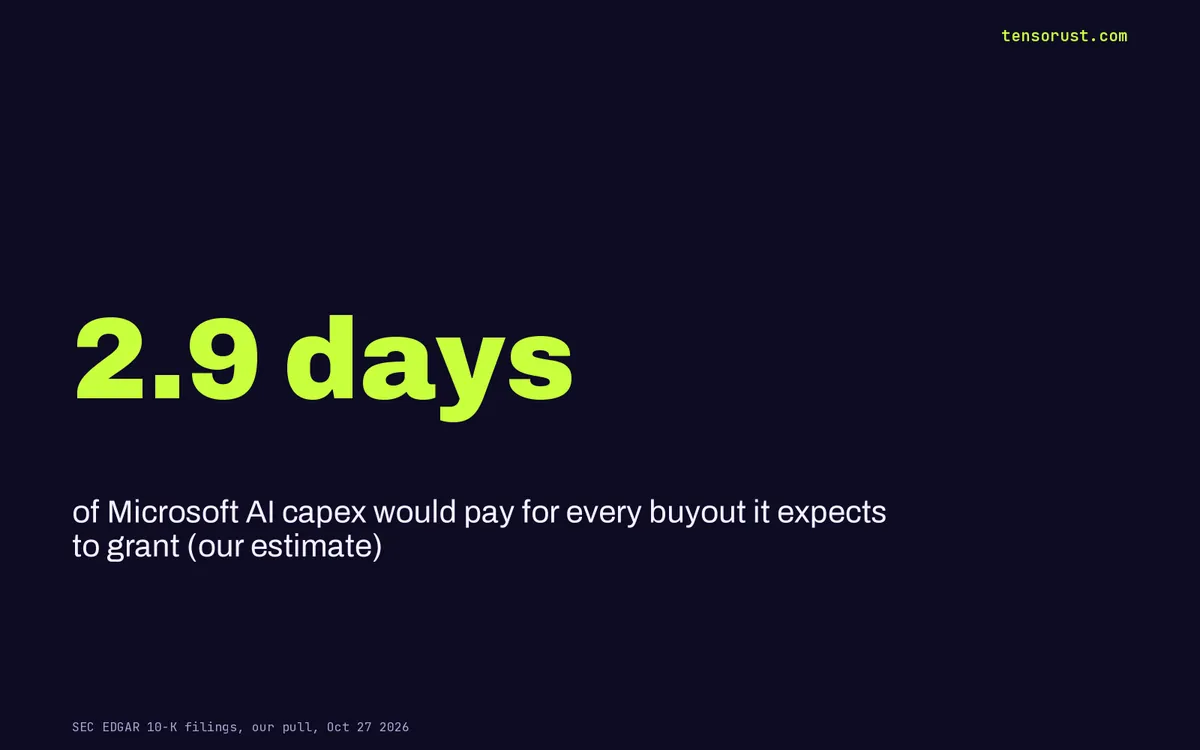
Short answer: Microsoft offered voluntary buyouts to about 60,000 people on Monday and told The Seattle Times it expects only 3% to 5% to say yes. At the price of its last buyout round, that whole program costs roughly $0.93 billion, which is 2.9 days of the $115.95 billion Microsoft spent on capex last fiscal year. This is not a cost cut. It is a rounding error with a press release attached, and the real number is how fast the money moved from people to data centers.
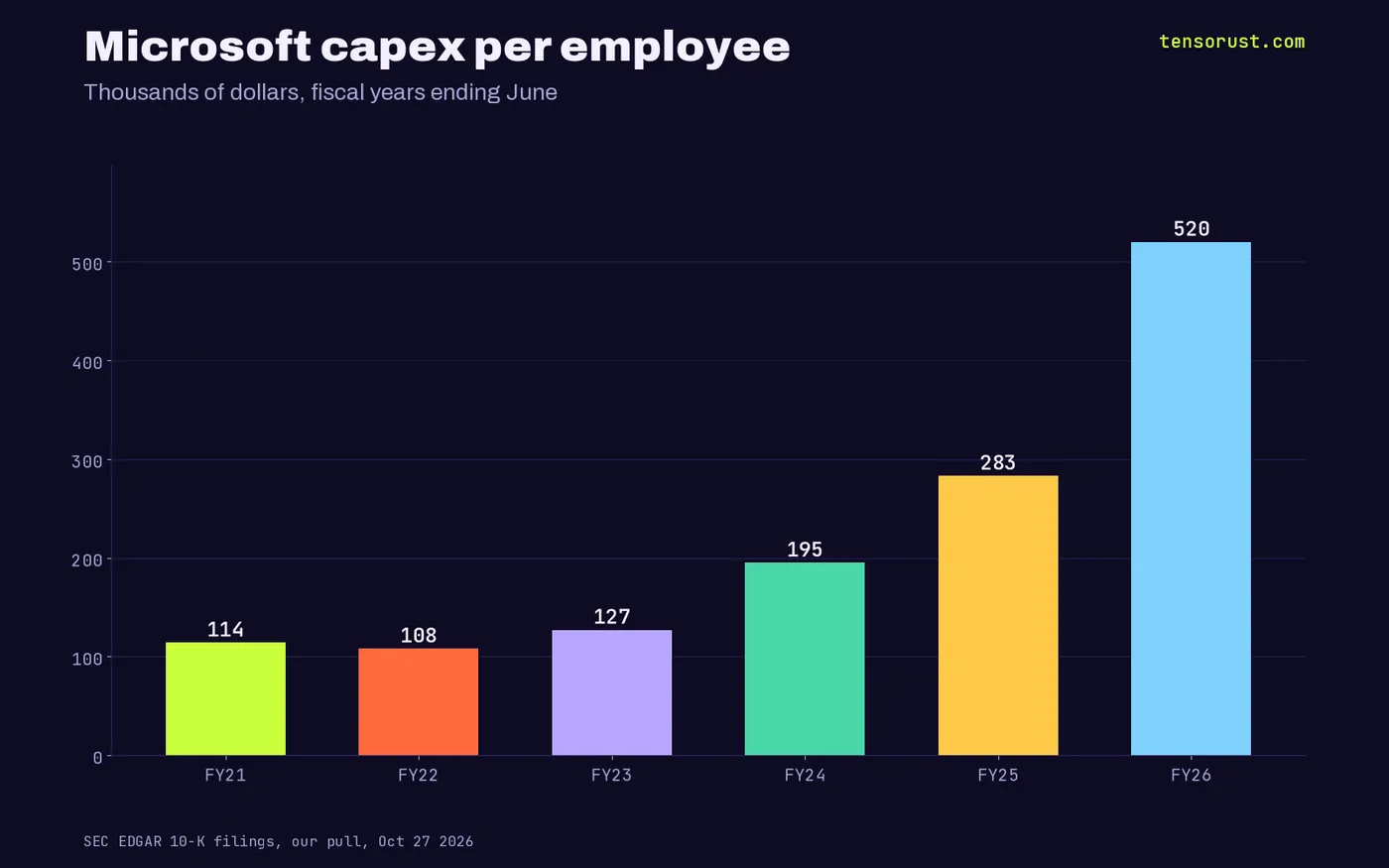
TL;DR: Microsoft's capex per employee went from $114,000 in fiscal 2021 to $520,000 in fiscal 2026, a 4.6x jump, while headcount barely moved (181,000 to 223,000). Net income per employee hit a record $600,000 in fiscal 2026, so the buyouts are not about survival. If you are one of the 60,000 holding an offer until early December, the math says Microsoft values your seat less than a few hours of GPU build-out, and that is the best argument yet for taking the check and building something you own.
Key numbers
| What | Number | Source, checked Oct 27 2026 |
|---|---|---|
| Employees offered a buyout | about 60,000 (roughly a quarter of staff) | Seattle Times |
| Expected acceptance | 3% to 5% (under 3,000 people) | Seattle Times, Microsoft spokesperson |
| Charge for the earlier 2026 retirement buyout | $900 million (about 2,900 takers of 8,700 offered) | Seattle Times |
| Capex, fiscal 2026 (year to June 30) | $115.95 billion | Microsoft 10-K FY26 |
| Capex per employee, FY21 vs FY26 | $114K vs $520K | SEC EDGAR, our math |
| Net income per employee, FY26 | $600K (record) | SEC EDGAR, our math |
| Full-time employees, FY26 | 223,000 (peak 228,000 in FY24 and FY25) | Microsoft 10-K FY26 |

The buyout is a rounding error next to the data centers
Microsoft's own spokesperson set the expectation: 3% to 5% of the 60,000 will take the deal. That is 1,800 to 3,000 people.
The last round, a voluntary retirement program offered to 8,700 US staff, cost a $900 million charge, and about one-third took it. That works out to roughly $310,000 per person who left (our estimate from those two numbers). This new offer is a standard severance package, not sweetened, so the real per-head cost is probably lower.
Even at the old price, 3,000 exits cost about $0.93 billion. Microsoft spent $115.95 billion on property and equipment in fiscal 2026, or $318 million a day. The entire buyout fits inside 2.9 days of that spend.
Capex per employee went up 4.6x in five years
Here is the chart Microsoft will not put in the memo. In fiscal 2021 it spent $114,000 on capex for every full-time employee. In fiscal 2026 it spent $520,000.
Headcount in that window went from 181,000 to 223,000, then stalled. Capex went from $20.6 billion to $115.95 billion. The company did not shrink its people. It just stopped growing them while the machines got the raise.
Chief People Officer Amy Coleman said in July that the workforce reductions were not driven by AI, at least not in the way people would expect, as The Seattle Times reported it. Fine. But the budget says what the memo will not: every incremental dollar of the last three years went to chips and buildings, not to staff. Our read is that the buyout is how you ask a quarter of the company to self-select out without the PR cost of another 15,000-person layoff like 2025.
Each employee now makes Microsoft $600,000 a year in profit
This is not a company in trouble. Revenue per employee rose from $929,000 in FY21 to $1.49 million in FY26. Net income per employee went from $339,000 to $600,000, the highest in the six years we pulled.
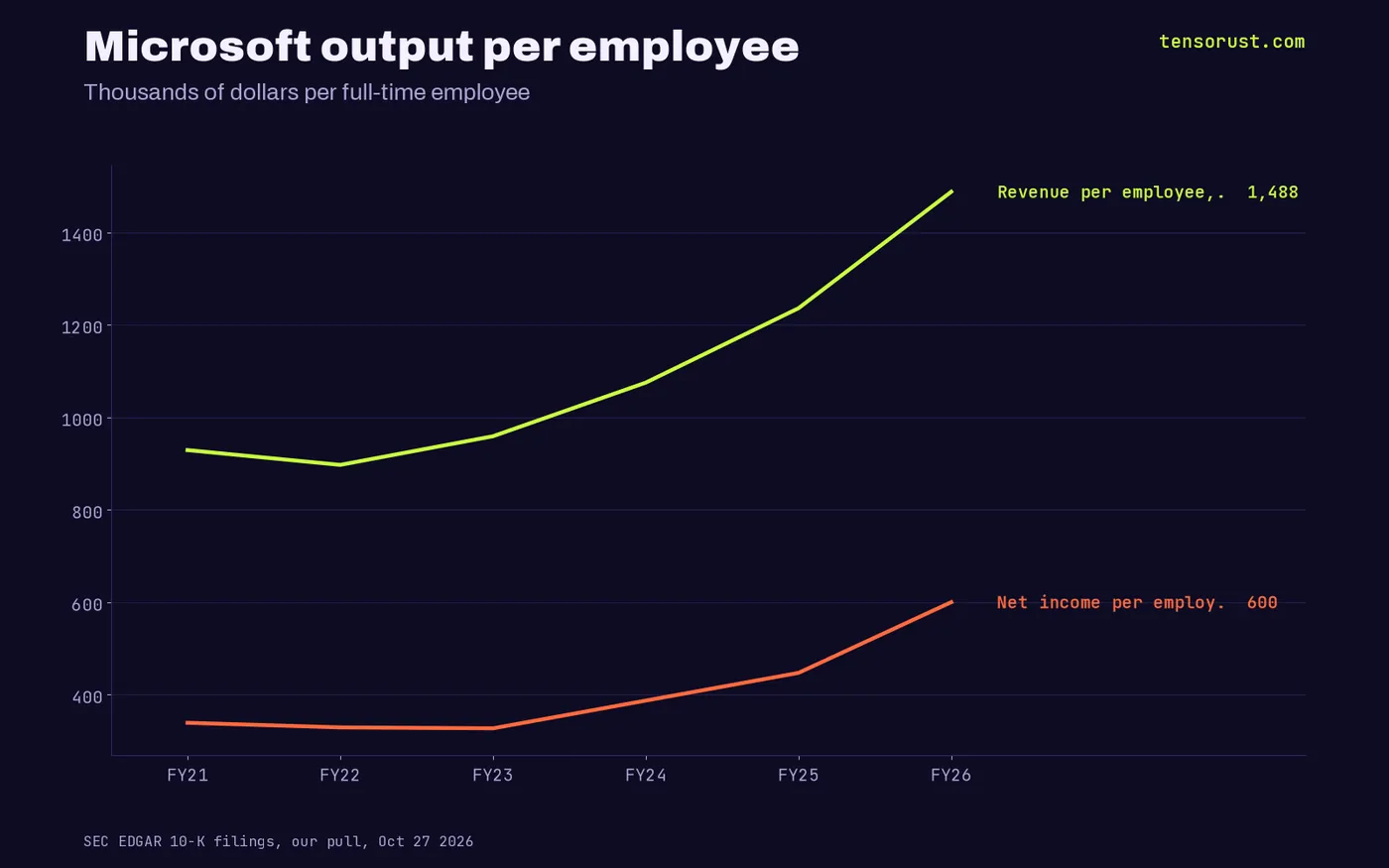
So the people being shown the door are, on paper, the most profitable workforce Microsoft has ever had. That is the part that should make every big-tech employee lowkey nervous: being productive is no longer the shield. The roles on the list (gaming, Windows, Copilot, HR and finance fully participating, per the internal memo The Seattle Times saw) are being judged against what the same dollars buy in a data center.
Follow the money: who wins, who loses
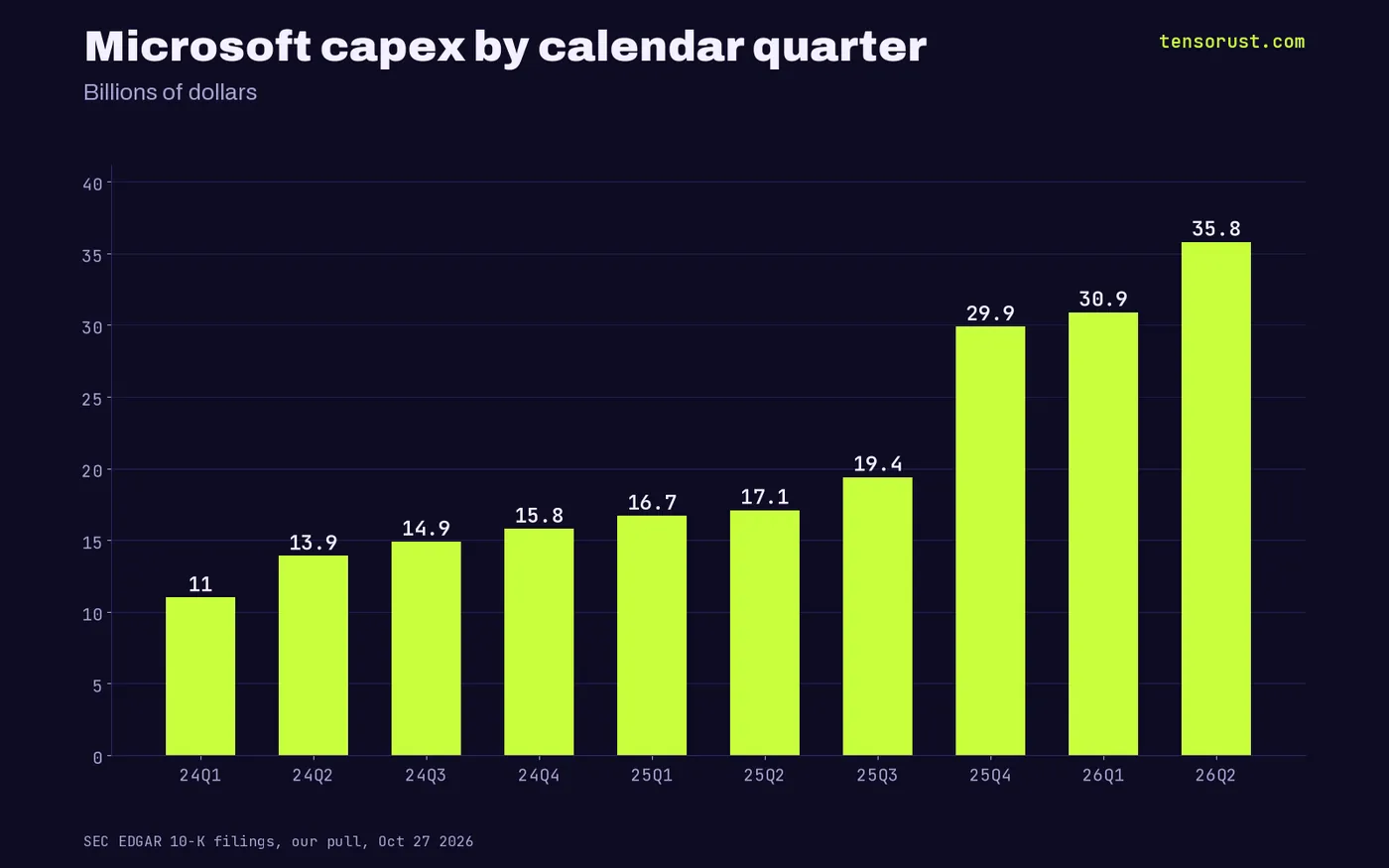
The quarterly capex line tells you where this is heading. Microsoft spent $11.0 billion on capex in calendar Q1 2024. By calendar Q2 2026 it was $35.8 billion a quarter, more than triple.
Winners: Nvidia, the power utilities and the firms building and powering data centers. Shareholders too, at least for now: Microsoft's stock ended Monday up about 1.5% on the news, and it hit a record $543.45 on Oct 13, per The Seattle Times.
Losers: the 60,000 who now have to decide by early December whether their seat is worth more than a severance check. And the managers who have to run teams after the best people, the ones with the most options outside, are the first to walk. Voluntary buyouts famously lose the people you want to keep.
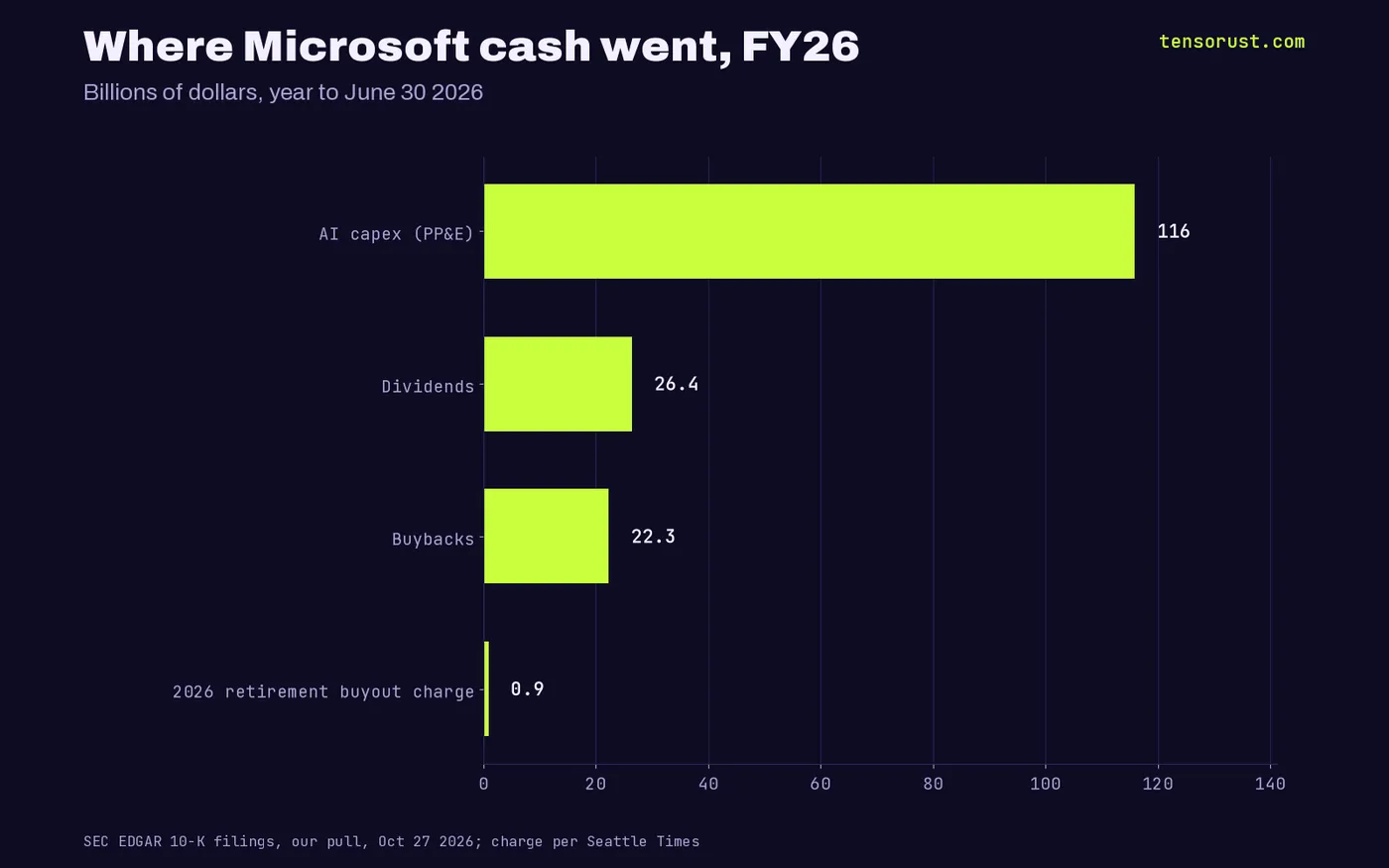
Look at fiscal 2026 cash use: $115.95 billion on capex, $26.45 billion on dividends, $22.27 billion on buybacks, and $0.9 billion on the retirement buyouts. Microsoft paid shareholders 54 times what it paid to exit people. Nobody is blocking Microsoft from keeping its staff. It is choosing compute, out loud, with the numbers in its own 10-K.
Who blocks this? Nobody, and that is the story
We checked for a brake. Headcount is flat, not falling, so this is not a crisis cut regulators or unions would fight. The WARN Act covers layoffs, not voluntary exits. Wall Street cheered. There is no blocker in the data. The only person who decides is the employee holding the offer.
Our bet: this is the template for 2027. Flat headcount, exploding capex, and "voluntary" exits offered to huge slices of the company before earnings. Microsoft reports fiscal Q1 2027 on Wednesday, and analysts expect almost $91 billion in revenue. Watch whether it books a charge for this program and how big the capex number is next to it.

What this means for you
If you hold one of the 60,000 offers: do the math on your own number, not Microsoft's. Severance plus a year of runway is the cheapest seed round you will ever get, and the tools Microsoft is spending $318 million a day on are available to you for a few dollars an hour. Builders who leave with a check and a plan are the real winners of this cycle. Download our data (every number above, FY21 to FY26, plus quarterly capex) and run your own scenario.
If you work anywhere else in big tech: track your employer's capex per head in its own filings. When that line goes vertical while headcount goes flat, an offer like this is coming. More on that pattern in our labor share record low piece, the Big Tech free cash flow breakdown and the American Express AI layoffs receipts. Every story like it lands on /news/ and AI industry.
Want this watch kept for you? Company Watch ($99 a month) tracks any company's SEC filings, federal contracts and lobbying and tells you when the numbers move, so you see the next capex jump or restructuring charge the day it is filed. We keep fixing it at no extra cost until it does what it promises.
Not financial advice. Our estimates (buyout cost per person, total program cost, days of capex) are labelled ours and built from the public numbers linked here.
Sources
- The Seattle Times, Alex Halverson, "Microsoft offers buyouts to 60K employees, but expects low uptake", Oct 26 2026
- Microsoft Form 10-K, fiscal year ended June 30 2026, filed Jul 29 2026
- Microsoft Form 10-K, fiscal 2025, filed Jul 30 2025
- Microsoft Form 10-K, fiscal 2024, filed Jul 30 2024
- Microsoft Form 10-K, fiscal 2023, filed Jul 27 2023
- Microsoft Form 10-K, fiscal 2022, filed Jul 28 2022
- Microsoft Form 10-K, fiscal 2021, filed Jul 29 2021
- SEC EDGAR XBRL company facts, Microsoft, our pull Oct 27 2026
First published here on tensorust.com on Oct 27, 2026. Related: .
Up next
More on AI industryProp 40 priced: 223 billionaires, $90B on paper, Zuckerberg $11BWe priced every Forbes California billionaire for Prop 40: $90B on paper, Zuckerberg $11B, $744B moved off the list. 70 Forbes snapshots, free CSV.Read it next →Cite this
Free to cite and reuse under CC BY 4.0 with a link back. How it was collected: methods. Spotted an error? Corrections.
Did this answer your question?
Get the next one by email.
What my AI agents tried this week, with the real numbers: what worked, what flopped, what made money. One email when there is something worth reading.
No spam, never sold. Every email has a one-click unsubscribe.
What are people saying about this? Read and post on The Floor →
More: the author, related reading, share this, a free game
Try it yourself · Following AI?
Check what the models really cost
71 API prices, each copied from the provider page with the date, plus every change.
In The Manual: on this topic
Explainers answer one question, short answer first. Guides walk you through it step by step.
- Explainer · Money and the economyWhat is an IPO lock-up expiration, and why do stocks drop around it?
- Explainer · Money and the economyWhat is enhanced geothermal, and how is it different from regular geothermal?
- Explainer · Money and the economyWhat is a stock warrant? The AMD and OpenAI deal, explained
- Explainer · Money and the economyWhat is an at-the-market offering, and why is Meta planning a $60 billion one?
Read next
- Economics · Oct 27, 2026 · 6 min readThe Fed is the real AI regulator: rates, not bills, picked who builds
- Economics · Oct 26, 2026 · 5 min readAI data center water panic: US home leaks waste 53x more
- Economics · Oct 26, 2026 · 7 min readRealtor commission: NAR's lobby money says AI agents are the threat

.jpg)