
By Matt Busel, who built the apps, crates and game he writes about · every number links to its source and every dataset is downloadable (methods) · corrections · featured in Kirino, gamebiz, This Week in Rust, New Mobile Life, By-Press
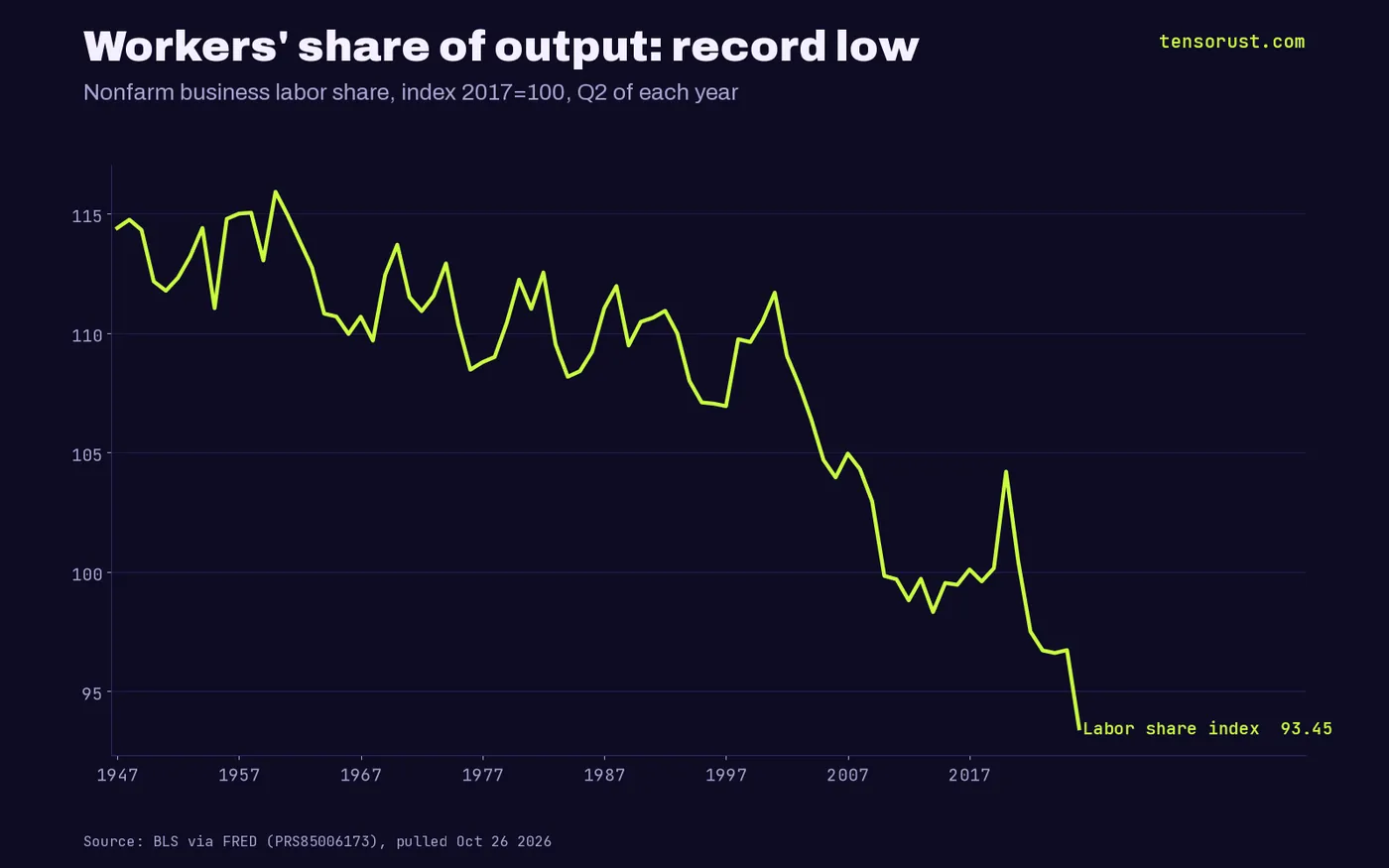
Labor share record low: workers' cut hits 93.4, worst since 1947
On this page · 9 sections
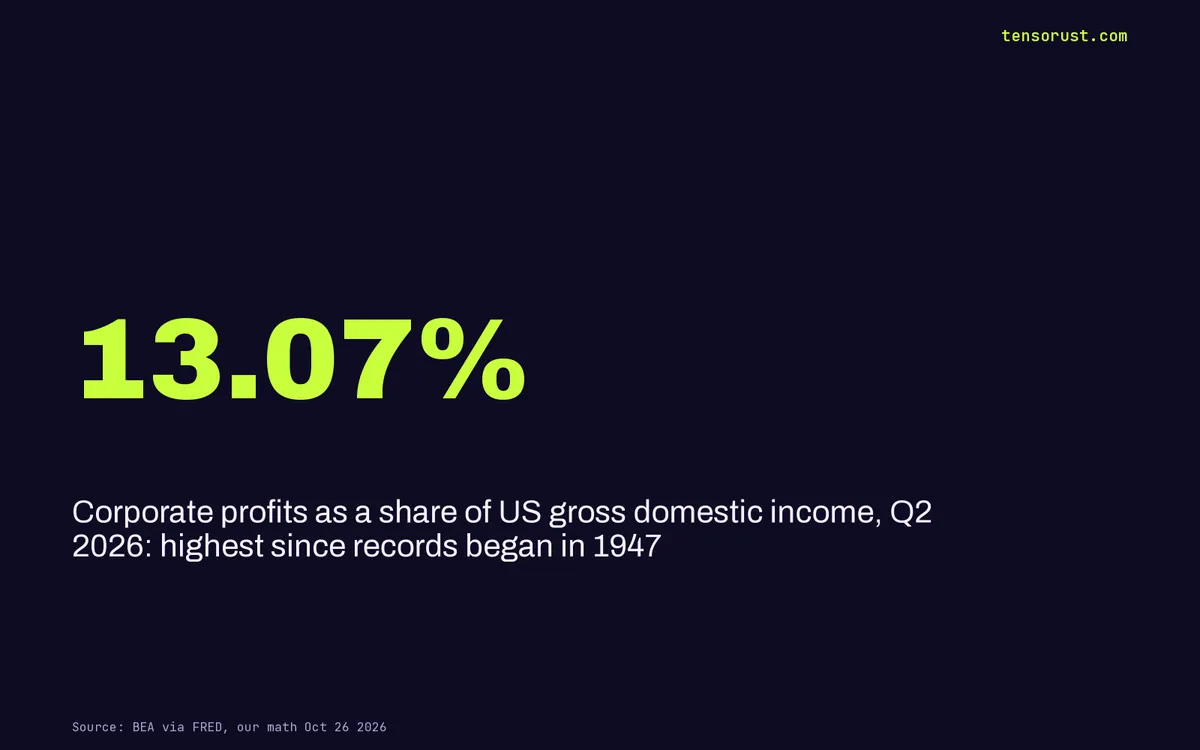
Short answer: Yes, the US labor share is at a record low. The BLS index of workers' share of nonfarm business output fell to 93.4 in Q2 2026, the lowest reading since the series starts in 1947, while corporate profits hit a record 13.07% of all US income in the same quarter. Our read: this is not a robot apocalypse, it is a scoreboard, and the side that owns the machines is winning.
TL;DR: The labor share index has fallen five quarters in a row, from 97.9 in Q1 2025 to 93.4 in Q2 2026, and sits 20% below its 1960 peak of 117.1. Over the same stretch corporate profits after tax climbed to $4.28 trillion a year, or 13.07% of gross domestic income, beating the 2021 record of 12.76%. Microsoft, Alphabet, Amazon and Meta spent $525.7 billion on capex in their latest four quarters, up 74% in a year, which tells you exactly where the money that is not going to wages is going.
Key numbers
| What | Number | Source, checked Oct 26 2026 |
|---|---|---|
| Labor share index, nonfarm business, Q2 2026 | 93.4 (2017 = 100), record low since 1947 | BLS via FRED |
| Labor share index peak | 117.1, Q4 1960 | BLS via FRED |
| Corporate profits as % of GDI, Q2 2026 | 13.07%, record (prior high 12.76%, Q2 2021) | BEA CP / BEA GDI, our math |
| Wages and salaries as % of GDI, 2025 | 42.0%, tied with 2013 for the lowest since 1948 | BEA via FRED |
| Total compensation as % of GDI, 2025 | 50.9%, lowest since 1935 | BEA via FRED |
| MSFT + GOOGL + AMZN + META capex, last 4 quarters | $525.7B, up 74% from $302.0B | SEC EDGAR XBRL, our pull |

The record nobody wanted: 93.4
The number that lit up Hacker News this weekend was a FRED chart: wages as a share of gross domestic income at a 75-year low. We pulled the full set of series behind it, and the quarterly picture is sharper than the annual one.
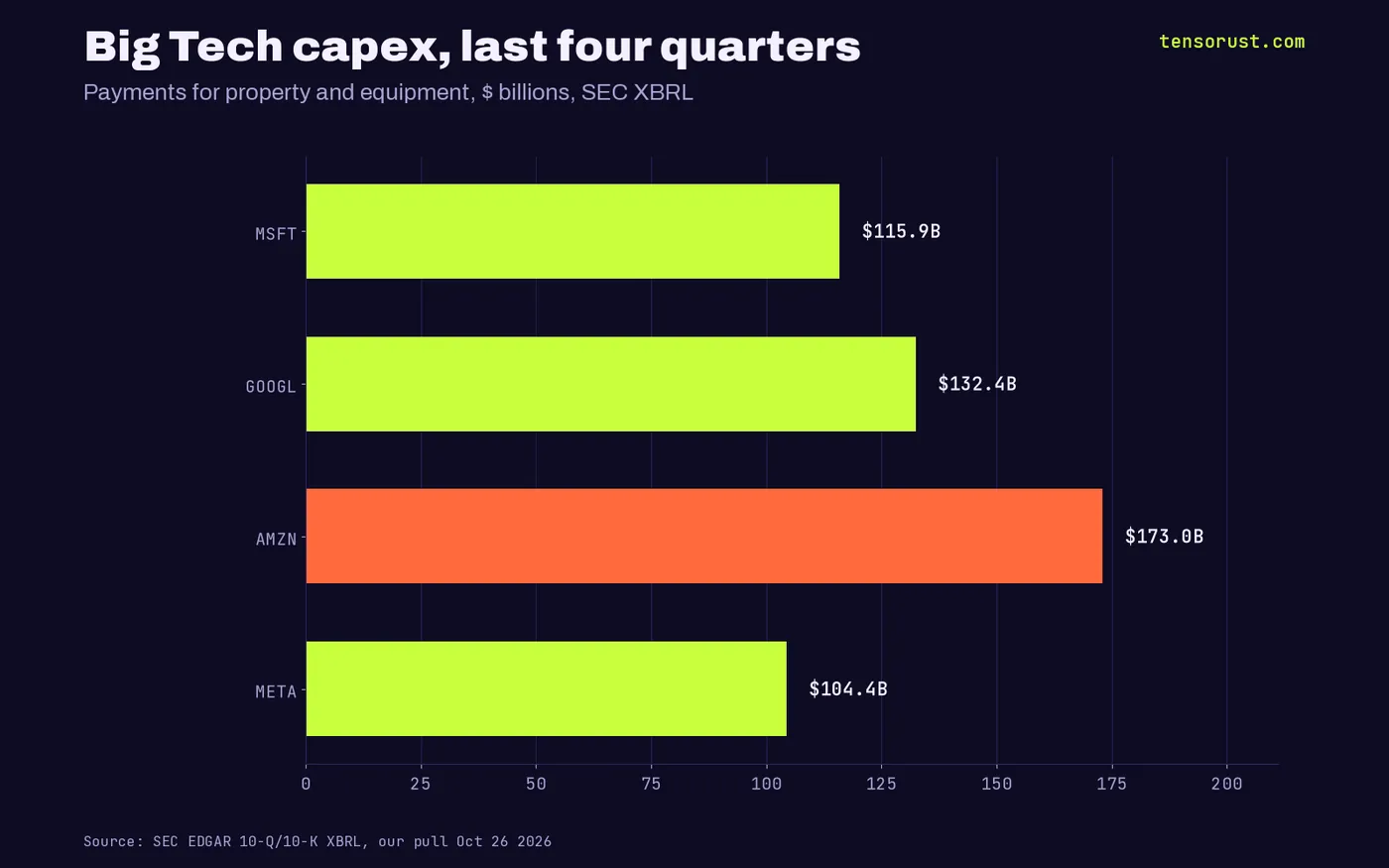
The labor share index measures how much of the value made by US businesses goes to the people working in them, as pay and benefits. It was 99.6 at the end of 2019. It was 97.9 in Q1 2025. Then it fell five straight quarters to 93.4 in Q2 2026.
There is no lower reading in the data. Not in the 1970s stagflation, not after the 2008 crash, not in the 2021 profit boom.
Where the money went: record profits, same quarter
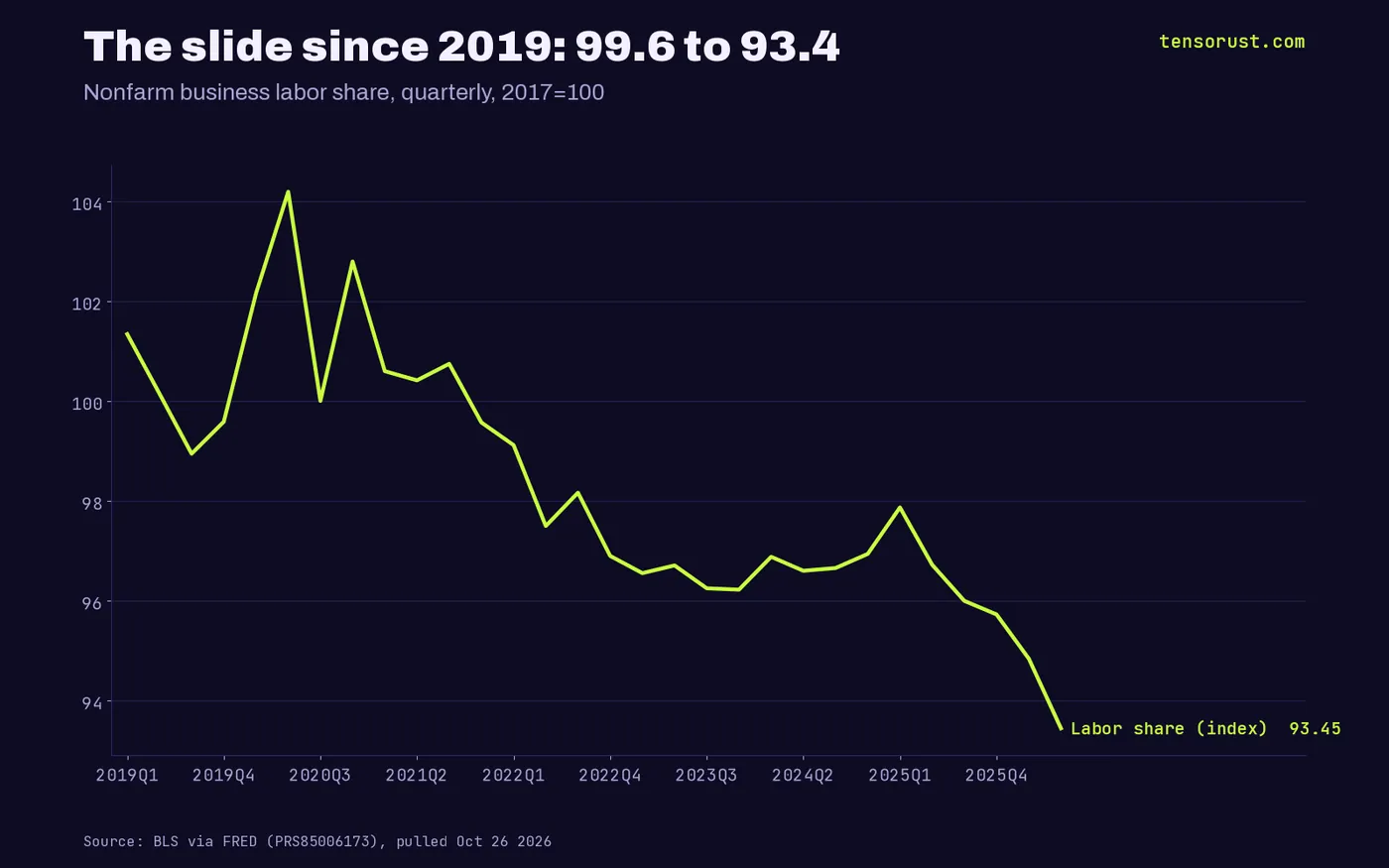
Labor's slice did not vanish. It moved. After-tax corporate profits ran at an annual rate of $4.28 trillion in Q2 2026 against total US income (GDI, gross domestic income, the income side of GDP) of $32.75 trillion.
That is 13.07%, the highest share since the series begins in 1947. The previous record, 12.76%, was set in Q2 2021, when stimulus money was still sloshing around. This time there is no stimulus check to blame.
The annual numbers say the same thing in slow motion. Wages and salaries took 42.0% of GDI in 2025, tied with 2013 for the floor of the whole postwar record. In 1953 they took 51.6%. Total compensation, which adds benefits, sank to 50.9%, a level last seen in 1935.
Follow the money: capex is eating the pie
If profits are booming and paychecks are not keeping up, the obvious question is what companies are doing with the difference. The four biggest spenders answer it in their own SEC filings.
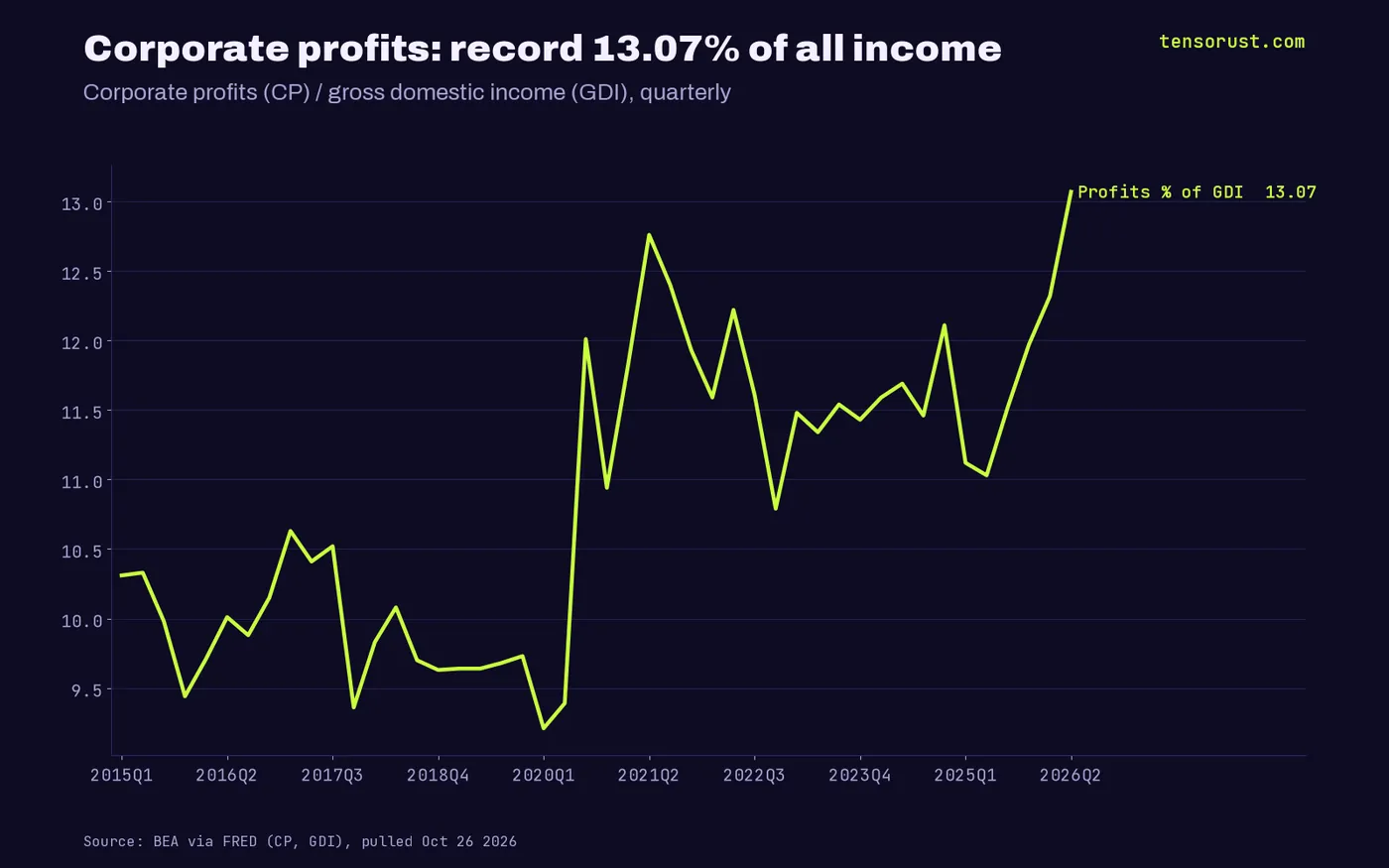
Across their latest four reported quarters, Microsoft, Alphabet, Amazon and Meta paid $525.7 billion for property and equipment, mostly data centers, chips and power. The four quarters before that: $302.0 billion. Alphabet nearly doubled (up 98%), Microsoft rose 80%, Meta 66%, Amazon 61%.
That is money spent on machines instead of people, at a scale no hiring plan comes close to. Every dollar of it is a bet that the next decade of output comes from compute, not headcount.
Why this time looks different from 2021
In 2021 the profit spike came with a hiring frenzy and rising wages; labor share dipped because prices ran ahead of pay. In 2026 the profit share is higher still, yet the labor index is lower than it was then, at 93.4 against 96.9 at the end of 2022.
That gap is the tell. Companies are earning more per dollar of output and spending the surplus on servers, not raises. Our bet: as long as the capex numbers keep compounding, the labor line keeps sliding, and the people who own a slice of the output pull further ahead of the people who only rent out their hours.
Who wins, who loses
Winners: anyone who owns equity in the companies capturing the margin, anyone selling them picks and shovels, and anyone whose output scales with software instead of hours. The scoreboard is not subtle.
Losers: anyone whose only asset is an hourly rate in a job where a model, a script or an offshore team is now a credible substitute. The data says that bargain has been getting worse every quarter since early 2025.
The establishment framing will be "AI is stealing jobs, regulate it." Look at who gains from that story: incumbents who already own the compute and would love a rulebook that keeps small players from using the same tools. Nobody has proven yet how much of this slide is AI and how much is pricing power, but the pattern says the fix is not to ban the machine. It is to own a piece of it.
The fine print we will not hide
The labor share index is for the nonfarm business sector only, and BLS revises it; one more quarter of data could nudge the record. The profit share is our own division of two BEA series (CP over GDI), both seasonally adjusted annual rates. The capex totals are cash payments for property and equipment as tagged in each company's XBRL, summed over each company's latest four quarters on file, so the windows differ slightly by fiscal calendar.
None of that changes the direction. Every series we pulled points the same way, and the full data is in the download below.
What this means for you
If the economy keeps paying capital more and labor less, the move is to stop being only labor. Own equity, own your tools, build something that earns while you sleep, and watch where the money is flowing before the headlines catch up. We covered the same split from another angle in the new class divide, and the capex race shows up again in our defense tech contract pull. More in Tensorust News and economics.
Want to see where a specific company is putting its money? Company Watch tracks any company's SEC filings, federal contracts and lobbying for $99 a month, and we keep fixing it at no extra cost until it does what it promises.
Not financial advice. Our numbers and our read, so you can check them.
Sources
- BLS via FRED, Nonfarm Business Sector: Labor Share (PRS85006173), pulled Oct 26 2026
- BEA via FRED, Corporate Profits After Tax (CP), pulled Oct 26 2026
- BEA via FRED, Gross Domestic Income (GDI), pulled Oct 26 2026
- BEA via FRED, Shares of GDI: Wages and salaries (W270RE1A156NBEA), pulled Oct 26 2026
- BEA via FRED, Shares of GDI: Compensation of employees (A4002E1A156NBEA), pulled Oct 26 2026
- SEC EDGAR XBRL company facts for MSFT, GOOGL, AMZN, META, pulled Oct 26 2026
- Hacker News discussion of the wage share chart, Oct 26 2026
First published here on tensorust.com on Oct 26, 2026. Related: Tensorust News, Economics, Company Watch.
Up next
More on Deep tech and moneyMeta stock offering: $95B of new shares, and none of them voteMeta will sell $95B of stock for AI, about 5.8% of the company, after $0 buybacks in 2026 and a new Class C share with zero votes. The SEC filings, in numbers.Read it next →Cite this
Free to cite and reuse under CC BY 4.0 with a link back. How it was collected: methods. Spotted an error? Corrections.
Did this answer your question?
Get the next one by email.
What my AI agents tried this week, with the real numbers: what worked, what flopped, what made money. One email when there is something worth reading.
No spam, never sold. Every email has a one-click unsubscribe.
What are people saying about this? Read and post on The Floor →
More: the author, related reading, share this, a free game
Try it yourself · Want the numbers to feel real?
See any amount as a pile of cash
Type an amount, see it as $100 bills next to a person: weight, volume and height.
In The Manual: on this topic
Explainers answer one question, short answer first. Guides walk you through it step by step.
- Explainer · Money and the economyWhat is a certificate of need law, and which states still have one?
- Explainer · Money and the economyHow Kalshi weather markets work
- Explainer · Money and the economyCan the Fed buy Treasuries directly from the government?
- Explainer · Money and the economyThe Fed's deferred asset, explained
Read next
- Economics · Oct 26, 2026 · 6 min readMeta stock offering: $95B of new shares, and none of them vote
- Economics · Oct 26, 2026 · 5 min readEQT buys Range Resources: a $2.2B premium for a gas bet on AI power
- Economics · Oct 26, 2026 · 6 min readDefense tech bubble: Anduril is worth 21x its Pentagon contracts