
RTX 5090 China AI conversions: Nvidia's China sales doubled to $7.9B
On this page · 8 sections
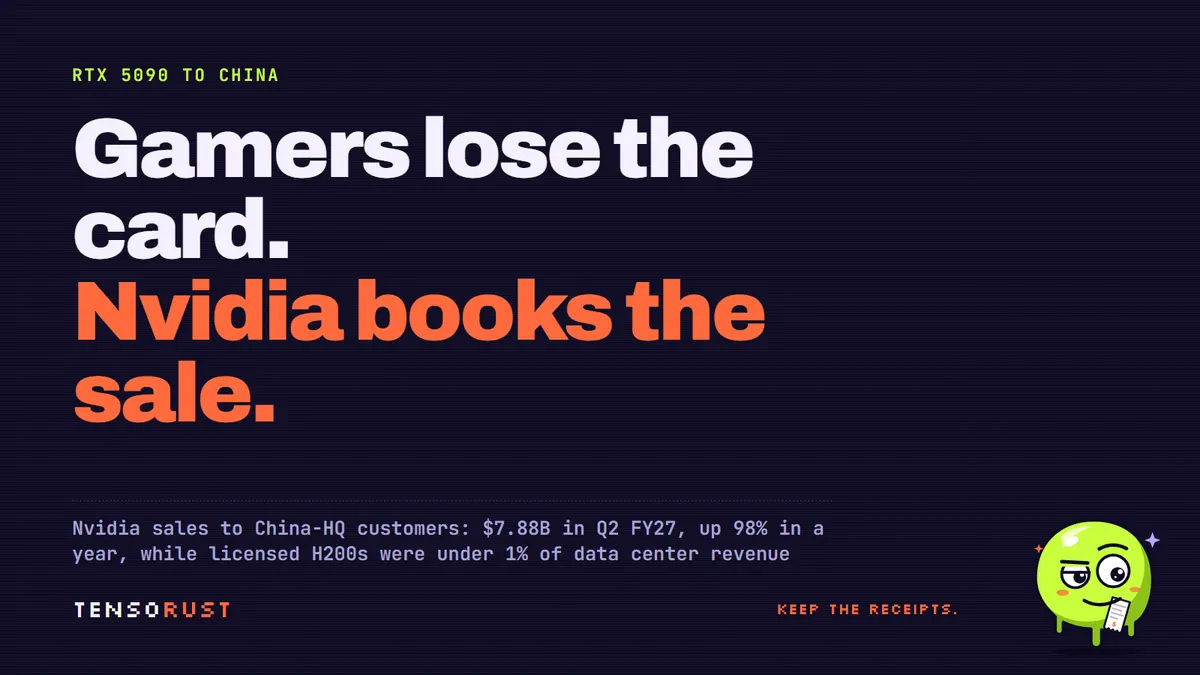
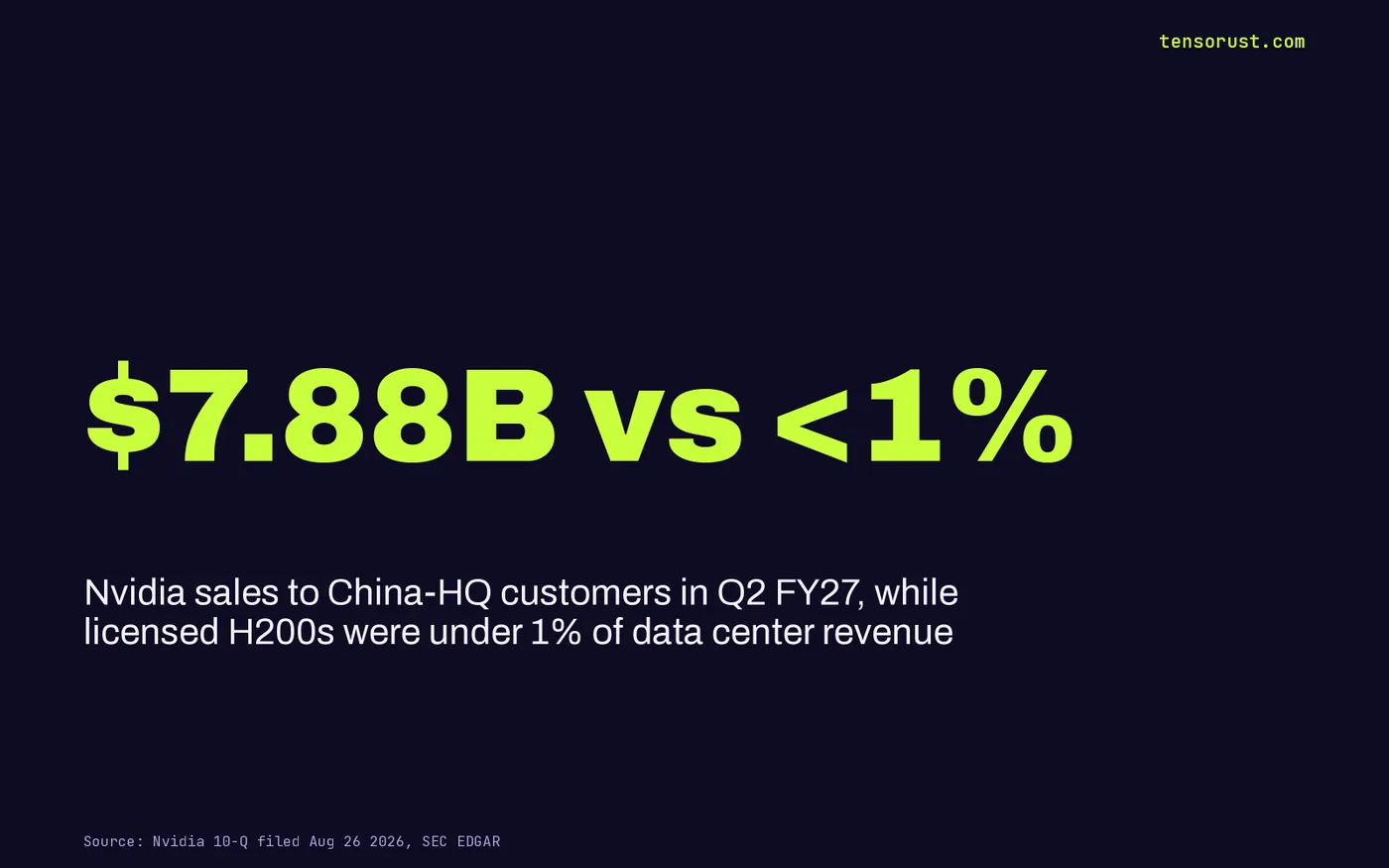
Short answer: Footage posted by Hong Kong outlet HKEPC on October 23 shows shelves of retail RTX 5090s, Founders Editions included, being stripped in a Chinese workshop so the GB202 chip and its 32 GB of memory can be moved onto blower-style boards for AI servers. Nvidia's own filings show the money side: sales to China-headquartered customers hit $7.88 billion in the quarter to July 26, up 98% in a year, while the licensed H200 shipments to China were under 1% of data center revenue. Export controls did not stop the demand. They moved it into the gaming aisle, and gamers are paying the bill.
TL;DR: The RTX 5090 launched at $1,999 and now sells for about $7,300 to $8,500 in the US, roughly four times list, after Nvidia confirmed on October 17 that supply is "somewhat constrained". Nvidia's revenue from China-headquartered customers fell from $9.66 billion to $2.97 billion after the H20 ban, then climbed back to $7.88 billion in two quarters, and its Graphics segment grew 46% year on year to $7.92 billion. A gigabyte of 5090 memory at street price now costs $228 to $266, more than a gigabyte on Nvidia's own $16,000 RTX PRO 6000, which tells you the gray market is paying for access, not a bargain.
Key numbers
| What | Number | Source, checked Oct 25 2026 |
|---|---|---|
| Nvidia revenue, China-HQ customers, Q2 FY27 (May to Jul 2026) | $7.88B (8.2% of total) | Nvidia 10-Q, Aug 26 2026 |
| Same, one year earlier (Q2 FY26) | $3.99B | Nvidia 10-Q, recast |
| Low point after the H20 ban (Q3 FY26) | $2.97B | Nvidia 10-Q, Nov 19 2025 |
| Licensed H200 shipments to China, share of data center revenue | under 1% | Nvidia 10-Q, Aug 26 2026 |
| Nvidia Graphics segment revenue, Q2 FY27 | $7.92B (+46% y/y) | Nvidia 10-Q |
| RTX 5090 launch price vs US street price, Oct 17 | $1,999 vs $7,300 to $8,500 | Hardware Busters, Oct 17 2026 |
| RTX PRO 6000 Blackwell (96 GB), launch vs Aug 2026 | $8,565 vs $16,000 | Tech Insider, Aug 2026 |
| Cost per GB of VRAM: 5090 at street vs PRO 6000 at $16,000 | $266 vs $167 (our calc) | our data.csv |

What the footage shows, and what it does not
HKEPC posted the clips on X on October 23, saying they leaked from inside a graphics card conversion workshop. Wccftech's Sarfraz Khan counted "hundreds" of boxed RTX 5090s on the shelves, from several board makers, including ASUS ROG Astral cards that sell for around $10,000.
Workers pull the triple-fan coolers, lift the GB202 die and the memory chips, and mount them on custom boards with a dual-slot blower. Blower cards exhaust heat out the back, which is what lets eight of them sit side by side in a server, as Hardware Busters explains.
The honest limits: the clips do not show when they were filmed, how many cards pass through, or who buys the output. The memory is moved, not upgraded, so these are still 32 GB cards. And this is not new: Tom's Hardware covered a Shenzhen line doing the same thing to 5090s in July 2025. What is new is the scale on the shelves and the timing, one week after the card started vanishing from US stores.
Nvidia's China number fell off a cliff, then came back
In the third quarter of fiscal 2026 Nvidia changed how it reports geography, from where customers are billed to where they are headquartered, and recast the old quarters. On that basis, here is the China and Hong Kong line, straight from the filings.
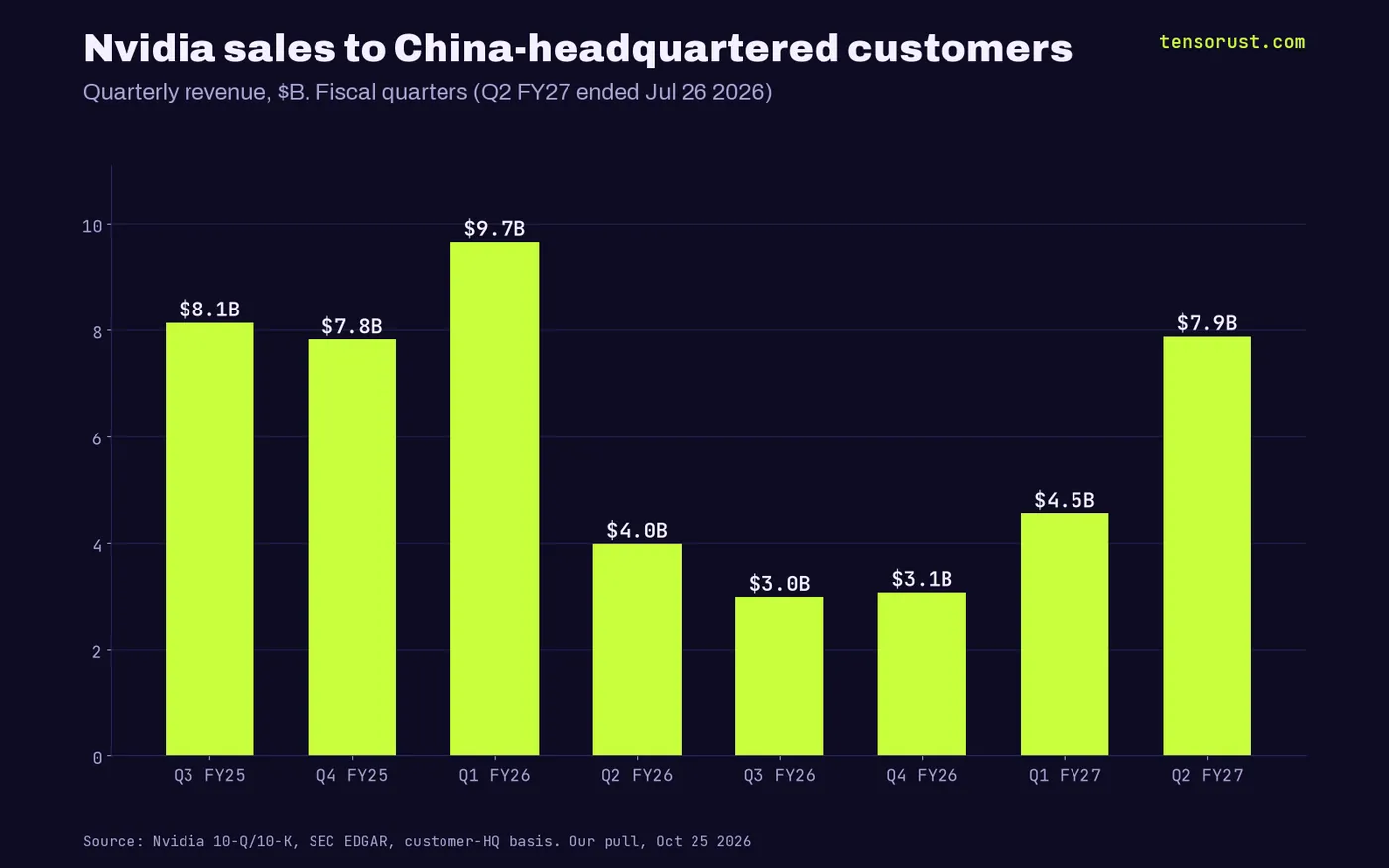
Q1 FY26, the quarter that ended April 2025, was $9.66 billion. Then the US required licenses for the H20, Nvidia took a $4.5 billion charge, and the line dropped to $3.99 billion, then $2.97 billion. Beijing then blocked the licensed H20 and H200 sales from its side. Nvidia says it has made "a fraction of the allowed shipments" of H200 and that those were "less than 1% of Data Center revenue" last quarter.
And yet the China line climbed to $3.06 billion, $4.55 billion and then $7.88 billion. The 10-Q does not say what China-headquartered customers bought. It does say, in the same document, that "the end customer and shipping location may be different" from the headquarters location, and that "we do not have physical control of our products after sale."
The demand did not leave. It changed aisles
Our reading, and it is a reading, not a finding in the filing: when the legal data center chips are blocked from both sides, the cheapest legal-to-buy Blackwell silicon on earth is a gaming card. The full RTX 5090 is itself controlled for export to China, which is why Nvidia sells the cut-down RTX 5090 D there. But a retail box bought in another country is a lot harder to police than a pallet of H200s that has to pass a US inspection before it ships.
The Graphics segment, which holds GeForce and the RTX PRO workstation cards, tells the same story from the other end.
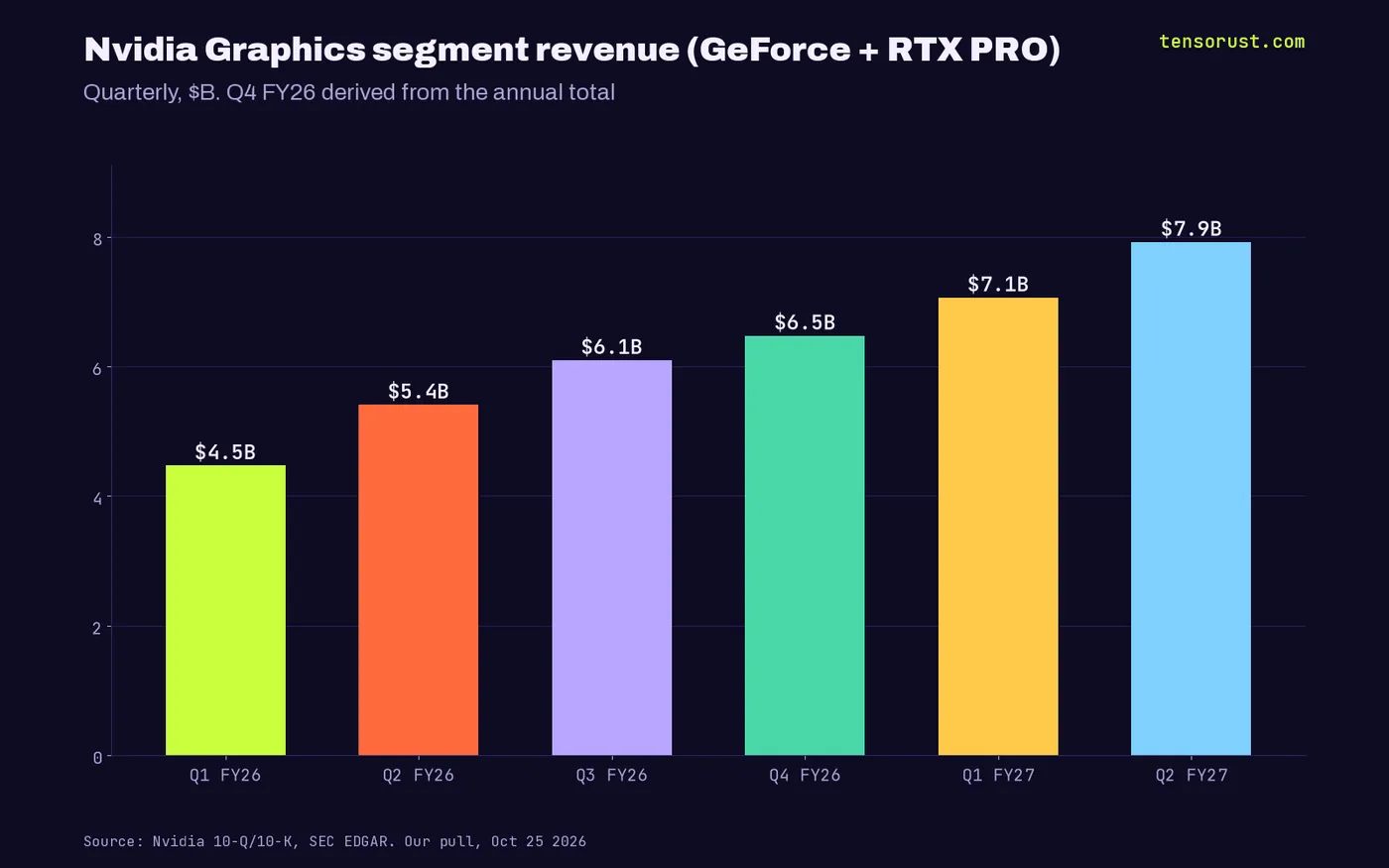
Graphics revenue went from $4.47 billion in Q1 FY26 to $7.92 billion in Q2 FY27, up 77% in five quarters. Nvidia credits "sales of our Blackwell architecture." We would add: a lot of that Blackwell went into racks, not rigs. Nobody has proven the split yet, and Nvidia does not report one.
Follow the money: who wins, who loses
Nvidia wins either way. Every 5090 that ends up in a Chinese server was first sold into the channel at Nvidia's price. Nvidia's 10-Q warns that "reports of diversion of controlled products, even when unsubstantiated and untrue" can hurt its reputation, and it says it helps authorities on attempted diversion. We are not accusing Nvidia of anything; there is no record that it sold to this workshop. We are pointing out that the incentive runs one way.
Resellers win the spread. Nvidia books about $1,999 of list value on a card that clears at $8,500 on Amazon. The $6,500 gap goes to whoever holds the box. That is the shortage tax, and it is collected by the middlemen, not the chipmaker.
Nvidia captures the premium where it can. On the workstation card it sells direct, it raised the price. The RTX PRO 6000 Blackwell, same GB202 family with 96 GB, went from $8,565 at launch to $16,000 on Nvidia's US Marketplace by August, up 87%.
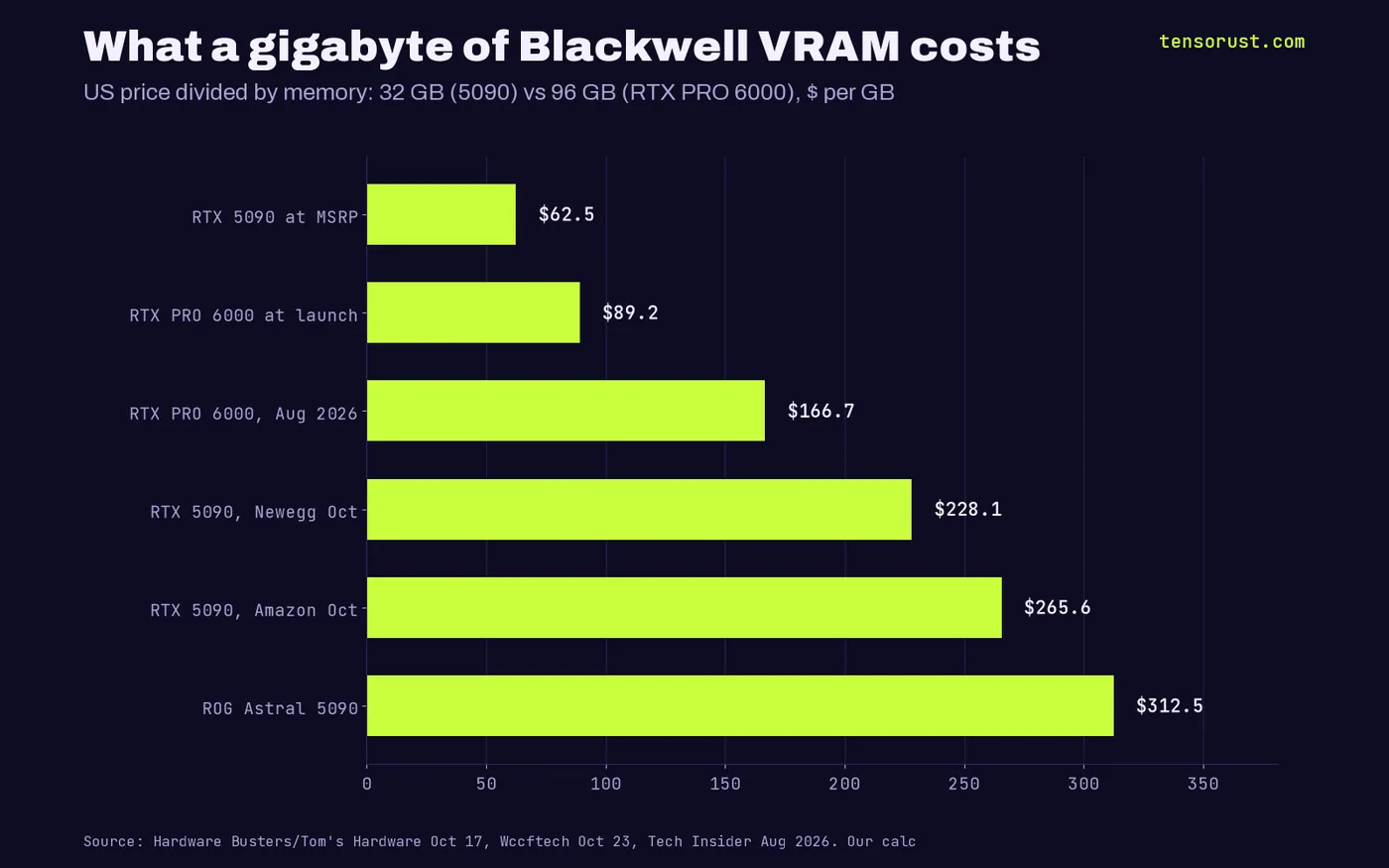
Put both cards on a per-gigabyte basis and the gray market looks irrational: at street prices a 5090 costs $228 to $266 per GB of memory, the ROG Astral $312, while the PRO 6000 at its marked-up $16,000 is $167. Buyers paying more per GB for the consumer card are paying for the one thing the pro card cannot offer them: a supply line that does not run through a licensed, inspected sale.
Gamers lose. They compete with server buyers for the same die. Micro Center marked several 5090 models "Not Carried," the card fell off Nvidia's own store list, and the 50 Super refresh is reportedly on hold. Jeff Fisher, who runs GeForce, told Taiwanese press the card "has definitely not been discontinued." It might as well be at four times list.
Export control credibility loses. Washington has been tightening thresholds on data center parts since at least October 2023, per Nvidia's own filing. The 10-Q's own list of controlled products already includes the RTX 4090. If a $1,999 retail box can be turned into an AI server card on a factory floor, the rule controls paperwork, not compute.
Where the real leverage sits
The pattern says the fight over who gets AI compute is drifting from rules to plumbing: memory supply, die allocation and retail channels. Memory makers warn the DRAM squeeze could run through 2028, per Micron's CEO via Ars Technica. Every gigabyte that goes into a data center card does not go into a gaming one.
Our bet: Nvidia's next 10-Q shows the China-HQ line above $7.88 billion again, with no new licensed data center product to explain it, and the 5090 stays above $5,000 in the US through the holidays. If the line falls back toward $3 billion, we were wrong and we will say so. We covered a similar Nvidia story from the other side in the RTX 3090 half-rate unlock, and the bigger AI spending picture in Mag 7 vs S&P 493.
What this means for you
- If you want a 5090 for gaming, do not pay four times list. Wait for first-party stock or buy a used 4090 or a lower card; the premium is a shortage tax, not the card's value.
- If you want local AI, price by memory, not by name. Check what your model actually needs with our free LLM VRAM calculator before you spend $8,500 on 32 GB.
- If you own Nvidia stock, read the China line in the next 10-Q, not the headlines. It is the cleanest public signal of how much controlled demand is finding a way around the rules.
- More deep tech and money stories live on Tensorust News and the deep tech and money hub.
If you are building with AI on whatever hardware you can get, including a local model on a smaller card, the $29 AI Builder Kit is five offline apps that keep your AI building what you meant, on any model. If it does not get your AI building what you meant, we keep working with you at no extra cost until it does what it promises.
Not financial advice. Our numbers and our read, so you can check them. Every figure is in the free data.csv.
Sources
- HKEPC on X, conversion workshop footage, Oct 23 2026
- Wccftech, Sarfraz Khan, "The RTX 5090 Isn't Gone, It's In Chinese Labs", Oct 23 2026
- Hardware Busters, RTX 5090 AI conversion footage, Oct 23 2026
- Hardware Busters, Nvidia says the RTX 5090 isn't discontinued, street prices hit $8,500, Oct 17 2026
- Notebookcheck, Chinese labs turn RTX 5090 cards into AI accelerators, Oct 2026
- Nvidia 10-Q, quarter ended Jul 26 2026, filed Aug 26 2026
- Nvidia 10-Q, quarter ended Apr 26 2026, filed May 20 2026
- Nvidia 10-K, fiscal 2026, filed Feb 25 2026
- Nvidia 10-Q, quarter ended Oct 26 2025, filed Nov 19 2025
- Tech Insider, RTX PRO 6000 Blackwell price history, Aug 2026
- Nvidia, GeForce RTX 5090 specs, checked Oct 25 2026
First published here on tensorust.com on Oct 25, 2026. Related: Tensorust News, Deep tech and money, LLM VRAM calculator, RTX 3090 half-rate unlock.
Up next
More on Deep tech and moneyGoogle Finland data center: €4.5M of trees vs a €400M power edgeGoogle cleared 530 ha of Finnish forest: 0.34% of a year of clear-cuts, about €4.5M of timber. Finland's cheap power is worth ~€400M a year. Free CSV.Read it next →Cite this
Free to cite and reuse under CC BY 4.0 with a link back. How it was collected: methods. Spotted an error? Corrections.
Did this answer your question?
Get the next one by email.
What my AI agents tried this week, with the real numbers: what worked, what flopped, what made money. One email when there is something worth reading.
No spam, never sold. Every email has a one-click unsubscribe.
What are people saying about this? Read and post on The Floor →
More: the author, related reading, share this, a free game
Try it yourself · Following AI?
Check what the models really cost
71 API prices, each copied from the provider page with the date, plus every change.
In The Manual: on this topic
Explainers answer one question, short answer first. Guides walk you through it step by step.
- Explainer · Money and the economyCan the Fed buy Treasuries directly from the government?
- Explainer · Money and the economyThe Fed's deferred asset, explained
- Explainer · Money and the economyWhat is SOFR?
- Explainer · Money and the economyWhat are bank reserves?
Read next
- Economics · Oct 24, 2026 · 10 min readGoogle Finland data center: €4.5M of trees vs a €400M power edge
- Economics · Oct 24, 2026 · 15 min readMag 7 vs S&P 493: the AI payoff is AI selling to itself
- Economics · Oct 24, 2026 · 12 min readAI didn't kill dev jobs. A tax rule might have: US posts up 21%