
By Matt Busel, who built the apps, crates and game he writes about · every number links to its source and every dataset is downloadable (methods) · corrections · featured in Kirino, gamebiz, This Week in Rust, New Mobile Life, By-Press
US coal retirements 2026: 0 MW in 9 months, TVA quietly filed 2034
On this page · 8 sections
Short answer: As of the September 2026 federal generator inventory, the United States has retired zero megawatts of coal capacity in 2026. In January, owners told the government 6,354 MW would go this year. Nine months later not one of those units is gone, 2,770 MW has been pulled out of 2026 entirely, and the Tennessee Valley Authority has quietly written December 2034 next to 1,675 MW it once promised to close this December.
TL;DR: We joined the January 2026 and September 2026 editions of EIA Form 860M unit by unit: 16 coal units, 6,354 MW, were due to retire in 2026, and 0 MW have. The first nine months of 2026 are the first January-to-September stretch since at least 2012 with no coal retired at all, down from 10,570 MW in the same months of 2022. Every remaining 2026 retirement, 3,584.5 MW, is now stacked into November and December, the same calendar trick that turned 8.0 GW of planned 2025 retirements into 2.6 GW of real ones.
Key numbers
| What | Number | Source, checked Oct 27 2026 |
|---|---|---|
| Coal MW scheduled to retire in 2026 (Jan 2026 filing) | 6,354 MW, 16 units | EIA-860M, January 2026 |
| Coal MW actually retired, Jan to Sep 2026 | 0 MW | EIA-860M, September 2026, Retired sheet |
| Coal retired Jan to Sep, same months of 2022 | 10,570 MW | EIA-860M, September 2026 |
| TVA Cumberland 2 + Kingston 7-9 new planned date | December 2034 (1,675 MW) | EIA-860M, September 2026 |
| Pulled out of 2026 entirely | 2,770 MW | Our join of the two filings |
| Still claimed for Nov-Dec 2026 | 3,584.5 MW | Our join of the two filings |
| Planned vs real coal retirements in 2025 | 8.0 GW planned, 2.6 GW retired | EIA Today in Energy, Feb 23 2026 |
| Operating US coal fleet, Sep 2026 | 167,235 MW | EIA-860M, September 2026 |

The number nobody added up: zero
EIA publishes a monthly inventory of every power plant generator in the country, called Form 860M. Each unit carries the month and year its owner says it will retire. EIA itself wrote in February that 6.4 GW of coal was scheduled to close in 2026. Nobody has gone back to check how that list is doing.
We did. We matched every coal unit (bituminous, subbituminous, lignite, refined and waste coal) with a 2026 retirement date in the January 2026 file to the same plant and generator ID in the September 2026 file. The match found 16 units and 6,354 MW, the same total EIA reported. In September, the retired-units sheet lists 0 MW of coal with a 2026 retirement date. The units that did retire this year are almost all gas: 643 MW of gas combustion turbines leads the sheet.
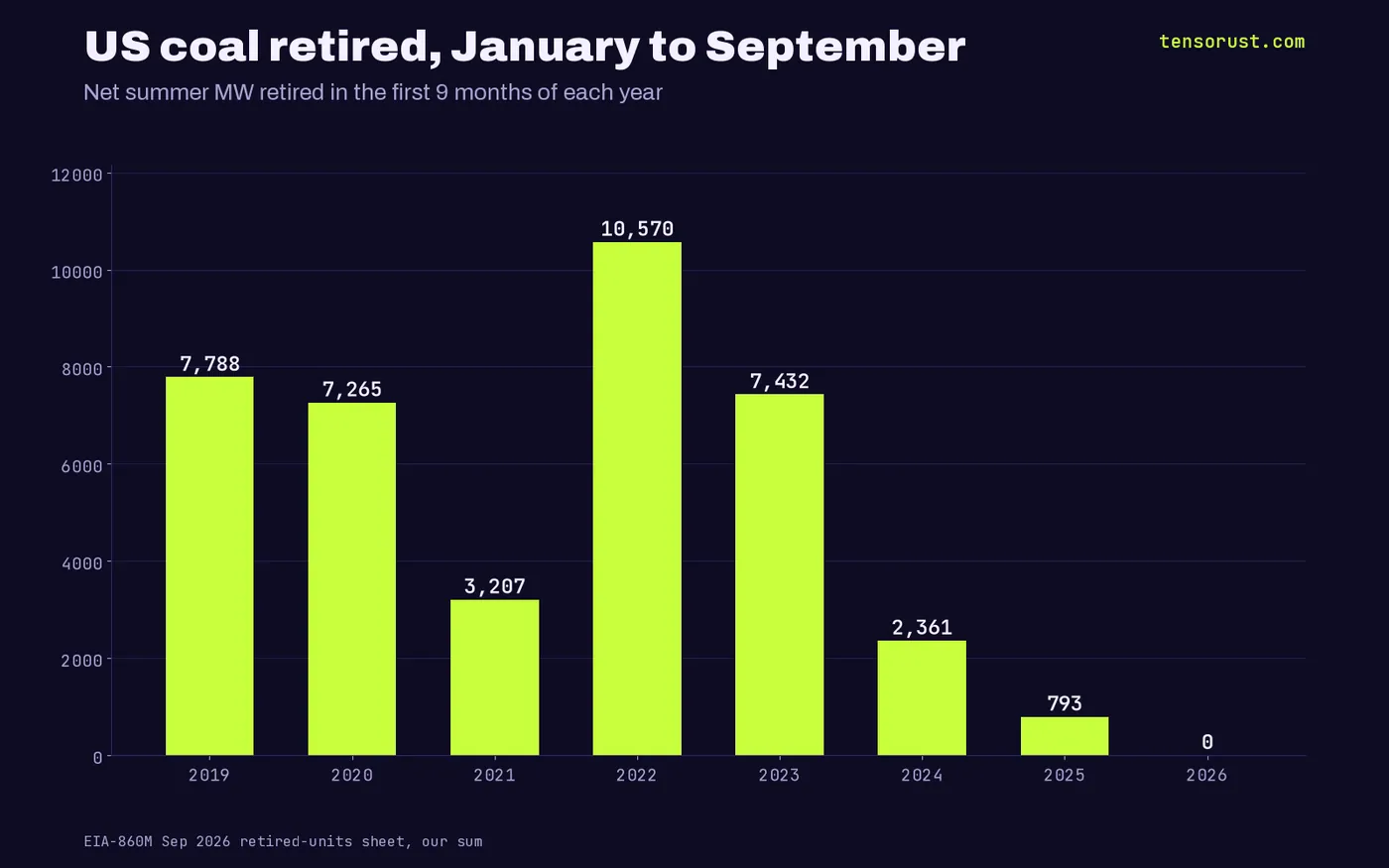
That is not a slowdown. It is a full stop. In the first nine months of 2022 the country retired 10,570 MW of coal. In 2023, 7,432 MW. In 2025, the year federal emergency orders started, 793 MW. In 2026, nothing.
TVA moved its dates eight years, and said 2034 nowhere we can find
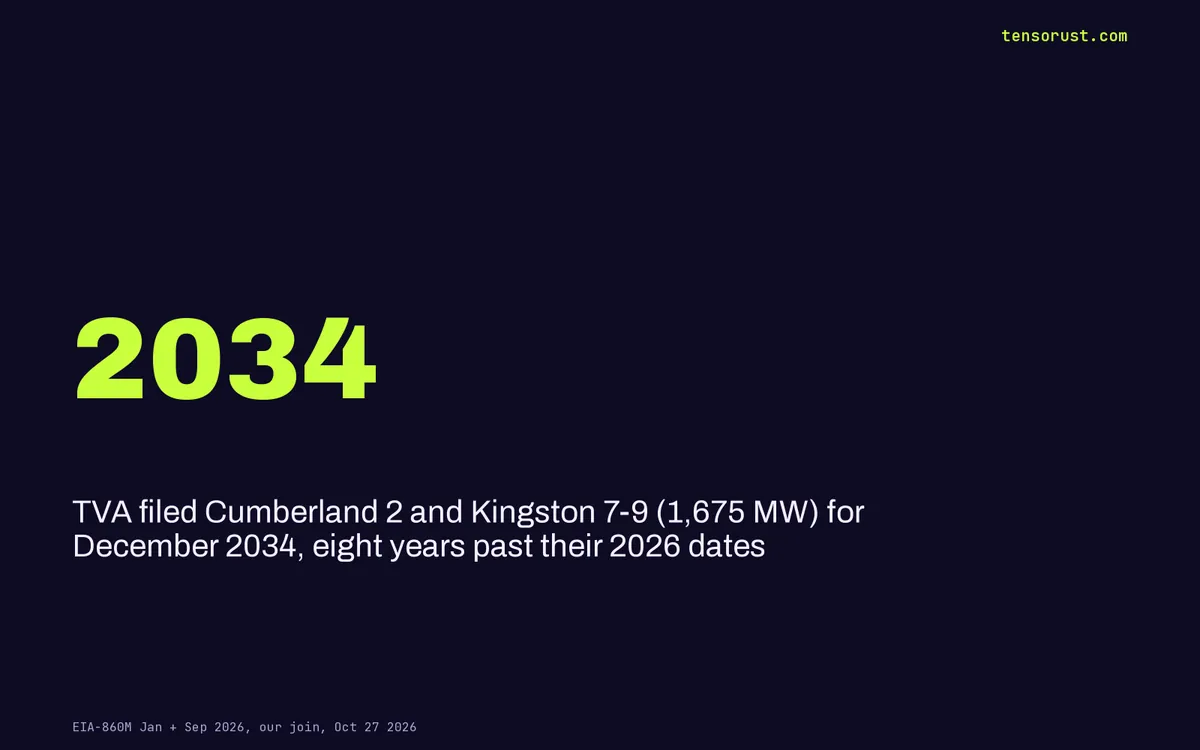
The biggest single move in the file belongs to the Tennessee Valley Authority, the federal utility. In January, Cumberland Unit 2 in Tennessee (1,231 MW) and Kingston Units 7, 8 and 9 (444 MW together) carried December 2026 retirement dates. In September, all four carry December 2034.
The TVA board voted in February to postpone the two plants, and press coverage at the time reported that TVA set no new dates. The 2034 date sits only in the federal filing. We searched for "Cumberland" and "Kingston" with "2034" and found no news report, board summary or press release carrying it as of Oct 27 2026. Cumberland is the second biggest coal retirement EIA had on the 2026 list, so this one line erases a fifth of the year's promised coal closures on its own.
Read that as the planning signal it is: the federal government's own utility is now planning coal through most of the next decade,. Whether that is caution or capture, the filing says the old units will be there either way.
Where the other 4,679 MW went
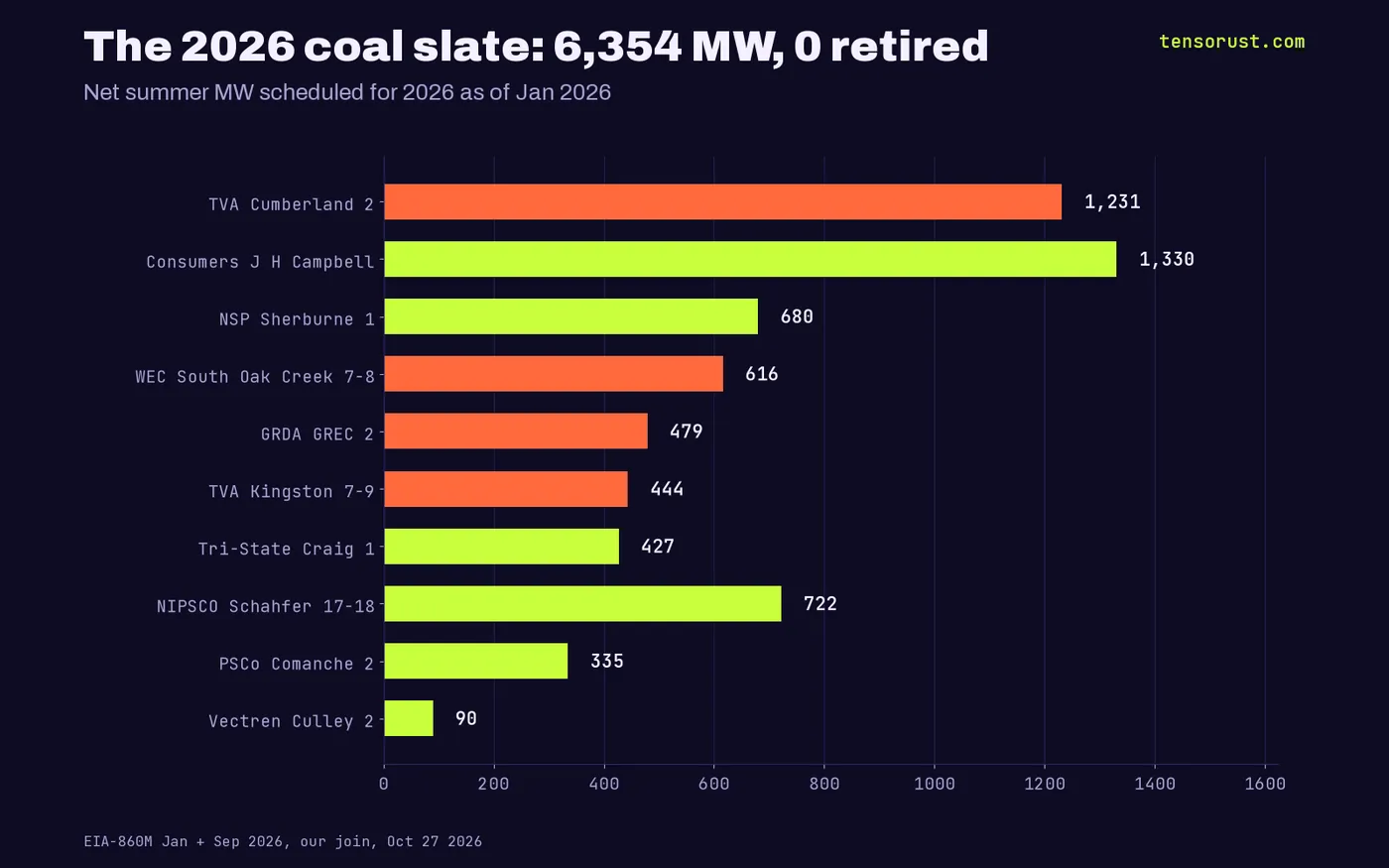
Here is the whole 2026 slate, unit by unit, as the two filings tell it:
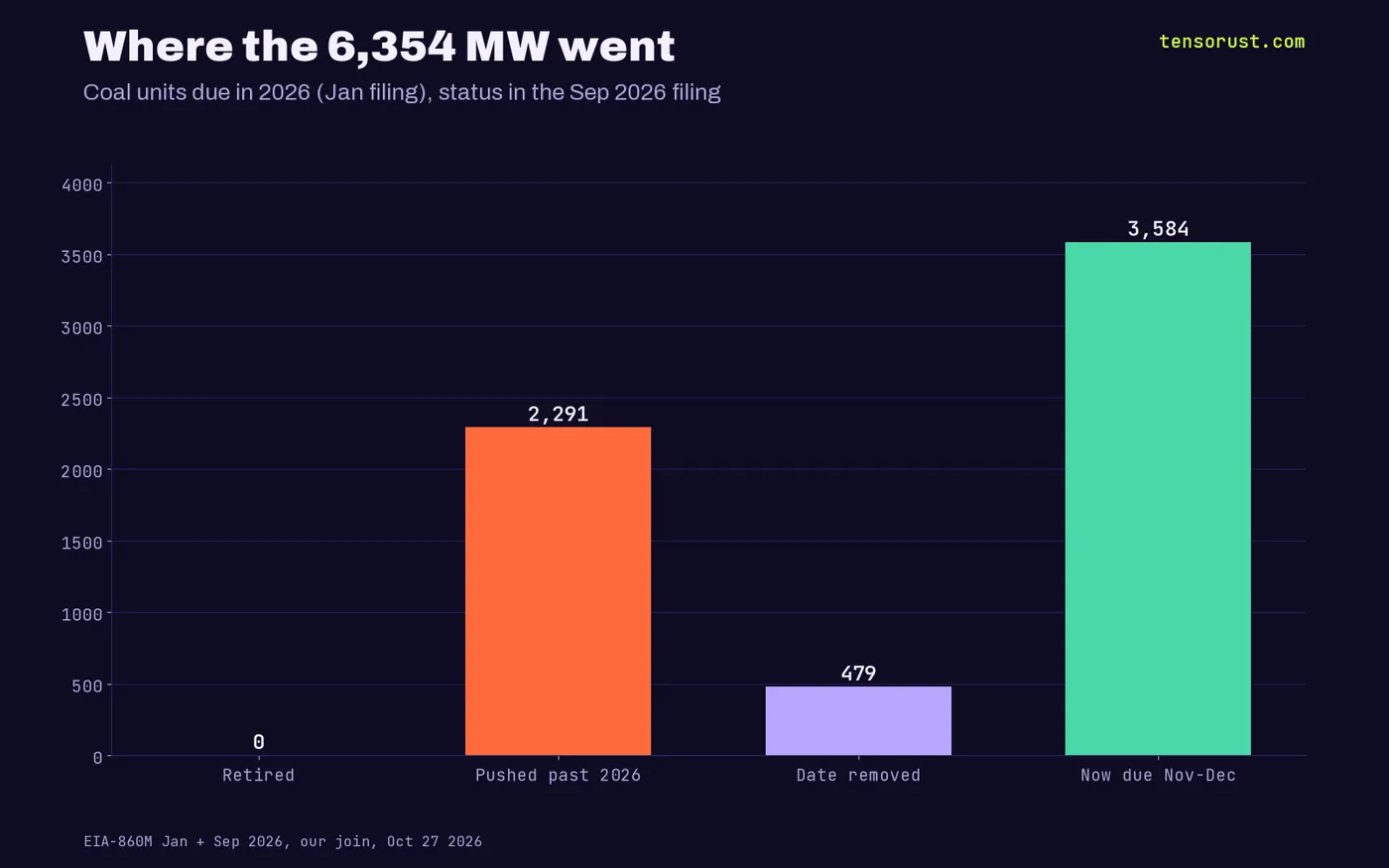
- Pushed past 2026 (2,291 MW): TVA Cumberland 2 and Kingston 7-9 to December 2034; We Energies South Oak Creek 7 and 8 (616 MW, Wisconsin) to December 2027.
- Retirement date deleted (478.9 MW): Grand River Dam Authority's GREC Unit 2 in Oklahoma, due June 2026, now has no retirement date at all.
- Still claimed for 2026, all slid to Nov-Dec (3,584.5 MW): Consumers Energy J H Campbell 1-3 (1,330.5 MW, Michigan) moved from February to November; Tri-State Craig 1 (427 MW, Colorado) and Vectren F B Culley 2 (90 MW, Indiana) from March to December; NIPSCO R M Schahfer 17 and 18 (722 MW, Indiana) from June to December; Xcel Sherburne County 1 (680 MW, Minnesota) and Comanche 2 (335 MW, Colorado) stay in December.
J H Campbell is the plant DOE kept running with emergency orders under Section 202(c) of the Federal Power Act in 2025, per EIA. Its filing has now slid nine months inside one calendar year. Five of the six plants still listed for 2026 were already on EIA's 2025 list and missed it.
Follow the pattern: December is where retirements go to die
Last year owners planned 8.0 GW of coal retirements and delivered 2.6 GW, EIA says. Our join shows how that happens. A retirement date does not get cancelled in one move. It slides from February to November, then from November to "next year", then the date disappears. Every unit still on the 2026 list now sits in the last eight weeks of the year, exactly where the 2025 misses sat.
Our bet, labelled as ours: on current filings, 2026 finishes with less coal retired than 2025's 2.6 GW, and possibly with none. Nobody has proven it yet. The October and November 860M files will.
Who wins, who loses
Winners: owners whose units run on, the coal suppliers and rail lines behind them, and grid operators who wanted every megawatt they could keep while data center demand climbs. Losers: ratepayers paying to keep 1960s and 1970s units staffed past the dates their owners filed, and anyone who built a business plan on the replacement capacity those retirements were meant to make room for.
The honest read for builders is that the limit here is not coal's appeal. It is how slowly new capacity reaches the grid. Batteries are the fastest new capacity on the US grid right now, 54 GW and climbing, and solar just passed nuclear worldwide. Old plants close when something faster replaces them. Every delay on this list is a measurement of how far behind the replacements are.

What this means for you
If you build or invest in energy, power-hungry compute or grid software, stop using announced retirement dates as facts. Download our unit-by-unit table below (both filings, every date change) and check any plant you depend on against the newest 860M file each month. If you are in Tennessee, Michigan, Wisconsin, Oklahoma, Colorado, Indiana or Minnesota, those units are your local grid, and your utility commission dockets are where you can push.
Want this watched for you? Company Watch tracks a company's federal filings, contracts and lobbying and tells you when something moves, for $99 a month. We keep fixing it at no extra cost until it does what it promises.
Not financial advice. More: news, Frontiers, economics.
Sources
- EIA, Preliminary Monthly Electric Generator Inventory (Form 860M), January 2026 and September 2026 editions, pulled Oct 27 2026
- EIA Today in Energy, "Retirement delays of U.S. electric generating capacity may continue in 2026", Feb 23 2026
- Industrial Info Resources, TVA to delay retirement of two large coal-fired power plants, 2026
- SynMax, Coal retirements: EIA's 2025 figures look overstated, 2025
First published here on tensorust.com on Oct 27, 2026. Related: .
Up next
More on FrontiersFermi America filed 11.7 GW of gas with EIA: 41% of the US surgeFermi America put 157 gas units (11.7 GW) on EIA's list in 2026: 41% of all new US gas, 3x what the US built this year. 300 MW is under construction.Read it next →Cite this
Free to cite and reuse under CC BY 4.0 with a link back. How it was collected: methods. Spotted an error? Corrections.
Did this answer your question?
Get the next one by email.
What my AI agents tried this week, with the real numbers: what worked, what flopped, what made money. One email when there is something worth reading.
No spam, never sold. Every email has a one-click unsubscribe.
What are people saying about this? Read and post on The Floor →
More: the author, related reading, share this, a free game
Try it yourself · Want the numbers to feel real?
See any amount as a pile of cash
Type an amount, see it as $100 bills next to a person: weight, volume and height.
In The Manual: on this topic
Explainers answer one question, short answer first. Guides walk you through it step by step.
- Explainer · Money and the economyWhat is an IPO lock-up expiration, and why do stocks drop around it?
- Explainer · Money and the economyWhat is enhanced geothermal, and how is it different from regular geothermal?
- Explainer · Money and the economyWhat is a stock warrant? The AMD and OpenAI deal, explained
- Explainer · Money and the economyWhat is an at-the-market offering, and why is Meta planning a $60 billion one?
Read next
- Economics · Oct 27, 2026 · 7 min readFermi America filed 11.7 GW of gas with EIA: 41% of the US surge
- Economics · Oct 27, 2026 · 7 min readMercury to gold: Marathon Fusion beat CERN 10x. The US buries mercury
- Economics · Oct 27, 2026 · 6 min readHelium is a critical material now. The US exports 4.75x its imports

.jpg)