
By Matt Busel, who built the apps, crates and game he writes about · every number links to its source and every dataset is downloadable (methods) · corrections · featured in Kirino, gamebiz, This Week in Rust, New Mobile Life, By-Press
Meta stock offering: $95B of new shares, and none of them vote
On this page · 8 sections
Short answer: Meta said Monday it will raise $95 billion by selling stock: $35 billion in underwritten offerings first, then $60 billion through an at-the-market program, to pay for AI data centers and what it calls superintelligence. At Friday's $642.62 close that is about 148 million new shares, roughly 5.8% of the company. Five days earlier, Zuckerberg's own holding entities signed off on a new Class C share with zero votes. Our read: the money comes from you, the control stays with him.
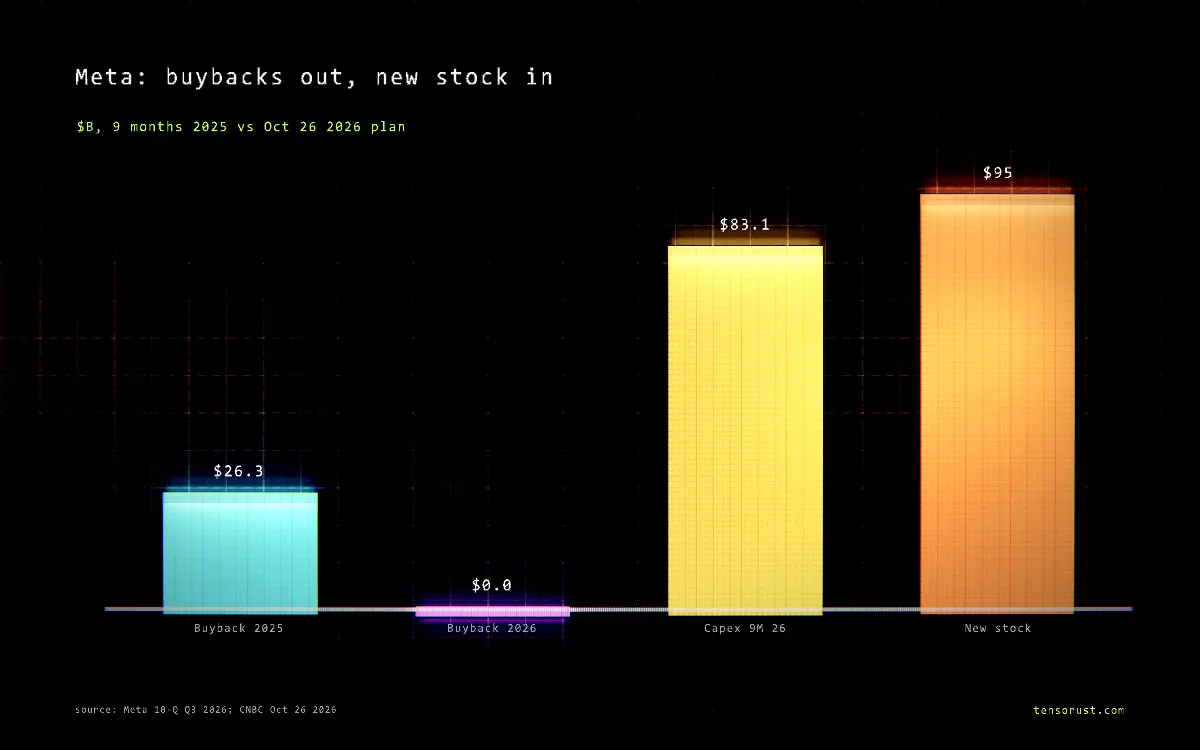
TL;DR: Meta bought back $26.3 billion of its own stock in the first nine months of 2025 and $0 in the same stretch of 2026, while capex jumped from $48.3 billion to $83.1 billion. Its free cash flow went negative, minus $2.12 billion in Q3, even after it borrowed $24.9 billion this year. So the buyback machine is now running in reverse: a $95 billion share sale, about 5.8% dilution, with a new non-voting share class arriving January 19, 2027 so the extra stock never touches Zuckerberg's 56.1% of the vote.
Key numbers
| What | Number | Source, checked Oct 26 2026 |
|---|---|---|
| Total stock sale announced | $95B ($35B underwritten + $60B at-the-market) | CNBC |
| Shelf registration filed | Form S-3ASR, Oct 26 2026 | SEC EDGAR |
| Shares outstanding (A + B), Oct 1 2026 | 2,556.2M | Meta PRE 14C |
| Dilution if all $95B sells at $642.62 | ~147.8M shares, 5.8% | Tensorust calc from the above |
| Capex, first 9 months 2026 vs 2025 | $83.1B vs $48.3B (+72%) | Meta 10-Q Q3 2026 |
| Share buybacks, first 9 months 2026 vs 2025 | $0 vs $26.3B | Meta 10-Q Q3 2026 |
| Free cash flow, Q3 2026 | -$2.12B (was +$10.63B a year earlier) | Meta Q3 release |
| Long-term debt | $80.9B (Dec 2025: $58.7B) | Meta 10-Q Q3 2026 |
| Zuckerberg entities' voting power | 56.1% | Meta PRE 14C |
| 2026 capex guide (incl. finance leases) | $135-145B | Meta Q3 release |

The biggest buyback company just became a seller
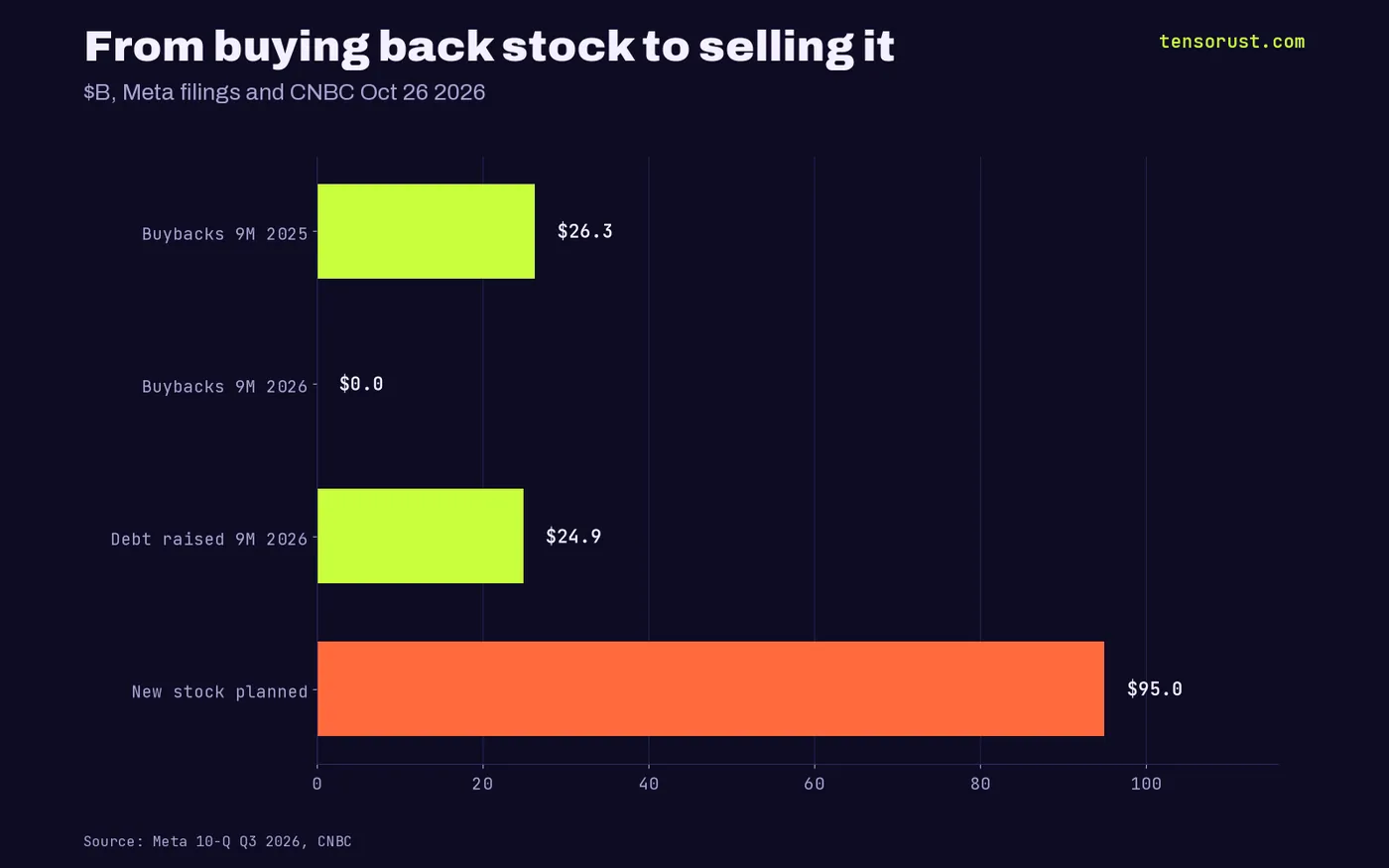
For years the Meta trade was simple: print cash, buy back stock, shrink the share count. In the first nine months of 2025 Meta spent $26.3 billion doing exactly that.
In the first nine months of 2026 it spent zero. Not a cut. Zero, in all three quarters, per its own 10-Q.
Today it flipped the sign. Meta told the market it will sell $95 billion of new stock, per CNBC, and filed an automatic shelf registration (an S-3ASR, the fast-lane form big companies use to sell securities on short notice) with the SEC the same morning. The stock was up 1.6% premarket, because markets like a funded plan more than an unfunded one.
Why a $1.6 trillion company needs your money
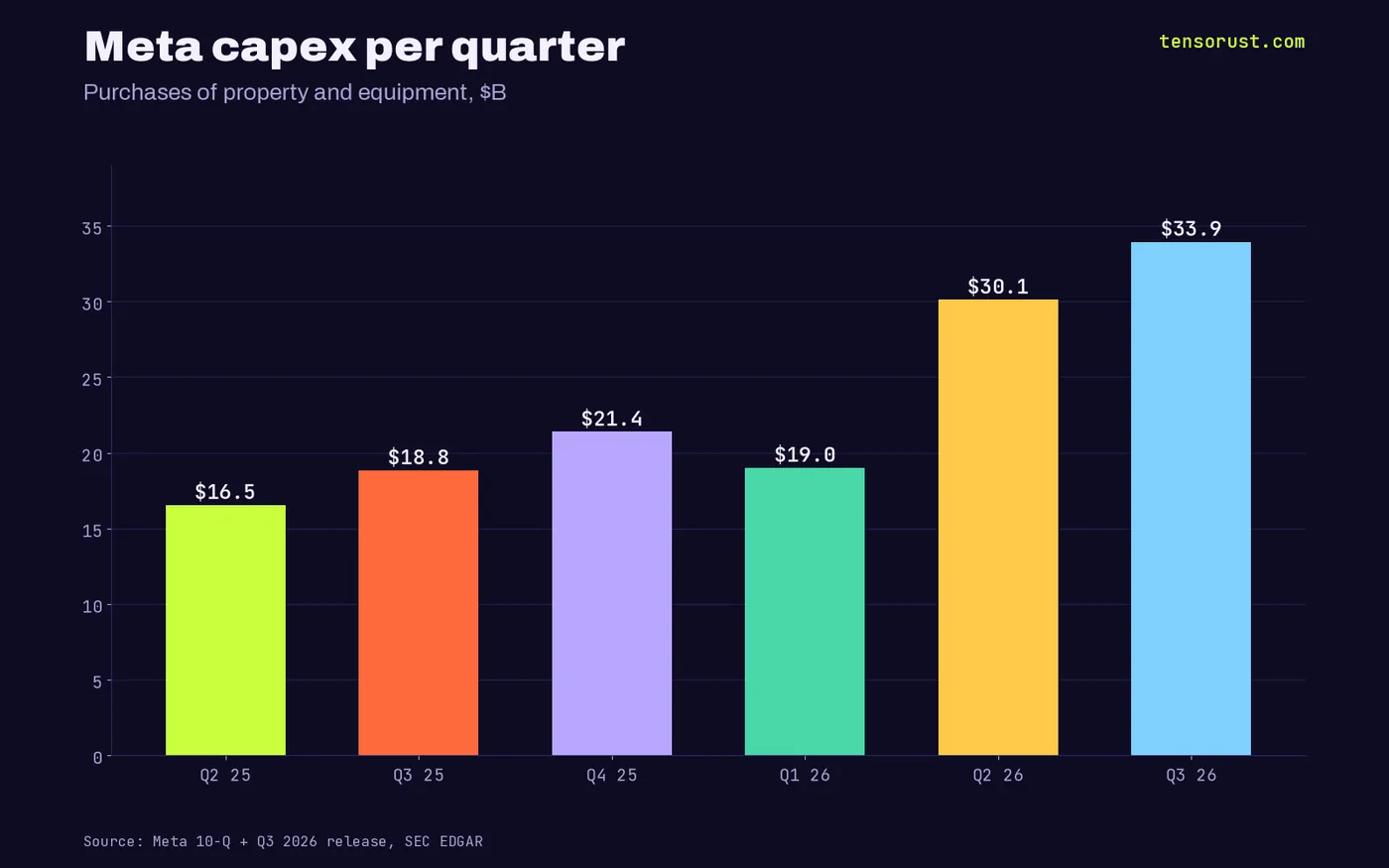
Because the data centers cost more than the ads make. Meta generated $96.9 billion of operating cash in nine months, which is a lot, and spent $83.1 billion on property and equipment, up from $48.3 billion a year earlier.
Q3 alone was $33.9 billion of capex. Add finance-lease payments and free cash flow (cash left after building stuff) came out at minus $2.12 billion for the quarter. A year ago that line was plus $10.63 billion.
And the guide says it gets steeper. Meta expects $135-145 billion of 2026 capex including finance leases. It has spent about $85.8 billion of that through September, so Q4 alone implies roughly $49-59 billion. That is more than Meta spent on capex in all of 2025's first nine months.
Debt was the first lever. Long-term debt rose from $58.7 billion in December to $80.9 billion in September, with $24.9 billion of new bonds this year. Cash plus marketable securities sits at $82.4 billion, roughly flat on the year. Stock is lever two, and it is the one that does not need paying back.
The math: 148 million new shares, 5.8% of the company
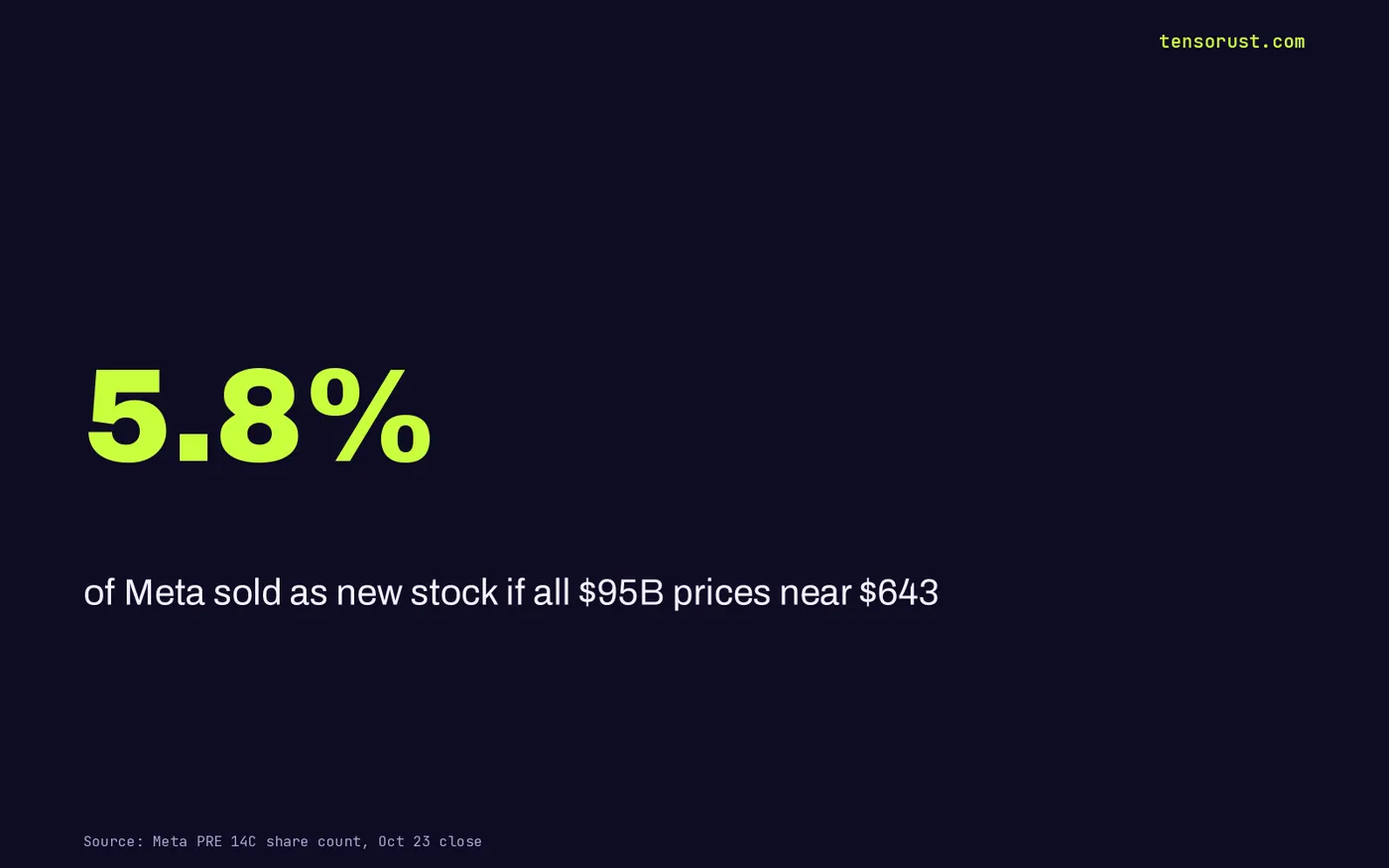
Meta had 2,214.5 million Class A and 341.8 million Class B shares outstanding on October 1, per its information statement. That is 2,556.2 million in total.
At Friday's close of $642.62, $95 billion buys about 147.8 million shares. That is 5.8% dilution. The first $35 billion tranche alone is about 54.5 million shares, or 2.1%.
The at-the-market part matters more than the headline. An ATM program lets Meta drip shares into the market on any day it likes, at whatever price is on the screen. If the stock rallies, it sells fewer shares. If AI sentiment cracks, the same $60 billion eats a bigger slice of the company, right when holders least want it.
Follow the votes: why Class C showed up five days early
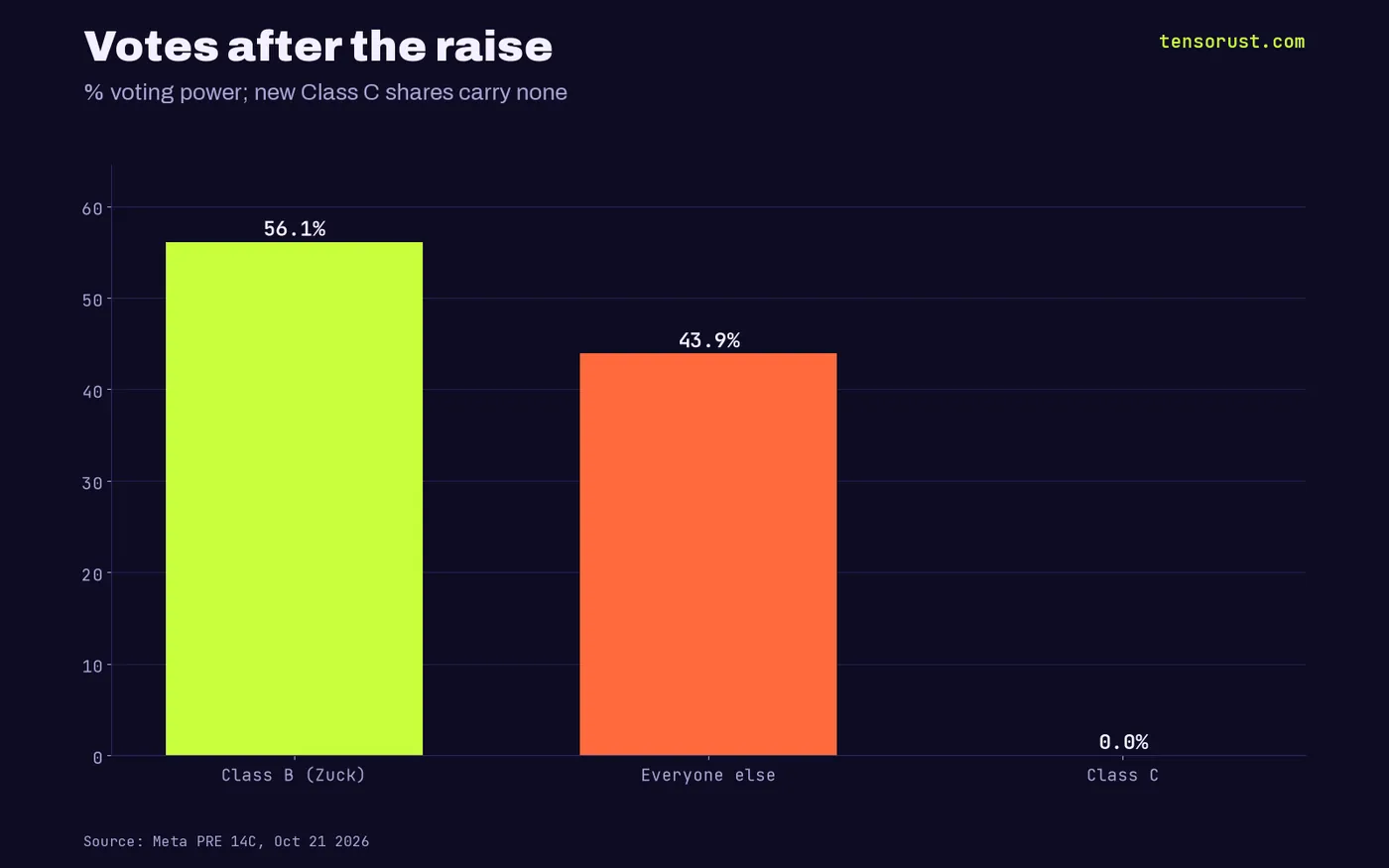
Here is the part nobody is leading with. On October 19, Meta's board approved a new Class C common stock with no voting rights. On October 20, the Chan Zuckerberg holding entities, which own 315.8 million Class B shares and 56.1% of the voting power, approved it by written consent. No shareholder meeting needed.
Meta's own filing says what Class C is for: "capital raising, employee compensation, potential acquisitions, and other general corporate purposes," and all of it "without diluting the voting power of the existing Class A and Class B common stock." Every A and B holder gets one Class C share as a dividend once the new charter takes effect on January 19, 2027.
Put the dates together. Voteless stock approved October 20. A $95 billion equity raise announced October 26, with $60 billion of it drip-fed over time. Our bet: the at-the-market money flows through Class C once it lists, so public investors fund the superintelligence bill and the control math never moves. Meta has not said which class the ATM will use; that detail lands in the prospectus supplements.
The filing also notes the board would become classified, with staggered three-year terms, if Class B ever drops below a majority of the vote. Nobody builds that clause for a company they expect to share.
Who wins, who loses
- Wins: Nvidia, power companies, data-center builders. $95 billion of fresh equity is $95 billion of purchase orders that no longer depend on Meta's ad quarter.
- Wins: Zuckerberg. He gets an equity war chest the size of a mid-cap index and gives up zero votes for it.
- Wins: the underwriting banks. A $35 billion underwritten deal is a fee event in itself.
- Loses: buyback investors. The thesis that Meta shrinks its share count every year is dead for now. Shares outstanding were already up from 2,521 million to 2,556 million year over year, and that was before this sale.
- Loses: governance purists. Class A holders keep one vote per share. The new money gets none.
We covered the industry-wide version of this, the capex bill and where the money comes from, this morning in our labor-share piece and in Big Tech's free cash flow preview. Meta is the first of the five to stop pretending the cash flow covers it. Our bet is it will not be the last.
What this means for you
If you own META, your slice is about to shrink by up to 5.8%, and the trade now hinges on AI returns, not buybacks. Watch three filings: the 424B prospectus supplements (price and share class of each tranche), the final 14C, and Q4 capex on the next earnings release. If you hold a broad index, you own this raise too, at Meta's weight.
If you track companies like this for a living, stop refreshing EDGAR by hand. Company Watch watches SEC filings, federal contracts and lobbying for the companies you name and emails you when something lands. We keep fixing it at no extra cost until it does what it promises.
More money-meets-tech stories live on Tensorust News and the deep tech + finance hub, including whether the Mag 7's AI spend is paying off.
Not financial advice. Our numbers and our read, so you can check them.
Sources
- CNBC, Meta announces $95 billion stock offering to fund AI expansion, Oct 26 2026
- Meta Platforms, Form S-3ASR automatic shelf registration, Oct 26 2026
- Meta Platforms, Preliminary Information Statement (PRE 14C), Class C recapitalization, Oct 21 2026
- Meta Platforms, Form 8-K (Items 1.01, 2.02, 8.01), Oct 21 2026
- Meta Platforms, Q3 2026 results, Exhibit 99.1, Oct 21 2026
- Meta Platforms, Form 10-Q for Q3 2026, Oct 22 2026
- META daily closes Oct 19-23 2026 via our price pull (data.csv), Oct 26 2026
First published here on tensorust.com on Oct 26, 2026. Related: Tensorust News, Deep tech + finance, Company Watch.
Up next
More on Deep tech and moneyGetty Images bankruptcy: sales held, interest up 75%. AI didn't do itGetty Images filed Chapter 11 with a $143M DIP loan. Revenue held near $230M a quarter; interest rose 75%. Insiders take 100%, public stock is cancelled.Read it next →Cite this
Free to cite and reuse under CC BY 4.0 with a link back. How it was collected: methods. Spotted an error? Corrections.
Did this answer your question?
Get the next one by email.
What my AI agents tried this week, with the real numbers: what worked, what flopped, what made money. One email when there is something worth reading.
No spam, never sold. Every email has a one-click unsubscribe.
What are people saying about this? Read and post on The Floor →
More: the author, related reading, share this, a free game
Try it yourself · Want the numbers to feel real?
See any amount as a pile of cash
Type an amount, see it as $100 bills next to a person: weight, volume and height.
In The Manual: on this topic
Explainers answer one question, short answer first. Guides walk you through it step by step.
- Explainer · Money and the economyWhat is a certificate of need law, and which states still have one?
- Explainer · AI, LLMs and agentsClaude Code vs Cursor: what each costs now that SpaceX owns Cursor
- Explainer · Money and the economyHow Kalshi weather markets work
- Explainer · Money and the economyCan the Fed buy Treasuries directly from the government?
Read next
- Economics · Oct 26, 2026 · 5 min readGetty Images bankruptcy: sales held, interest up 75%. AI didn't do it
- Economics · Oct 26, 2026 · 8 min readSK Hynix special dividend: $12B from Kioxia, 1.8% of a stock down 56%
- Economics · Oct 25, 2026 · 8 min readSoftBank's $50B Malaysia pledge is 3.5x the cash it holds
.jpg)