
By Matt Busel, who built the apps, crates and game he writes about · every number links to its source and every dataset is downloadable (methods) · corrections · featured in Kirino, gamebiz, This Week in Rust, New Mobile Life, By-Press
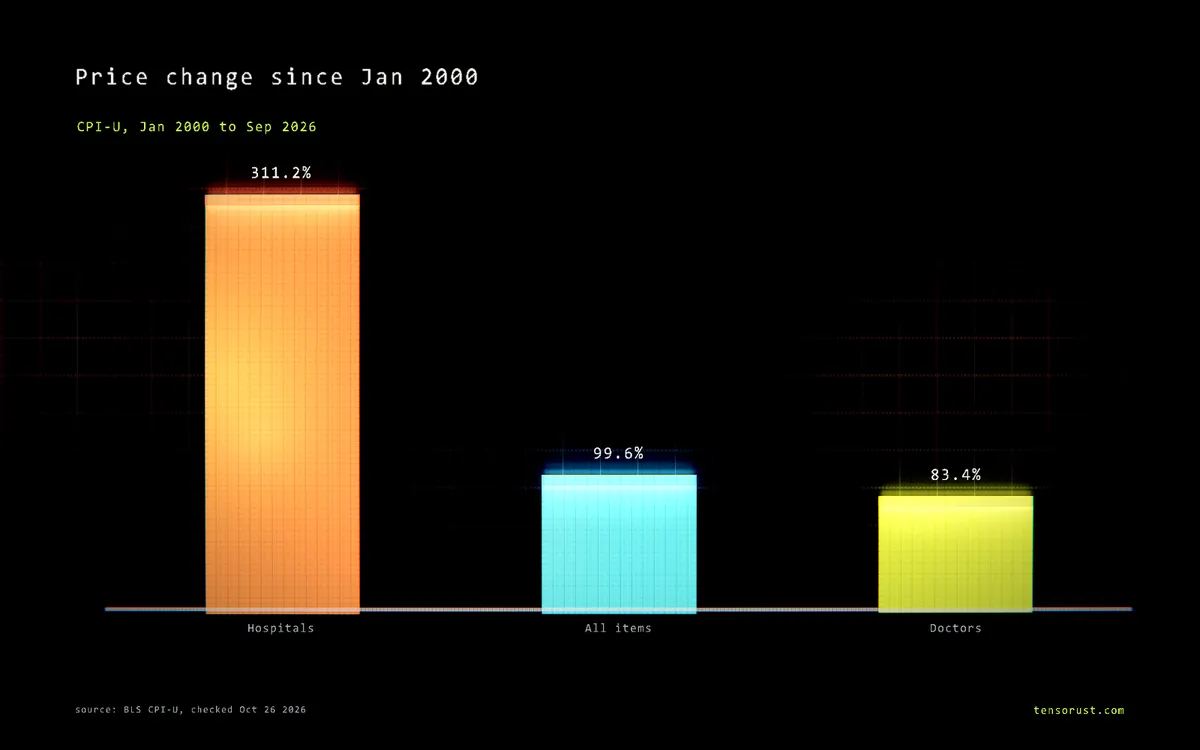
Hospital prices +311% since 2000: hospitals are the new landlords
On this page · 9 sections
- Key numbers
- The doctors are not the expensive part. The building is.
- A hospital is a landlord with a monopoly permit
- Follow the money: who wins, who loses
- The lobby that guards the moat
- The steelman, and why it does not hold
- The quiet twist: the next front door does not need a permit
- What this means for you
- Sources
Short answer: Hospital prices are so high because the hospital is no longer mainly a care business. It is a permit-protected real estate and bottleneck business. Hospital services in the consumer price index are up 311% since January 2000, while the doctors working inside those buildings are up 83% and prices overall are up about 100%. The gap is not medicine. It is ownership of the front door.
TL;DR: BLS data shows hospital services rose 311.2% from January 2000 to September 2026, nearly four times the 83.4% rise for physicians' services and three times the 99.6% rise in overall prices. HCA Healthcare, the biggest for-profit chain, grew revenue from $43.6 billion in 2017 to $75.6 billion in 2025, and 35 states plus DC still make a new hospital ask permission, often over the objection of the hospital it would compete with. The fix is not cheaper doctors; it is more front doors, and AI triage plus telehealth are the first ones the incumbents cannot zone out.
Key numbers
| What | Number | Source, checked Oct 26 2026 |
|---|---|---|
| Hospital services price change, Jan 2000 to Sep 2026 | +311.2% | BLS CPI-U, CUUR0000SEMD01 |
| Physicians' services price change, same period | +83.4% | BLS CPI-U, CUUR0000SEMC01 |
| All items (overall inflation), same period | +99.6% | BLS CPI-U, CUUR0000SA0 |
| HCA Healthcare revenue, 2017 vs 2025 | $43.6B to $75.6B | SEC EDGAR XBRL |
| HCA net income, 2017 vs 2025 | $2.2B to $6.8B | SEC EDGAR XBRL |
| American Hospital Association lobbying, 2015 vs 2025 | $19.4M to $27.2M | Senate LDA filings |
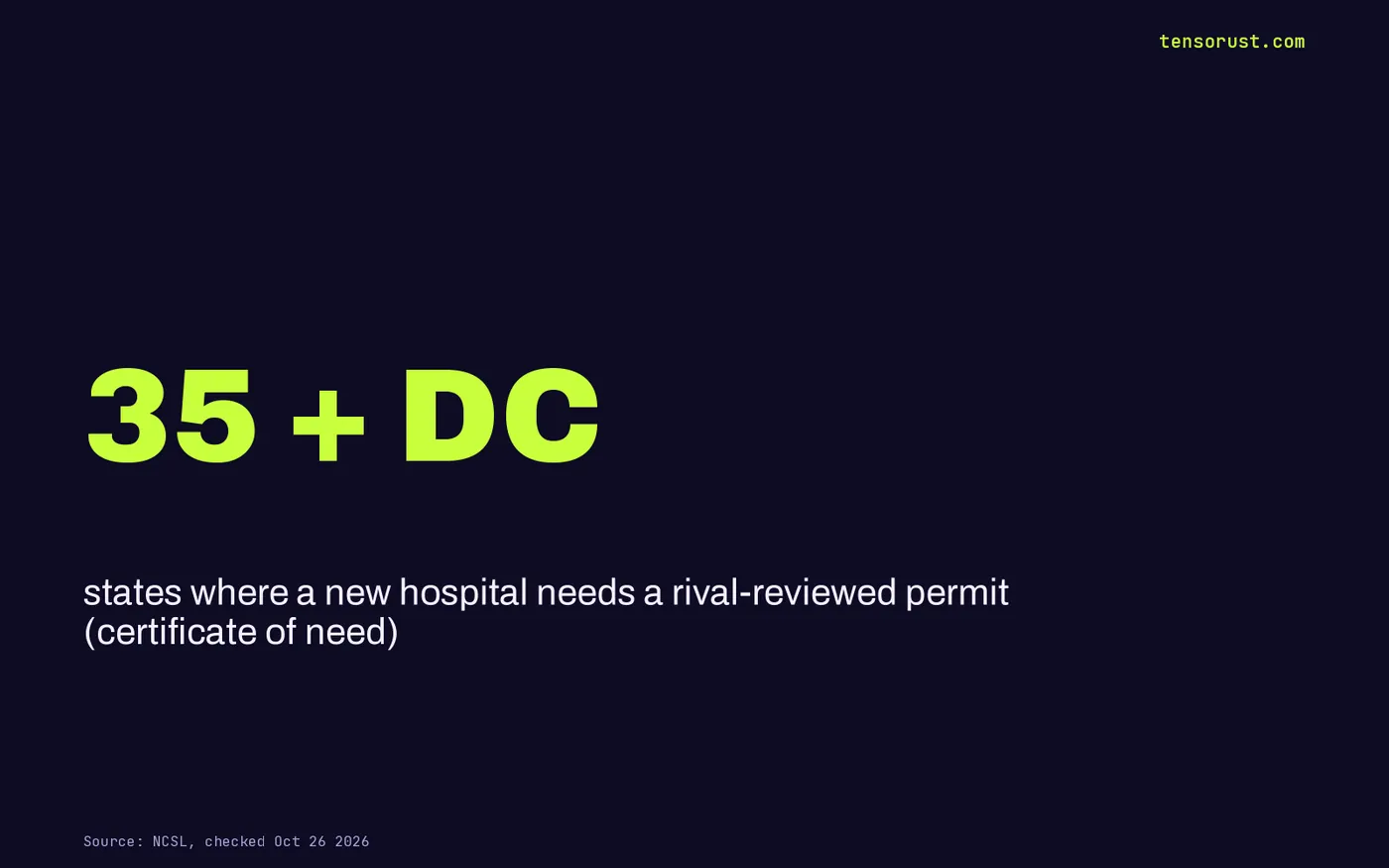
| States with certificate-of-need programs | 35 + DC | NCSL |

The doctors are not the expensive part. The building is.
Everyone argues about health care as if it were one price. It is not. The BLS splits it, and the split tells the whole story.
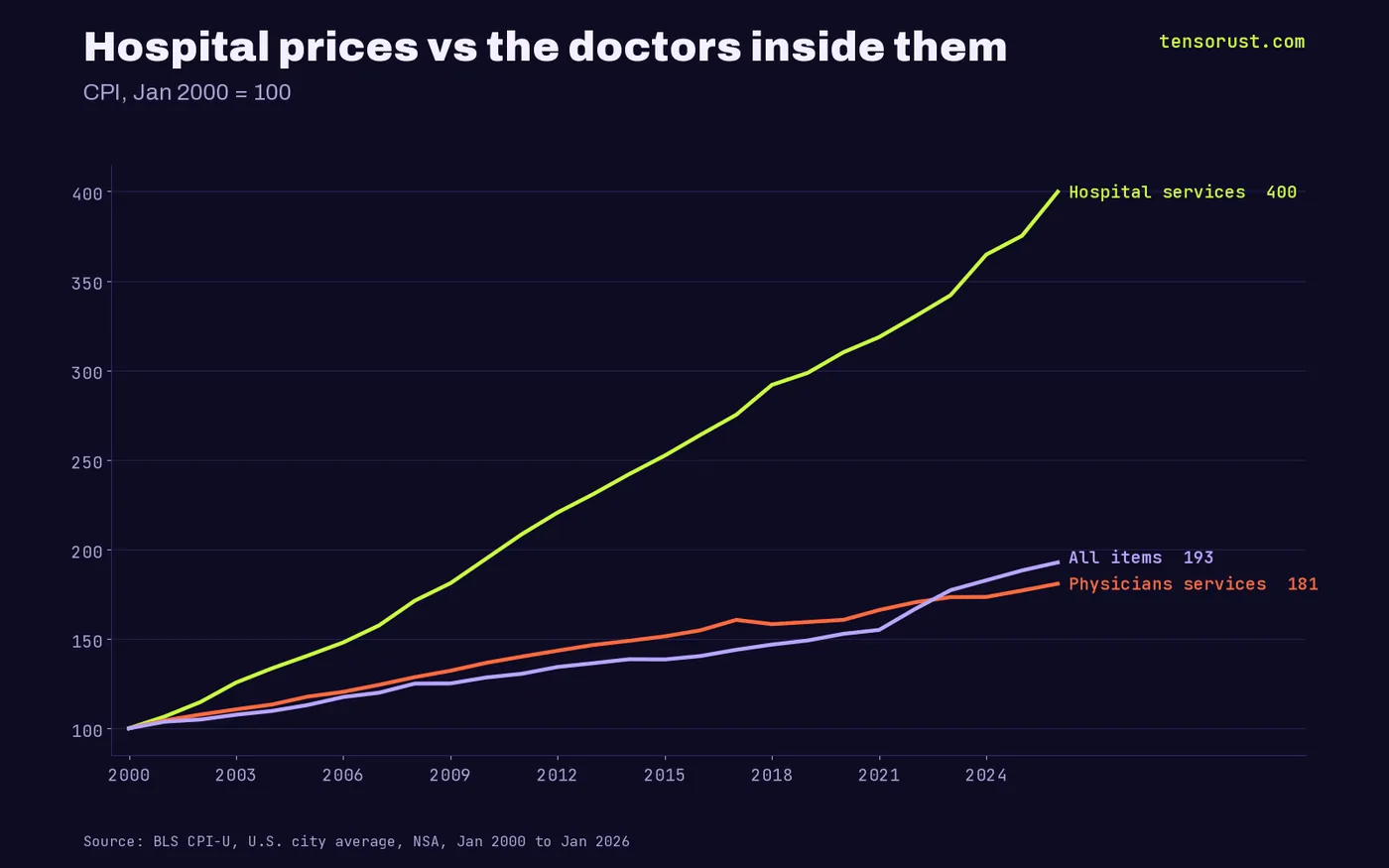
Since January 2000, what you pay a physician has risen 83.4%. That is slower than overall inflation (99.6%). Doctors, in real terms, got cheaper.
What you pay a hospital rose 311.2%. Same patients, same decades, often the same doctors walking the same halls. The difference is who owns the room.
We covered the wide version of this pattern in Inflation is a tax on what software can't touch: TVs fell 98% while hospitals tripled. This piece goes into the one line that ate everything.
A hospital is a landlord with a monopoly permit
Think about what a landlord sells: not the work done inside the building, but access to a scarce space. Rent rises when nobody can build next door.
That is the hospital model. The surgeon's fee barely moves. The "facility fee", the room charge, the operating suite, the emergency door: that is where the price lives. The building is the product.
And unlike an apartment market, nobody can just build next door. In 35 states plus DC, according to the National Conference of State Legislatures, you need a certificate of need (a state permit saying the area "needs" your new beds, scanner or surgery center) before you open. New York started it in 1964; 26 states followed within a decade.
Guess who gets to show up and argue that the area does not need you? The incumbent hospital. Certificate-of-need is the zoning code of medicine, and the existing landlord sits on the zoning board.
Follow the money: who wins, who loses
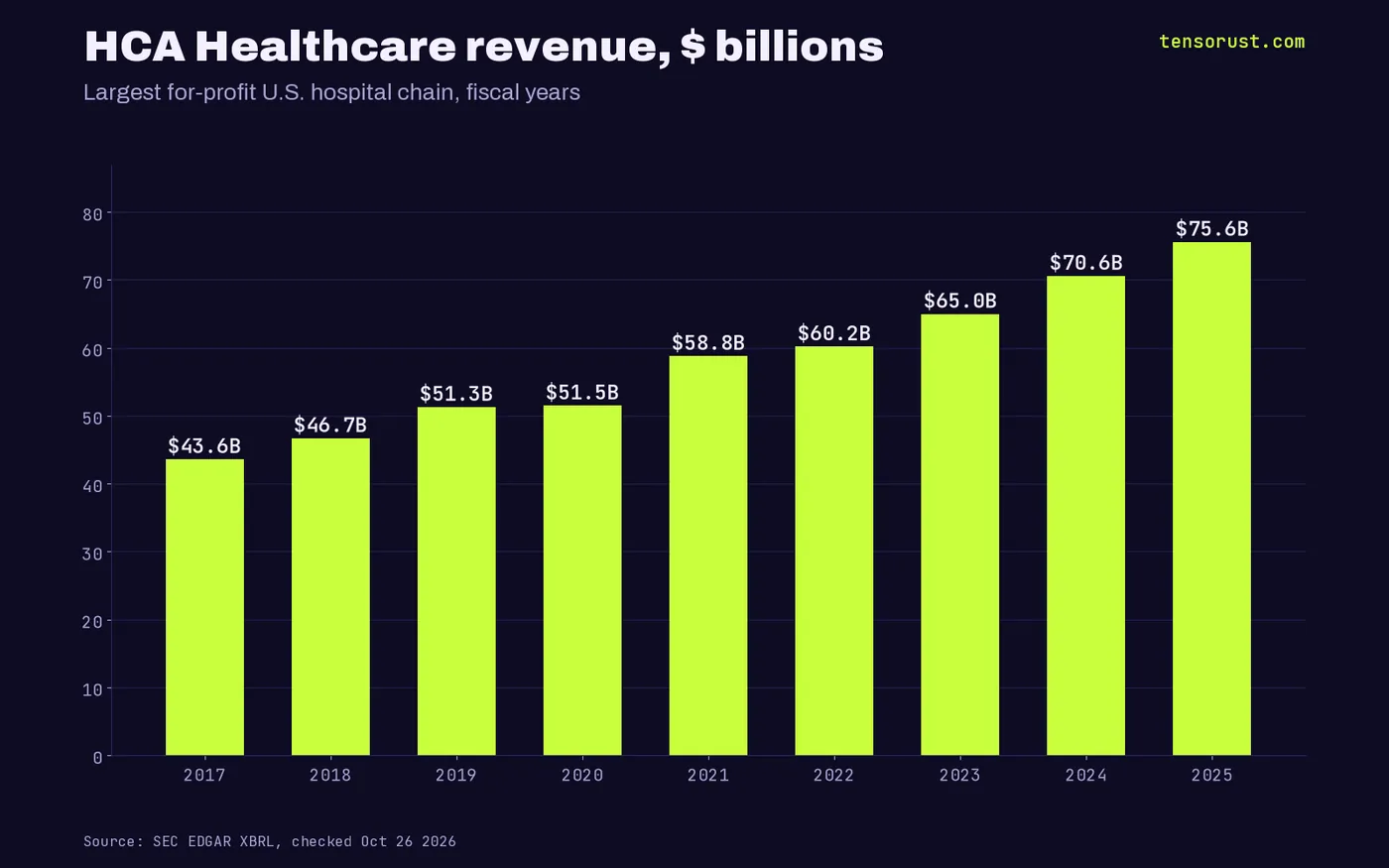
The winners file with the SEC, so we do not have to guess. HCA Healthcare, the largest for-profit hospital chain in the US, reported $43.6 billion in revenue in 2017 and $75.6 billion in 2025, per its XBRL filings. Net income went from $2.2 billion to $6.8 billion over the same years.
Revenue up 73% in eight years. Profit roughly tripled. Margin (net income over revenue) went from about 5% to about 9%, by our math on those filings. That is not a struggling utility. That is a toll booth with pricing power.
The rest of the industry is mostly "nonprofit." That word does a lot of work. Nonprofit hospitals skip federal income tax and, in most places, property tax on some of the most valuable real estate in their cities. In exchange, they promise "community benefit," a standard loose enough that the IRS rarely tests it.
So the landlord pays no property tax on the building whose access it rents to you at four times the inflation rate. The tax exemption is not charity. It is a subsidy on the moat.
The lobby that guards the moat
Moats need maintenance. The American Hospital Association reported $19.4 million in federal lobbying in 2015 and $27.2 million in 2025, per Senate Lobbying Disclosure Act filings with amendments de-duplicated. The Federation of American Hospitals, the for-profit chains' group, added $5.0 million in 2025.
That is more than $32 million in one year from two trade groups, aimed at site-neutral payment rules, price transparency enforcement, and anything else that would let a cheaper front door compete on equal terms.
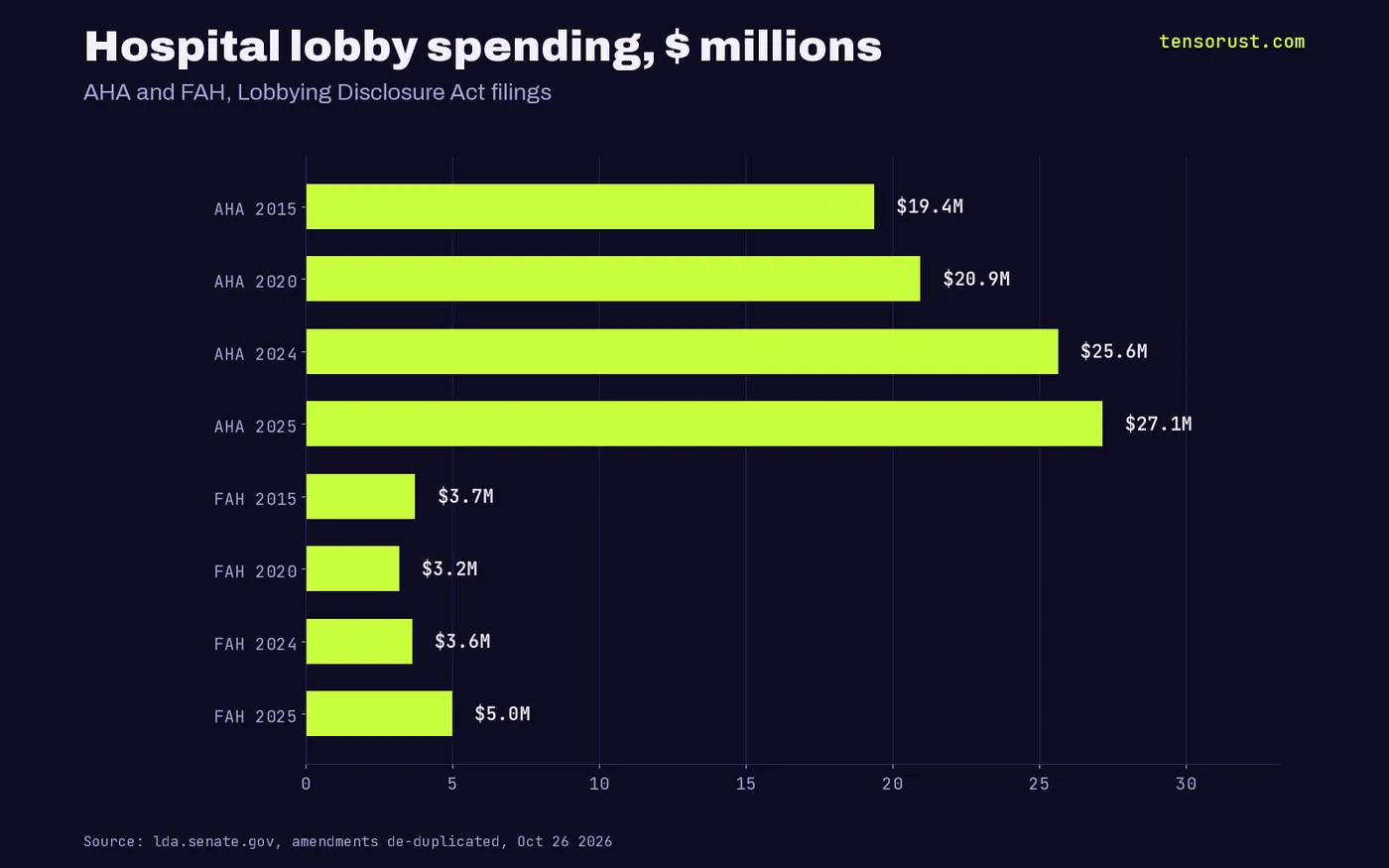
Site-neutral payment is the tell. It means Medicare pays the same for a procedure whether it happens in a hospital-owned clinic or an independent one. Hospitals fight it because their whole margin is the "hospital-owned" label. Same doctor, same needle, higher bill, because the landlord's sign is on the door.
The steelman, and why it does not hold
The best defense of hospitals is real: they run emergency rooms that must treat everyone under federal law (EMTALA), they eat unpaid bills, and they cross-subsidize trauma units and burn wards that would never make money alone.
All true. But none of it explains a price line that ran three times faster than inflation for 26 straight years while the clinical labor inside rose slower than inflation. Charity care is a cost. It is not a 311% compounding engine. If uncompensated care were the driver, the for-profit chain that does the least of it would not be the one posting $6.8 billion profits.
The honest read: emergency obligations are the shield, and the permit system is the sword.
The quiet twist: the next front door does not need a permit
Here is the part the industry has not priced in. Certificate-of-need laws regulate beds, buildings and machines. They do not regulate a phone.
A huge share of what sends people into hospital doors is triage: is this serious, where should I go, what test do I need. That is information work. It is exactly what AI models and telehealth do cheaply, at 3 AM, with no facility fee.
Our bet: the first real competition hospitals face in 60 years will not come from a rival building that a state board can block. It will come from software that routes patients away from the expensive door before they reach it. Nobody has proven the savings at scale yet, but the incentive is obvious, and so is who will lobby against it.
Watch for the tell: "AI safety in medicine" bills written so that only hospital-affiliated systems can legally triage. When the moat owners start worrying loudly about patient safety from chatbots, ask who loses when the patient never walks in. We wrote about that pattern in the anti-AI movement's money trail. More takes like this live on our opinion page and in economics.
What this means for you
Ask for the cash price and the "facility fee" separately before any non-emergency procedure, and compare against an independent surgery center or imaging center; under federal price transparency rules hospitals must publish them. Use telehealth triage first for anything that is not an emergency. And if you live in a certificate-of-need state, know that your legislature is the one keeping the second hospital out.
If you invest in, sell to, or compete with hospital chains, watch their filings the way they watch their permits. Company Watch tracks any company's SEC filings, federal contracts and lobbying in one feed for $99 a month, and we keep fixing it at no extra cost until it does what it promises: set up Company Watch. This is not financial advice.
Sources
- U.S. Bureau of Labor Statistics, CPI-U series CUUR0000SEMD01, CUUR0000SEMC01, CUUR0000SA0, pulled Oct 26 2026
- SEC EDGAR, HCA Healthcare XBRL company facts (revenue, net income), pulled Oct 26 2026
- U.S. Senate Lobbying Disclosure Act filings, American Hospital Association and Federation of American Hospitals, pulled Oct 26 2026
- National Conference of State Legislatures, Certificate of Need State Laws, checked Oct 26 2026
First published here on tensorust.com on Oct 26, 2026. Related: Opinion, Inflation since 2000, Company Watch.
Up next
Goes deeper on one question from this articleWhat is a certificate of need law, and which states still have one?A certificate of need (CON) law makes a hospital, surgery center, nursing home or imaging center get state permission before it opens, adds beds, buys big equipment or...Read it next →Cite this
Free to cite and reuse under CC BY 4.0 with a link back. How it was collected: methods. Spotted an error? Corrections.
Did this answer your question?
Get the next one by email.
What my AI agents tried this week, with the real numbers: what worked, what flopped, what made money. One email when there is something worth reading.
No spam, never sold. Every email has a one-click unsubscribe.
What are people saying about this? Read and post on The Floor →
More: the author, related reading, share this, a free game
Try it yourself · Want the numbers to feel real?
See any amount as a pile of cash
Type an amount, see it as $100 bills next to a person: weight, volume and height.
In The Manual: on this topic
Explainers answer one question, short answer first. Guides walk you through it step by step.
- Explainer · Money and the economyWhat is a certificate of need law, and which states still have one?
- Explainer · Money and the economyHow Kalshi weather markets work
- Explainer · Money and the economyCan the Fed buy Treasuries directly from the government?
- Explainer · Money and the economyThe Fed's deferred asset, explained
Read next
- Economics · Oct 26, 2026 · 7 min readRealtor commission: NAR's lobby money says AI agents are the threat
- Economics · Oct 26, 2026 · 9 min readPrediction markets are more honest than the news: 92% right a week out
- AI · Oct 26, 2026 · 6 min readThe GPU shortage was manufactured. H100 rental prices just proved it
.jpg)