
By Matt Busel, who built the apps, crates and game he writes about · every number links to its source and every dataset is downloadable (methods) · corrections · featured in Kirino, gamebiz, This Week in Rust, New Mobile Life, By-Press
Hegseth's Polymarket memo: 3 wallets turned $41K into $334K on Maduro
On this page · 11 sections
- Key numbers
- What Hegseth's memo actually says
- War is now a $4.14 billion product
- The Maduro night, minute by minute
- Burdensome-Mix: the wallet in the indictment
- Three more wallets nobody has charged
- Iran: 9.6 hours of secret, $539K of yes
- Follow the money: who wins, who loses
- Why banning the bet is the wrong fix
- What this means for you
- Sources
Short answer: Pete Hegseth's October 20 memo bans Pentagon staff from betting on military outcomes with nonpublic information, and it is roughly ten months late. We pulled Polymarket's public trade records for the night of the Maduro raid and found three accounts nobody has charged that turned $40,770 into $333,545 within hours, one of them placing its first ever bet four minutes before Trump gave the order. The markets did not hide this. They printed it on a public ledger, and the Pentagon is only now writing a memo.
TL;DR: Polymarket has hosted at least 906 war-outcome events worth $4.14 billion in reported volume, $3.15 billion of it on events ending in 2026 alone. On January 2 and 3, 2026, the "Maduro out by January 31" market climbed from 6.5 cents to 12.5 cents before the first bomb fell, and the one wallet that matches the April indictment (Burdensome-Mix, 13 buys, $409,881 net) had company: French-Incense, Wee-Pseudoscience and Calm-Oversight cleared another $292,774 between them. On the Iran strike in February, three accounts born after Trump authorized Operation Epic Fury put $30,572 on "yes" and collected $166,621.
Key numbers
| What | Number | Source, checked Oct 25 2026 |
|---|---|---|
| Polymarket war-outcome events found | 906 events, $4.14B reported volume | Polymarket gamma API, our pull |
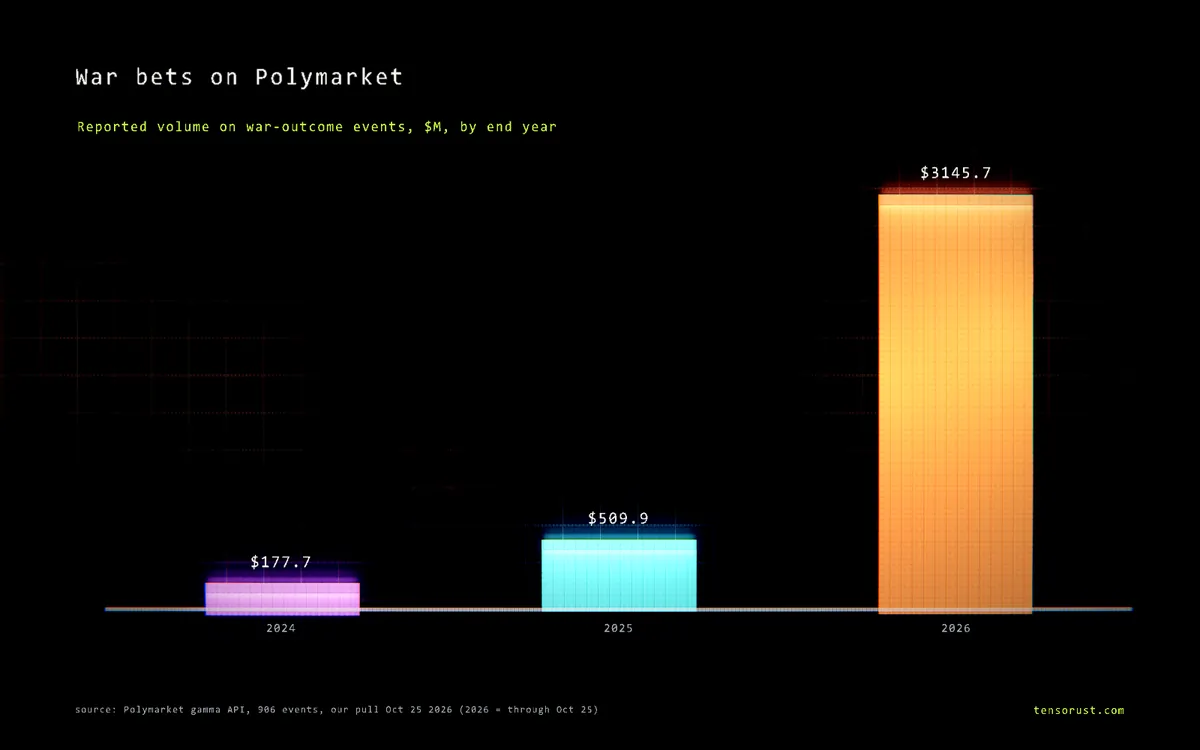
| War-event volume, events ending in 2024 vs 2026 | $177.7M vs $3,145.7M (17.7x) | Polymarket gamma API, our pull |
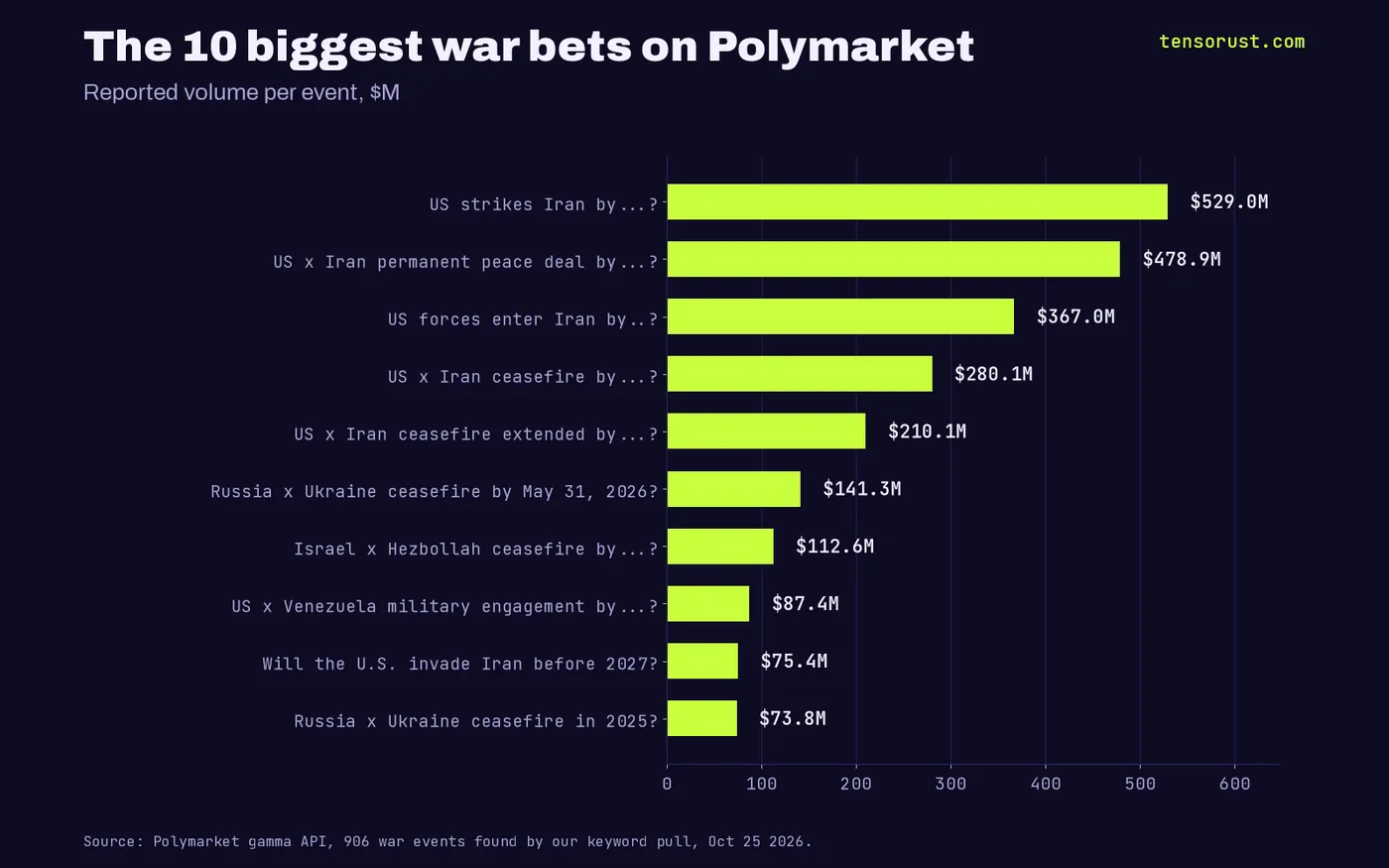
| Biggest single war event | "US strikes Iran by...?" $529.0M | Polymarket |
| Maduro raid order given | 10:46 PM EST, Jan 2 2026 | Wikipedia, citing Gen. Dan Caine |
| "Maduro out by Jan 31" YES price, afternoon vs just before the bombs | 6.5 cents vs 12.5 cents | Polymarket CLOB price history, our pull |
| Burdensome-Mix (the charged account), net | $409,881 on 13 buys | Polymarket data API |
| Three uncharged Maduro wallets, in vs out | $40,770 in, $333,545 out | Polymarket data API, our pull |
| Iran: YES buys of $500+ between authorization and strikes | 203 buys, $539,163 | Polymarket data API, our pull |
| Kalshi series that reference war action | 1 of 15,394 (a Congress vote) | Kalshi trade API, our pull |

What Hegseth's memo actually says
The memo, dated October 20 and published by CBS News, carries the subject line "Do Not Compromise Military Operations for Personal Financial Gain." It went to senior Pentagon leadership, combatant commanders and field activity directors, as Jon Brodkin at Ars Technica reported.
The core line is the one every trader should read twice: "Our enemies watch movements in these markets. When an American Service member... engages in a financial transaction on a military outcome, they create a signal." It names Polymarket and Kalshi and threatens action under the Uniform Code of Military Justice.
Here is the part the memo skips. Hegseth is describing a signal that has been sitting on a public blockchain since January. Anyone with a laptop can read it. We did, tonight, in about an hour.
War is now a $4.14 billion product
We pulled every Polymarket event we could find through its public gamma API using 41 war keywords (strike, invade, ceasefire, troops, Maduro, Iran and so on), then kept only events about military action or ceasefires. That left 906 events and $4.14 billion in reported volume. It is a floor, not a ceiling, because keyword search misses oddly named markets.
The growth is the story. Events ending in 2024 did $177.7 million. Events ending in 2025 did $509.9 million. Events ending in 2026 have done $3.15 billion with two months to go. Lowkey the fastest growing product in prediction markets is war.
US military action alone, the stuff a logistician or analyst at the Pentagon could actually know in advance, covers 181 events and $1.61 billion. The single biggest is "US strikes Iran by...?" at $529.0 million, followed by "US forces enter Iran by...?" at $367.0 million.
The Maduro night, minute by minute
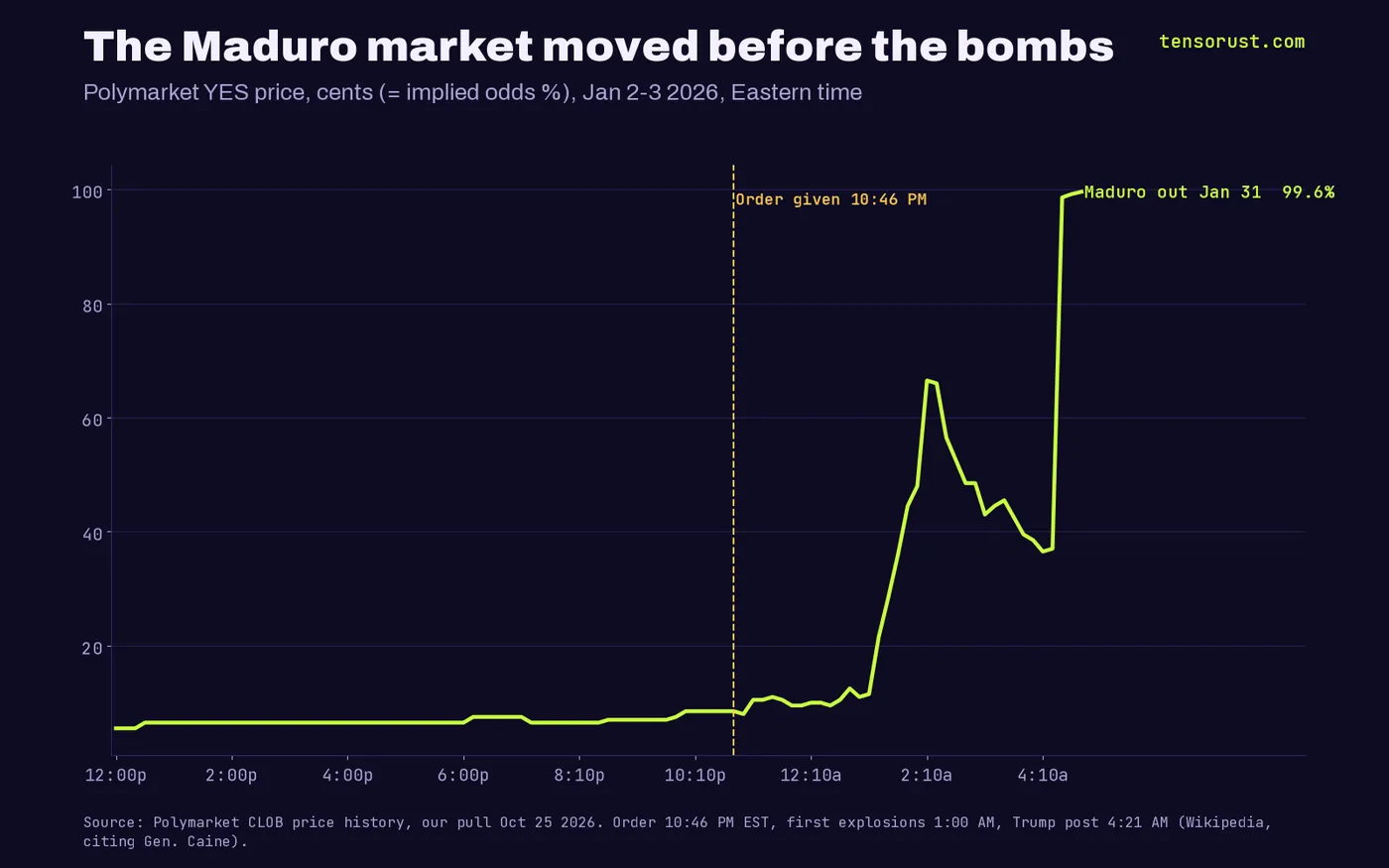
According to Gen. Dan Caine, chairman of the Joint Chiefs, Trump gave the order to proceed at 10:46 PM EST on January 2. Explosions hit Caracas around 1:00 AM EST. Trump announced the capture at 4:21 AM EST. Those three timestamps are the whole case.
The "Maduro out by January 31, 2026?" market (a $10.97 million contract) sat at 6.5 cents all afternoon on January 2, even though Trump had said that day that strikes inside Venezuela were coming. Then it started climbing: 8.5 cents around the order, 10.5 by 11:10 PM, 12.5 cents at 12:50 AM, ten minutes before the first explosions. It doubled while the operation was still a secret.
That move is small in cents and huge in money. At 12 cents a share, every dollar on "yes" pays about eight.
Burdensome-Mix: the wallet in the indictment
In April, federal prosecutors in Manhattan charged Master Sgt. Gannon Ken Van Dyke, a Special Forces soldier, with using classified information to bet on Polymarket. NPR reported he traded under usernames including "Burdensome-Mix", and Mediaite and others put the profit near $409,000 to $410,000 from about 13 bets, with roughly $32,500 on Maduro out by January 31. He is charged, not convicted.
The public ledger for the Burdensome-Mix wallet (0x31a5...8ed9) matches those numbers to the dollar. It opened on December 27, made exactly 13 buys across four Venezuela markets, put $32,538 into "Maduro out by January 31", and took out $443,815 against $33,934 in. That is $409,881 net. Its last buy, $7,215 at 8.2 cents, landed at 9:58 PM EST, 48 minutes before the order.
So the data works. If the account that got charged looks exactly like this, the question writes itself: who else looks like this?
Three more wallets nobody has charged
We pulled every taker trade in that market from January 1 to the close and checked the history of the biggest "yes" buyers. Three stood out.
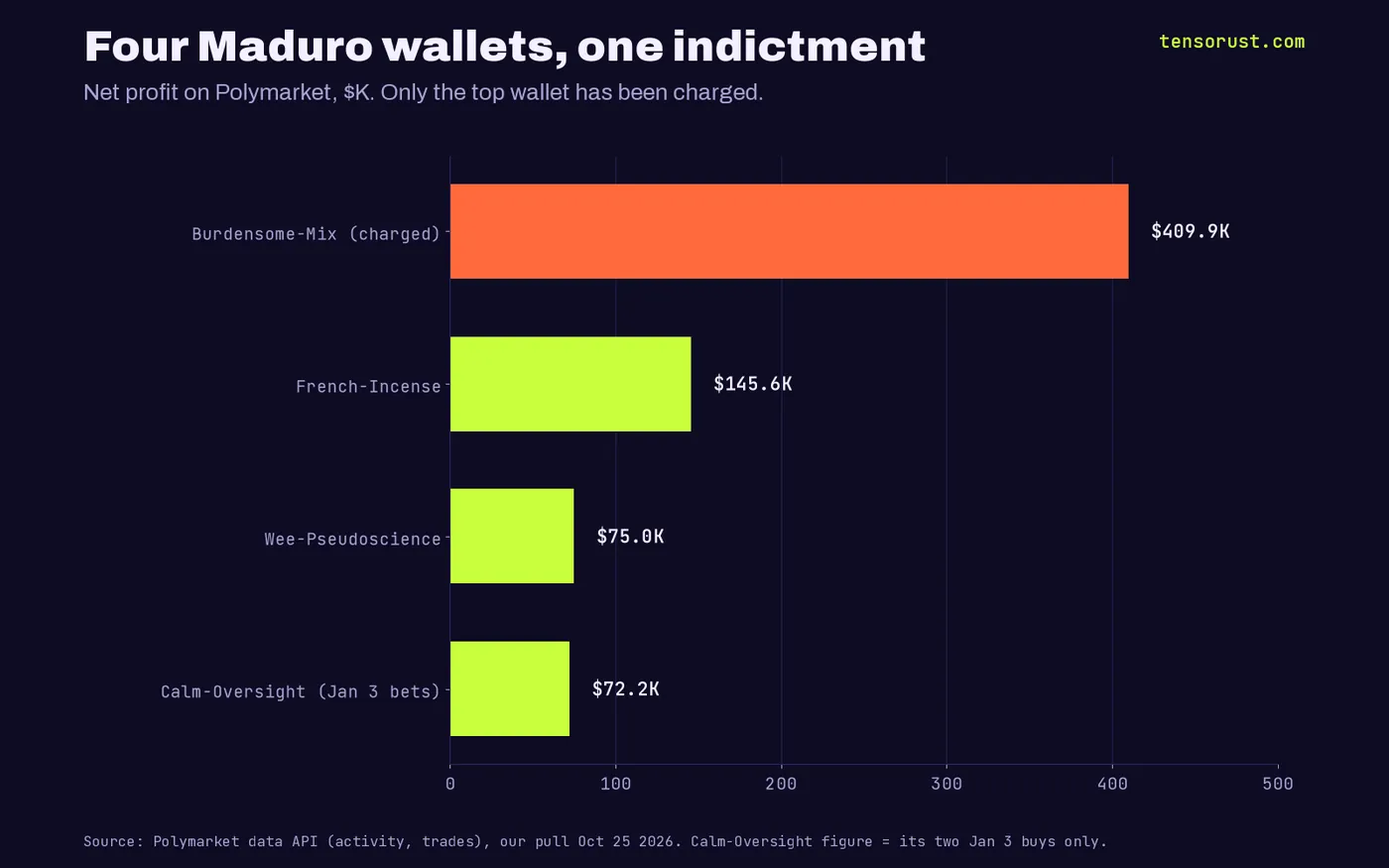
- French-Incense (0x6baf...94c5): first trade ever at 10:42 PM EST, four minutes before the order. $10,000 on Maduro out by January 31 at 11.3 cents. Two minutes after the order, at 10:48 PM, another $15,090 on February 28. It redeemed $170,710 at 7:39 AM. Profit $145,620 in nine hours.
- Wee-Pseudoscience (0xa72d...bd4): one trade in its entire life. $5,782.66 at 7.2 cents at 4:44 PM EST on January 2. It redeemed $80,764.94 and never traded again.
- Calm-Oversight (0x168b...714b): had already lost $37,821 betting Maduro would be gone by New Year's. Then $9,897.67 at 12:35 AM and 12:46 AM EST, 25 and 14 minutes before the first explosions. It redeemed $82,070.14.
Together: $40,770 in, $333,545 out. None of these accounts has been publicly charged, and we are not saying who runs them or that they had inside information. A brand-new account can be a lucky gambler, a news junkie or a Venezuelan with a view of the sky. What we are saying is that this is exactly the pattern Hegseth's memo describes, and it took us one evening with free APIs to find it.
Between the order and the first bomb, 27 "yes" buys worth $23,848 hit the January 31 market and paid out $204,876. Before the order, from 7 AM EST that day, another $43,108 went in. Burdensome-Mix was most of that, but not all.
Iran: 9.6 hours of secret, $539K of yes
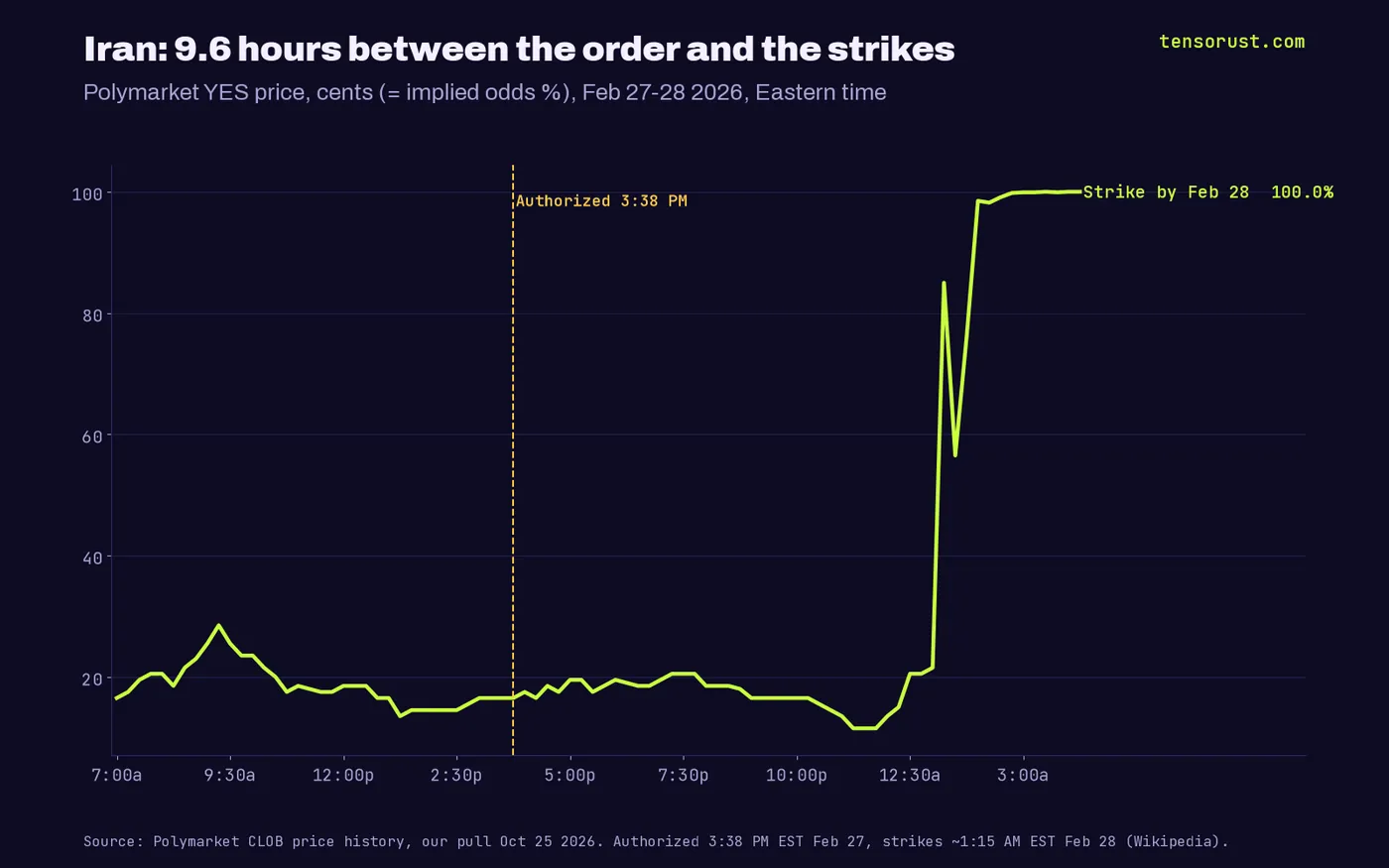
The Iran war started the same way. Trump authorized Operation Epic Fury at 3:38 PM EST on February 27, aboard Air Force One. US missiles and Israeli jets started hitting Iran around 1:15 AM EST on February 28. That is 9 hours and 37 minutes where the decision existed and the public did not know.
The "US strikes Iran by February 28, 2026?" market did $89.65 million. Unlike Maduro, the price did not run early. It drifted between 11.5 and 21.5 cents all night, which means the crowd as a whole did not see it coming.
Individual accounts are a different story. In that window, 203 "yes" buys of $500 or more went in, worth $539,163, for shares that paid $2.72 million. Most came from wallets with long betting histories. Three did not: an unnamed account (0x3811...f61) whose first ever trade was $10,000 at 18 cents at 5:43 PM EST, Meaty-Beetle with its first trade, $11,272 at 20 cents, at 7:07 PM, and Glossy-Detective, created at 6:54 PM, with $9,300 at 17 cents at 10:05 PM. All three were born after the authorization. $30,572 in, $166,621 out.
The Anti-Corruption Data Collective counted 152 suspicious wallets that won a combined $8 million on longshot military bets by August. The AP found new accounts that hit the April Iran ceasefire right before Trump announced it. The pattern is not one soldier. It is a genre.
Follow the money: who wins, who loses
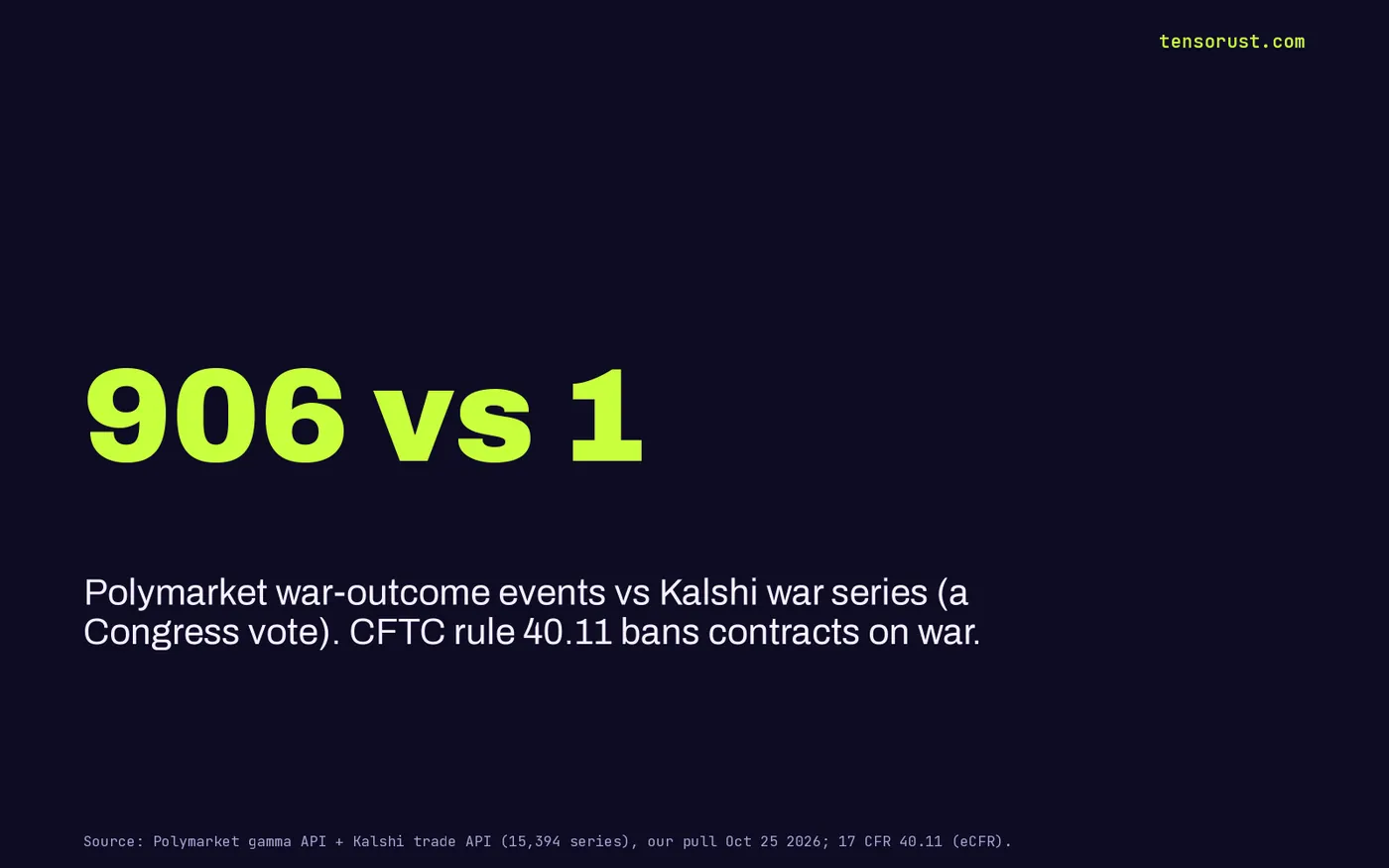
Polymarket wins. Shayne Coplan's exchange lists the war markets. Kalshi, regulated by the CFTC, basically cannot. CFTC rule 40.11 bars regulated exchanges from listing contracts that involve "terrorism, assassination, war". In Kalshi's 15,394 series we found exactly one that mentions military action, and it is about a Congressional vote on Greenland. Tarek Mansour's Kalshi gets the teleprompter scandal (an aide reportedly made $100,000 betting on Trump's words); Polymarket gets the $529 million Iran book.
Early wallets win. At 7 to 12 cents a share, a correct bet pays 8x to 14x overnight. That return is the whole reason the market works, and the whole reason it leaks.
The Pentagon loses twice. Once when the signal leaks, and again when it takes ten months and a memo to notice what a public ledger showed in real time. Hegseth calls the market an enemy intelligence feed. Our read: it is the cheapest counterintelligence tool the government has ever been handed, and it is running unread.
Why banning the bet is the wrong fix
The memo goes after the troops. Fine, insider trading on a raid is indefensible, and the charge sheet already exists. But the leak is not the price. The leak is the person who knew. Kill the market and the person still knows; you just lose the alarm that went off at 10:42 PM.
A price that doubles while an operation is secret is the most honest operational security audit the Department has. A better memo would say: we watch these markets too, we flag every fresh wallet that buys a military outcome in a classified window, and we hand them to the FBI the same week. That is cheaper than a ban and it actually deters.
Our bet, and nobody has proven it yet: there is at least one more prosecution coming out of the February 27 Iran window within a year, and Polymarket quietly adds identity checks or size limits on US strike markets before the 2026 midterms. The industry knows the next Burdensome-Mix is a regulatory event, not a news cycle.
What this means for you
If you trade these markets, assume every bet is public forever, tied to a wallet age and a timestamp anyone can line up against Wikipedia. If you see a war market move with no news, that move is information; treat it like a filing, not a rumor. And if you work anywhere near a military decision, the memo is now the rule: the bet that pays 14x also comes with a Uniform Code of Military Justice file.
Want the same watchfulness on the companies that profit from all this? Company Watch emails you the day a defense contractor, exchange or AI company lands a federal contract, files with the SEC or changes its lobbying. If it does not do what it promises, we keep fixing it at no extra cost until it does. More money and power stories on Tensorust News and the economics hub; for how prediction-market pricing works, read our Kalshi weather markets explainer, and for another no-questions-asked federal money trail, ICE's no-bid robot dogs.
Not financial advice. We are a studio that reads public data; do your own research before you trade anything.
Method: Polymarket events from the gamma API (tag and keyword search, 41 terms, titles filtered to military action or ceasefire wording); trades from data-api.polymarket.com (taker trades, Maduro January 31 market in full from January 1, Iran February 28 market for trades of $500 or more from February 27); wallet histories from the public activity endpoint; prices from the CLOB price-history endpoint at 10 to 15 minute resolution. Reported volume is Polymarket's own figure. Times converted to EST. Every row is in the downloadable data.
Sources
- CBS News, Hegseth betting ban memo, Oct 22 2026
- Ars Technica (Jon Brodkin), Hegseth warns prediction market bets endanger troops, Oct 23 2026
- Polymarket gamma API, events and search, pulled Oct 25 2026
- Polymarket data API, trades and wallet activity, pulled Oct 25 2026
- Polymarket CLOB price history, pulled Oct 25 2026
- Kalshi trade API, series list, pulled Oct 25 2026
- eCFR, 17 CFR 40.11, checked Oct 25 2026
- Wikipedia, 2026 United States intervention in Venezuela, checked Oct 25 2026
- Wikipedia, 2026 Iran war, checked Oct 25 2026
- NPR via WRVO, soldier charged over Maduro raid bets, Apr 23 2026
- Mediaite, soldier indicted for betting on Maduro's ouster, Apr 2026
- Radio X, Special Forces soldier charged, Apr 2026
- Anti-Corruption Data Collective, Classifying Insider Trading Risk, Aug 2026
- AP, new Polymarket accounts and the Iran ceasefire, 2026
First published here on tensorust.com on Oct 25, 2026. Related: Tensorust News, Economics, How Kalshi weather markets work, ICE's no-bid robot dogs.
Up next
More on EconomicsiPhone Duo screen repair costs $999, half the phone. Samsung: $579Apple's own price tool: a cracked iPhone Duo inner screen costs $999 to fix, 50% of the phone and 3x an iPhone 18 Pro screen. Samsung's Fold8: $579.Read it next →Cite this
Free to cite and reuse under CC BY 4.0 with a link back. How it was collected: methods. Spotted an error? Corrections.
Did this answer your question?
Get the next one by email.
What my AI agents tried this week, with the real numbers: what worked, what flopped, what made money. One email when there is something worth reading.
No spam, never sold. Every email has a one-click unsubscribe.
What are people saying about this? Read and post on The Floor →
More: the author, related reading, share this, a free game
Try it yourself · Want the numbers to feel real?
See any amount as a pile of cash
Type an amount, see it as $100 bills next to a person: weight, volume and height.
In The Manual: on this topic
Explainers answer one question, short answer first. Guides walk you through it step by step.
- Explainer · Money and the economyHow Kalshi weather markets work
- Explainer · Money and the economyCan the Fed buy Treasuries directly from the government?
- Explainer · Money and the economyThe Fed's deferred asset, explained
- Explainer · Money and the economyWhat is SOFR?
Read next
- Economics · Oct 25, 2026 · 8 min readSoftBank's $50B Malaysia pledge is 3.5x the cash it holds
- Economics · Oct 25, 2026 · 8 min readiPhone Duo screen repair costs $999, half the phone. Samsung: $579
- Economics · Oct 25, 2026 · 9 min readRAM prices up 429%: Micron makes 90% margins on your PC memory