
By Matt Busel, who built the apps, crates and game he writes about · every number links to its source and every dataset is downloadable (methods) · corrections · featured in Kirino, gamebiz, This Week in Rust, New Mobile Life, By-Press
RAM prices up 429%: Micron makes 90% margins on your PC memory
On this page · 9 sections
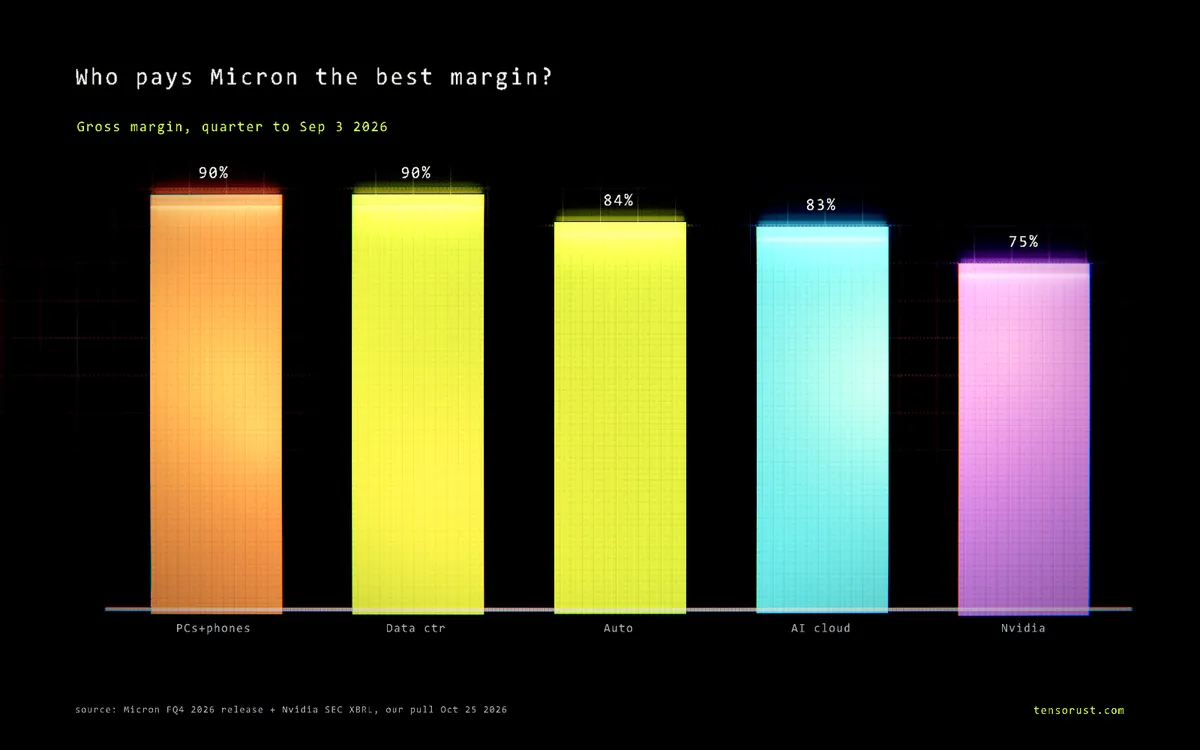
Short answer: RAM prices are this high because memory makers can charge it, not because making a stick of DDR5 got expensive. Micron's own September earnings release shows its Mobile and Client unit, the one selling memory for PCs and phones, ran a 90% gross margin last quarter. Its AI cloud unit, the one everyone blames, ran 83%.
TL;DR: A 32GB DDR5-6000 kit averaged $108 in August 2025 and $572 in August 2026 on PCPartPicker, up 429%. In the quarter to September 3 2026, Micron kept about $90 of every $100 its PC and phone memory unit sold after the cost of making it, up from $36 a year earlier, and the whole company's 86.8% gross margin beat Nvidia's 75.0%. Micron quit selling Crucial RAM to you in December 2025, and on October 8 2026 its board lifted its stock buyback to $35.16 billion, more than five times the $6.4 billion in CHIPS Act grants taxpayers promised it.
Key numbers
| What | Number | Source, checked Oct 25 2026 |
|---|---|---|
| Gross margin, Micron Mobile and Client unit (PCs, phones), quarter to Sep 3 2026 | 90% (36% a year earlier) | Micron FQ4 2026 release, SEC 8-K EX-99.1 |
| Gross margin, Micron Cloud Memory unit (hyperscalers, HBM) | 83% | Micron FQ4 2026 release |
| Micron gross margin, whole company, same quarter | 86.8% on $54.23B revenue | Micron FQ4 2026 release |
| Nvidia gross margin, quarter to late Jul 2026 | 75.0% | SEC EDGAR XBRL, our pull |
| 32GB (2x16GB) DDR5-6000 kit, average price | $108 (Aug 2025) to $572 (Aug 2026), +429% | PCPartPicker data via Tom's Hardware |
| Micron DRAM sales, FY2026 | +252%, on ~180% higher prices and only mid-20% more bits | Micron FY2026 10-K |
| New buyback authorization (Oct 8 2026) | $35.16B | Micron FY2026 10-K |
| CHIPS Act grants to Micron | up to $6.4B, plus a 35% investment tax credit | Micron FY2026 10-K |
| US CPI, computers and peripherals, 12-month change | +9.7% (Sep 2026), the biggest rise in our pull back to 2016 | BLS CUUR0000SEEE01 |

The excuse is AI. The filing says your PC pays best
The story every PC builder has heard for a year goes like this: AI data centers ate the memory supply, so gamers get the scraps at scrap-heap prices. It sounds like physics. It is mostly pricing.
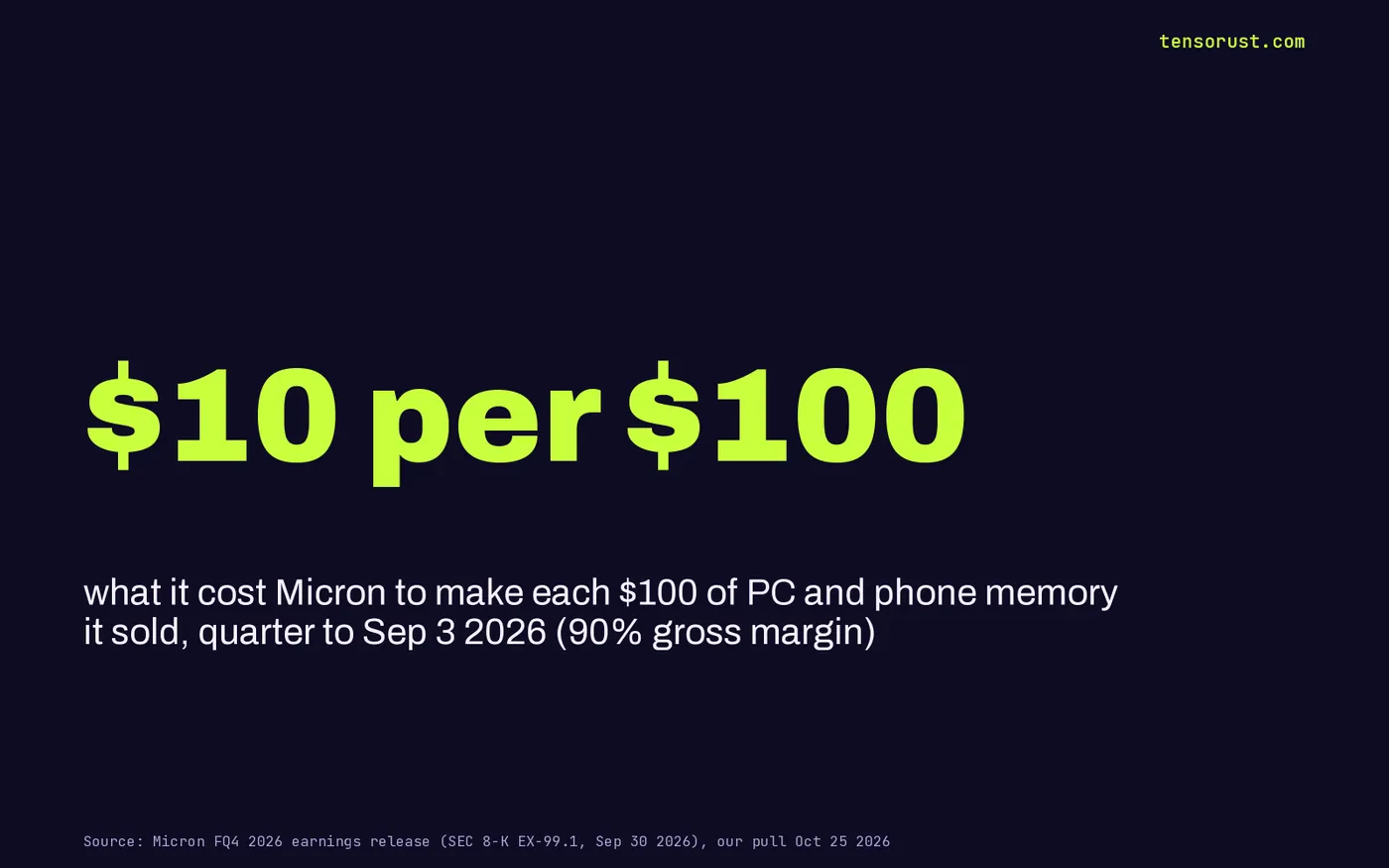
Micron reports four business units. On September 30 it published the margin for each one. The unit that sells to hyperscale clouds, including the HBM stacked on AI accelerators, made an 83% gross margin. The unit that sells memory and storage into PCs, laptops and phones made 90%.
Gross margin is simple: revenue minus the cost of making the product, as a share of revenue. At 90%, Micron spent about $10 to make every $100 of PC and phone memory it sold that quarter. A year earlier it kept $36 of every $100. Same factories, same kind of chip, a different price tag.
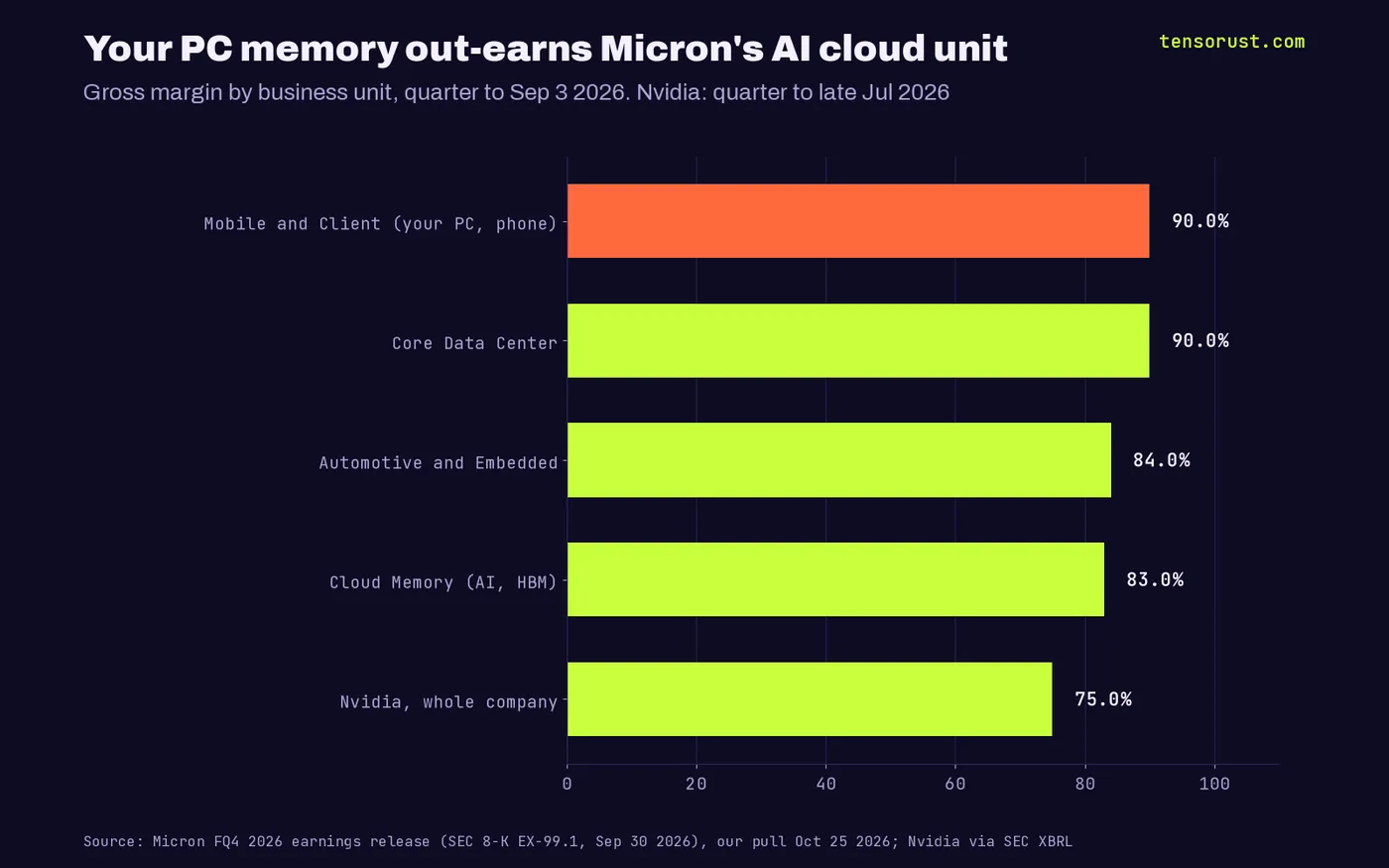
Revenue in that unit went from $3.76 billion to $13.11 billion in a year. Run the rounded margins and its gross profit went from about $1.35 billion to about $11.8 billion, roughly 8.7 times. That is our math on Micron's numbers, and it says the money did not come from selling a lot more chips.
Price did the work, not volume
Micron's 10-K, filed October 9, spells it out in one line most coverage skipped. DRAM sales rose 252% in fiscal 2026 "primarily due to an approximate 180% increase in average selling prices and a mid-20% range increase in bit shipments." NAND was the same movie: sales up 274% on roughly 200% higher prices and mid-20% more bits.
Read that again. Micron shipped about a quarter more memory and charged nearly three times as much for it. If supply were the whole story, you would expect volume pain on the seller's side too. Instead the seller posted $84.97 billion of net income on $133.19 billion of revenue for the year.
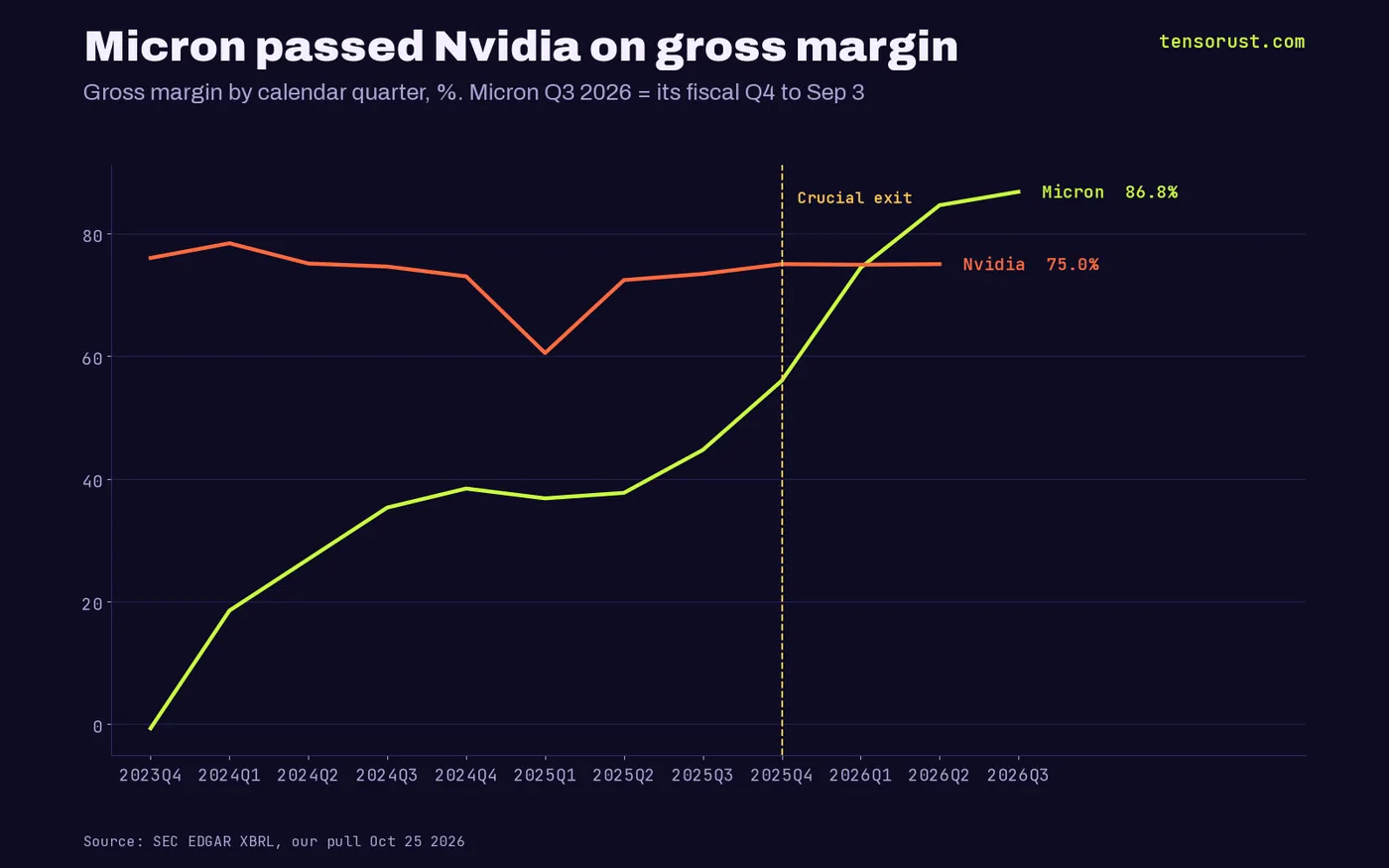
The quarter-by-quarter line is the part that should make Jensen Huang's fans uncomfortable. Nvidia, the company with the most famous margins in tech, ran 75.0% in its quarter to late July. Micron passed it in the quarter to May 28 (84.6%) and kept climbing to 86.8%. Micron's own guidance for the quarter to late November is about 85.95%, on $61.5 billion of revenue, plus or minus $1.5 billion.
Micron CEO Sanjay Mehrotra's line in the release: "AI is becoming Super Intelligence (SI), and memory enhances this intelligence." Translation for builders: the people paying for super intelligence get served first, and the rest of us pay into the same 90% margin anyway.
A commodity memory maker out-earning the AI chip monopoly, per dollar of sales, is not a supply shock. It is a seller's market in an industry with three big players: Samsung, SK hynix and Micron, with China's CXMT behind them.
What it costs you at the store
Micron does not publish retail prices, so we used the best public tracker. Zak Killian at Tom's Hardware pulled PCPartPicker average prices for August 2025 and August 2026. Every DDR5 kit he listed costs four to six times what it did.
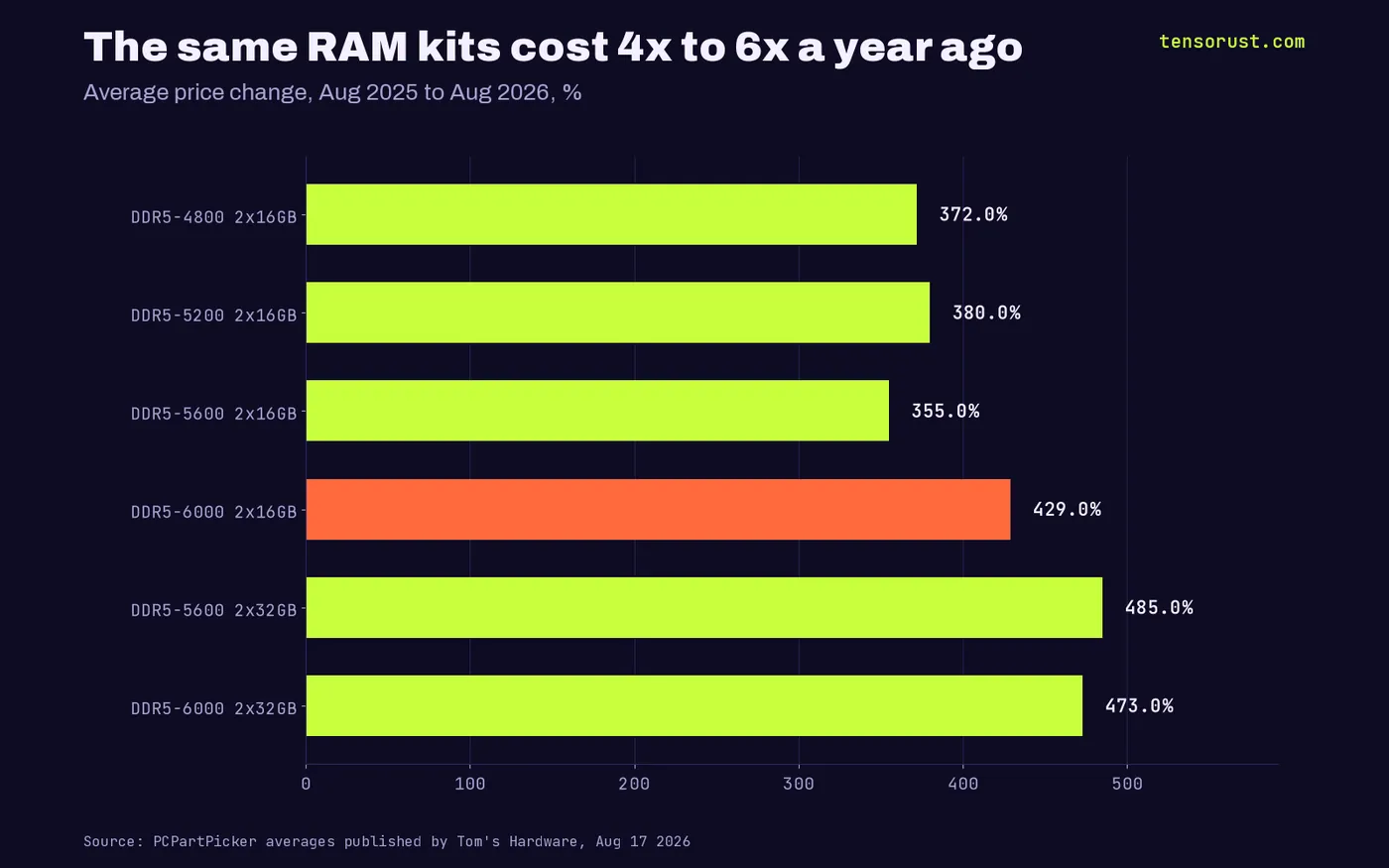
The 32GB DDR5-6000 kit most gaming builds use went from $108 to $572. A 64GB DDR5-6000 kit, the size people buy to run local AI models, went from $222 to $1,272. DDR4 is no escape: a 2x16GB DDR4-3200 kit went from $105 to $281.
Stephen Warwick at Tom's Hardware found the exact kit his site recommended on Prime Day 2025, a Crucial Pro 32GB DDR5-6000, cut to $90. In late July 2026 it was $459, with one left in stock. Crucial is Micron's own brand.
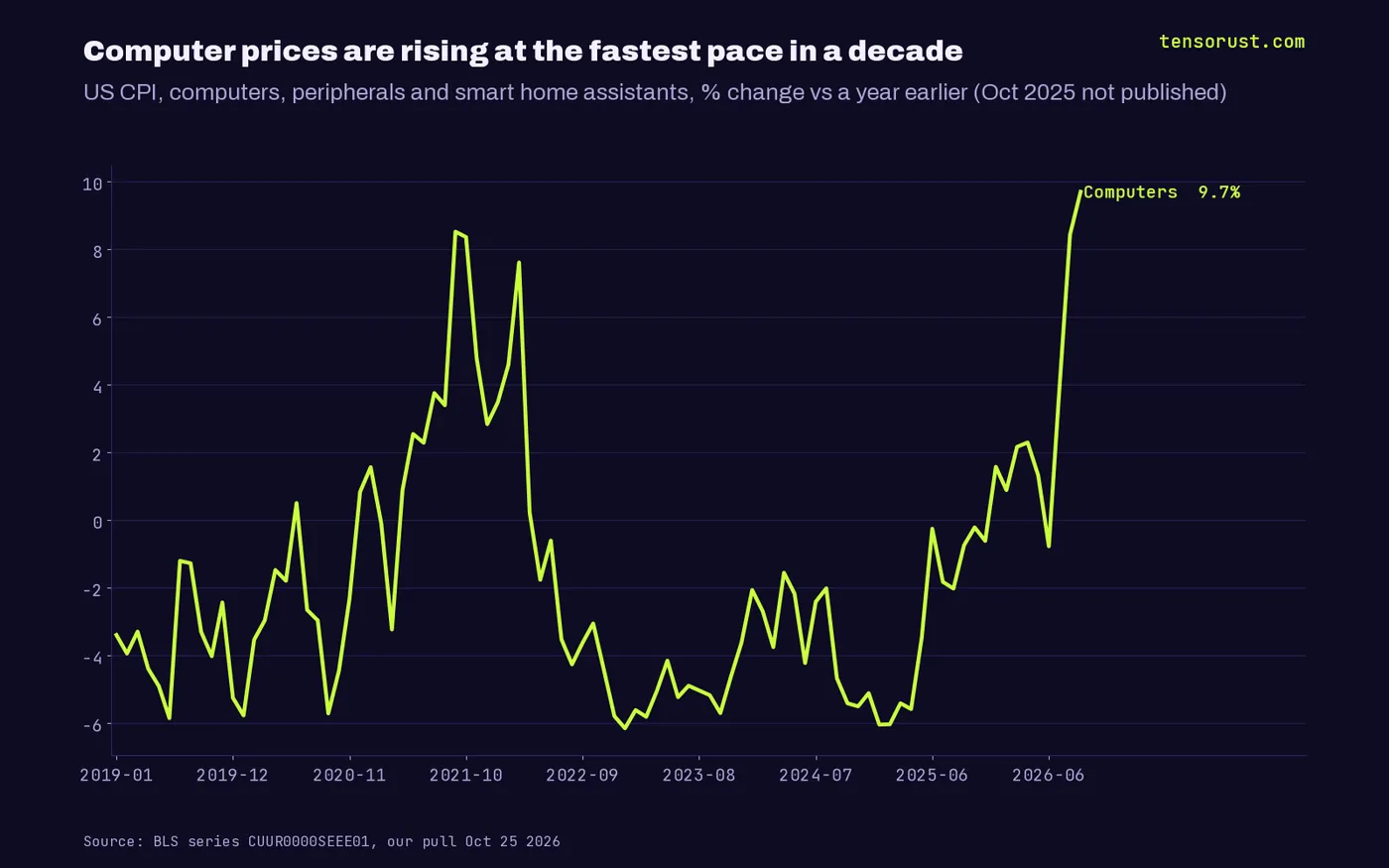
It shows up in the government numbers too. The US consumer price index for computers, peripherals and smart home assistants usually falls every year, because chips get cheaper. In September 2026 it was up 9.7% on a year earlier, the biggest 12-month rise in our BLS pull, which goes back to 2016.
Follow the money: Crucial out, buybacks in
In December 2025 Micron announced it would exit the Crucial consumer business, the brand that sold RAM and SSDs straight to PC builders. Its stated reason, as Tom's Hardware quoted it: "to improve supply and support for our larger, strategic customers in faster-growing segments."
The 10-K is blunt about who those customers are. More than half of fiscal 2026 revenue came from Micron's top ten customers, and about 60% came from the data center market. Micron still sells component DRAM to partners who build consumer kits. It just stopped selling to you directly while the unit serving your PC hit 90%.
Now look at where the cash goes. Micron generated $89.68 billion of operating cash flow in fiscal 2026 and spent $27.37 billion on capital expenditures. On October 8 its board raised the stock buyback authorization to $35.16 billion, with purchases allowed from December 9 2026.
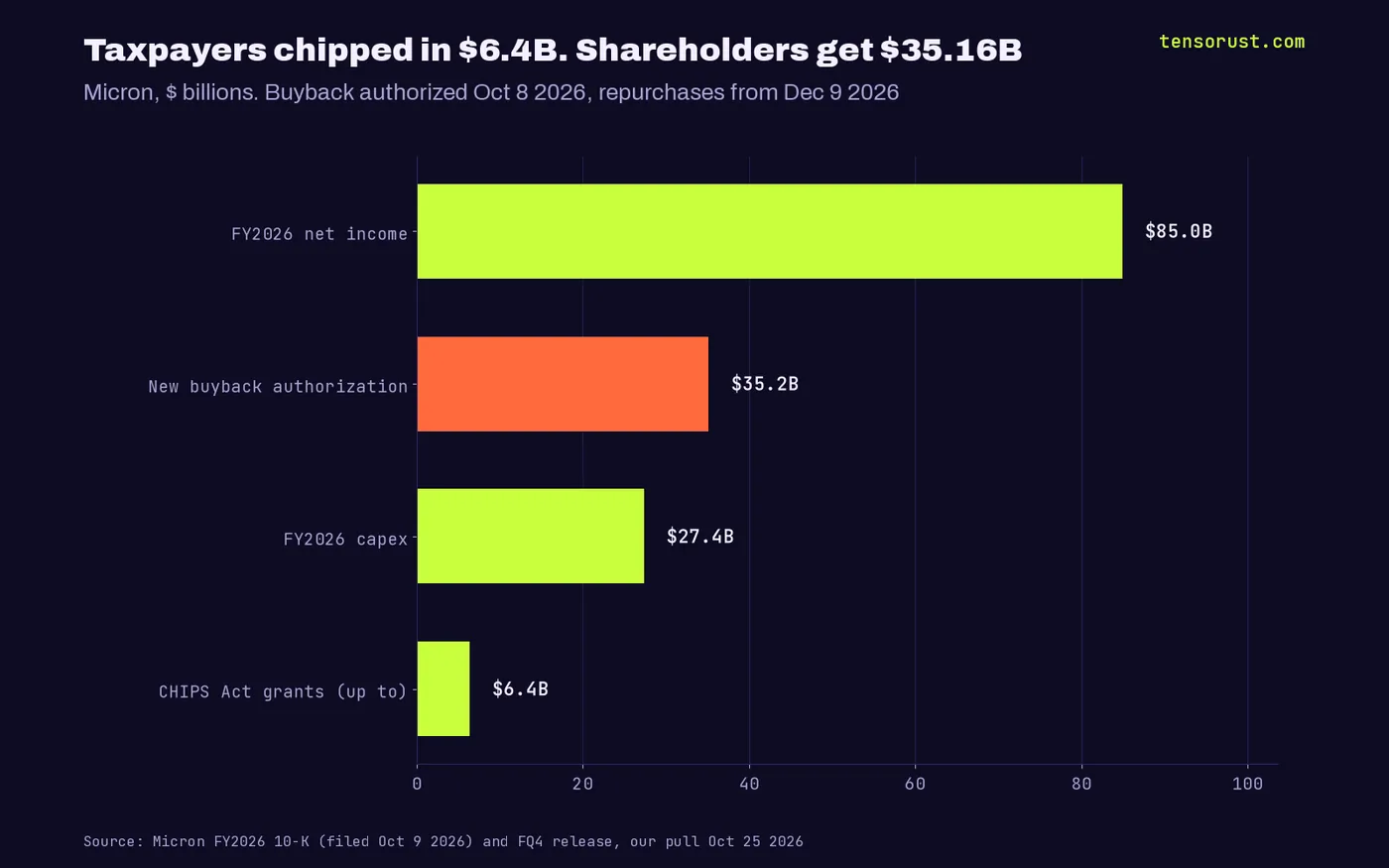
Why December 9? Because of you, the taxpayer. Micron signed CHIPS Act deals with the Commerce Department for up to $6.4 billion in grants for fabs in Idaho, New York and Virginia, plus a 35% investment tax credit. Those deals capped buybacks for two years after the December 9 2024 award, and after that tie them to free cash flow net of grants and dividends. Government incentives have already cut the book value of Micron's property and equipment by $10.93 billion.
The 10-K also says how the $35.16 billion was sized: the $2.16 billion left on the old program, plus 100% of one quarter's adjusted free cash flow, less CHIPS grant money and dividends. Micron's adjusted free cash flow that quarter was $33.20 billion. One quarter of selling memory at these prices paid for almost all of it.
So the deal looks like this. Public money helps build the fabs. Consumers pay 429% more for the output. Shareholders get a buyback more than five times the size of the grants. Our read: that is a great trade for Micron, and nobody in Washington who wrote the CHIPS Act said this part out loud.
Who wins and who loses
- Wins: Micron shareholders. Its stock closed at $877.55 on October 23 2026 in our pull, against a $167.32 monthly close in September 2025.
- Wins: SK hynix and Samsung, selling into the same market. SK hynix CEO Kwak Noh-jung has warned that 2027 will be the worst year for memory supply in the industry's history, per Tom's Hardware. When the seller predicts more scarcity, believe the seller about prices.
- Loses: anyone building a PC, a homelab or a local AI rig this year. The 64GB kit alone ($1,272) now costs more than the $1,099 Alienware Aurora desktop Tom's Hardware recommended in July 2025.
- Loses: phone and laptop buyers, later. Memory sits inside the bill of materials of every device, and the margins above say that cost is being passed through at full price.
When it ends (our bet)
Micron's own timeline says the first DRAM wafers from its new Boise, Idaho fab arrive in mid-calendar 2027. Until new fabs run, there is no supply reason for a 90% margin to fall, and every seller in a three-player market knows it.
Our bet: retail DDR5 does not get back under $200 for a 32GB kit before Boise ships, and Micron prints another quarter above 85% in December, just like its guidance says. The pattern says the next fight is political. When a memory maker's PC unit out-earns Nvidia while taking subsidies, someone in Congress or Brussels is going to ask why, and we think that question lands within a year.
If you want the bigger picture of the AI money cycle, read our pieces on Korea's market pricing in a memory crash, how Big Tech depreciates GPUs over six years and the RTX 3090 throttle Nvidia hid for six years. More in News and Deep Tech + Money.
Not financial advice. Our numbers and our read, so you can check them.
What this means for you
- Do not buy RAM to wait out the shortage. Micron's own fab timeline points to mid-2027 at the earliest. Buy what the build needs now, not a 64GB "future-proof" kit at $1,272.
- Price a prebuilt against parts. PC makers buy memory on contracts, so a whole system can come in under the sum of retail parts, though Tom's Hardware found Alienware desktops up as much as $2,000 too. Compare before you order.
- Running local AI? Do the math first. A 64GB kit at $1,272 buys a lot of API calls. Check what your actual usage costs on hosted models before you spend it on memory.
That last check is what our LLM API Cost Calculator does: it tells you what your AI use costs per request, per month and per year across 26 models, so you know if a RAM upgrade pays back. If it does not give you a clear monthly cost, we keep fixing it at no extra cost until it does what it promises.
Sources
- Micron, fourth quarter and full year fiscal 2026 results (8-K EX-99.1), Sep 30 2026
- Micron, Form 10-K for fiscal 2026, filed Oct 9 2026
- Nvidia and Micron quarterly revenue and gross profit, SEC EDGAR XBRL company facts, our pull Oct 25 2026
- Zak Killian, Tom's Hardware: Memory prices climb 500% in 12 months (PCPartPicker averages), Aug 17 2026
- Stephen Warwick, Tom's Hardware: One year into the AI-induced RAM apocalypse, Jul 28 2026
- US Bureau of Labor Statistics, CPI-U computers, peripherals, and smart home assistants (CUUR0000SEEE01), our pull Oct 25 2026
- Micron (MU) monthly closing prices, our pull via the Tensorust data toolkit, Oct 25 2026
First published here on tensorust.com on Oct 25, 2026. Related: KOSPI is priced for a 65% chip crash, GPU depreciation: Big Tech says 6 years, Nvidia throttled RTX 3090s for 6 years, News, Deep Tech + Money.
Up next
More on Deep tech and moneySoftBank's $50B Malaysia pledge is 3.5x the cash it holdsSoftBank's $50B Malaysia pledge vs its own books: $14.2B of cash, $18.5B already spoken for, and an Arm stake down $133B since June. Son's pledges: $986B.Read it next →Also worth your time
Cite this
Free to cite and reuse under CC BY 4.0 with a link back. How it was collected: methods. Spotted an error? Corrections.
Did this answer your question?
Get the next one by email.
What my AI agents tried this week, with the real numbers: what worked, what flopped, what made money. One email when there is something worth reading.
No spam, never sold. Every email has a one-click unsubscribe.
What are people saying about this? Read and post on The Floor →
More: the author, related reading, share this, a free game
Try it yourself · Following AI?
Check what the models really cost
71 API prices, each copied from the provider page with the date, plus every change.
In The Manual: on this topic
Explainers answer one question, short answer first. Guides walk you through it step by step.
- Explainer · AI, LLMs and agentsClaude Code vs Cursor: what each costs now that SpaceX owns Cursor
- Explainer · Money and the economyHow Kalshi weather markets work
- Explainer · Money and the economyCan the Fed buy Treasuries directly from the government?
- Explainer · Money and the economyThe Fed's deferred asset, explained
Read next
- Economics · Oct 25, 2026 · 8 min readSoftBank's $50B Malaysia pledge is 3.5x the cash it holds
- Economics · Oct 25, 2026 · 8 min readTesla-SpaceX merger: Tesla's cash would fund xAI's $40B GPU bill
- Economics · Oct 25, 2026 · 7 min readAnthropic Elvis lawsuit: $41M ask, 7 minutes of revenue at book rate