
By Matt Busel, who built the apps, crates and game he writes about · every number links to its source and every dataset is downloadable (methods) · corrections · featured in Kirino, gamebiz, This Week in Rust, New Mobile Life, By-Press
Nvidia's $2,000-per-GPU software fee: rent on a stack vLLM gives away
On this page · 11 sections
- Key numbers
- What Huang actually said, and what he didn't
- The price list Nvidia already has
- $0.23 an hour: small per GPU, huge per fleet
- Follow the money: who pays, who wins, who loses
- Nvidia's own filings say software barely registers
- The open-source problem Nvidia is pricing against
- What it could be worth: our scenarios
- What to watch next
- What this means for you
- Sources
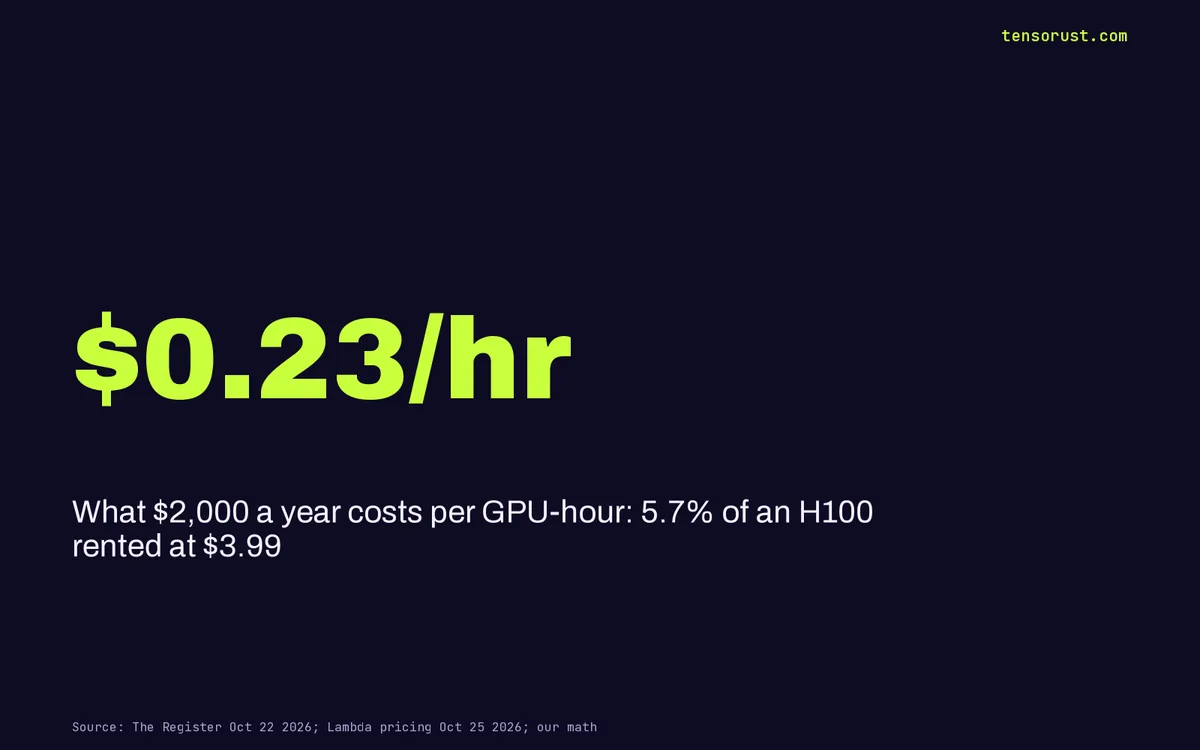
Short answer: At GTC Berlin on Oct 22, Jensen Huang put the cost of running Nvidia's agent software on its "AI factories" at about $2,000 per GPU per year. That is $0.23 a GPU-hour, or 5.7% of the rent on an H100 at $3.99. Our read: this is Nvidia trying to turn a one-time chip sale into a yearly toll before free, open-source inference servers make the toll impossible to collect.
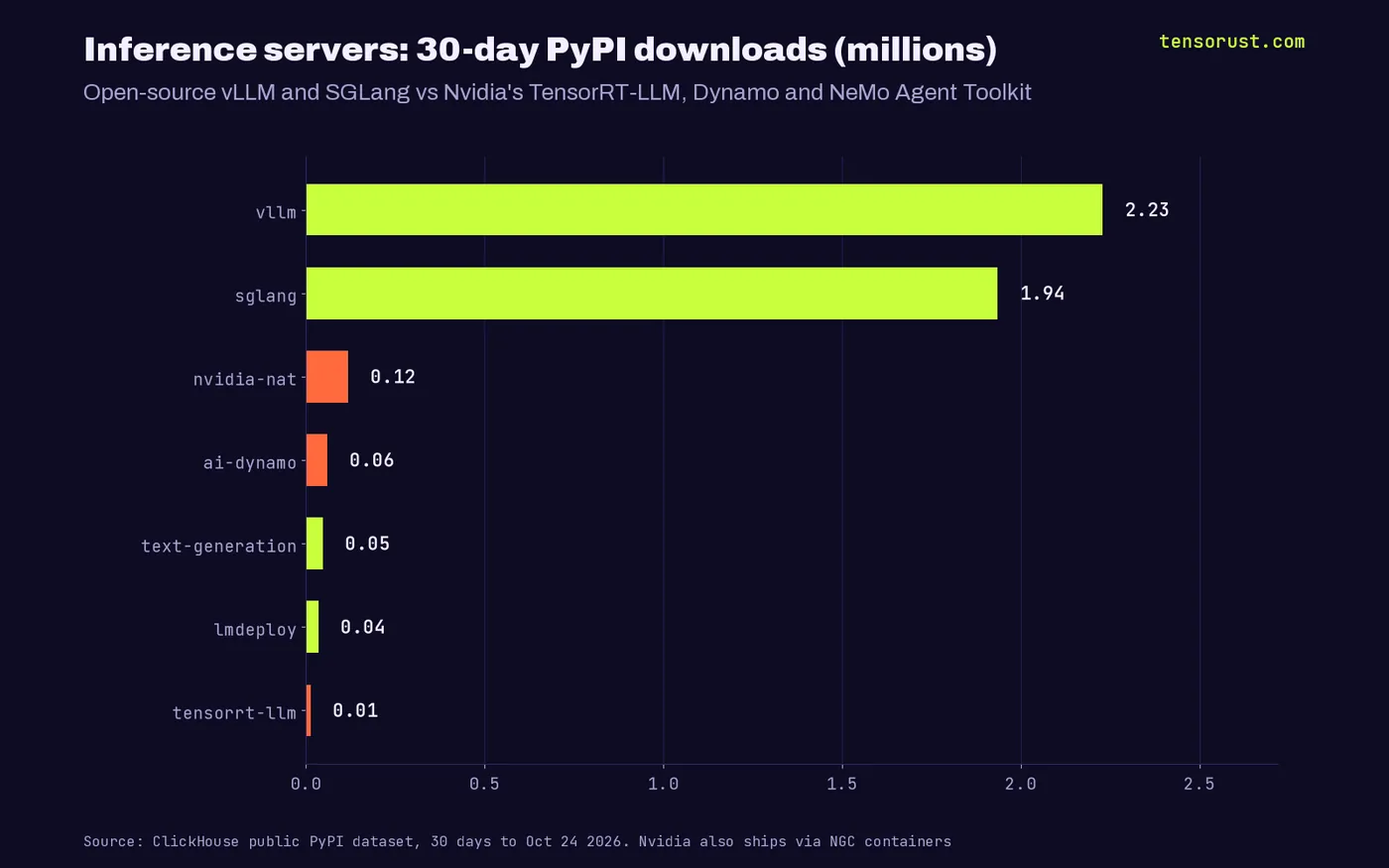
TL;DR: Nvidia already lists AI Enterprise at $4,500 per GPU for one year, so $2,000 reads like a cheaper, agent-shaped door into the same rent. Its whole deferred revenue pile, the place subscription money sits, was about $3.6B (excluding customer advances) on Jul 26 2026, against $96.2B of revenue in that single quarter. Meanwhile the open-source servers vLLM and SGLang pulled 4.16M PyPI downloads in 30 days versus about 74,000 for Nvidia's TensorRT-LLM and Dynamo combined, which tells you who would actually pay this fee and who would route around it.
Key numbers
| What | Number | Source, checked Oct 25 2026 |
|---|---|---|
| Huang's agent software price, per GPU per year | about $2,000 | The Register, Oct 22 2026 |
| AI Enterprise list price, 1 year | $4,500 per GPU | NVIDIA licensing guide |
| AI Enterprise in the cloud | $1 per GPU-hour plus the instance | NVIDIA licensing guide |
| $2,000 a year as an hourly rate | $0.23 per GPU-hour | Our math (2,000 / 8,760) |
| Share of an H100 rented at $3.99/hr | 5.7% | Lambda pricing, our math |
| Nvidia revenue, quarter to Jul 26 2026 | $96.2B | NVIDIA 10-Q |
| Deferred revenue, Jul 26 2026 (ex $2.8B advances) | $6.41B ($3.6B) | NVIDIA 10-Q |
| vLLM + SGLang PyPI downloads, 30 days | 4.16M | ClickHouse public PyPI data |
| TensorRT-LLM + Dynamo PyPI downloads, 30 days | 74,392 | Same dataset |

What Huang actually said, and what he didn't
The number comes from a Q&A at GTC Berlin. The Register's Dan Robinson reported that Huang put the price of licensing Nvidia's software stack at "about $2,000 per GPU annually". That is a paraphrase, not a transcript.
Wall St Engine's post the next day carries the fuller version: software licensing "will become increasingly a major part of our company's business," at about $2,000 per GPU per year to run Nvidia's software for agents on AI factories. Tom's Hardware picked it up on Oct 25 and flagged the obvious problem: Nvidia already charges more than twice that.
What nobody has said: when it starts, what it covers, whether it replaces or stacks on AI Enterprise, and how many GPUs it would apply to. Nvidia has published no price page for it. So treat $2,000 as a stated intent, not a SKU.
The price list Nvidia already has
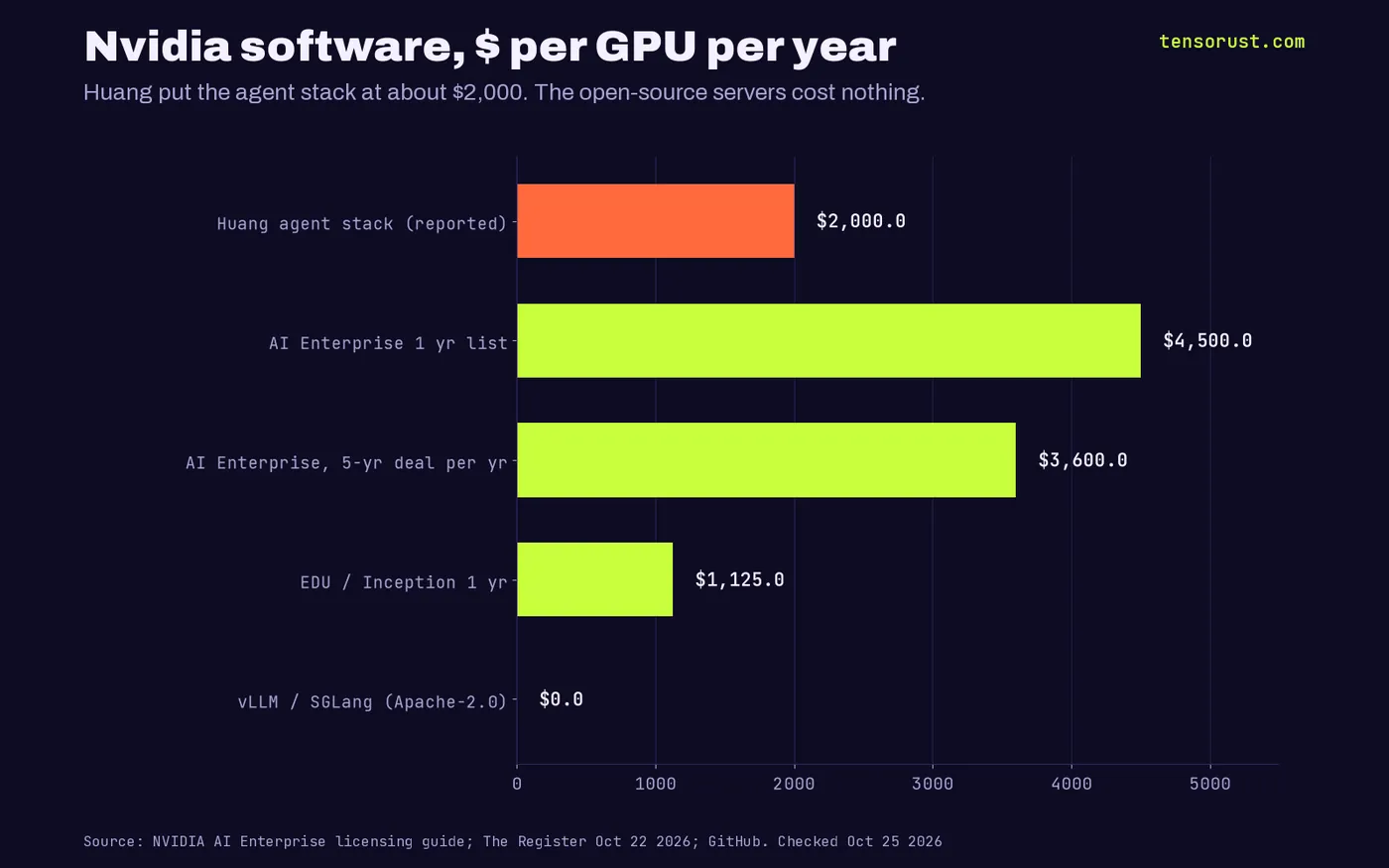
Nvidia's own AI Enterprise licensing guide lists $4,500 per GPU for one year, $18,000 for four years, and the same $18,000 for five ("five years for the price of four"). A perpetual license with five years of support is $22,500. Schools and Inception startups pay $1,125 a year.
In the cloud it is $1 per GPU-hour on top of the instance. Run that for a year and it is $8,760, more than four times Huang's new number.
Here is the tell. The five-year subscription is already bundled with H100, H200 NVL and A800 PCIe cards, per the same page. A price that comes "free" with the chip is a price nobody has to justify. A $2,000 annual line item for agents is a price somebody has to sign every year.
$0.23 an hour: small per GPU, huge per fleet
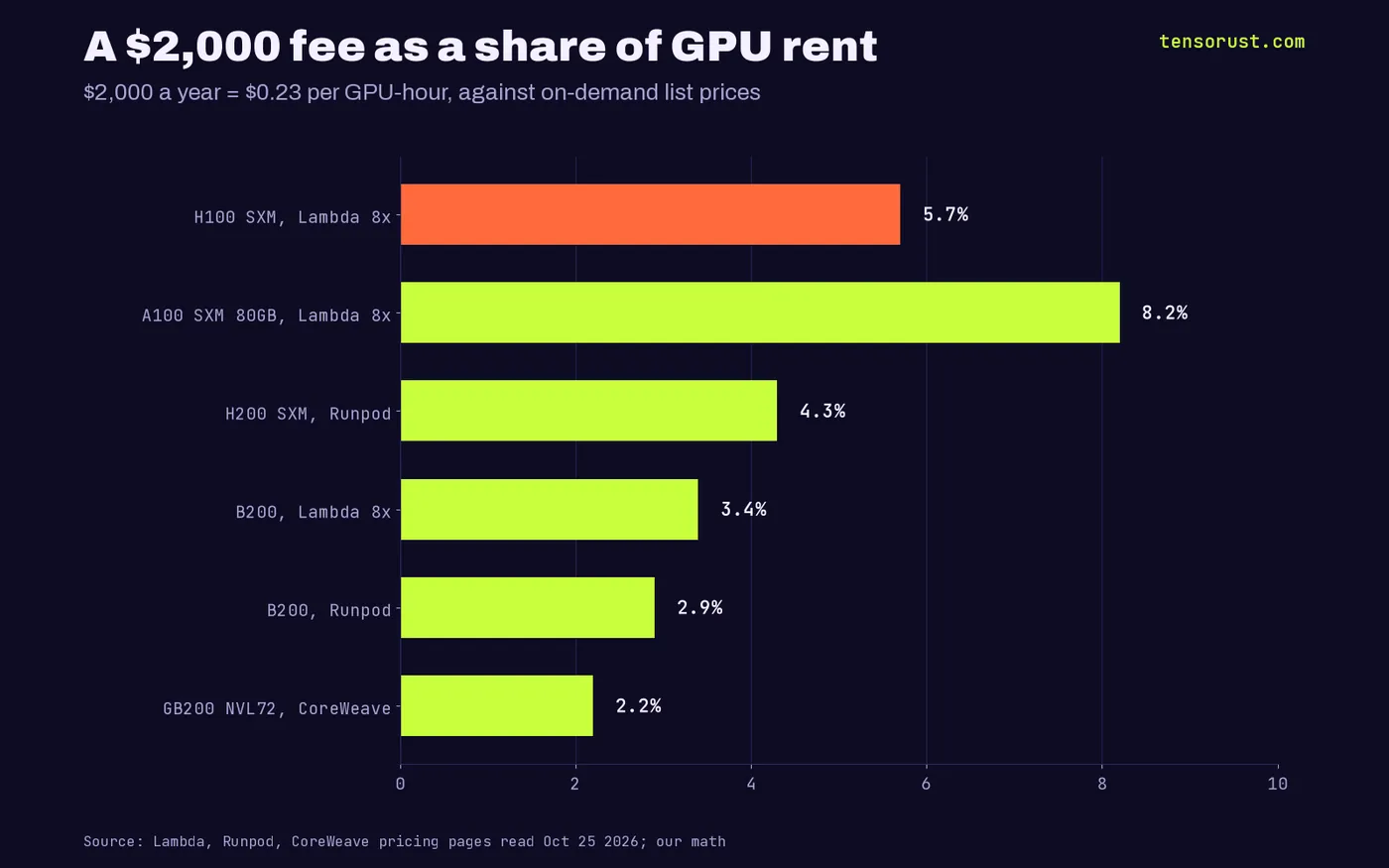
Divide $2,000 by 8,760 hours and you get $0.23 per GPU-hour. On the pricing pages we read this morning, Lambda rents an H100 SXM for $3.99 an hour in an 8-GPU box, a B200 for $6.69, and CoreWeave lists a GB200 NVL72 at $10.50 per GPU-hour.
So the fee is 5.7% of H100 rent, 3.4% of Lambda B200 rent and 2.2% of CoreWeave GB200 rent, at 100% use. At the 50% use most fleets would brag about, double those shares. On an A100 at $2.79 it is 8.2% before you idle a single minute.
That is the whole game in one chart. On new Blackwell iron the fee hides in the rounding. On the older Hopper and Ampere fleets, the ones whose rental prices keep sliding, it eats straight into the margin of whoever owns them.
Follow the money: who pays, who wins, who loses
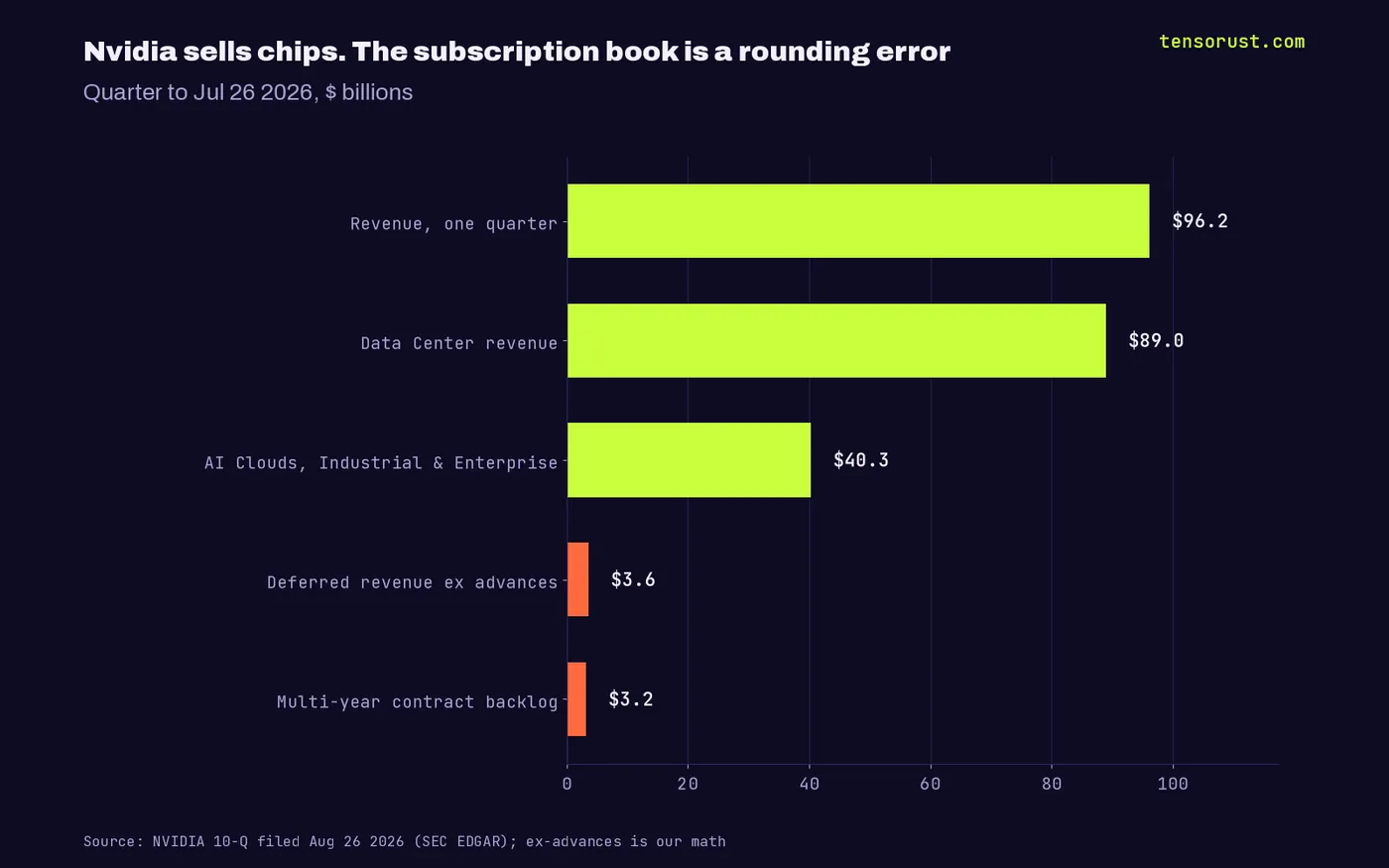
Who pays: enterprises and neoclouds. Nvidia's "AI Clouds, Industrial & Enterprise" line did $40.3B in the quarter to Jul 26, up 138% in a year, per the 10-Q. These are the buyers without their own software armies. The neoclouds among them are the same borrowers we showed cracking under Nvidia's $288B of backstops. A per-GPU toll lands on them first.
Who doesn't pay: hyperscalers. Hyperscale was $48.7B of that quarter, and the big clouds run their own serving stacks. Our bet: they negotiate the fee to zero or never touch it, which means the toll falls hardest on the smallest buyers. That is how incumbents usually price.
Who wins: Nvidia shareholders, if it sticks. Software rent has no wafer cost and renews every year. Who loses: anyone running agents on a thin margin, and anyone who thought buying the GPU meant owning the stack.
Nvidia's own filings say software barely registers
Nvidia does not break out software revenue. The closest proxy is deferred revenue, which the 10-Q says includes "unearned revenue primarily related to hardware and software support, and license and development arrangements."
On Jul 26 2026 it was $6.41B, but $2.8B of that was customer advances (up from $160M in January). Strip those out and the support-and-license pile is about $3.6B, our math. Revenue from contracts longer than a year still to be recognized was $3.2B. The quarter's revenue was $96.2B.
Even Nvidia hedges. Its FY2026 10-K says of standalone software like AI Enterprise: "we may fail to sell any meaningful standalone software or services." When a company with $192.9B of trailing net income writes that in a risk factor, the $2,000 number is a pitch, not a business yet.
The open-source problem Nvidia is pricing against
The agent-serving layer Nvidia wants to charge for already exists for free. vLLM (95,444 GitHub stars) and SGLang (38,133) are both Apache-2.0. In the 30 days to Oct 24 they pulled 2.23M and 1.94M PyPI downloads.
Nvidia's own servers on the same index: TensorRT-LLM 13,769, Dynamo 60,623, and the NeMo Agent Toolkit (nvidia-nat) 119,170. Fair caveat: Nvidia ships a lot through its NGC containers and its own package index, so PyPI undercounts it. But the developer gravity is not subtle.
That is why a fee aimed at "agents on AI factories" matters. The bet is that enterprises will pay for a supported, certified bundle rather than wire vLLM themselves. Some will. Every one that doesn't is proof the moat was CUDA, not the serving stack. We showed last night how one register on a 3090 undid years of product segmentation; open serving code does the same thing to software pricing.
What it could be worth: our scenarios
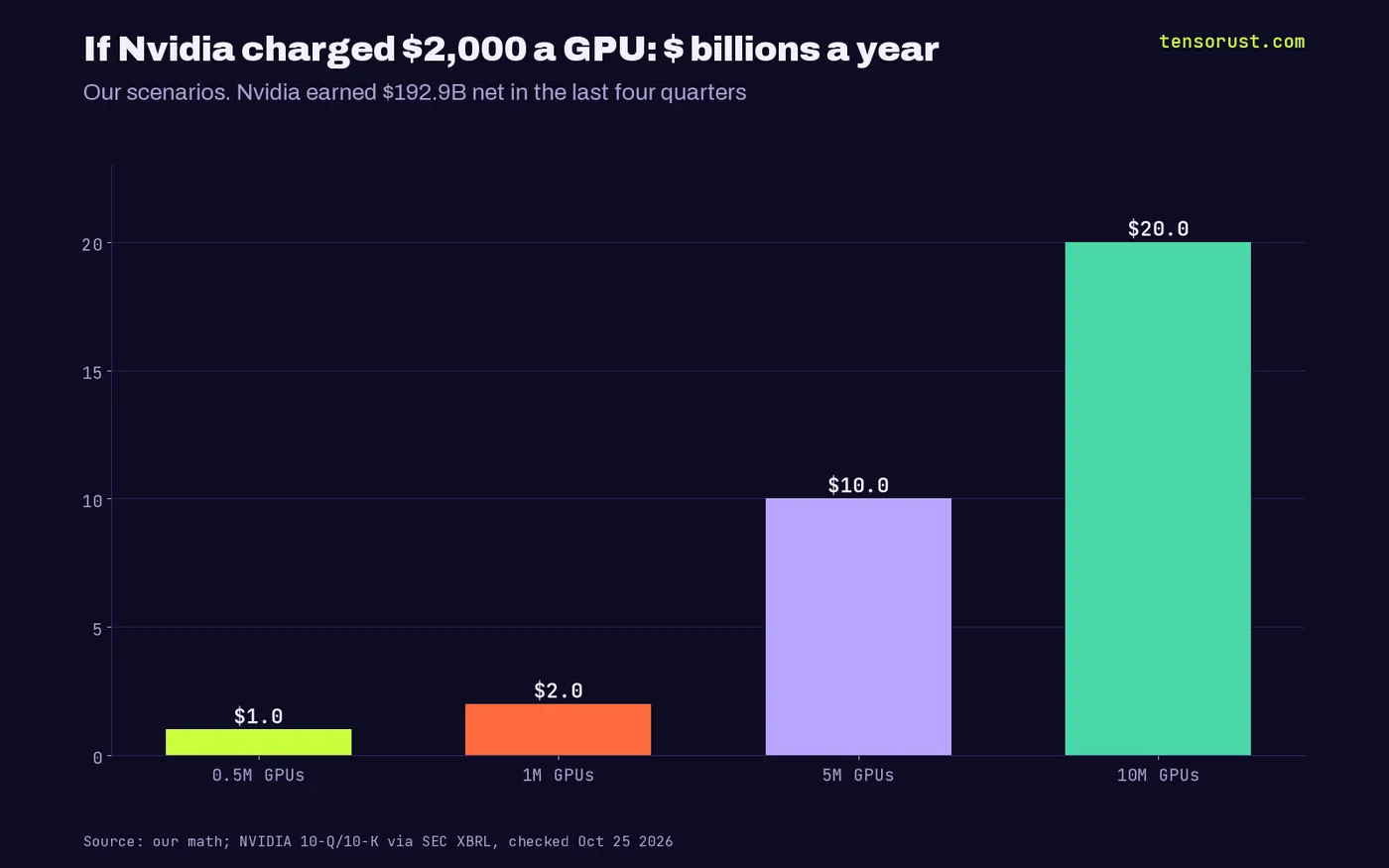
Nvidia gave no GPU count. So here is plain multiplication, labelled ours. At 500,000 licensed GPUs, $2,000 is $1B a year. At 1M it is $2B, at 5M $10B, at 10M $20B.
Against $192.9B of net income over the last four quarters (our sum of XBRL quarters), even the 10M case is about 10%. That is real money, and it is recurring, but it is not what moves Nvidia. What it moves is the buyer's cost per token, and that is where agent margins live. We priced the same tradeoff at the model layer in Qwen3.8-27B vs Fable 5: open weights on 21 hosts beat one price list.
What to watch next
- A real price page or SKU for the agent stack, and whether it stacks on AI Enterprise or replaces it.
- Nvidia's Q3 FY27 10-Q: deferred revenue ex advances above $3.6B would be the first sign the rent is landing.
- Neocloud earnings: any line that says "software licensing" next to GPU depreciation.
- vLLM and SGLang download trend versus Dynamo. If Dynamo closes the gap, Nvidia's bundle is winning.
What this means for you
If you run agents on rented GPUs, price the $0.23 per GPU-hour in now, at your real utilization, and check whether your stack actually needs anything vLLM or SGLang doesn't already do for free. If you are buying a fleet, ask in writing what software is bundled and for how many years, before the fee has a SKU. More deep tech money stories on Tensorust News and the deep tech + finance hub; the spending side is in our Big Tech cash-flow preview.
To see what a per-GPU fee does to your own cost per token, the $7 LLM API Cost Calculator prices your workload across 26 models and hosts. If it does not show you what your workload costs, we keep fixing it at no extra cost until it does.
Not financial advice. Our numbers and our read, so you can check them. Download the data below.
Sources
- The Register, Dan Robinson, "Nvidia's Huang: Don't mention the AI-pocalypse", Oct 22 2026
- Wall St Engine on X, Huang GTC Berlin remarks, Oct 23 2026
- Tom's Hardware, Nvidia discusses $2,000-per-GPU annual fee, Oct 25 2026
- NVIDIA AI Enterprise licensing guide, pricing, read Oct 25 2026
- NVIDIA 10-Q for the quarter ended Jul 26 2026, filed Aug 26 2026
- NVIDIA 10-K for fiscal 2026, filed Feb 25 2026
- Lambda GPU pricing, Runpod pricing, CoreWeave pricing, read Oct 25 2026
- ClickHouse public PyPI downloads dataset, 30 days to Oct 24 2026
- GitHub repos: vLLM, SGLang, TensorRT-LLM, Dynamo, read Oct 25 2026
First published here on tensorust.com on Oct 25, 2026. Related: Tensorust News, Deep tech + finance, Nvidia backstops: $288B on the hook.
Up next
More on Deep tech and moneyNvidia backstops: $288B on the hook while its neocloud borrowers crackNvidia now holds, owes or guarantees $288B in the AI buildout, 5.3x January. CoreWeave burned $17.7B and fell 38% in October. Our full SEC pull.Read it next →Cite this
Free to cite and reuse under CC BY 4.0 with a link back. How it was collected: methods. Spotted an error? Corrections.
Did this answer your question?
Get the next one by email.
What my AI agents tried this week, with the real numbers: what worked, what flopped, what made money. One email when there is something worth reading.
No spam, never sold. Every email has a one-click unsubscribe.
What are people saying about this? Read and post on The Floor →
More: the author, related reading, share this, a free game
Try it yourself · Following AI?
Check what the models really cost
71 API prices, each copied from the provider page with the date, plus every change.
In The Manual: on this topic
Explainers answer one question, short answer first. Guides walk you through it step by step.
- Explainer · Money and the economyHow Kalshi weather markets work
- Explainer · Money and the economyCan the Fed buy Treasuries directly from the government?
- Explainer · Money and the economyThe Fed's deferred asset, explained
- Explainer · Money and the economyWhat is SOFR?
Read next
- Economics · Oct 25, 2026 · 9 min readNvidia backstops: $288B on the hook while its neocloud borrowers crack
- Economics · Oct 25, 2026 · 10 min readBig Tech earnings week: 4 of 5 AI spenders burn cash, $1.2T waits
- Economics · Oct 25, 2026 · 10 min readAmerican Express layoffs: 5% cut for AI after $5.5B in buybacks