
By Matt Busel, who built the apps, crates and game he writes about · every number links to its source and every dataset is downloadable (methods) · corrections · featured in Kirino, gamebiz, This Week in Rust, New Mobile Life, By-Press
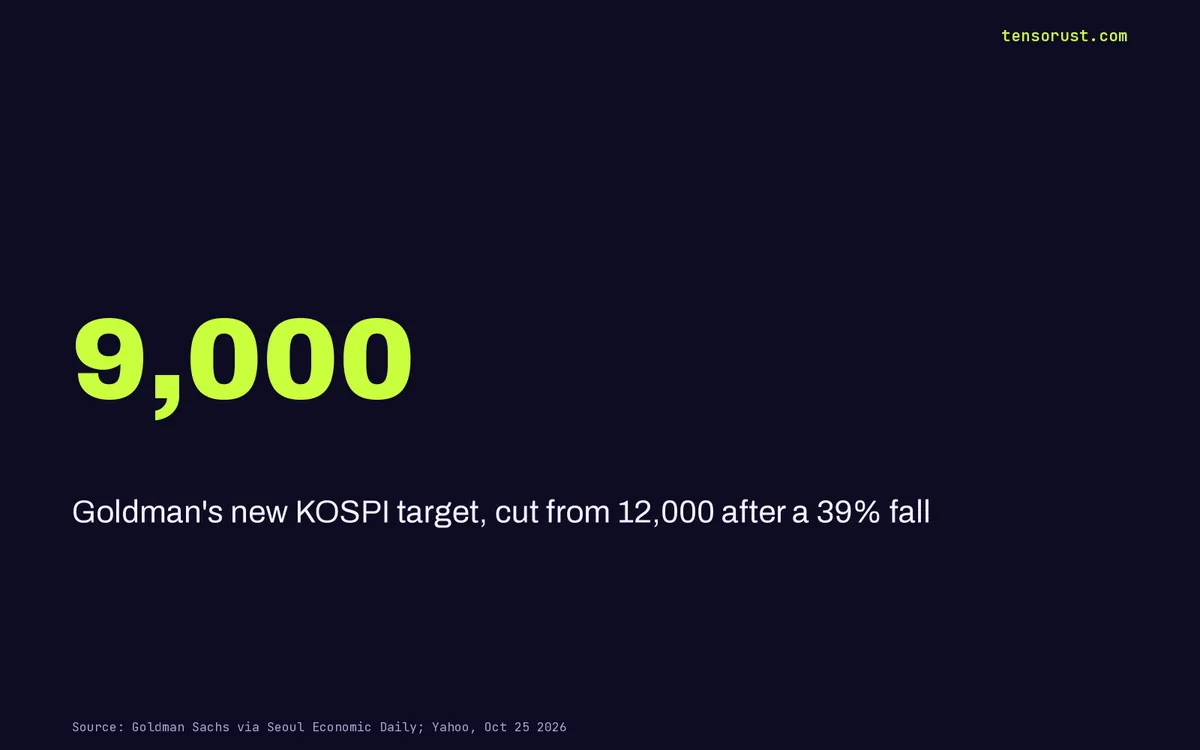
KOSPI target cut to 9,000: Korea is priced for a 65% chip crash
On this page · 9 sections
Short answer: Goldman Sachs cut its 12-month KOSPI target from 12,000 to 9,000 on Sunday, Oct 25 2026, after the index fell 39.1% from its Jun 22 peak of 9,114.55 to 5,550.30. Goldman says the market now prices a 65% drop in chip earnings next year and calls that too gloomy. Our read from Micron's own filings: the last two memory busts cut profit by 90% or more, so a 65% fall is the soft-landing case, not the doom case.
TL;DR: Goldman raised its KOSPI target to 12,000 in June, right at the top, and cut it 25% after a 39% fall, so the target chased the price both ways. Samsung guided Q3 operating profit to 107.4 trillion won, 8.8 times a year earlier, yet its stock sits 40.6% under its June high, and SK Hynix is down 56.3%. Korean retail investors bought a net 47.3 trillion won of local stock from Jun 4 to Oct 23 while foreigners sold, then piled $3.55 billion into a triple-leveraged US chip ETF in October: the people holding the bag are the ones who believed the 12,000 call.
Key numbers
| What | Number | Source, checked Oct 25 2026 |
|---|---|---|
| Goldman 12-month KOSPI target | 12,000 (June) to 9,000 (Oct 25) | Seoul Economic Daily |
| KOSPI peak and latest close | 9,114.55 (Jun 22) to 5,550.30 (Oct 23), down 39.1% | Yahoo Finance, our pull |
| KOSPI forward P/E | about 4x, lowest of 18 major markets since 2006 | Asia Business Daily (Bloomberg data) |
| Chip earnings drop the market prices for 2027 | 65% | Goldman via Seoul Economic Daily |
| Samsung Q3 2026 operating profit (guidance) | 107.4T won vs 12.17T a year earlier | Samsung, Oct 8 2026 |
| Micron's worst past profit falls | -90% (2018 to 2020), peak to a loss (2022 to 2023) | SEC EDGAR, our pull |
| Brokerage cash, Jun 4 vs Oct 22 | 139.7T won to 88.7T won (-36.5%) | KOFIA via BigGo Finance |
| Korean net buying of SOXL, Oct 1 to 22 | $3.55B, 73.9% of all US net buys | SEIBro via Seoul Economic Daily |

Goldman's target followed the price up and back down
Goldman strategists led by Timothy Moe cut the 12-month KOSPI target 25%, to 9,000, in a note dated Sunday Oct 25. They said they wanted "more conservative assumptions," and that Korean stocks "remain attractive" on risk and reward.
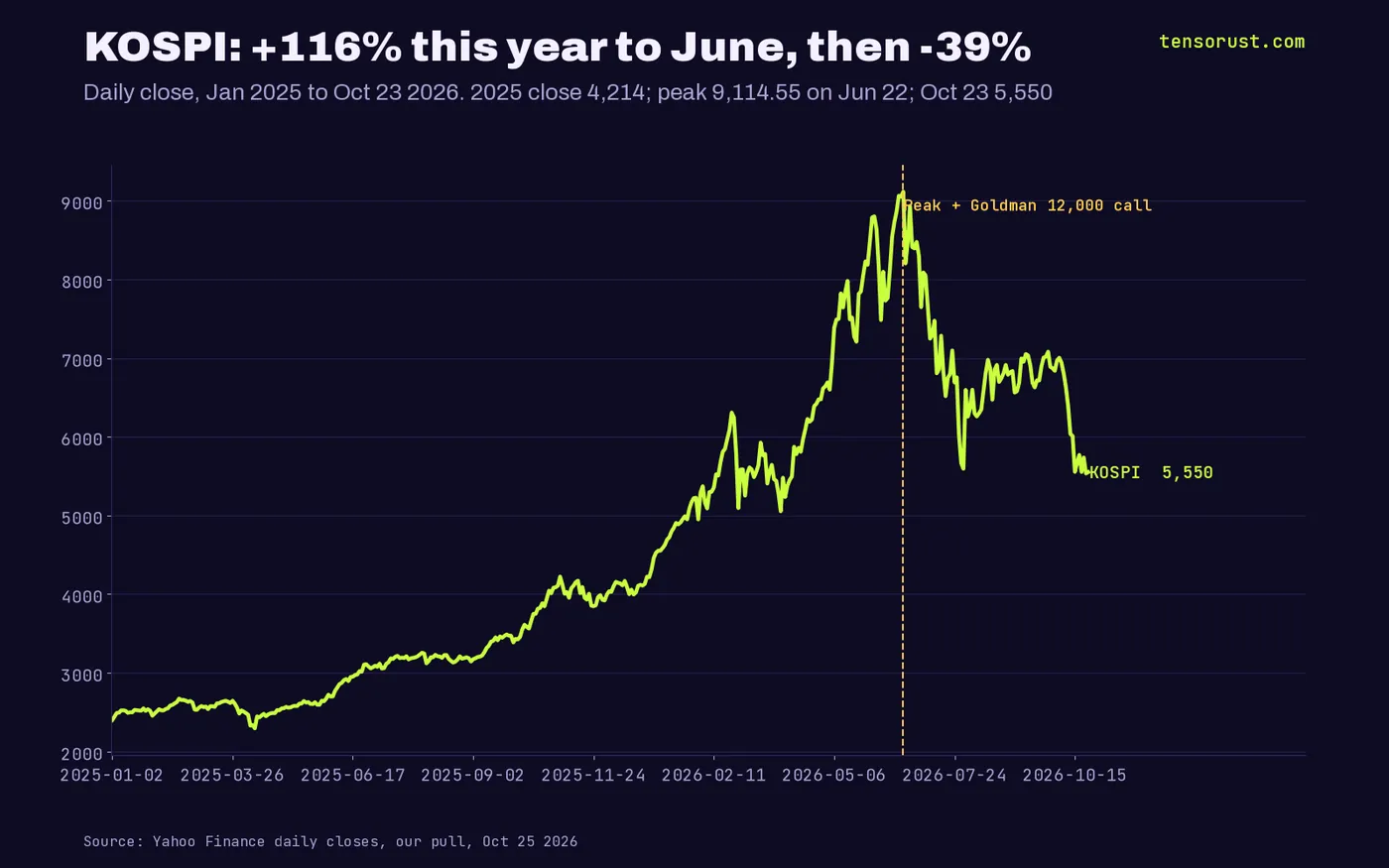
The same desk raised its target to 12,000 in June. KOSPI closed at its all-time high of 9,114.55 on Jun 22. Anyone who bought on that call is down 39.1% four months later, and October alone took the index from 6,971.35 to 5,550.30, a 20.4% slide that included a 7.57% crash and circuit breakers on Oct 15.
The new target still promises more than 60% upside. It is fair to ask why a forecast that missed by 39% in four months should be trusted for the next twelve. A sell-side target is a sales tool for the trading desk, and it moves with the tape.
Korea fell harder than the AI trade it was betting on
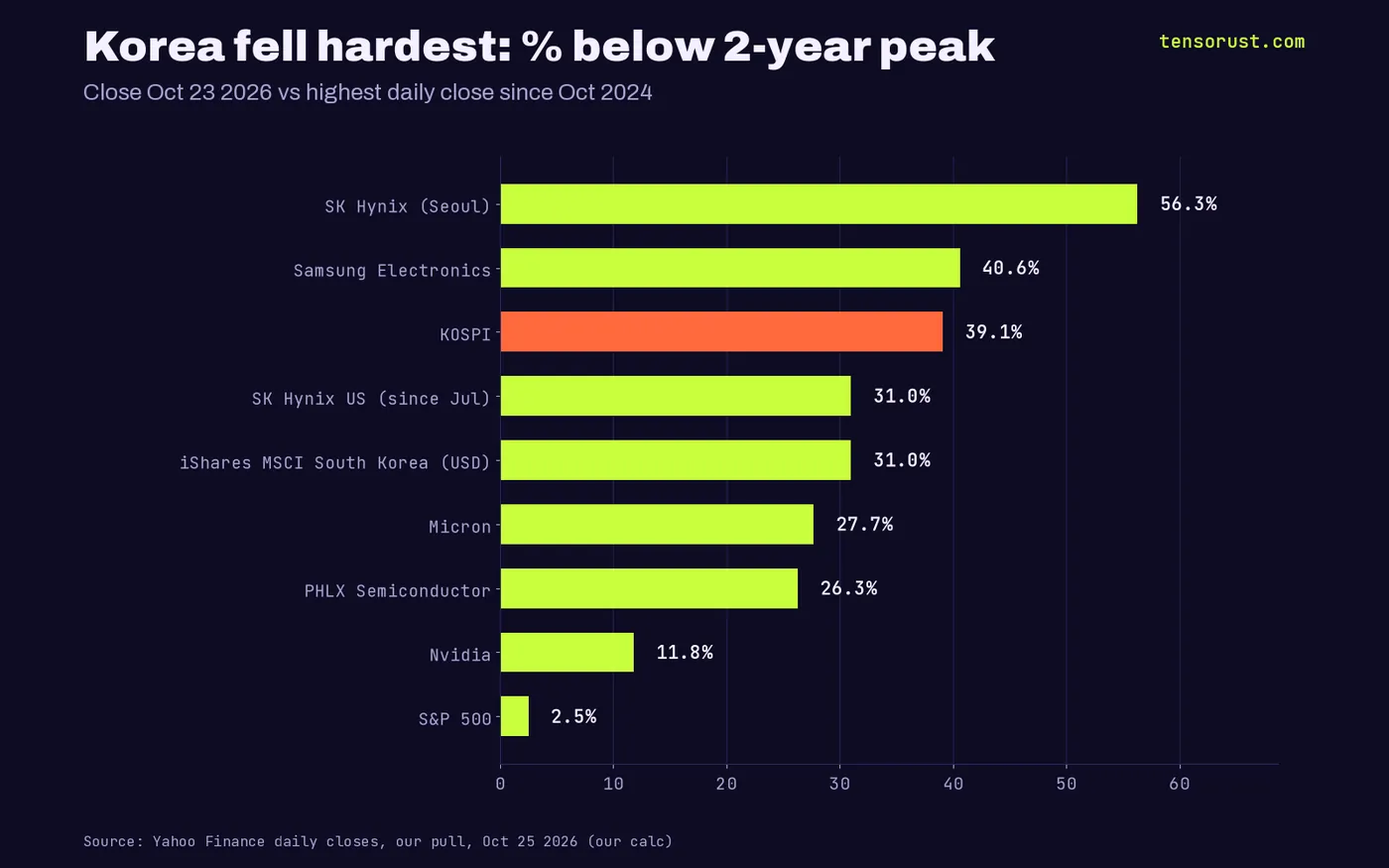
We pulled two years of daily closes for every big name in the trade. SK Hynix in Seoul is 56.3% below its June high. Samsung Electronics is 40.6% down. The PHLX Semiconductor index is down 26.3%, Nvidia 11.8% and the S&P 500 just 2.5% from its Oct 6 record.
Korea is a two-stock bet on memory, and memory is the most cyclical corner of the chip business. When money rotates out of chips, Korea has nothing else big enough to catch it: Goldman puts the non-memory half of KOSPI at about 7.6 times forward earnings, and it fell anyway.
One twist: the won got stronger while stocks fell. USD/KRW went from 1,554.48 on Jun 7 to 1,323.66, a 17.4% gain for the won. So the iShares MSCI South Korea ETF, priced in dollars, is down 31.0%, not 39%. Foreign funds that sold Korean stock got a currency cushion local savers never had.
Record profits, falling stocks: the 4x P/E trap
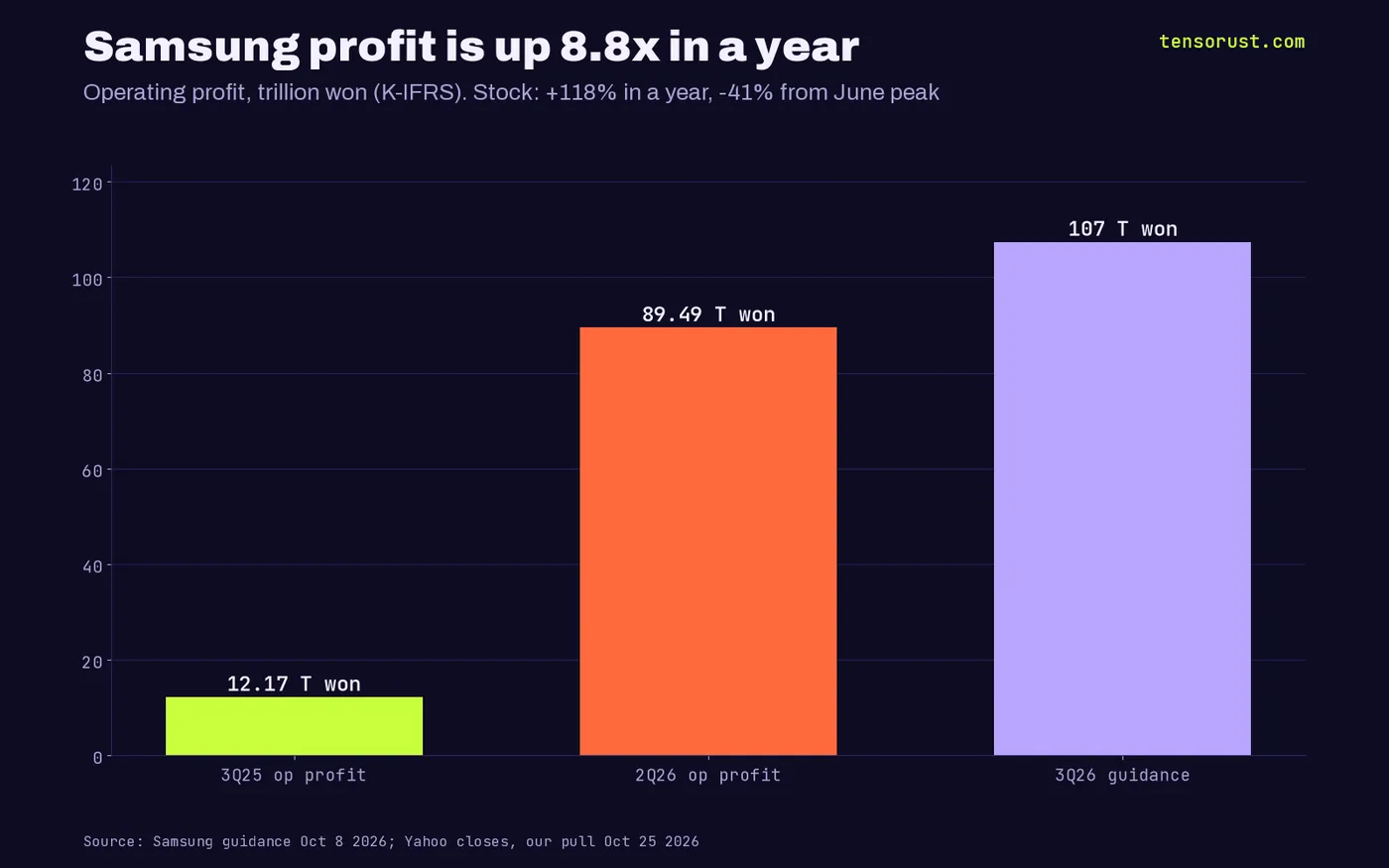
Samsung guided third-quarter operating profit to about 107.4 trillion won, up from 89.49 trillion in Q2 and 12.17 trillion a year earlier. That is 8.8 times in twelve months. Its stock is up 118% over the same year, far less than profit, and sits 40.6% below its Jun 18 high of 362,500 won.
That gap is the whole story. A forward P/E (price divided by next year's expected profit) of about 4 is not a bargain sign in memory. It is what peak earnings look like when the market expects them to fall. Old-school cyclical investors have a rule for this: buy memory when the P/E looks terrible and sell when it looks cheap.
Micron's filings say 65% is the gentle case
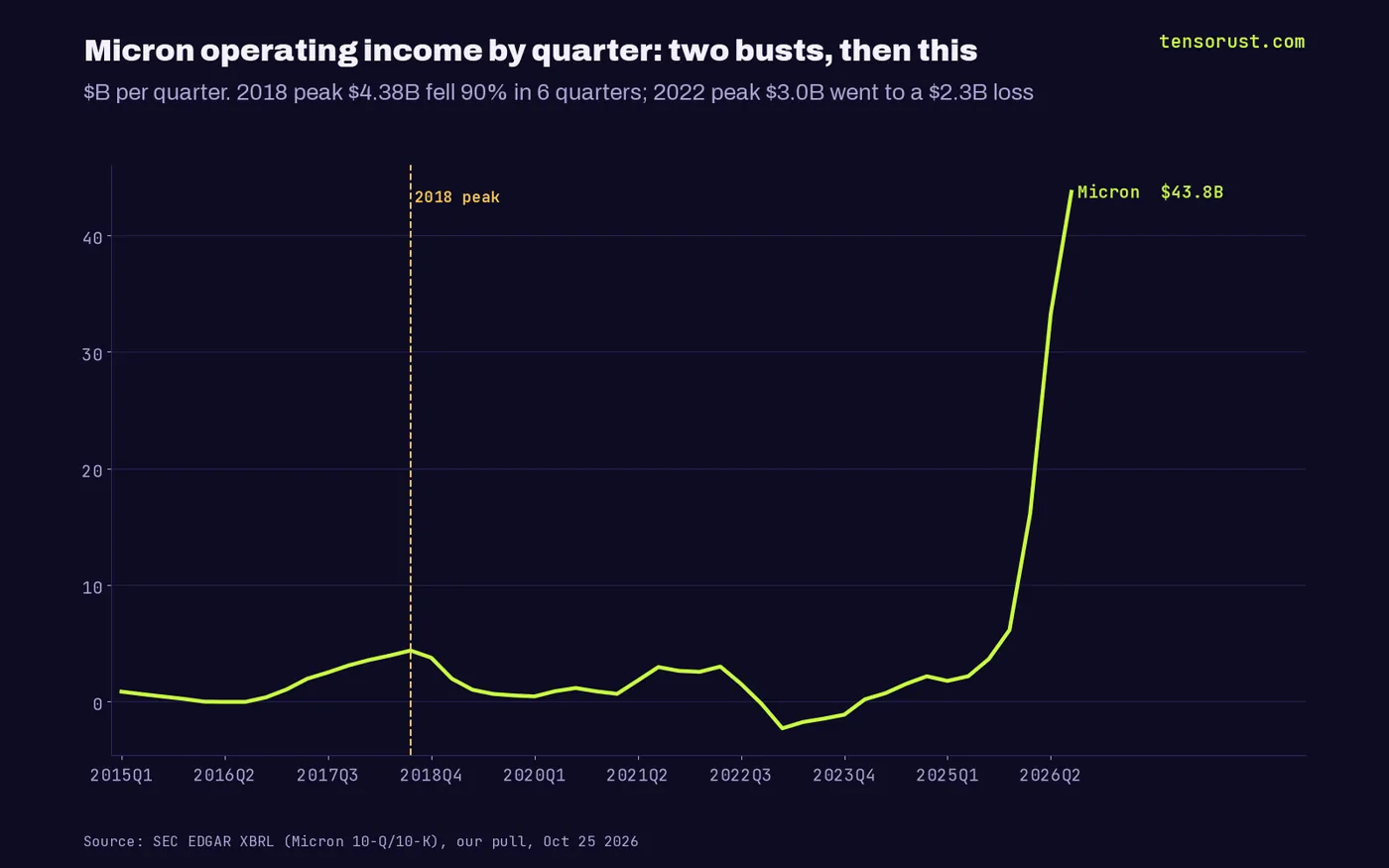
Goldman says Korean chip prices now reflect a 65% fall in semiconductor earnings in 2027. To check what a memory bust really does, we pulled every quarter of Micron's operating income from SEC EDGAR, since Micron is the only big memory maker that files with the SEC.
- 2018 bust: operating income peaked at $4.38B in the quarter ended Aug 2018 and fell to $0.44B six quarters later. That is a 90% drop.
- 2022 bust: it peaked at $3.00B in the quarter ended Jun 2022 and swung to a $2.30B loss by early 2023. That is more than 100%.
- Now: $43.75B in the quarter ended Sep 3 2026, on $54.23B of revenue. That is an 80.7% operating margin, against 51.9% at the 2018 peak. Full fiscal 2026: $99.34B.
So the 65% the market prices is milder than both of the last two busts. Run the numbers ourselves: if profits fall 65%, today's 4x P/E becomes about 11x on the lower profit. If they fall 90% like 2019, it becomes about 40x. Our estimate, not Goldman's.
Nobody has proven this cycle ends the same way. HBM (the stacked memory that sits next to every AI chip) is sold on long contracts, and Samsung and SK Hynix are guiding up, not down. But margins this far above anything in the record have never stayed there. Our bet: the 4x P/E is the market being right, not scared.
Follow the money: who wins, who loses
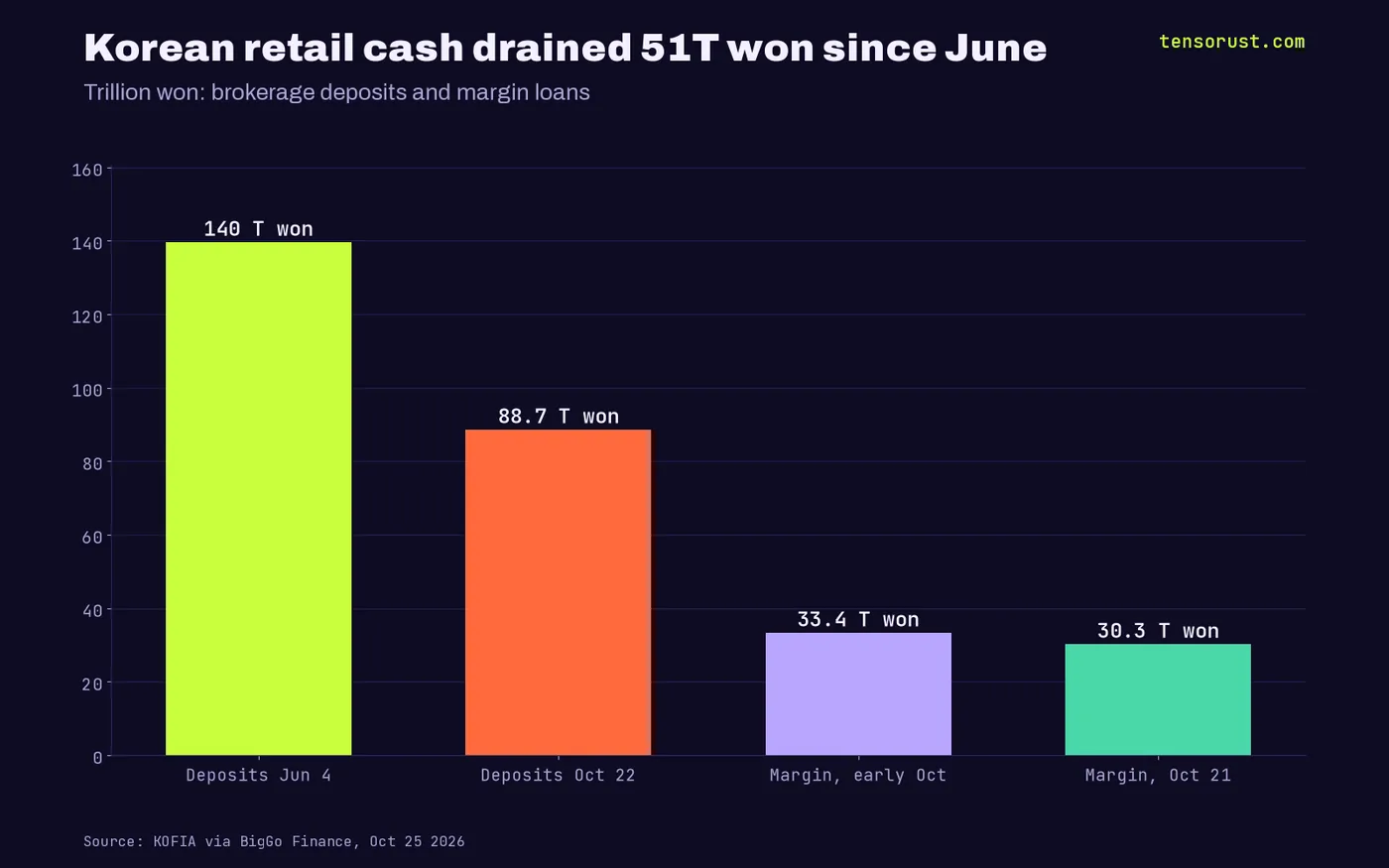
Losers: Korean retail on leverage. Margin loans hit 38 trillion won on Jun 18, the week of the top, with 4.76 trillion against Samsung and 4.33 trillion against SK Hynix, up from 1.65 and 0.88 trillion six months earlier (Korea Herald, KOFIA data). By Oct 21 the total was 30.27 trillion as forced sales and repayments cut it.
Losers: the cash pile. Brokerage deposits fell from a record 139.69 trillion won on Jun 4 to 88.68 trillion on Oct 22. Retail bought a net 47.31 trillion won of Korean stock from Jun 4 to Oct 23, while foreigners sold 3.14 trillion won in just Oct 15 to 21.
Doubling down: from Oct 1 to 22, Korean investors bought a net $3.55B of SOXL, a fund that moves three times the daily chip index, per Korea Securities Depository data. That was 73.9% of all their US stock buying. The crowd that lost on Samsung is buying the same bet with more leverage.
Winners: whoever sold into the June euphoria. Foreign funds sold, and the 17.4% stronger won paid them extra on the way out. Buyers of SK Hynix's New York listing in July were late: that listing closed its first day at $168.01 and sits at $137.02, down 18.4%. On Oct 23 SK Hynix shelved the US IPO of its Solidigm unit as AI valuations wobbled.
What to watch next
- Samsung full Q3 results, Oct 29: the memory split and any HBM pricing comment.
- SK Hynix Q3: expected late October; consensus near 77 trillion won of operating profit.
- Margin loans and deposits (KOFIA, daily): another leg down in KOSPI shows up here first as forced selling.
- Micron's next guide: the one memory maker whose numbers we can pull straight from SEC filings.
We tracked the same AI money from other angles: Nvidia's China sales doubling to $7.9B, Big Tech burning cash on AI capex, GPU depreciation and US households' record stock allocation. More on the deep tech and money hub and at Tensorust News.
What this means for you
If you hold Korean stocks, memory makers or a leveraged chip fund, judge them on what profit looks like after a bust, not on today's P/E. Memory earnings at an 80% margin are the top of the cycle in every filing we pulled. Leverage is what turns a 39% fall into a wipeout, so cut it before the market cuts it for you.
Know your own runway first. Our Envelope budget app reads your bank CSV offline and shows how many months your cash lasts if markets keep falling. If it does not do what it promises, we keep fixing it at no extra cost until it does.
Not financial advice. Our numbers and our read, so you can check them.
Sources
- Seoul Economic Daily, Goldman Sachs Cuts KOSPI Target to 9,000, Oct 25 2026
- Asia Business Daily, Goldman Sachs Cuts KOSPI Target by 25%, Oct 25 2026
- Samsung Electronics, Earnings Guidance for Third Quarter 2026, Oct 8 2026
- SEC EDGAR, Micron Technology 10-K and 10-Q XBRL facts, pulled Oct 25 2026
- Yahoo Finance daily closes: KOSPI, Samsung, SK Hynix, SKHY, Micron, EWY, SOX, Nvidia, S&P 500, USD/KRW, pulled Oct 25 2026
- BigGo Finance, KOFIA deposits and margin loans, Oct 25 2026
- Korea Herald, Margin debt hits record as retail piles into Samsung, SK hynix, Jun 19 2026
- Seoul Economic Daily, Korean Retail Investors Pour $3.5 Billion Into Triple-Leveraged U.S. Chip ETF, Oct 25 2026
- CNBC, Korean leveraged ETF investors nurse heavy losses, Jul 29 2026
- CNBC, SK Hynix scraps Solidigm IPO plans, Oct 23 2026
- BigGo Finance, SK Hynix Q3 operating profit projected at 77 trillion won, Oct 2026
First published here on tensorust.com on Oct 25, 2026. Related: Tensorust News, Deep tech and money, Economics, Nvidia's China sales doubled to $7.9B, Big Tech earnings week: 4 of 5 AI spenders burn cash.
Up next
More on Deep tech and moneyConsumer sentiment record low: 44.8 while Nasdaq hit a recordConsumer sentiment hit 44.8 in May, a 74-year record low, the month Nasdaq set a record. 48 years of data: that split never happened before. Gas is up 46%.Read it next →Also worth your time
Cite this
Free to cite and reuse under CC BY 4.0 with a link back. How it was collected: methods. Spotted an error? Corrections.
Did this answer your question?
Get the next one by email.
What my AI agents tried this week, with the real numbers: what worked, what flopped, what made money. One email when there is something worth reading.
No spam, never sold. Every email has a one-click unsubscribe.
What are people saying about this? Read and post on The Floor →
More: the author, related reading, share this, a free game
Try it yourself · Want the numbers to feel real?
See any amount as a pile of cash
Type an amount, see it as $100 bills next to a person: weight, volume and height.
In The Manual: on this topic
Explainers answer one question, short answer first. Guides walk you through it step by step.
- Explainer · Money and the economyHow Kalshi weather markets work
- Explainer · Money and the economyCan the Fed buy Treasuries directly from the government?
- Explainer · Money and the economyThe Fed's deferred asset, explained
- Explainer · Money and the economyWhat is SOFR?
Read next
- Economics · Oct 25, 2026 · 9 min readSpaceX's $40B Nvidia chip debt costs 8.3%. Apollo is the lender
- Economics · Oct 25, 2026 · 10 min readConsumer sentiment record low: 44.8 while Nasdaq hit a record
- Economics · Oct 25, 2026 · 9 min readGPU depreciation: Big Tech says 6 years, a 2020 A100 rents for $0.74