
By Matt Busel, who built the apps, crates and game he writes about · every number links to its source and every dataset is downloadable (methods) · corrections · featured in Kirino, gamebiz, This Week in Rust, New Mobile Life, By-Press
Tesla-SpaceX merger: Tesla's cash would fund xAI's $40B GPU bill
On this page · 9 sections
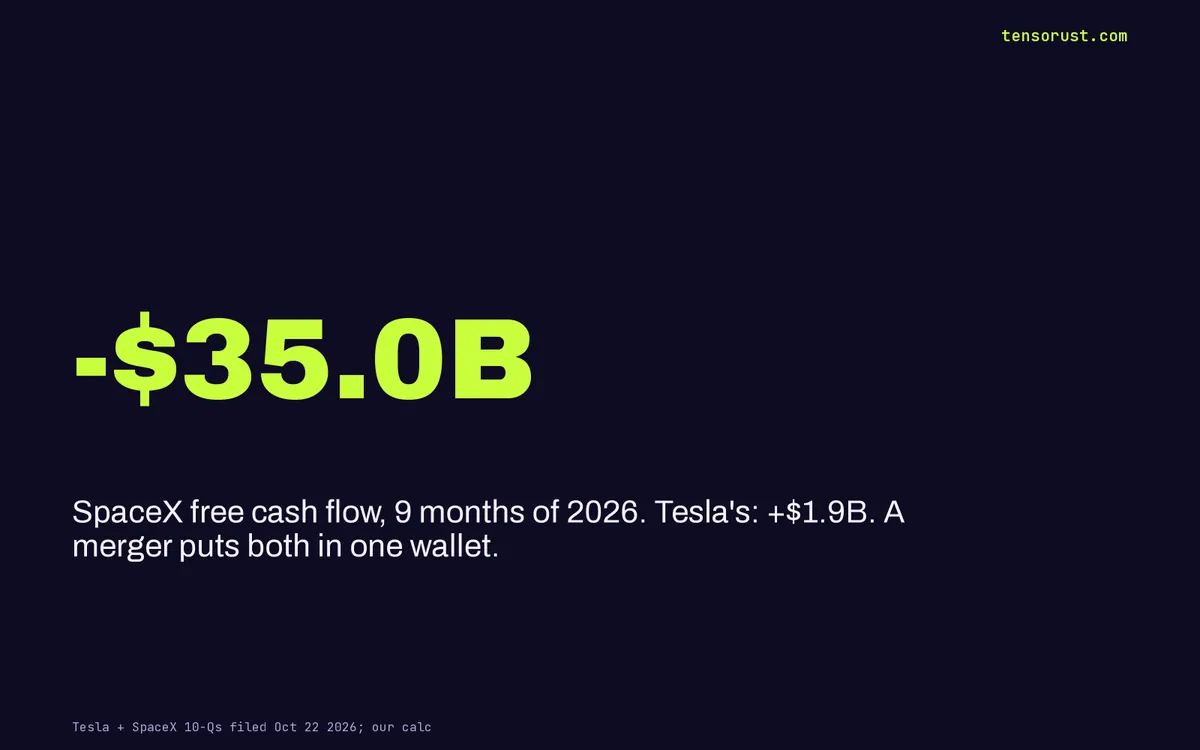
Short answer: The Tesla-SpaceX merger is a funding deal dressed up as a moonshot. SpaceX spent $48.1 billion on capex in the first nine months of 2026, $40.0 billion of it on its AI unit (xAI plus compute), and burned $35.0 billion of free cash flow. Tesla made $1.9 billion of free cash flow, holds $45.4 billion of cash and short-term investments, and signed $30 billion of new unsecured credit lines on Sep 29. A merger puts all of that in one wallet, and the wallet's biggest bill is GPUs.
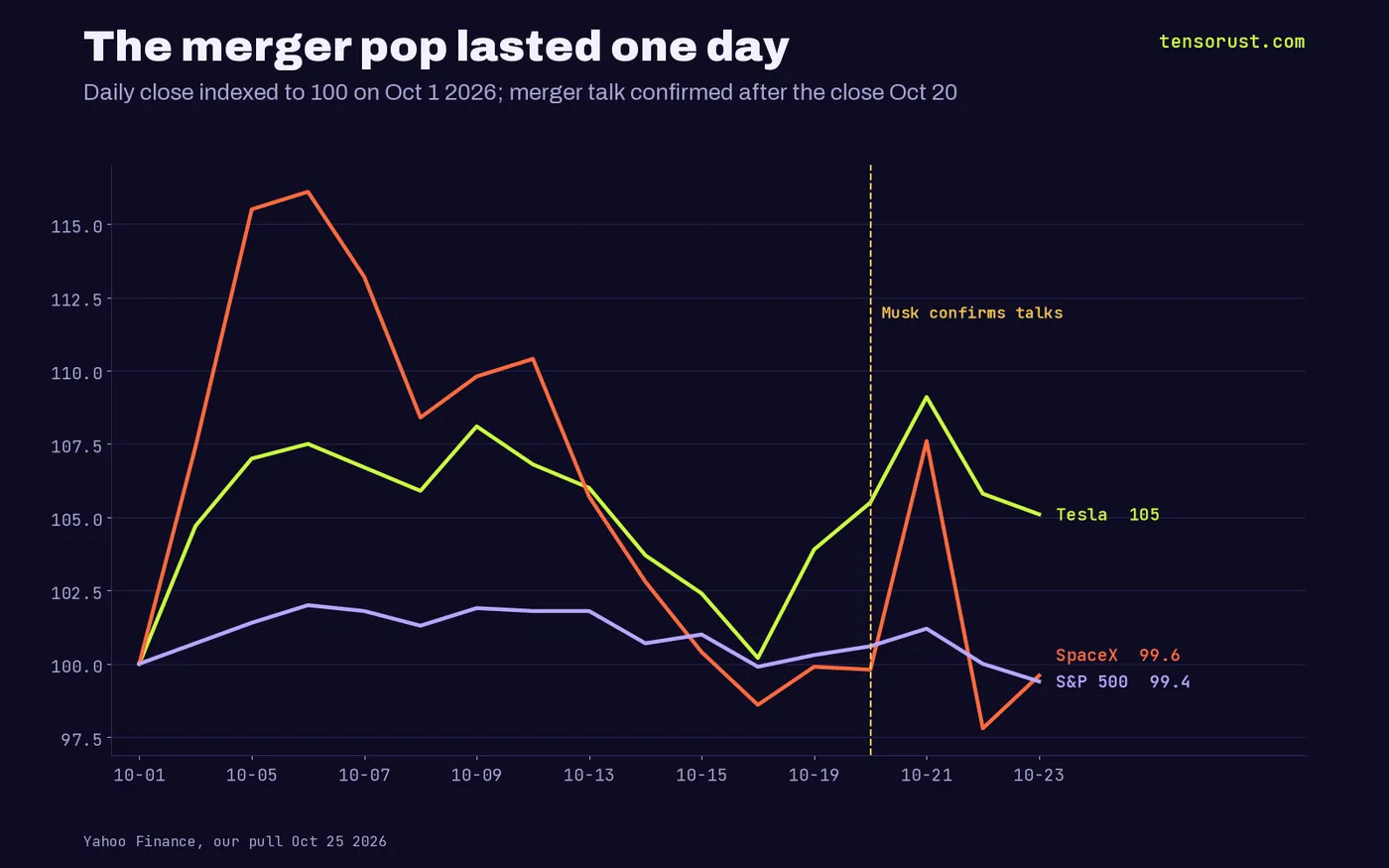
TL;DR: Both companies filed 10-Qs on Oct 22, two days after Musk confirmed special committees on SpaceX's earnings call, and the filings show who pays: Tesla brings 74.5% of the pair's nine-month operating income and 53.2% of its operating cash flow, while SpaceX's AI segment alone spent $40.0 billion and lost $3.3 billion. At the $420 to $550 a share that Gary Black, Brad Gerstner and Dan Ives float, Tesla holders would end up with 45.3% to 52.0% of the combined company, and Musk's 699.6 million Tesla shares would be worth $293.8 billion to $384.8 billion. The market already shrugged: SpaceX jumped 7.8% on Oct 21 and gave all of it back by Oct 23, and Tesla closed at $372.22, below its pre-call $373.71.
Key numbers
| What | Number | Source, checked Oct 25 2026 |
|---|---|---|
| SpaceX free cash flow, 9 months | -$35.0B ($13.1B OCF minus $48.1B capex) | SpaceX 10-Q, Oct 22 |
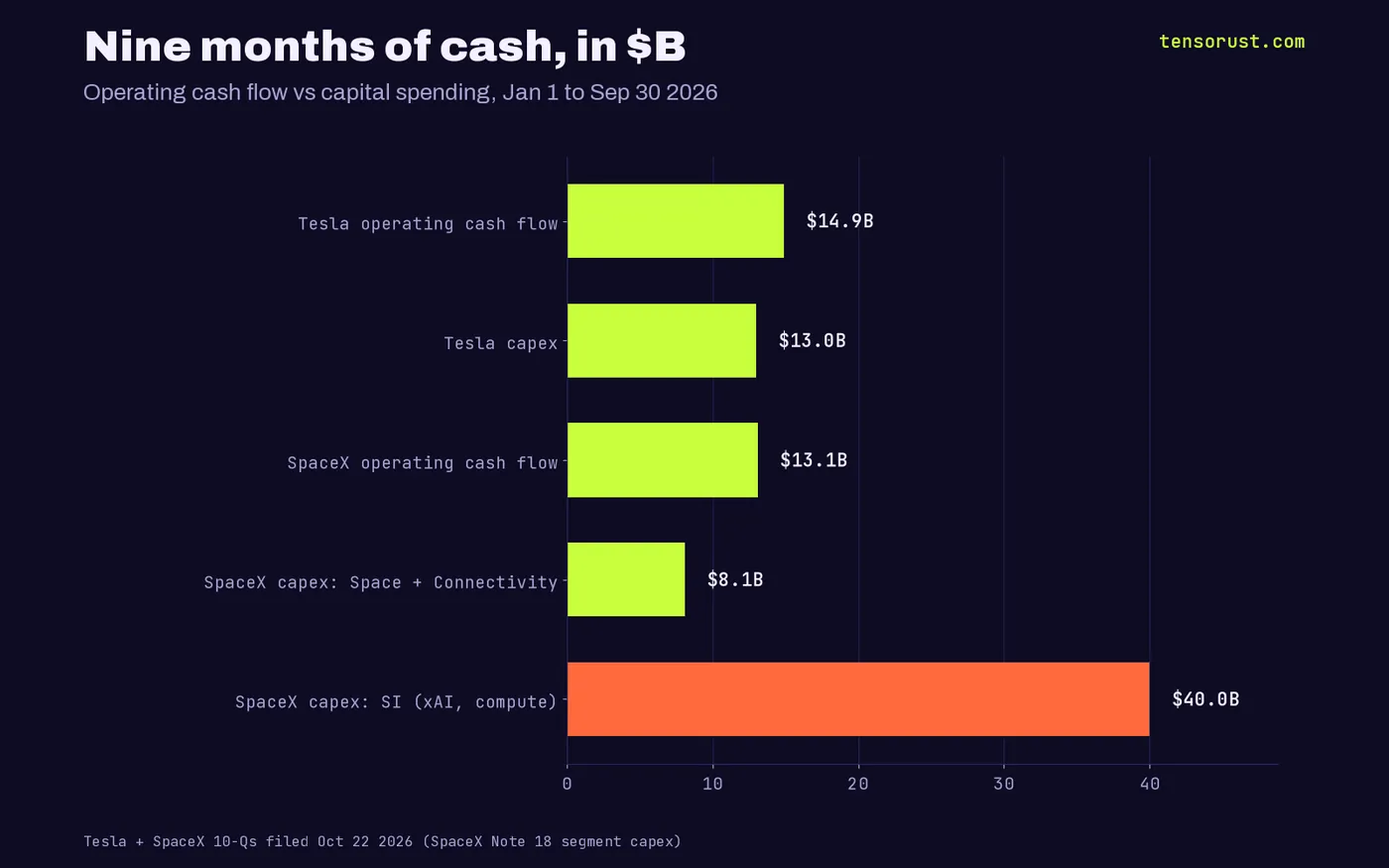
| SpaceX SI (xAI, compute) capex, 9 months | $40.0B, 83% of all SpaceX capex | SpaceX 10-Q, Note 18 |
| Tesla free cash flow, 9 months | +$1.9B ($14.9B OCF minus $13.0B capex) | Tesla 10-Q, Oct 22 |
| Tesla cash + short-term investments | $45.4B | Tesla 10-Q |
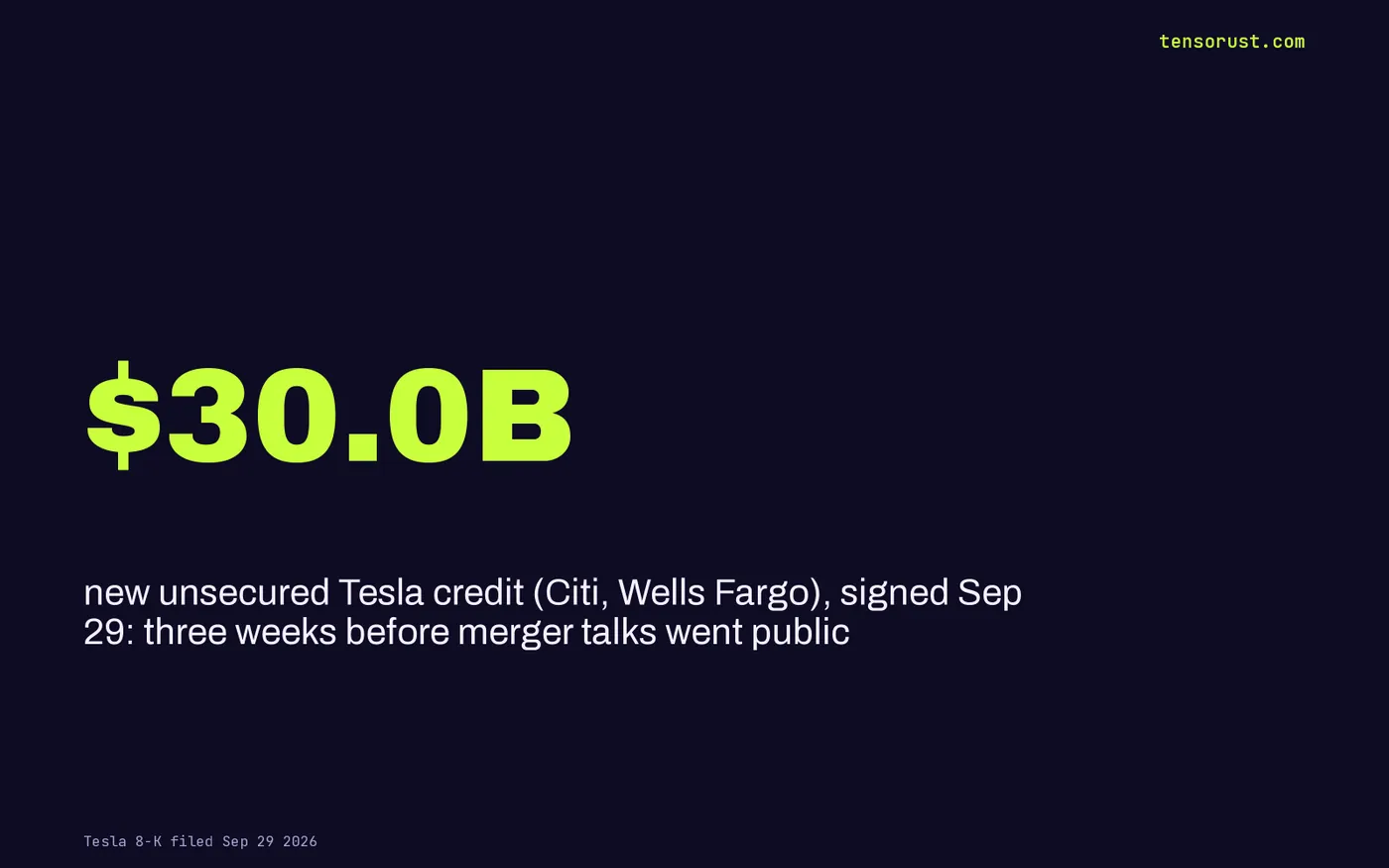
| New Tesla unsecured credit, Sep 29 | $30.0B ($20B term loan, $8B + $2B revolvers) | Tesla 8-K, Sep 29 |
| Market caps, Oct 23 close | SpaceX $2.00T, Tesla $1.47T | Yahoo Finance closes x share counts in the filings, our calc |
| Tesla holders' stake after a deal | 42.3% (no premium), 45.3% ($420), 52.0% ($550) | Our calc at SPCX $147.49 |
| Musk's Tesla votes | 699.6M of 3,952.6M shares (17.7%) | Tesla proxy, Oct 19 |
| Megapack margin on sales to SpaceX | 23.6% vs 30.2% for all Tesla energy (9 months) | Tesla 10-Q, Notes 13-14, our calc |

The filings say this is about who pays for GPUs
Musk confirmed the talks on SpaceX's Oct 20 earnings call: "a lot of merit to combining the companies," per CBS News. Both boards have special committees of directors who do not work for Musk. SpaceX's 10-Q adds that any deal also needs "our controlling shareholder." That is Musk.
Coverage has framed this as the "world's super company." The 10-Qs frame it differently. SpaceX has three segments: Space (rockets), Connectivity (Starlink) and SI, which is xAI plus the data centers it runs on.
Starlink is the only part that makes real money: $5.2 billion of operating income in nine months. Rockets lost $1.2 billion. SI lost $3.3 billion and spent $40.0 billion on capex. In Q3 alone SI spent $16.4 billion, more than double its $7.6 billion of revenue.
Capex (capital expenditure) is money spent on buildings and machines, here mostly GPUs and the halls that hold them. Free cash flow is the cash a business makes minus that spending. SpaceX's was negative $35.0 billion. Tesla's was positive $1.9 billion.
Gerstner said the quiet part on TV
The deal's own bulls make our point. On CNBC on Oct 21, Altimeter's Brad Gerstner called scale the core reason: SpaceX's compute buildout needs "hundreds of billions of dollars," and a combined balance sheet makes that money "easier and cheaper" to raise, as Stocktwits reported.
Cheaper is the key word. In June SpaceX sold $25 billion of bonds at 5.35% to 6.65%, per its pricing 8-K. The $40 billion Nvidia chip deal it is shopping now is reported at about 7.75% to 8.3%, junk territory, as we laid out in SpaceX's $40B Nvidia chip debt.
Tesla, meanwhile, signed $30 billion of unsecured bank lines on Sep 29 with Citi and Wells Fargo, three weeks before the talks went public. Unsecured means no collateral pledged. Fold Tesla in and xAI's GPU bill gets the cheaper borrower's balance sheet behind it.
What Tesla brings vs what Tesla holders get
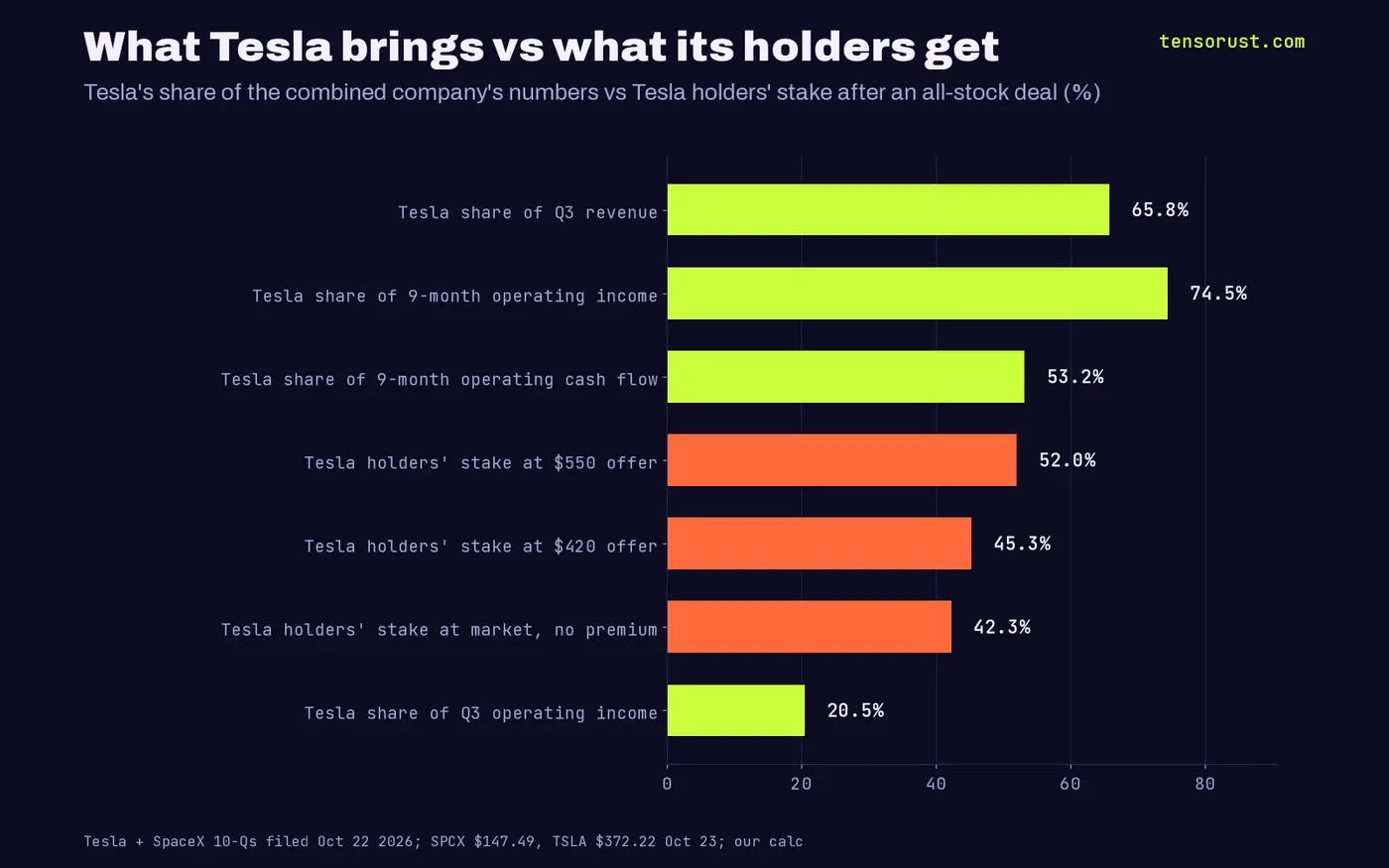
Here is the swap in numbers. On nine months of 2026, Tesla supplies 74.5% of the pair's operating income ($2.06 billion vs $0.71 billion) and 53.2% of operating cash flow. On Q3 alone SpaceX wins on profit ($2.79 billion vs $0.72 billion), because Starlink and a single strong AI quarter carried it.
In an all-stock deal at the Oct 23 closes, each Tesla share is worth 2.52 SpaceX shares. With no premium, Tesla holders end up owning 42.3% of the combined company.
The asks on the table go higher. Gary Black guessed $420 a share in an all-stock deal, per TIKR. Gerstner put the range at $420 to $550. Ives told CBS it likely needs "$500/$550 per share" to pass. At $420 Tesla holders get 45.3%. At $550, a 47.8% premium, they get 52.0%.
So even the richest ask hands Tesla holders less than their share of nine-month operating income and roughly their share of cash flow. The premium buys them into a company that spent $40 billion on AI capex in nine months. That is the trade, whatever the press release calls it.
Follow the money: who wins, who loses
xAI wins. Its segment lost $3.3 billion in nine months and needs a lender. A merged company puts Tesla's $45.4 billion of cash and short-term investments, its $14.9 billion of nine-month operating cash flow and its $30 billion of new credit behind the GPU orders.
Musk wins either way. His 699.6 million Tesla shares are worth $260.4 billion at $372.22 and $384.8 billion at $550, a $124 billion swing on the premium alone. He also holds 423.7 million unearned award shares on top. On the SpaceX side, Class B shares carry 10 votes each, which works out to 86.6% of all SpaceX votes, and the 10-Q names a controlling shareholder whose approval is required.
SpaceX's AI lenders win. Apollo and Goldman are leading a chip debt deal priced like junk. A bigger, cash-generating parent makes that paper safer.
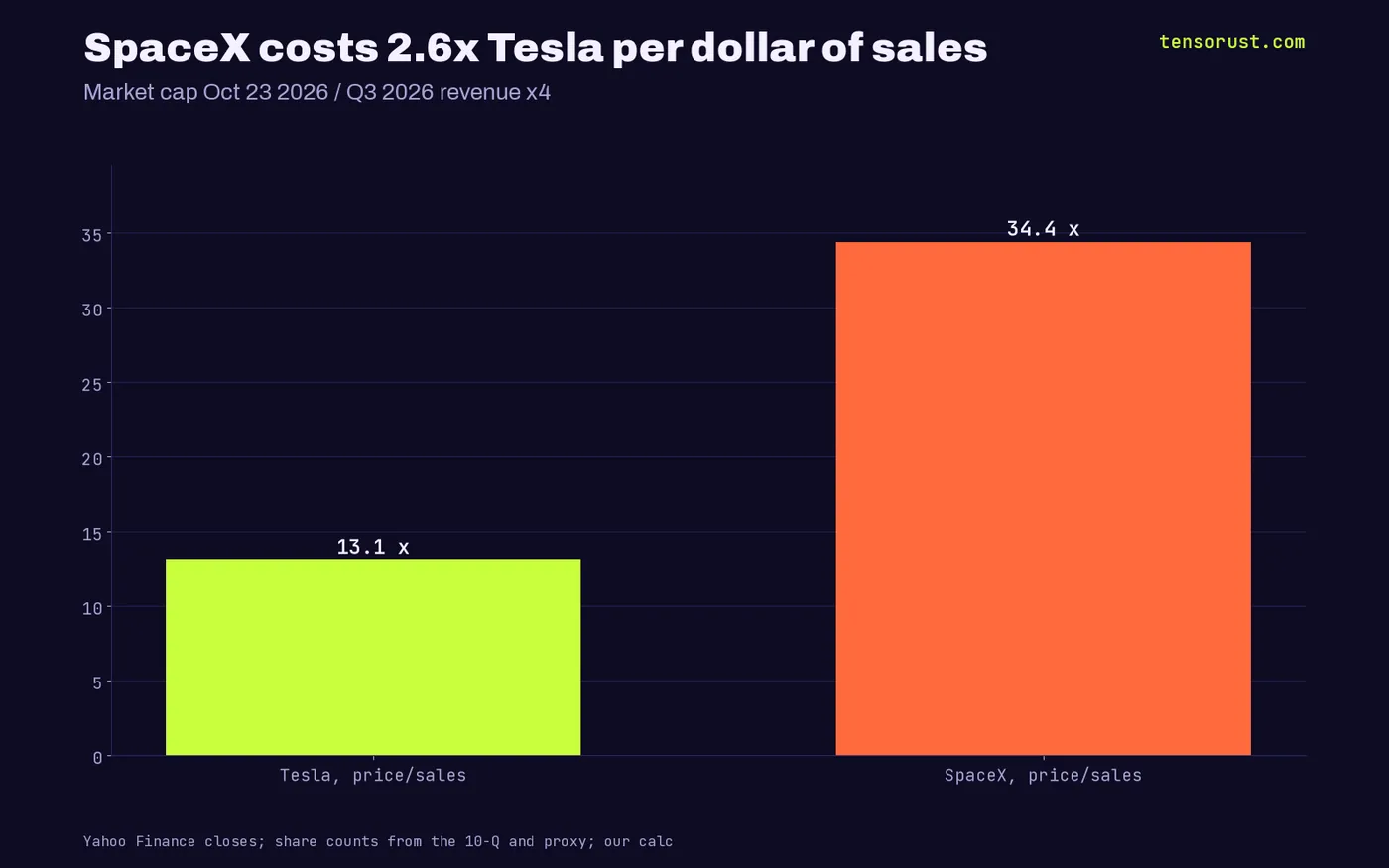
Tesla holders who want a car and energy company lose the option. Their 13.1x sales multiple turns into a slice of a 34.4x one (both on Q3 revenue times four, our math). On operating income the gap flips: Tesla trades at 512x run-rate operating income, SpaceX at 179x. Both prices are bets on the future, not on the last quarter.
The vote is not as hard as Musk says
Musk told the call Tesla needs "a 50% vote of all shares, not just those who vote," and called it "quite a high hurdle." Run the proxy numbers and it looks smaller.
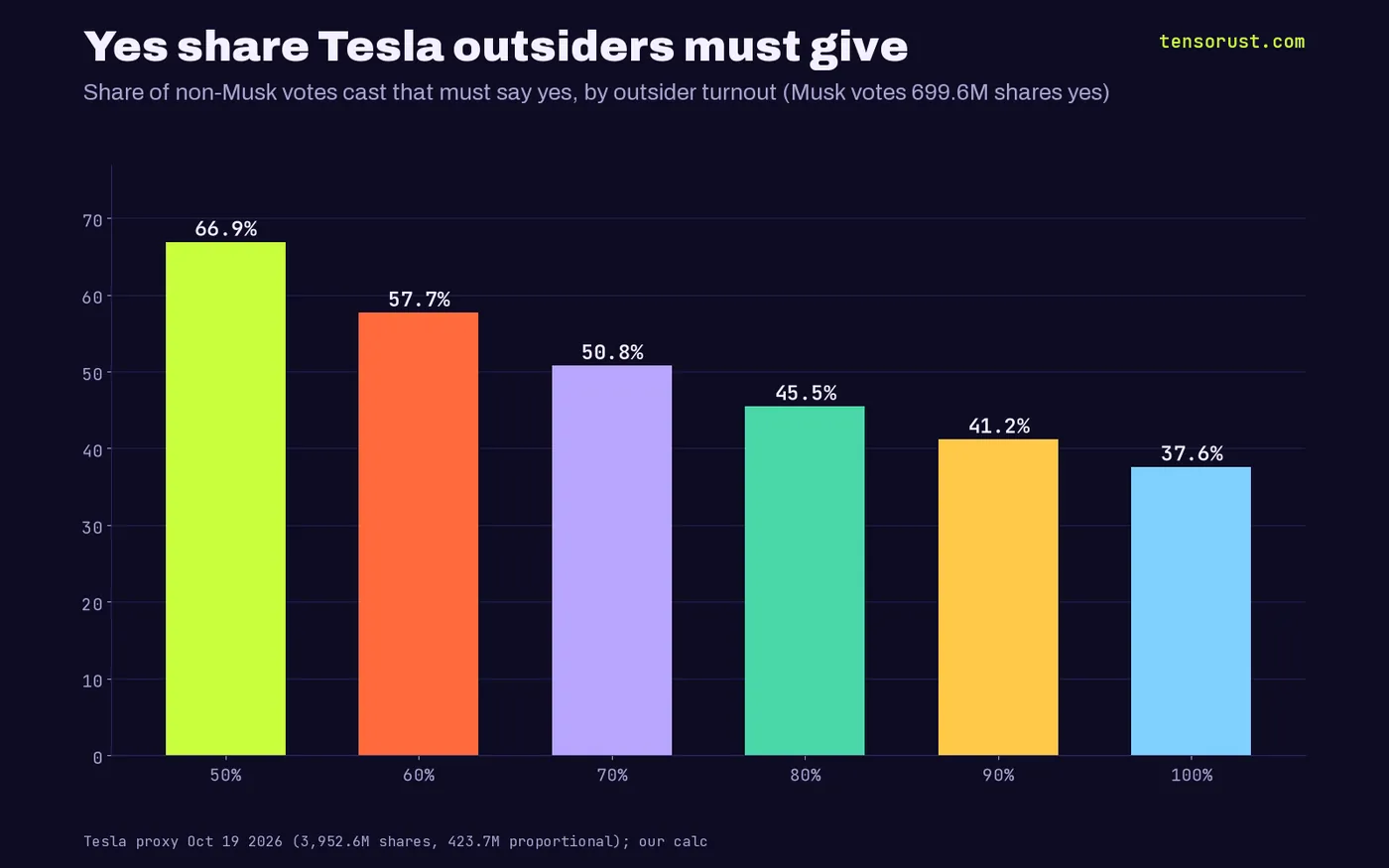
Tesla had 3,952.6 million shares at Sep 30, so a deal needs 1,976.3 million yes votes. Musk controls 699.6 million: 413.2 million in his trust plus 286.4 million restricted shares from the 2018 award, which "carry voting rights," per the Oct 19 proxy. Another 423.7 million award shares vote in proportion to everyone else, so they echo the result.
That leaves 2,829.3 million outside shares. If 80% of them vote, the deal passes with 45.5% of outside votes saying yes. At 90% turnout it needs 41.2%. Even at full turnout it needs only 37.6%. Musk does not need a majority of the outsiders who show up. Unless the committees add a majority-of-the-minority condition, which no filing promises.
The related-party trail is already running
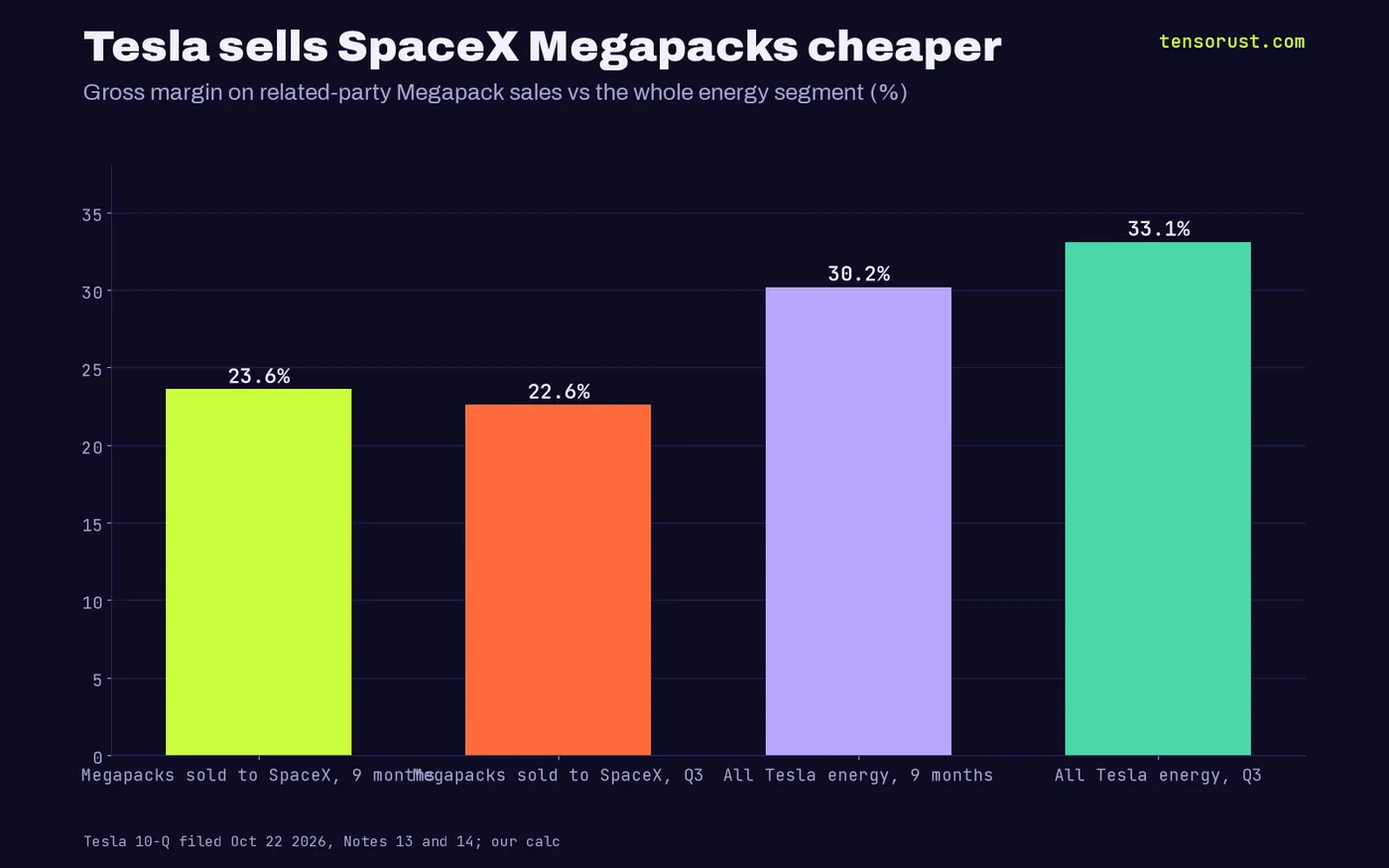
The two companies already trade with each other. Tesla booked $626 million of Megapack revenue from SpaceX in nine months, at $478 million of cost. That is a 23.6% gross margin. Tesla's whole energy segment earned 30.2% over the same months, and 33.1% in Q3 vs 22.6% on SpaceX's Q3 batteries.
SpaceX also owed Tesla $729 million at Sep 30, of which $588 million was billed for Megapacks not yet delivered. And Tesla owns SpaceX stock: $2.0 billion invested in March (its old xAI preferred stake), marked at $2.87 billion on Sep 30, with sale restrictions that run to December.
None of that breaks a rule. Tesla says the deals follow its related-person policy. It does show the direction of travel: Tesla's batteries, Tesla's cash and Tesla's balance sheet keep flowing toward the AI build.
What this means for you
If you hold Tesla, decide now whether you want to own an AI data center builder, because that is what an all-stock deal makes you. Track three things: the exchange ratio when the committees announce one, whether the deal adds a vote of non-Musk holders, and the final pricing of SpaceX's $40 billion chip debt this week. Above 8.3% means AI credit is still tightening, and a Tesla merger gets more valuable to SpaceX by the day.
If you are tempted to play the spread between TSLA and SPCX, know your real cash first. Black's own guess is a deal that "could take a year to close," and an all-stock price moves with SpaceX every day until then. The Envelope budget app shows what you can actually afford to lock up, from your bank CSV, fully offline. If it does not do what it promises, we keep fixing it at no extra cost until it does.
More from our news desk and the deep tech and money hub, including Musk's midterm bill vs SpaceX's federal money and Big Tech's AI capex vs free cash flow.
Not financial advice. Our numbers and our read, so you can check them. Download the data below.
Sources
- SpaceX, Form 10-Q for Q3 2026, Oct 22 2026
- Tesla, Form 10-Q for Q3 2026, Oct 22 2026
- Tesla, 2026 proxy statement (DEF 14A), Oct 19 2026
- Tesla, Form 8-K on $30B credit facilities, Sep 29 2026
- SpaceX, Form 8-K pricing $25B of senior notes, Jun 23 2026
- CBS News, Musk on the Tesla-SpaceX merger; Dan Ives on price, Oct 21 2026
- Axios, SpaceX and Tesla explore merger, Oct 20 2026
- Stocktwits, Brad Gerstner's $420-$550 range, Oct 21 2026
- TIKR, Gary Black's $420 guess, Oct 19 2026
- Yahoo Finance daily closes for TSLA, SPCX and the S&P 500, our pull, Oct 25 2026
First published here on tensorust.com on Oct 25, 2026. Related: Tensorust News, Deep tech and money, SpaceX's $40B Nvidia chip debt costs 8.3%, Musk's midterm bill vs SpaceX's federal money, Big Tech AI capex vs free cash flow.
Up next
More on Deep tech and moneySoftBank's $50B Malaysia pledge is 3.5x the cash it holdsSoftBank's $50B Malaysia pledge vs its own books: $14.2B of cash, $18.5B already spoken for, and an Arm stake down $133B since June. Son's pledges: $986B.Read it next →Cite this
Free to cite and reuse under CC BY 4.0 with a link back. How it was collected: methods. Spotted an error? Corrections.
Did this answer your question?
Get the next one by email.
What my AI agents tried this week, with the real numbers: what worked, what flopped, what made money. One email when there is something worth reading.
No spam, never sold. Every email has a one-click unsubscribe.
What are people saying about this? Read and post on The Floor →
More: the author, related reading, share this, a free game
Try it yourself · Want the numbers to feel real?
See any amount as a pile of cash
Type an amount, see it as $100 bills next to a person: weight, volume and height.
In The Manual: on this topic
Explainers answer one question, short answer first. Guides walk you through it step by step.
- Explainer · AI, LLMs and agentsClaude Code vs Cursor: what each costs now that SpaceX owns Cursor
- Explainer · Money and the economyHow Kalshi weather markets work
- Explainer · Money and the economyCan the Fed buy Treasuries directly from the government?
- Explainer · Money and the economyThe Fed's deferred asset, explained
Read next
- Economics · Oct 25, 2026 · 8 min readSoftBank's $50B Malaysia pledge is 3.5x the cash it holds
- Economics · Oct 25, 2026 · 9 min readRAM prices up 429%: Micron makes 90% margins on your PC memory
- Economics · Oct 25, 2026 · 7 min readAnthropic Elvis lawsuit: $41M ask, 7 minutes of revenue at book rate