By Matt Busel, who built the apps, crates and game he writes about · every number links to its source and every dataset is downloadable (methods) · corrections · featured in Kirino, gamebiz, This Week in Rust, New Mobile Life, By-Press
Helion, CFS stakes join a US portfolio up 309%. Ex-Intel it's red
On this page · 9 sections
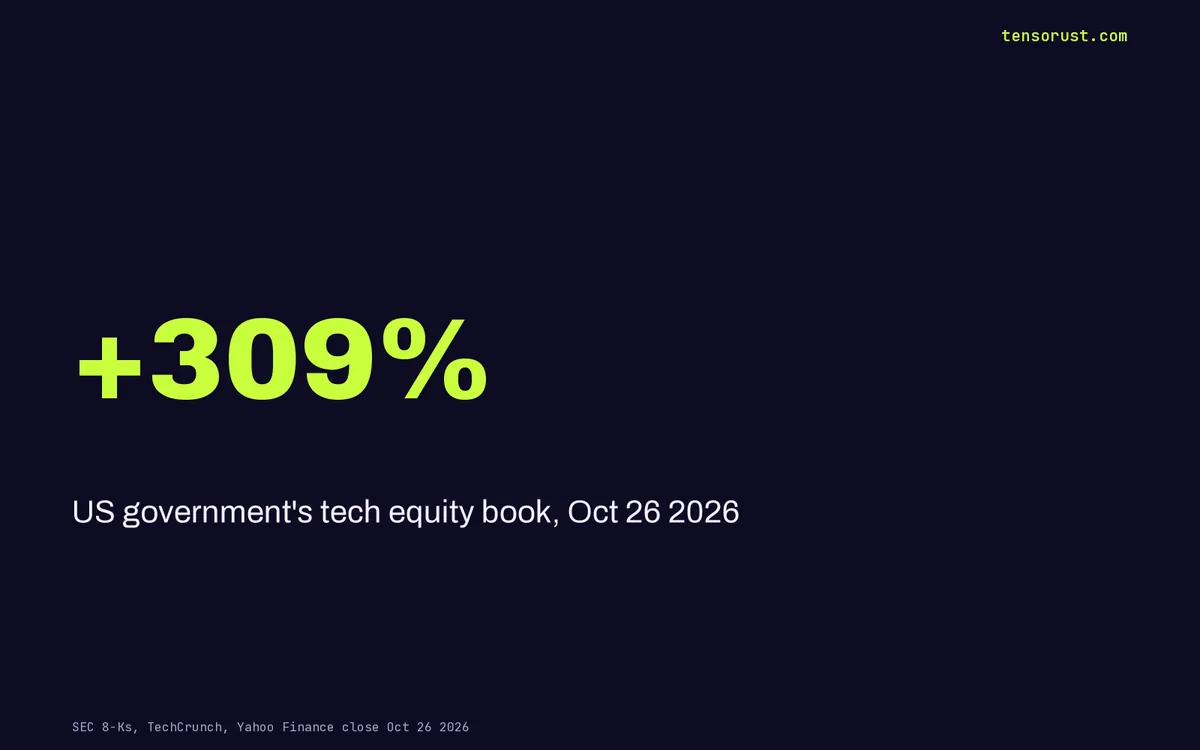
Short answer: Helion and Commonwealth Fusion Systems just traded nonvoting shares to Washington for $260 million in CHIPS Act awards. They join a government equity book we priced at $40.1 billion on a $9.8 billion cost, up 309%, but one Intel bet makes all of that gain. Take Intel out and the taxpayer is down 3.6%.
TL;DR: Commerce gave Helion $175 million and CFS $85 million for nonvoting equity, about 1% of Helion at its $15.5 billion Series G mark. The five equity-for-awards deals we could trace in filings cost $9.81 billion and were worth $40.11 billion at the October 26 close, because Intel shares bought near $20.47 now trade at $90.47. Without Intel, $937 million of stakes are worth $903 million, with USA Rare Earth down 48%, so fusion founders are joining a fund that has one big winner and a lot of luck to repeat.
Key numbers
| What | Number | Source, checked Oct 27 2026 |
|---|---|---|
| Helion CHIPS award for nonvoting equity | $175M (about 1% at $15.5B) | TechCrunch |
| CFS CHIPS award for nonvoting equity | $85M (stake size undisclosed) | TechCrunch |
| Intel shares owed to Commerce | 433,323,000 for $8.87B | Intel 8-K, Aug 22 2025 |
| MP Materials conversion price for DoD | $30.03 on $400M preferred | MP 8-K, Jul 2025 |
| USA Rare Earth shares issued to Commerce | 16,132,790 for a $277M award | USAR pro forma, EX-99.1 |
| Whole equity-for-awards book, cost vs value | $9.81B vs $40.11B (+309%) | Our math, data.csv |
| Same book without Intel | $937M vs $903M (-3.6%) | Our math |
| Fusion lobbying 2023 to Q3 2026 (Helion, CFS, FIA) | $4.5M | Senate LDA API |

Fusion just took the deal Washington now offers everyone
On October 22 and 23, Commerce handed Helion $175 million and CFS $85 million from the CHIPS and Science Act to build the power chips that run their reactors. Both paid in nonvoting shares, priced at their latest private rounds.
That is the new template. Grants used to be "nondilutive", meaning free money that did not shrink anyone's ownership. Now the government wants a slice, the way it did with Intel, MP Materials and USA Rare Earth.
Helion's CEO David Kirtley told TechCrunch's Tim De Chant the structure "aligns the interests of Helion and the U.S. taxpayer." Thea Energy, Avalanche Energy, Pacific Fusion and Inertia told the same reporter they have given the government no equity.
We priced the taxpayer's whole tech book
We pulled the deal terms from each company's SEC filing and marked every public stake to the October 26 close. Private fusion stakes stay at cost, since nobody has repriced them yet.
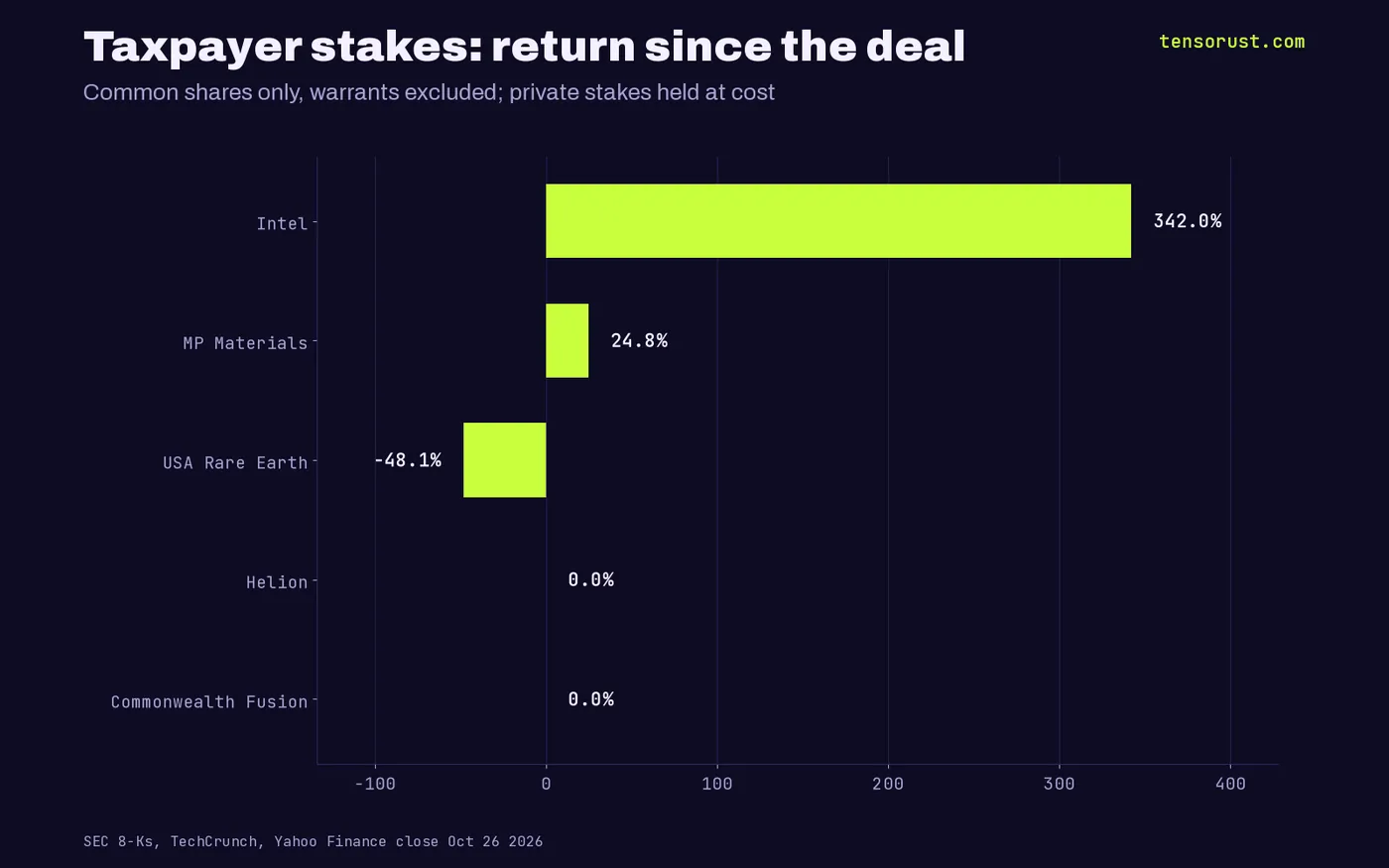
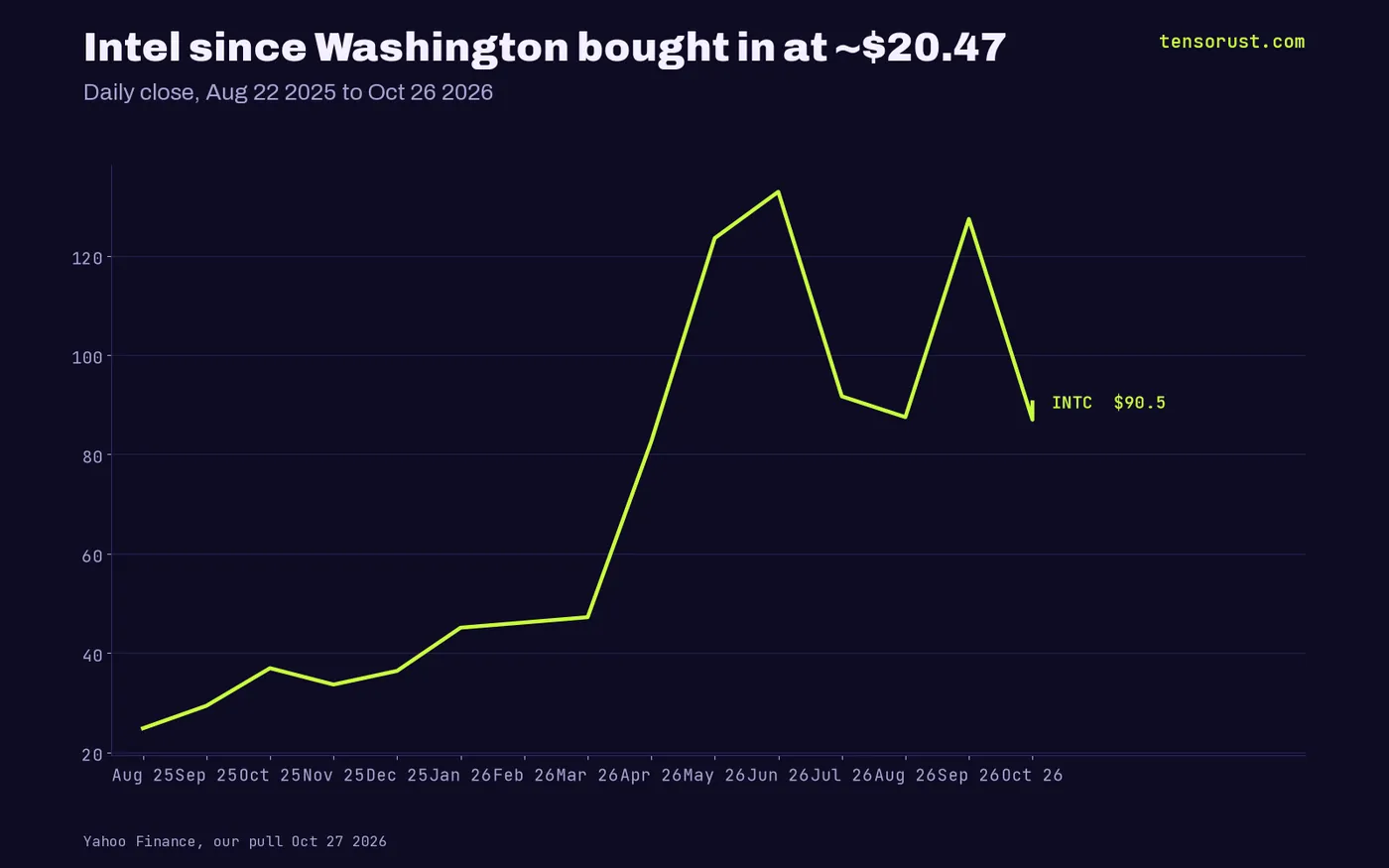
Intel is the monster. Commerce gets 433.3 million shares for $8.87 billion, an average near $20.47. At $90.47, that pile is worth $39.2 billion, up 342%.
MP Materials is up 25% on the Pentagon's $400 million of preferred stock, convertible at $30.03 with the stock at $37.47. USA Rare Earth is the loser: 16.1 million shares for a $277 million award, now worth $144 million, down 48%.
One bet carries the whole fund
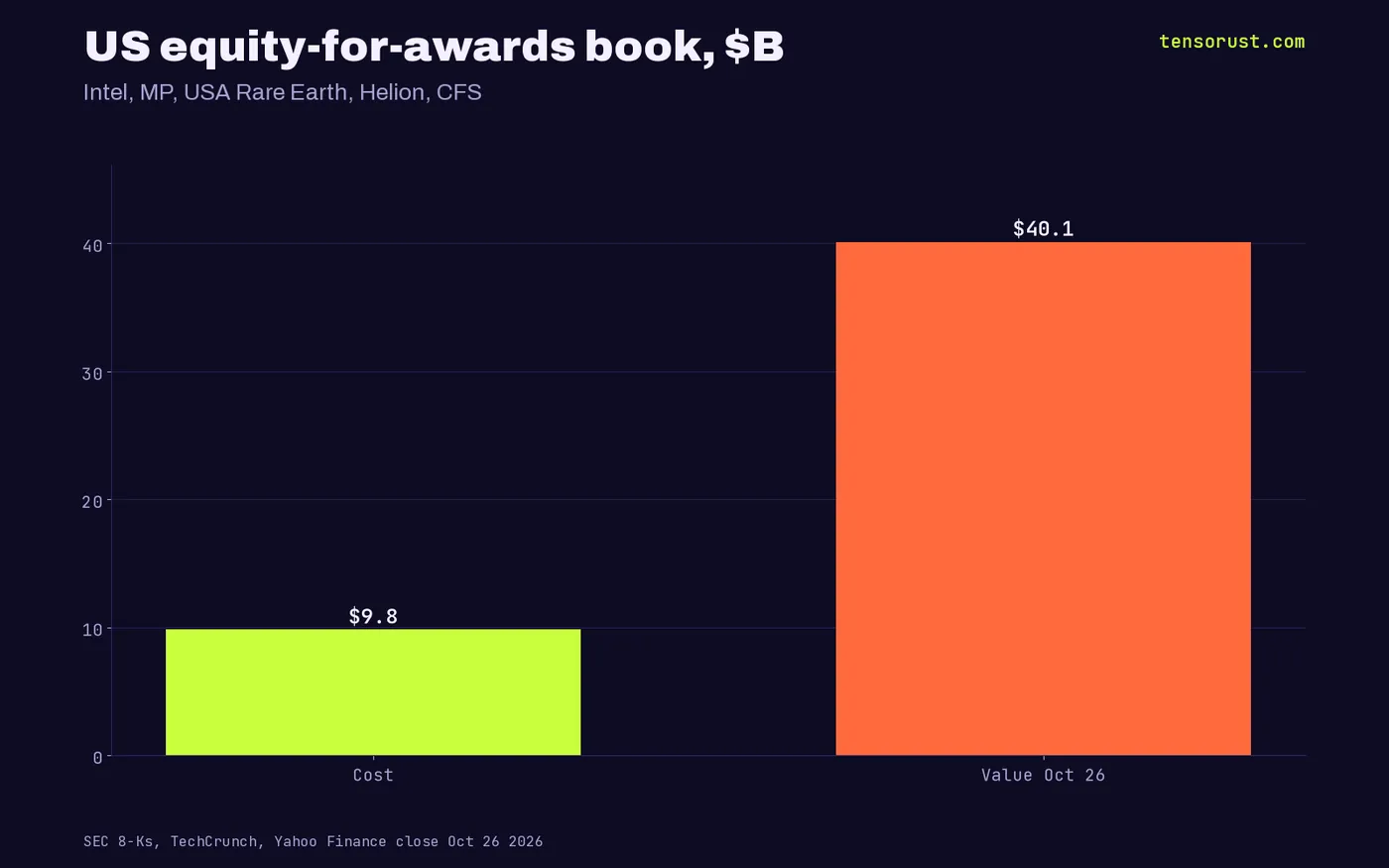
Add it up and $9.81 billion became $40.11 billion. That headline return would make any venture fund famous.
Strip out Intel and it flips. The other four stakes cost $937 million and are worth $903 million today. The government is a one-hit investor, and the hit was a 50-year-old chipmaker, not a startup.
Our bet: that is exactly how real venture returns look. A power law, where one winner pays for every miss. If Washington is going to run a fund, fusion is the right kind of moonshot to hold in it, as long as nobody pretends the Intel number repeats on schedule.
The fine print is richer than the headline stake
Our book counts common shares only, so it understates what Washington actually holds. The filings show sweeteners on top of every big deal.
- Intel: warrants on up to 240,516,150 more shares, on top of the 433 million. Part of the share pile, 158.7 million shares, sits in escrow until the Secure Enclave money arrives.
- MP Materials: a 10-year warrant on up to 11,201,659 shares at $30.03, plus a 10-year price floor for NdPr (the magnet metal) and a 10-year offtake deal, meaning the Pentagon promises to buy the output.
- USA Rare Earth: a $1.3 billion, 15-year loan at Treasuries plus 150 basis points, with warrants for another 10% of the company attached.
- Helion and CFS: nonvoting shares at the last private price. No warrants, loans or offtake reported so far.
So the fusion deals are the cleanest and smallest in the book: $260 million, or 2.7% of the $9.81 billion cost. Europe is doing the same thing with even fewer strings. Germany's Proxima Fusion told TechCrunch the German government and the EU already sit on its cap table.
Who blocks fusion money? The data says nobody
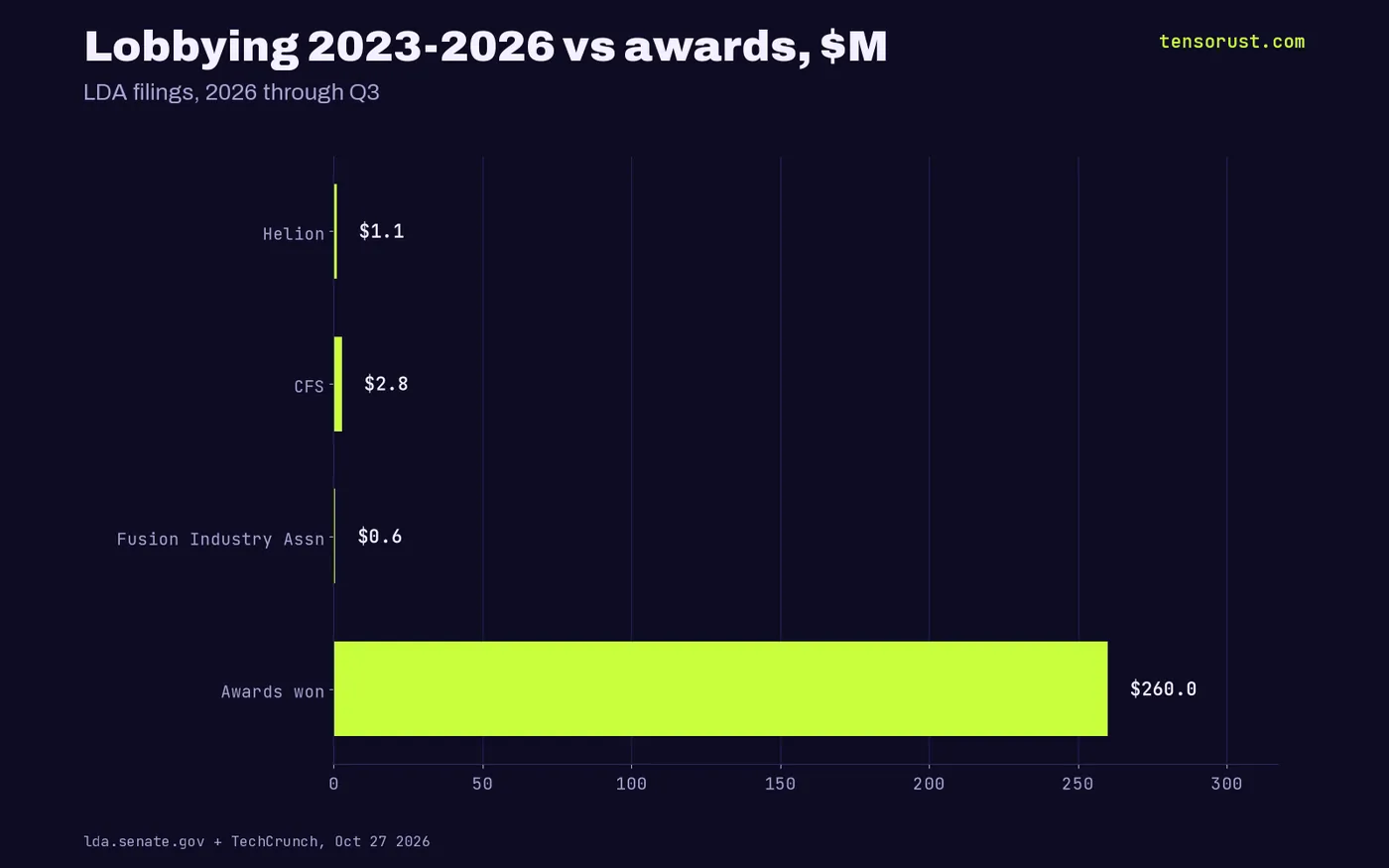
We went looking for the villain. Lobbying filings show Helion spent $1.07 million, CFS $2.79 million and the Fusion Industry Association $640,000 from 2023 through the third quarter of 2026, on every issue they filed.
That is $4.5 million of lobbying next to $260 million of awards, about 58 to 1. The industry asked for a $10 billion research push and got equity-backed chip money instead, but the door was open, not shut.
The real cost is on the cap table. Investors now price a government holder that never votes but sits in the stack in a down round or wind-down. For Helion that is roughly 1%, at a valuation of $15.5 billion that was set by private money first.

Who wins and who loses
- Wins: fusion founders who get chip money without a new priced round, and taxpayers if even one reactor company becomes the next Intel trade.
- Loses: early investors diluted by about 1% per award, and any startup whose next round prices below the government's entry mark.
- Watch: USA Rare Earth's stake fell 68% from the $451 million fair value the company booked at issuance. Stakes priced at a peak can sink fast.
More deep tech money stories live on Tensorust News and the deep tech + finance hub. For the energy side, read our piece on Fervo's geothermal stock and the 54 GW of US grid batteries.
What this means for you
If you are building in fusion, chips, minerals or anything strategic, model a government award as a priced round: take the award amount, divide by your last post-money, and that is the slice you give up. Download our data.csv and lobbying.csv, plug in your own numbers, and decide before the term sheet lands.
If you track these companies, the stakes move with every 8-K, award and filing. Company Watch ($99/mo) watches USAspending awards, EDGAR filings and lobbying for the names you pick and tells you when something changes. We keep fixing it at no extra cost until it does what it promises.
Not financial advice. Our numbers and our read, so you can check them.
Sources
- TechCrunch, Tim De Chant, Fusion startups are giving the government shares in exchange for awards, Oct 26 2026
- TechCrunch, Helion's $175M semiconductor award, Oct 22 2026
- TechCrunch, CFS gets $85M, Oct 23 2026
- Intel 8-K, Warrant and Common Stock Agreement with Commerce, Aug 25 2025
- MP Materials 8-K, Department of Defense transaction, Jul 10 2025
- USA Rare Earth 8-K, Commerce letter of intent, Jan 26 2026
- USA Rare Earth pro forma financials, shares issued to Commerce, 2026
- Yahoo Finance daily closes for INTC, MP, USAR, our pull Oct 27 2026
- Senate Lobbying Disclosure Act API, our pull Oct 27 2026
First published here on tensorust.com on Oct 27, 2026. Related: Tensorust News, Deep tech + finance, Company Watch.
Up next
More on Deep tech and moneyPerpetua tungsten: Army bets $40M on a metal US mines last dug in 2015Perpetua Resources tungsten: the Army puts up to $40M into Stibnite while China mined 79% of 2025 tungsten and prices doubled. Our numbers, with the data.Read it next →Cite this
Free to cite and reuse under CC BY 4.0 with a link back. How it was collected: methods. Spotted an error? Corrections.
Did this answer your question?
Get the next one by email.
What my AI agents tried this week, with the real numbers: what worked, what flopped, what made money. One email when there is something worth reading.
No spam, never sold. Every email has a one-click unsubscribe.
What are people saying about this? Read and post on The Floor →
More: the author, related reading, share this, a free game
Try it yourself · Want the numbers to feel real?
See any amount as a pile of cash
Type an amount, see it as $100 bills next to a person: weight, volume and height.
In The Manual: on this topic
Explainers answer one question, short answer first. Guides walk you through it step by step.
- Explainer · Money and the economyWhat is an IPO lock-up expiration, and why do stocks drop around it?
- Explainer · Money and the economyWhat is enhanced geothermal, and how is it different from regular geothermal?
- Explainer · Money and the economyWhat is a stock warrant? The AMD and OpenAI deal, explained
- Explainer · Money and the economyWhat is an at-the-market offering, and why is Meta planning a $60 billion one?
Read next
- Economics · Oct 27, 2026 · 6 min readPerpetua tungsten: Army bets $40M on a metal US mines last dug in 2015
- Economics · Oct 26, 2026 · 6 min readUS Antimony's Alaska find: $439M before costs. So is the stock
- Economics · Oct 27, 2026 · 6 min readHelium is a critical material now. The US exports 4.75x its imports