
By Matt Busel, who built the apps, crates and game he writes about · every number links to its source and every dataset is downloadable (methods) · corrections · featured in Kirino, gamebiz, This Week in Rust, New Mobile Life, By-Press
JetBlue bankruptcy watch: DOJ blocked Spirit, fares rose 28% anyway
On this page · 11 sections
- Key numbers
- The creditors are already in the room
- JetBlue has lost money every year since 2019
- They already pawned the frequent-flyer program
- Then jet fuel more than doubled, and JetBlue had zero hedges
- The DOJ won the case. Travelers lost the market
- What the fare data actually says
- Follow the money: who wins, who loses
- Our bet: Chapter 11 or a sale before summer
- What this means for you
- Sources
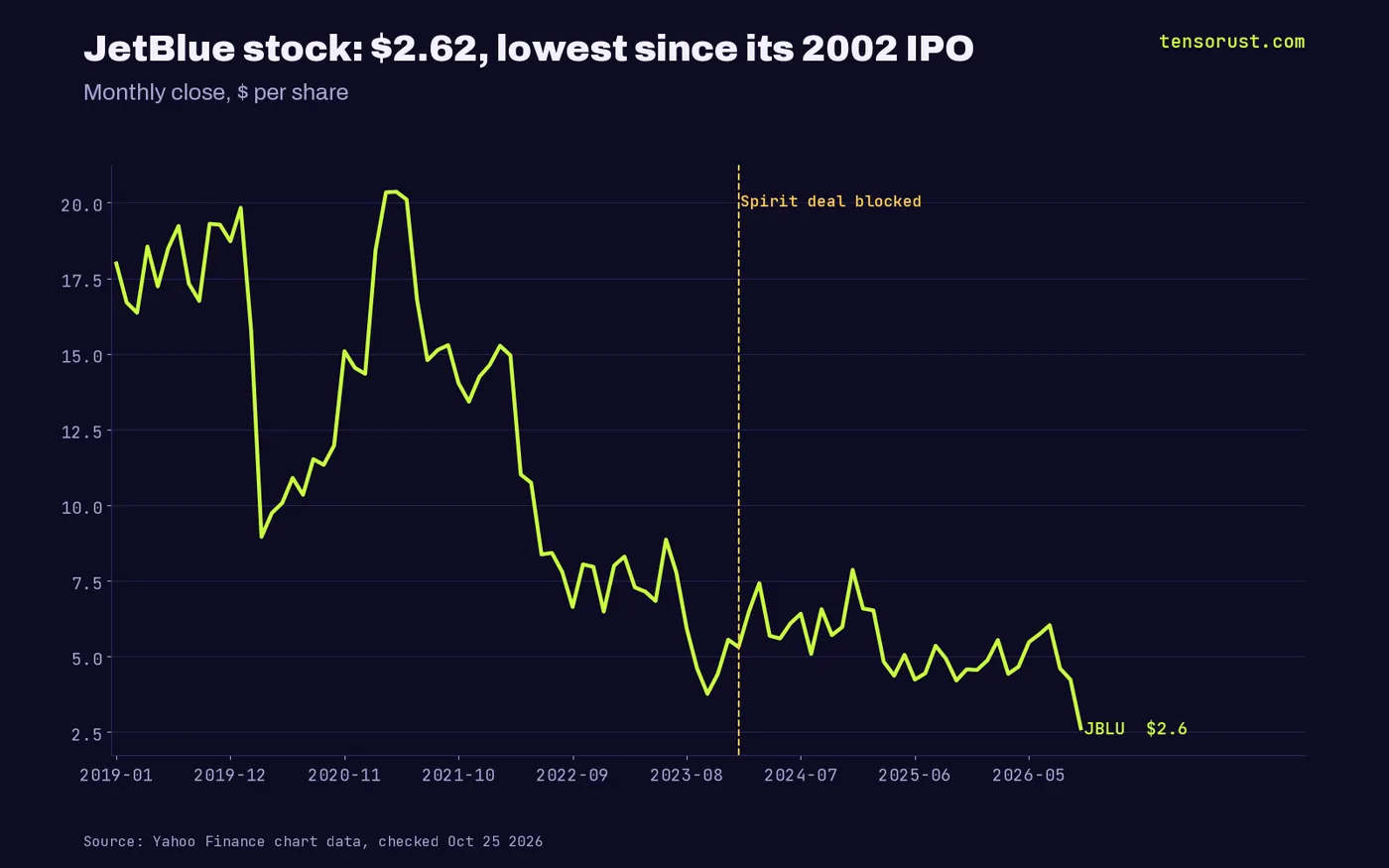
Short answer: JetBlue has not filed for bankruptcy, but its creditors just hired restructuring advisers PJT Partners and Akin Gump, the stock closed at a record low near $2.62, and its own filings show $8.48 billion of long-term debt against $1.59 billion of equity. The deal that was supposed to fix it, a $3.8 billion purchase of Spirit, was blocked by the Justice Department to protect fares. Spirit is now dead, and airline fares are up 27.8% since the ruling.
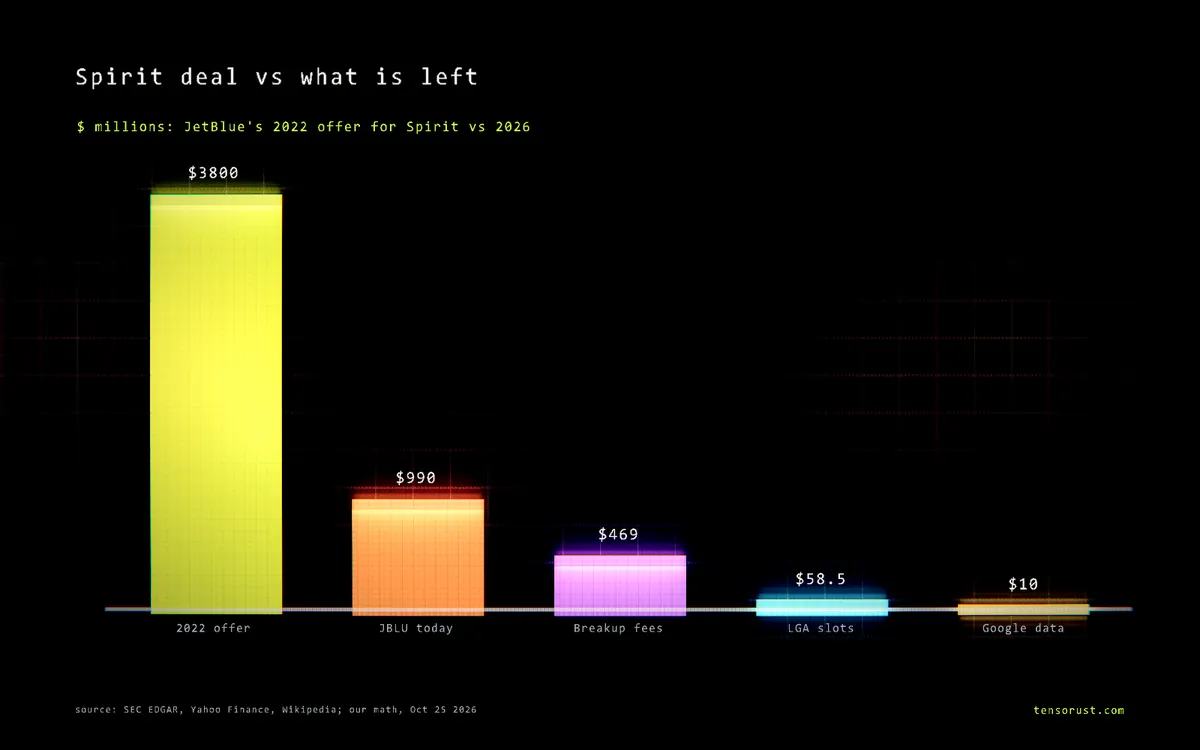
TL;DR: We pulled every JetBlue quarter from SEC EDGAR since 2019: the airline has lost money every single year since then, $4.17 billion in total, while its interest bill went from $79 million to $588 million a year. The DOJ told a court in 2023 that JetBlue buying Spirit meant "higher fares, fewer seats"; the judge agreed in January 2024, and BLS data shows airline fares have since risen 27.8% against 8.6% for everything else. Spirit stopped flying on May 2 2026, Google won the auction for its employee data for about $10 million, and JetBlue's whole company now trades for about $990 million, roughly a quarter of what it once offered for Spirit.
Not financial advice. Our numbers and our read, so you can check them.
Key numbers
| What | Number | Source, checked Oct 25 2026 |
|---|---|---|
| JetBlue share price | $2.62 (lowest since the 2002 IPO), down 42% in 2026 | Simple Flying, Yahoo Finance |
| Market value | about $990M (377.3M shares x $2.62, our math) | JetBlue 10-Q |
| Long-term debt | $8.48B (Jun 2026) vs $2.25B (Dec 2019), 3.8x | SEC EDGAR XBRL |
| Shareholder equity | $1.59B vs $4.80B, down 67% | SEC EDGAR XBRL |
| Net losses, 2020 to mid-2026 | $4.17B (last profitable year: 2019, +$569M) | SEC EDGAR XBRL |
| Delta / United net income, 2023-2025 | $13.1B / $9.1B | SEC EDGAR XBRL |
| Interest cost per year | $79M (2019) to $588M (2025), 7.4x | SEC EDGAR XBRL |
| Q2 2026 fuel bill | $911M, up 80.7%; $4.23 a gallon; zero hedges | JetBlue 10-Q |
| Airline fares since the Jan 2024 ruling | +27.8% vs +8.6% for all prices | BLS CPI via FRED |
| Spirit deal vs today | $3.8B offer (2022) vs ~$990M for all of JetBlue | Wikipedia, our math |
| Google's bid for Spirit's internal data | about $10M: ~100M emails, 500M Teams messages | Wikipedia |

The creditors are already in the room
On October 23 and 24, the Wall Street Journal and Bloomberg reported that a group of JetBlue lenders had organized. Per Simple Flying's write-up of the WSJ scoop, they hired PJT Partners and the law firm Akin Gump, and the group includes holders of JetBlue's $2 billion of bonds due 2031 and a $742 million first-lien loan.
Lenders do not pay restructuring bankers for fun. That hire is the moment creditors stop asking "will we get paid" and start asking "what do we get when we don't". The Aviation Hub's headline put the bonds at 42 cents on the dollar.
The stock tells the same story. It closed at $2.65 on Thursday, its lowest since JetBlue went public in 2002, and sat at $2.62 when we pulled it. It was $18.72 at the end of 2019.
JetBlue has lost money every year since 2019
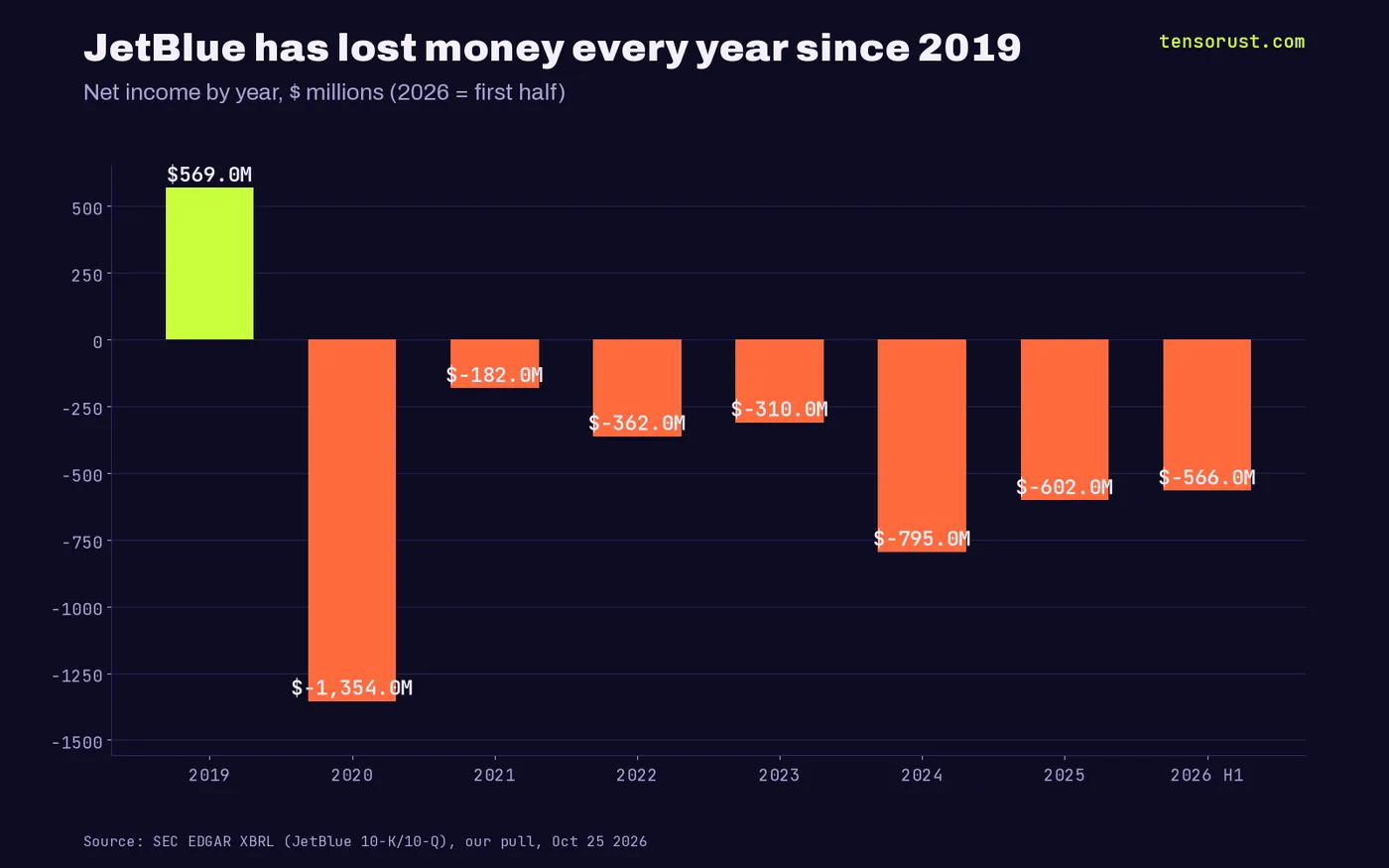
We pulled every quarter JetBlue has filed with the SEC since 2019. The last profitable year was 2019, at +$569 million. Since then: -$1.35B in 2020, then losses of $182M, $362M, $310M, $795M and $602M, and -$566M in just the first half of 2026.
That is $4.17 billion of cumulative losses. COVID explains 2020. It does not explain 2023, 2024 and 2025. Over those three years Delta earned $13.1 billion and United $9.1 billion, flying into the same airports, per the same SEC data. Both made money again in Q3 2026 with fuel at these prices: Delta $756 million, United $1.03 billion.
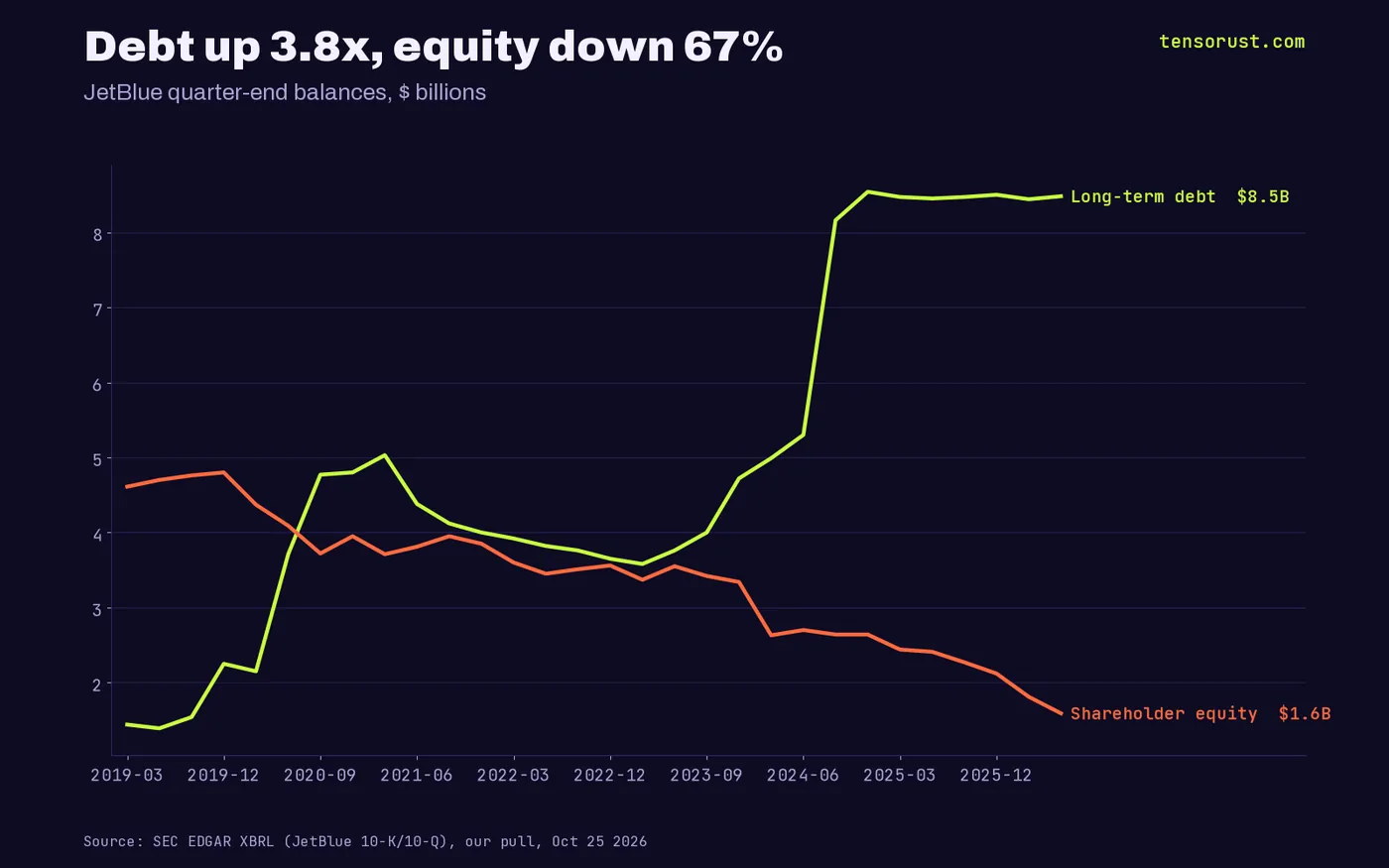
The balance sheet is the scoreboard. Long-term debt went from $2.25 billion at the end of 2019 to $8.48 billion in June 2026. Shareholder equity, what would be left for owners if you sold everything and paid every debt, fell from $4.80 billion to $1.59 billion.
They already pawned the frequent-flyer program
The vertical jump in that debt line in late 2024 is not a typo. In August 2024, JetBlue co-issued the TrueBlue Notes and a TrueBlue Term Loan with a new entity called JetBlue Loyalty LP, which is a polite way of saying it borrowed against its points program.
Its latest 10-Q says those loans carry minimum-liquidity and debt-service covenants, plus a cross-default to its other debt. It also says about 67% of its owned property, equipment and intangible assets are pledged or committed as collateral. The family silver is mostly spoken for.
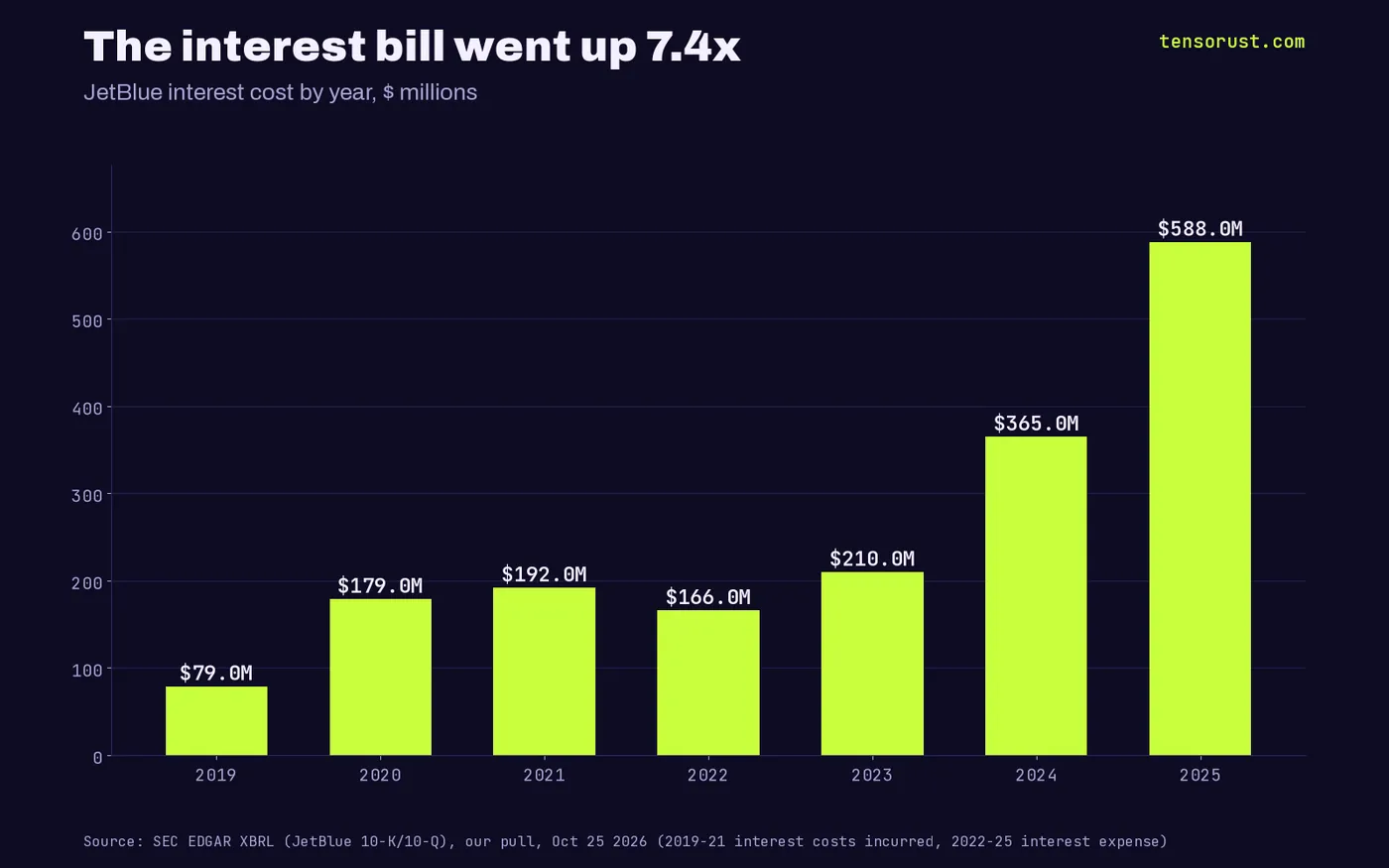
The bill for all that borrowing is brutal. Interest cost was $79 million in 2019. It was $588 million in 2025, and $147 million in Q2 2026 alone. JetBlue now pays more in interest every quarter than it lost in operating income in Q2 (-$141 million).
Then jet fuel more than doubled, and JetBlue had zero hedges
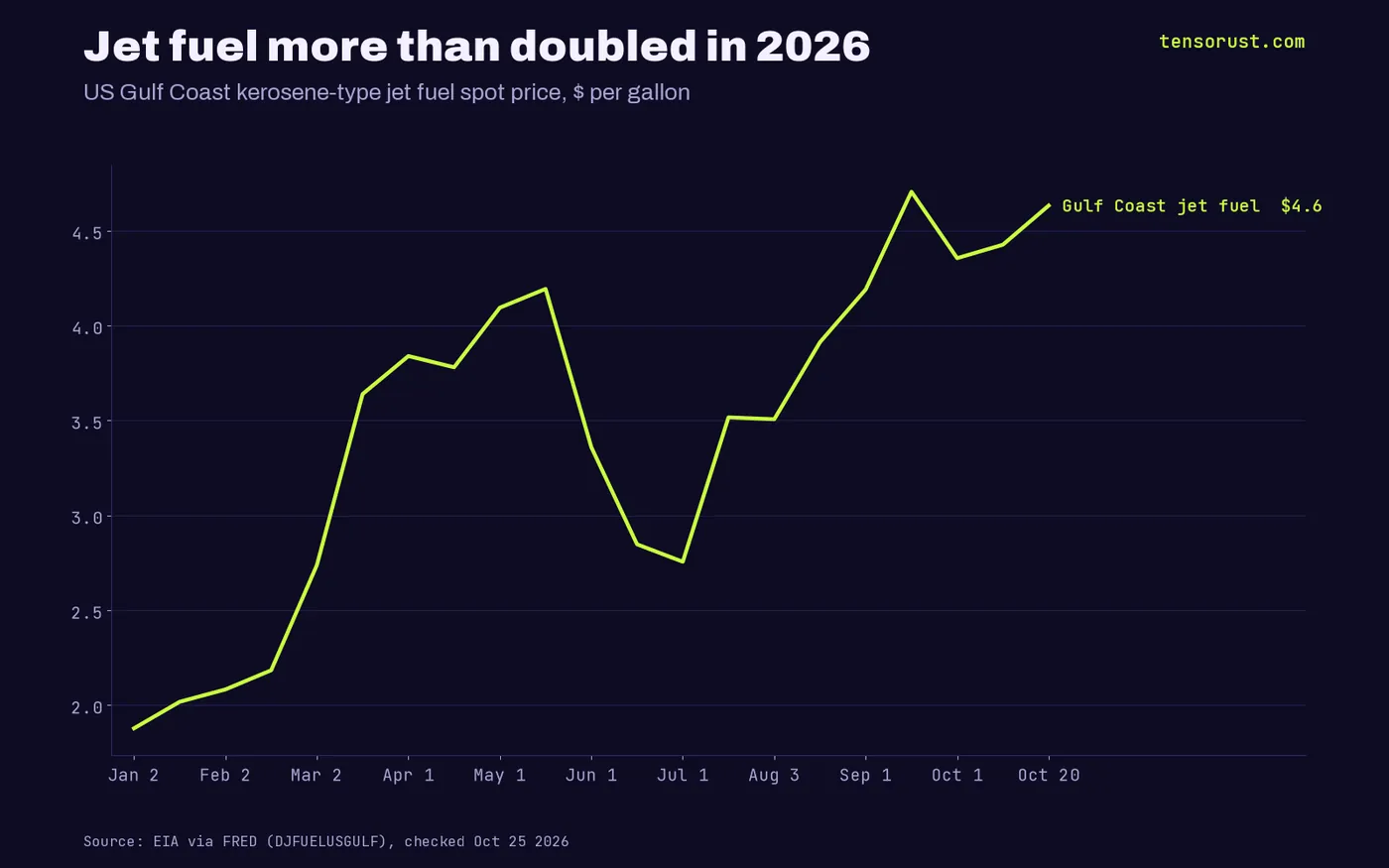
US Gulf Coast jet fuel was $1.88 a gallon on January 2 2026. It hit $4.71 on September 15 and was $4.63 on October 20, per EIA data on FRED. Brent crude peaked at $138 a barrel on April 7 during the Iran war and was still at $115 last week.
JetBlue's own filing spells out the damage: Q2 fuel spend rose 80.7% to $911 million, at an average $4.23 a gallon. And this line should scare every bondholder: "As of June 30, 2026, we did not have any outstanding fuel hedging contracts."
The company also says every 10% rise in the price per gallon adds roughly $309 million to its fuel bill over the next 12 months. Gulf Coast jet fuel is up about 146% since January. You can do that math yourself.
The DOJ won the case. Travelers lost the market
Here is the part nobody in Washington wants to revisit. In July 2022, JetBlue agreed to buy Spirit for $3.8 billion. The Justice Department's Antitrust Division sued, telling the court the merger would mean "higher fares, fewer seats, and harm millions of consumers", and argued an independent Spirit had to be protected for price-conscious flyers.
Federal judge William G. Young agreed and blocked the deal on January 16 2024. JetBlue walked away on March 4 2024, paying a $69 million breakup fee to Spirit and $400 million to Spirit shareholders. A year earlier, the same DOJ had already won a case killing JetBlue's Northeast Alliance with American.
So what did protecting Spirit buy? Spirit filed for Chapter 11 on November 18 2024, filed again on August 29 2025, and stopped flying entirely on May 2 2026, blaming the fuel spike. The independent competitor the government saved lasted 27 months.
What the fare data actually says
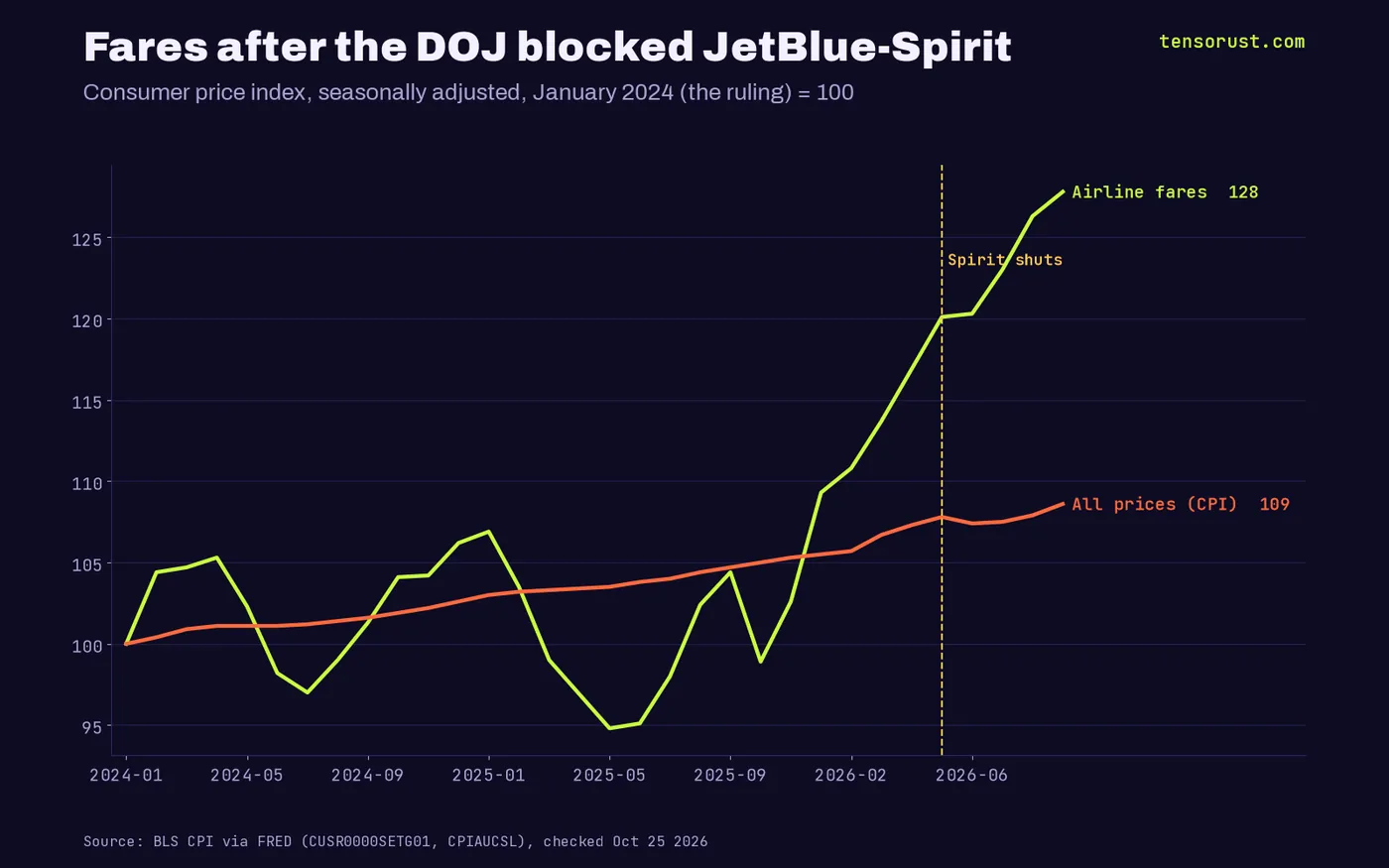
We indexed the BLS airline-fare CPI to January 2024, the month of the ruling. By September 2026 fares were up 27.8%. All consumer prices rose 8.6% over the same stretch. In the last 12 months alone, fares are up 22.4% against 3.7% for everything else.
To be fair to the trustbusters, fares actually dipped for most of 2024 and 2025, bottoming about 5% below the ruling month in May 2025. Fuel is doing most of the 2026 damage, and airlines charged 24.9% more in September 2026 than in January 2019, less than the 33.2% rise in overall prices.
But that is exactly the point. The DOJ's whole theory was that one more independent low-cost airline keeps fares down. Spirit stayed independent, went broke anyway, and took its seats with it. Since April, the last full month before Spirit shut, fares are up 9.3% while overall prices rose 1.2%. A blocked merger does not create a healthy competitor. It just picks how the weak one dies.
Follow the money: who wins, who loses
- Delta and United win. Two of the low-cost airlines that disciplined their fares in the Northeast are now gone or wounded. United is already set to return to New York's JFK in 2027 using JetBlue-provided slots under the "Blue Sky" partnership.
- Restructuring bankers and lawyers win. PJT and Akin Gump get paid either way.
- Google wins a weird little prize. In August 2026 Google won the auction for Spirit's internal employee and workplace data, a proposed purchase of about $10 million covering roughly 100 million emails and 500 million Microsoft Teams messages. Representative Steven Horsford and Senator Elizabeth Warren raised privacy concerns on October 8 about it being used for AI training. A dead airline's chat logs, sold as training data: the most 2026 sentence ever written.
- JetBlue picks the bones. It won Spirit's LaGuardia slots for $58.5 million and grew Fort Lauderdale capacity nearly 40% after Spirit folded. It once offered $3.8 billion for the whole airline.
- Carl Icahn already left. JetBlue's August 2026 8-K says the Icahn Group's stake fell below the level that gave it two board seats, and both of its directors resigned on August 24.
- Travelers and shareholders lose. Fewer cheap seats, a 27.8% fare bump since the ruling, and an equity cushion that shrank by two thirds.
Our bet: Chapter 11 or a sale before summer
JetBlue's management says it is not filing. CEO Joanna Geraghty pushed back in April when founder David Neeleman warned the airline might not survive as a "going concern", and the company told Reuters it "remains confident in its JetForward strategy". It says it has $2.2 billion of liquidity plus a $600 million undrawn credit line.
Our read is different. A company that lost an average of $283 million a quarter in 2026, pays $147 million a quarter in interest, and has no fuel hedges while fuel sits near its 2026 high, is burning its cushion on a clock. JetBlue already hired advisers in March 2026 to explore selling itself, with United, Alaska and Southwest named as possible buyers. The pattern says one of two things happens before summer 2027: a Chapter 11 filing, or a sale to a bigger airline.
And here is the spicy part. If it is a sale, the buyer will be bigger than Spirit ever was. The same antitrust logic that blocked JetBlue plus Spirit would have to wave through United plus JetBlue, or watch JetBlue go the way Spirit did. Regulators get to pick their poison. Lowkey, they already did in 2024.
Watch Q3 results on October 27. In September JetBlue told investors fuel stayed elevated and Northeast weather and air-traffic-control disruptions pushed costs higher, even as revenue per seat improved. If Q3 shows another nine-figure loss and cash under $2 billion, the creditors' advisers will be busy.
What this means for you
- If you hold JetBlue tickets or TrueBlue points: airlines usually keep flying and honoring tickets through Chapter 11, but points are the first thing that gets devalued. Burn points on near-term trips rather than hoarding them, and pay for flights with a credit card so you have chargeback rights.
- If you own the stock or the bonds: equity sits behind $8.48 billion of debt that is already organizing. Read the October 27 numbers before you average down.
- If you run a business: the lesson is runway. JetBlue had cash and a plan; what killed the plan was a cost it never hedged and debt that compounded while it waited. Know exactly how many months of cash you have before the next shock, not after it.
That is what we built the Envelope budget app for: drop in your bank CSV and it shows your real cash runway, fully offline, so a fuel-spike moment in your own life does not catch you unhedged. If it does not show you a clear runway, we keep fixing it at no extra cost until it does what it promises. Get the Envelope budget app.
More money-meets-data pieces: Tensorust News, deep tech and money, economics, Americans' record stock allocation, the AI boom vs 2008, and who else sells your work data in The Work Number exposed. The full dataset is below.
Sources
- SEC EDGAR, JetBlue Airways XBRL company facts and filings (CIK 1158463), our pull Oct 25 2026
- JetBlue Form 10-Q for the quarter ended June 30 2026, filed Jul 28 2026
- JetBlue Form 8-K, Q3 2026 operational and financial update, Sep 10 2026
- JetBlue Form 8-K, Icahn Group director resignations, Aug 27 2026
- JetBlue Form 8-K, $500M aircraft-backed financing with SKY Leasing, Apr 17 2026
- Simple Flying (Luke Bodell), JetBlue creditors call in restructuring experts as shares plummet to all-time low, Oct 24 2026, citing the Wall Street Journal
- The Aviation Hub, JetBlue creditors hire bankruptcy advisers as bonds crash to 42 cents, Oct 24 2026 (headline)
- BLS CPI airline fares (CUSR0000SETG01) and all items (CPIAUCSL) via FRED, through Sep 2026, checked Oct 25 2026
- EIA US Gulf Coast jet fuel (DJFUELUSGULF) and Brent (DCOILBRENTEU) via FRED, through Oct 20 2026
- Yahoo Finance, JBLU monthly price history, checked Oct 25 2026
- Wikipedia, JetBlue and Wikipedia, Spirit Airlines (merger, ruling, bankruptcies, shutdown, data auction), checked Oct 25 2026
First published here on tensorust.com on Oct 25, 2026. Related: Tensorust News, Deep tech and money, Economics, Record stock allocation.
Up next
More on Deep tech and moneyKOSPI target cut to 9,000: Korea is priced for a 65% chip crashGoldman cut its KOSPI target to 9,000 after a 39% fall. Micron's filings say memory busts cut profit 90%, so the 65% drop priced in is the gentle case.Read it next →Cite this
Free to cite and reuse under CC BY 4.0 with a link back. How it was collected: methods. Spotted an error? Corrections.
Did this answer your question?
Get the next one by email.
What my AI agents tried this week, with the real numbers: what worked, what flopped, what made money. One email when there is something worth reading.
No spam, never sold. Every email has a one-click unsubscribe.
What are people saying about this? Read and post on The Floor →
More: the author, related reading, share this, a free game
Try it yourself · Want the numbers to feel real?
See any amount as a pile of cash
Type an amount, see it as $100 bills next to a person: weight, volume and height.
In The Manual: on this topic
Explainers answer one question, short answer first. Guides walk you through it step by step.
- Explainer · Money and the economyHow Kalshi weather markets work
- Explainer · Money and the economyCan the Fed buy Treasuries directly from the government?
- Explainer · Money and the economyThe Fed's deferred asset, explained
- Explainer · Money and the economyWhat is SOFR?
Read next
- Economics · Oct 25, 2026 · 8 min readKOSPI target cut to 9,000: Korea is priced for a 65% chip crash
- Economics · Oct 25, 2026 · 9 min readGPU depreciation: Big Tech says 6 years, a 2020 A100 rents for $0.74
- Economics · Oct 25, 2026 · 8 min readNvidia's $2,000-per-GPU software fee: rent on a stack vLLM gives away