
By Matt Busel, who built the apps, crates and game he writes about · every number links to its source and every dataset is downloadable (methods) · corrections · featured in Kirino, gamebiz, This Week in Rust, New Mobile Life, By-Press
Spotify Family plan crackdown: your $3.67 seat is now $12.99
On this page · 10 sections
- Key numbers
- Spotify didn't announce it. A support page did
- Kicked off Family? Your price goes 3.5x
- Families already paid the biggest hikes
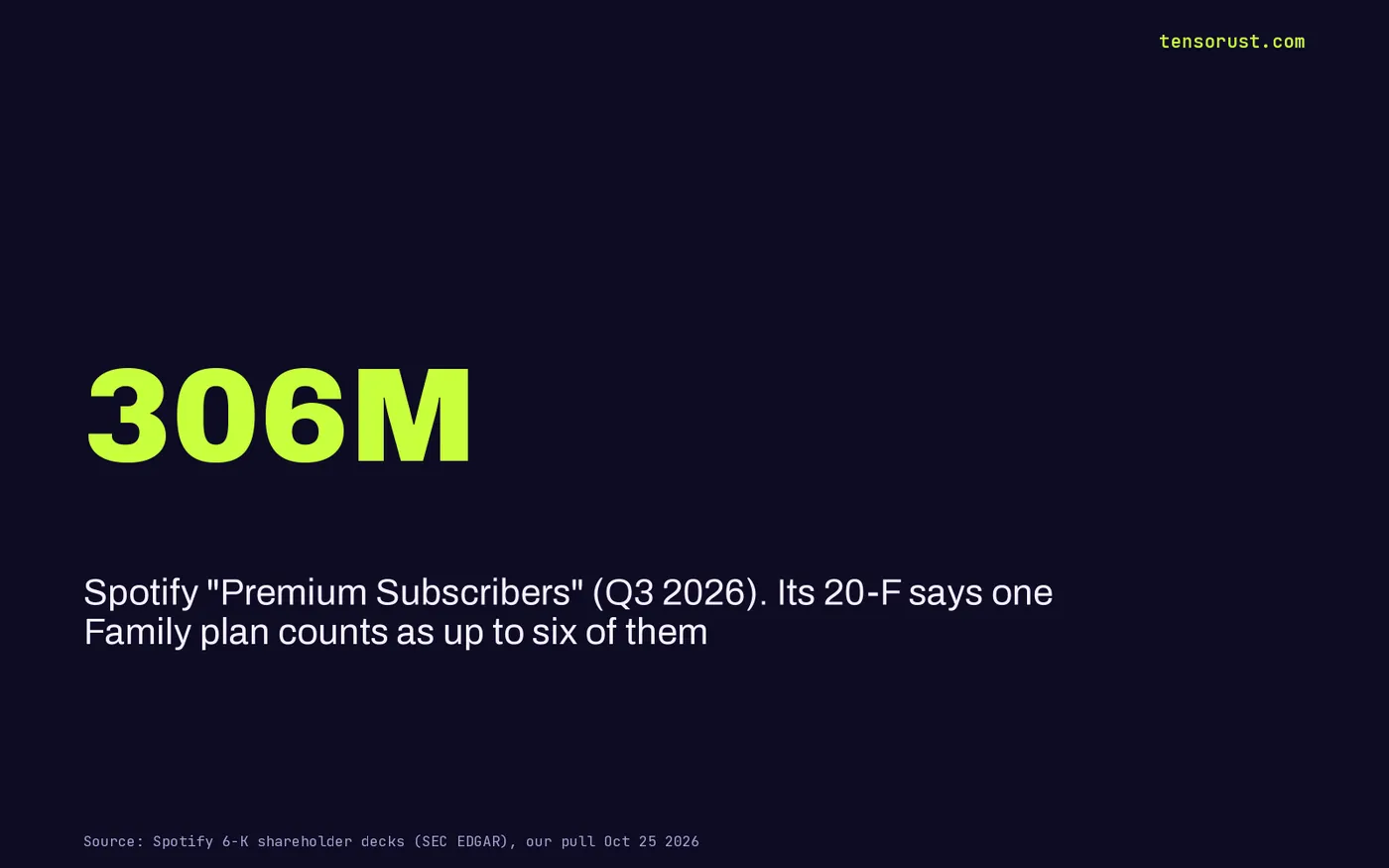
- The 306 million number has a Family plan inside it
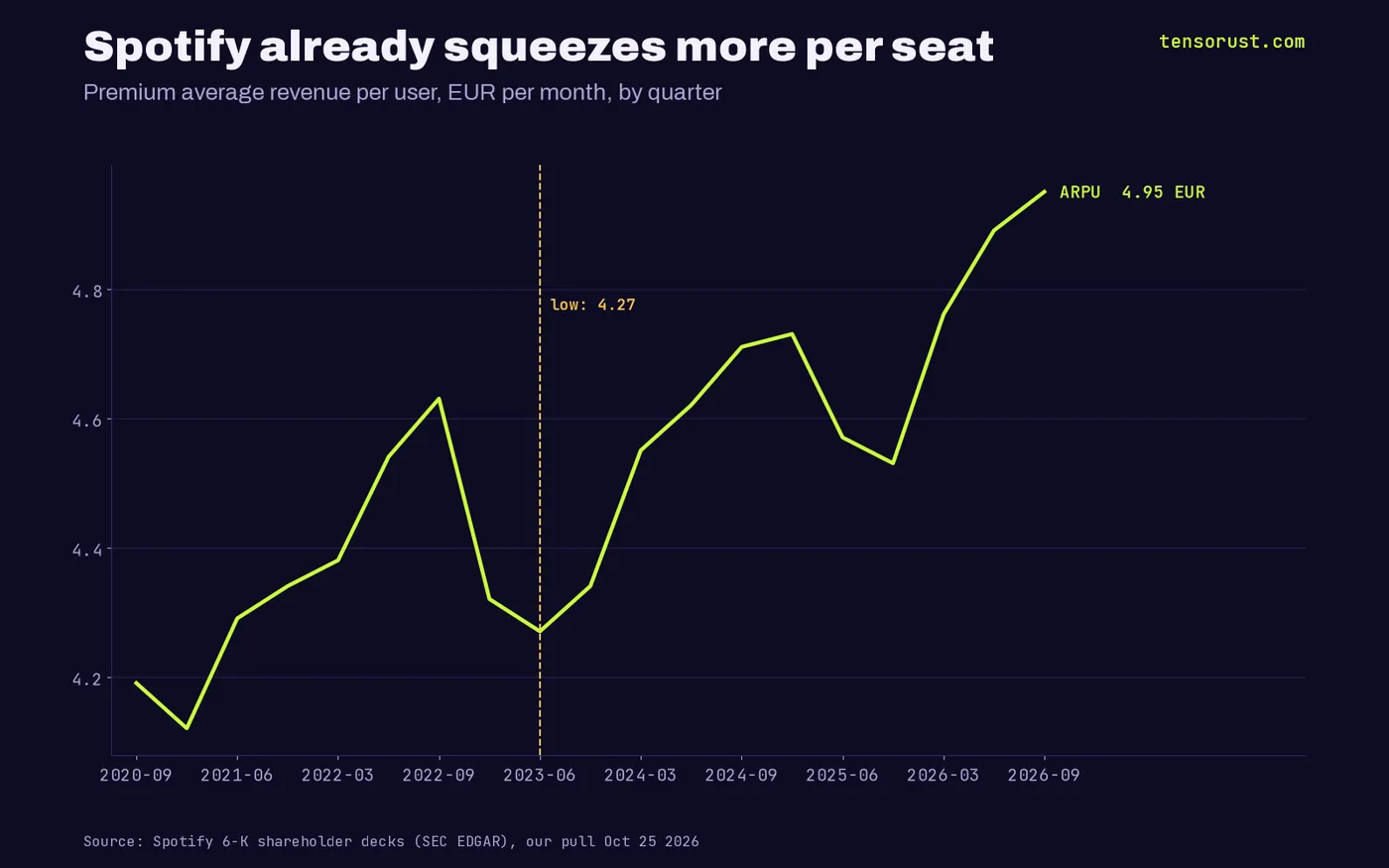
- Follow the money: Spotify is already squeezing more per seat
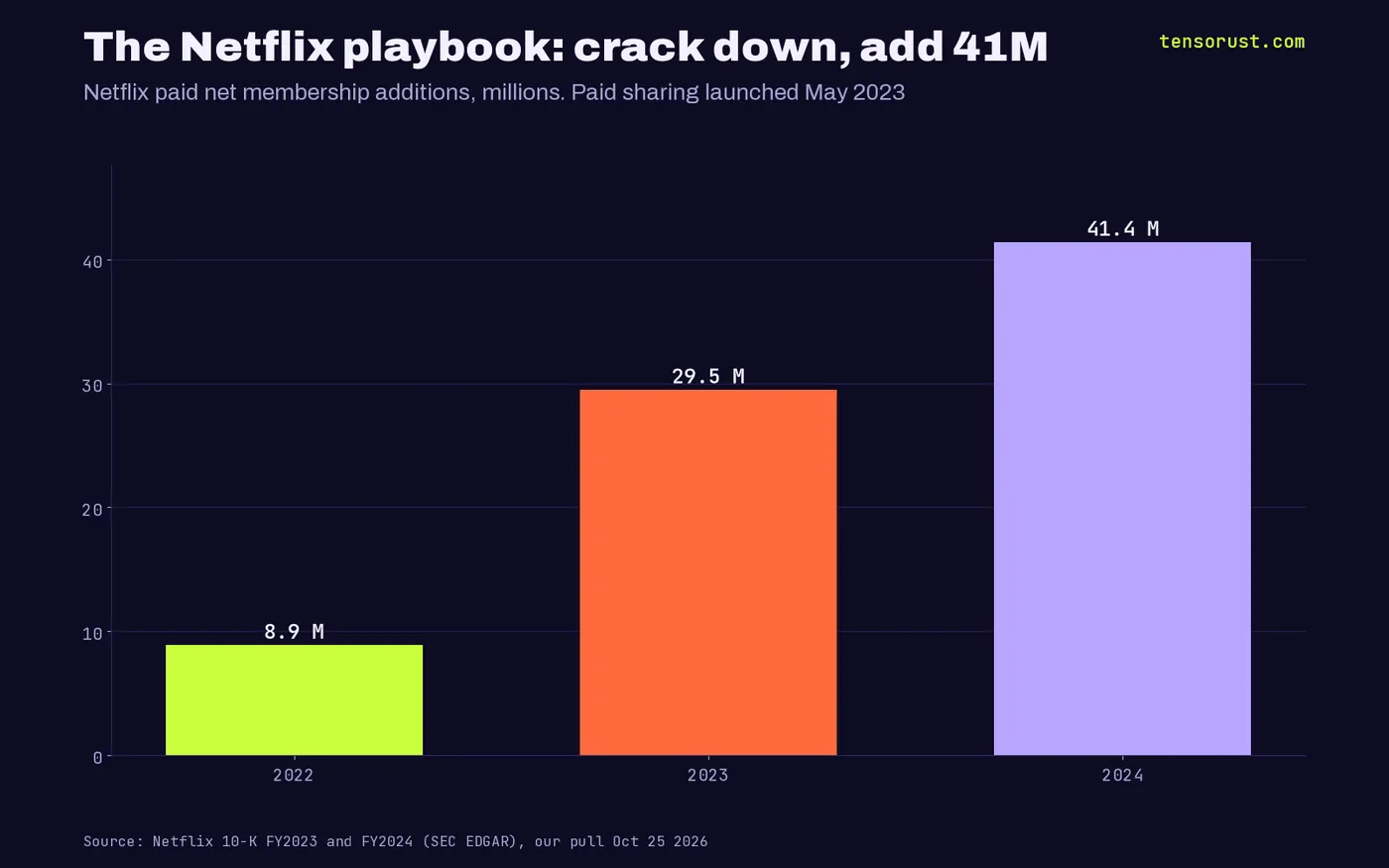
- The Netflix receipt: this playbook pays
- Our bet: this goes wide, and a paid "extra member" follows
- What this means for you
- Sources
Short answer: Spotify is asking some Premium Family members to prove they live with the plan manager by scanning a QR code in person, in the same room, within 7 days. Fail it and you drop to the free tier and are barred from joining any other Family or Duo plan for 12 months. In the US that turns a $3.67 seat (a $21.99 plan split six ways) into a $12.99 Individual plan, a 3.5x jump, and Wall Street wrote the playbook for it ten days earlier.
TL;DR: We pulled Spotify's US prices from every archived copy of its Premium page since 2020: Family went from $14.99 to $21.99 (+47%) while Individual went from $9.99 to $12.99 (+30%), so families already took the biggest hikes before anyone checked an address. Spotify's own 20-F says one Family plan counts as up to six "Premium Subscribers", which means part of the 306 million it reported for Q3 2026 is people paying $3.67 a month in the US. Netflix ran this exact move in May 2023 and went from 8.9 million paid net adds in 2022 to 41.4 million in 2024, and its operating profit is now 2.8x what it was before the crackdown.
Key numbers
| What | Number | Source, checked Oct 25 2026 |
|---|---|---|
| Window to scan the QR code in person | 7 days, then free tier + 12-month ban from other Family/Duo plans | Spotify Support, Address and verification for Family plan |
| US Premium Family price | $21.99/month for up to 6 accounts ($3.67 a seat) | spotify.com/us/premium |
| US Premium Individual price | $12.99/month (3.5x a Family seat) | spotify.com/us/premium |
| Family price change, Jan 2020 to Oct 2026 | $14.99 to $21.99 (+47%) | Wayback Machine snapshots of spotify.com/us/premium, our pull |
| Individual price change, same period | $9.99 to $12.99 (+30%) | Wayback Machine snapshots, our pull |
| Spotify Premium Subscribers, Q3 2026 | 306 million (a Family plan counts as up to 6) | Spotify Q3 2026 update (6-K), 2025 20-F |
| Premium ARPU, Q3 2026 | EUR 4.95 a month, up 16% from the EUR 4.27 low in Q2 2023 | Spotify 6-K decks, our pull |
| Netflix paid net adds before and after its sharing crackdown | 8.9M (2022) to 29.5M (2023) to 41.4M (2024) | Netflix 10-K FY2024 |
| Netflix operating income, trailing 4 quarters | $5.62B (to Q2 2023) to $15.57B (to Q3 2026), 2.8x | SEC EDGAR XBRL, our pull |

Spotify didn't announce it. A support page did
There was no blog post and no press release. Family members on Reddit started getting a prompt to scan a code, and Music Business Worldwide's Mandy Dalugdug found the rules sitting in Spotify's support docs.
The rules are blunt. The plan manager opens a QR code in the app, the member scans it with their own phone, and "both the manager and member need to be in the same place to complete the scan." The code "changes every few seconds", so a screenshot will not do. Miss the 7-day window and "they can't join a different Family or Duo plan for 12 months."
The same page still says "We don't track your location." Technically true. They just need you standing next to the person who pays.
Kicked off Family? Your price goes 3.5x
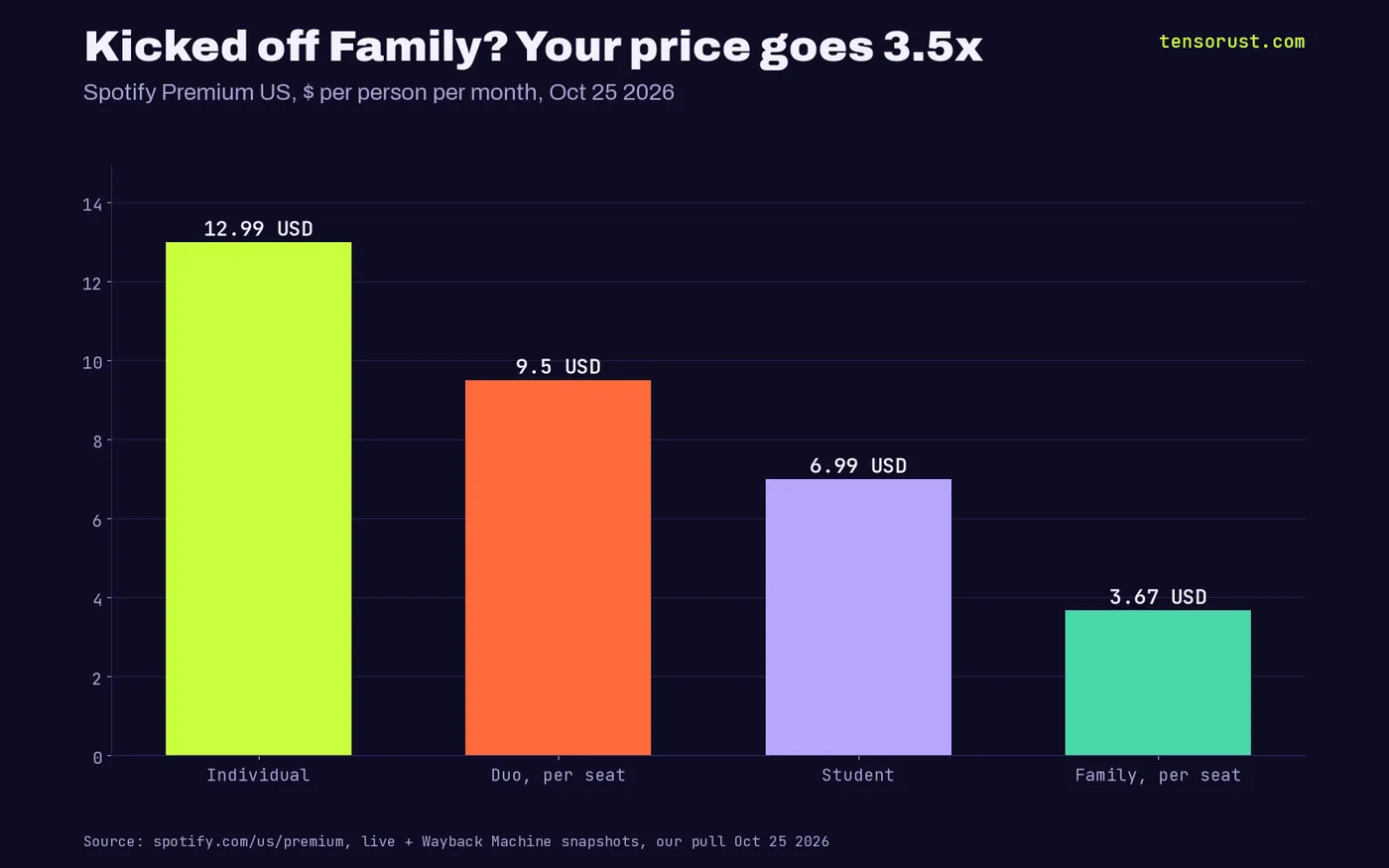
Here is the math nobody at Spotify put in a headline. The US Family plan is $21.99 for up to six accounts, or $3.67 a seat. Duo is $18.99 for two, or $9.50 a seat. Student is $6.99. Individual is $12.99.
So the member who fails a QR scan is not "losing a perk." They are being moved from $3.67 to $12.99, a 254% price increase, or out of Premium entirely. That is the whole point.
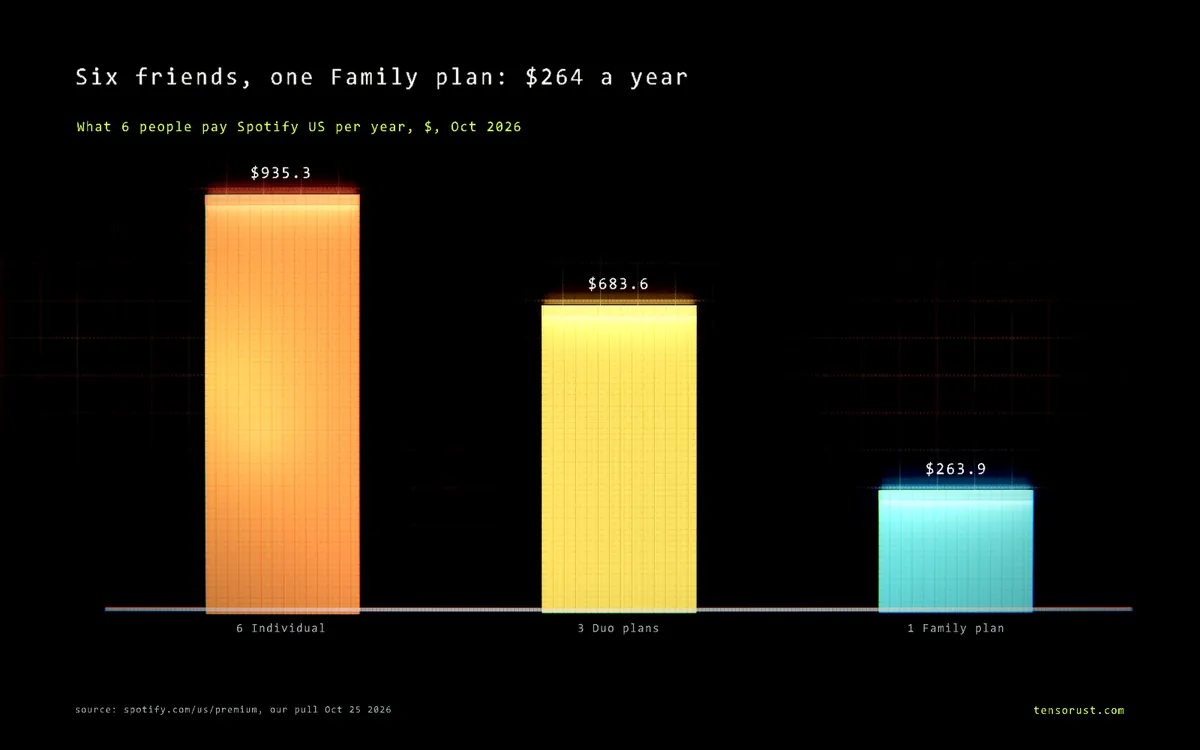
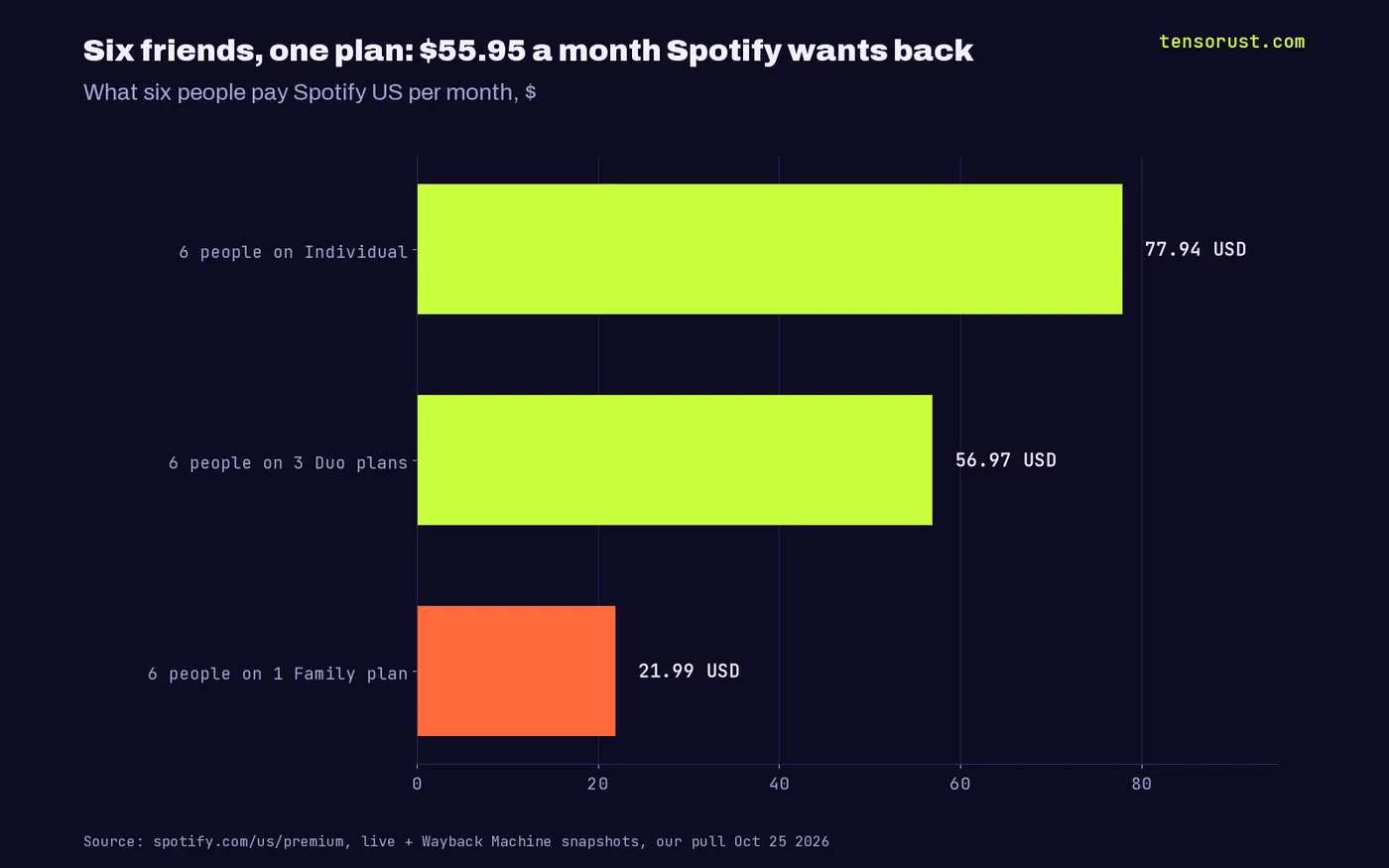
Scale it to a full plan of six people who do not share an address. On one Family plan they pay $263.88 a year. Split onto Individual plans they pay $935.28. That is $55.95 a month per plan that Spotify now has a tool to go collect.
Families already paid the biggest hikes
The Goldman framing is that Family plans are a deal that "materially lags individual plan pricing." Spotify's own price history says Family has been the plan it squeezed hardest.
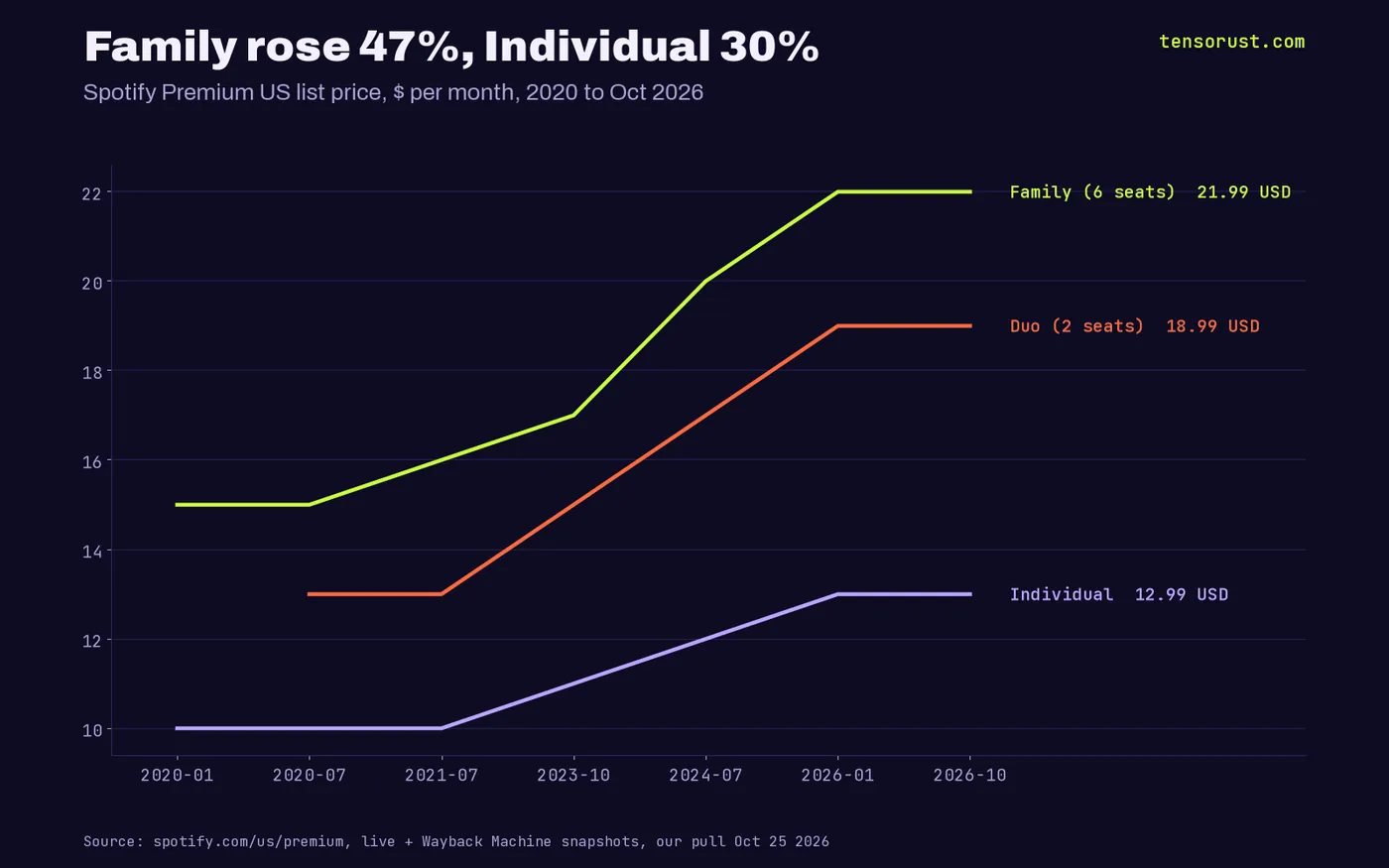
We pulled every archived copy of spotify.com/us/premium from the Wayback Machine, one per quarter from 2020 and every two weeks around the last hike. The US Individual plan sat at $9.99 until mid 2023, then went to $10.99, $11.99, and $12.99 in January 2026. That is +30%.
Family went from $14.99 to $15.99 in mid 2021, $16.99 in 2023, $19.99 in 2024 and $21.99 in January 2026. That is +47%. Duo went from $12.99 to $18.99, +46%. Student went from $4.99 to $6.99, +40%.
So the plan that real families use got hit 1.5x harder than the plan for one person, and now it gets an address check on top. Highkey the most Wall Street sequence possible: raise the group price first, then police who is in the group.
The 306 million number has a Family plan inside it
This is the detail most coverage skipped. Spotify's 2025 annual report (its 20-F) says: "Our Family Plan consists of one primary Premium Subscriber and up to five additional sub-accounts, allowing up to six Premium Subscribers per Family Plan subscription."
Read that again. Every sub-account counts as a Premium Subscriber. When Spotify reported 306 million Premium Subscribers for Q3 2026, up 9% in a year, each person on a Family plan was a full unit of that number, whether they paid $3.67 or $12.99.
The same filing says the cheap plans are cheap for Spotify too: "We have negotiated lower per user amounts for our lower priced subscription plans such as our Family Plan, Duo Plan, and Student Plan." The labels get paid less per Family seat. So a Family seat that converts to Individual is a win for Spotify and for the record labels at the same time.
And there is a catch that explains the careful rollout. The 20-F also says royalty rates with certain labels depend on "targets" that "can include such measures as the number of applicable Premium Subscribers." Kick out too many seats and the headline number shrinks. That is why the support page says Spotify "may ask some" members. Not all of them. Yet.
Follow the money: Spotify is already squeezing more per seat
Spotify does not need this to survive. Q3 2026 revenue was EUR 4.97 billion, up 16%, with a record Q3 gross margin of 33.0% and EUR 672 million in operating income. It guided Q4 to 316 million subscribers and EUR 820 million in operating income.
Its Premium average revenue per user hit EUR 4.95 a month in Q3 2026, up 9.3% in a year, and Spotify credited "price increase benefits." Three years ago, in Q2 2023, it was EUR 4.27. That is +16% per seat while the gross margin climbed from 24.1% to 33.0%.
So who wins? Spotify, whose co-CEOs Alex Norström and Gustav Söderström now run the company per the Q3 update. The labels, whose cut per seat rises with every conversion. And Goldman Sachs, whose October 15 "Music in the Air" report, led by analyst Stephen Laszczyk, told streaming services they have "room to implement periodic address/location verification." Spotify's QR prompts showed up days later.
Who loses? The college kid on a parent's plan. The spouse who works on the road. The brothers in different states. MBW quoted one Reddit user who shared a plan with "my actual family for about 7 years" and lived far away for six of them. Spotify's rules do not care that they are family. They care that they are not at the same address.
The Netflix receipt: this playbook pays
Netflix tweeted "Love is sharing a password" in 2017. In May 2023 it started enforcing against it. Here is what its own 10-K filings say happened next.
Paid net membership additions were 8.9 million in 2022, the year before. They jumped to 29.5 million in 2023 and 41.4 million in 2024, taking Netflix from 230.7 million to 301.6 million paid memberships. In the US and Canada, Netflix lost 919,000 members in 2022 and then added 5.8 million and 9.5 million.
The profit side is even louder. In the four quarters before the crackdown (to Q2 2023), Netflix made $5.62 billion in operating income on $32.1 billion of revenue. In the four quarters to Q3 2026 it made $15.57 billion on $49.7 billion. Revenue up 55%, operating profit up 2.8x.
That is the chart every streaming CFO has taped to the wall. Max and Disney followed Netflix. Spotify is just the first big music app to try it, and it will not be the last.
Our bet: this goes wide, and a paid "extra member" follows
The pattern says the "some members" wording is a test. Our bet is the QR check reaches every Family and Duo plan in the US within a year, and Spotify ships a paid way to keep an out-of-home member on your plan, because that turns a cancellation into revenue instead of a lost seat.
We also think Spotify will not talk about it on an earnings call until the numbers look good. If Q1 2027 subscriber adds beat guidance while ARPU jumps, that is the tell that the crackdown converted people instead of losing them. If adds stall, expect the QR prompts to get quieter. Nobody has proven which way it breaks yet, but Netflix's 41 million says the odds favor Spotify.
One more thing users already found: MBW quotes people getting through by pointing a phone at a video call of the changing code. That works until Spotify adds a location check to the scan, and a company that says "we don't track your location" would have to explain that one.
What this means for you
If you get the prompt and your member really lives with you, scan it inside the 7 days; missing it costs a 12-month lockout. If they do not live with you, do the math now: a Duo plan at $9.50 a seat beats Individual at $12.99, a Student seat is $6.99, and the free tier still exists. Do not let the deadline pick your plan for you.
Then look at every other subscription you split. Streaming bills only go one way after a crackdown. Our Envelope budget app reads your bank CSV, fully offline, and shows every recurring charge so you can see what Spotify, Netflix and the rest really cost you each month. If it does not show your real monthly spend from your CSV, we keep fixing it at no extra cost until it does what it promises.
More on what subscriptions really cost: car subscriptions and GM's $6.8B software toll, Apple's 30% App Store toll, Google's Gmail ads promise that now ends in "unless", and everything in Economics and News.
Prices are Spotify's US list prices on the dates checked and can change; company figures are as reported. This is not financial advice.
Sources
- Spotify Support, "Address and verification for Family plan" (QR code verification, 7-day window, 12-month bar), checked Oct 25 2026
- Spotify, Premium plans US (Individual $12.99, Student $6.99, Duo $18.99, Family $21.99), checked Oct 25 2026
- Internet Archive Wayback Machine, snapshots of spotify.com/us/premium, 2020 to 2026, our pull Oct 25 2026. Price table in the download.
- Spotify, Q3 2026 Update, Exhibit 99.1 to Form 6-K, Oct 22 2026, plus every quarterly update back to Q3 2020 (links per row in the download)
- Spotify Technology S.A., Form 20-F for 2025 (Family Plan definition, royalty terms), Feb 10 2026
- Music Business Worldwide, Mandy Dalugdug, "Spotify cracks down on Family plan sharing" (Goldman Sachs Music in the Air quotes, Reddit reports), Oct 21 2026
- Ars Technica, Nick Indge, "Spotify ramps up policy enforcement on family plans", Oct 23 2026
- Netflix, Form 10-K for 2024 (paid net additions 2022 to 2024, UCAN), Jan 27 2025
- Netflix quarterly revenue and operating income, SEC EDGAR XBRL, our pull Oct 25 2026
First published here on tensorust.com on Oct 25, 2026. Related: Car subscriptions: GM's $6.8B toll, Gmail ads are back, Apple's 30% App Store toll, News, Economics.
Up next
More on EconomicsHegseth's Polymarket memo: 3 wallets turned $41K into $334K on MaduroHegseth's betting memo is 10 months late. Polymarket's ledger shows 3 uncharged wallets turned $40,770 into $333,545 the night of the Maduro raid.Read it next →Cite this
Free to cite and reuse under CC BY 4.0 with a link back. How it was collected: methods. Spotted an error? Corrections.
Did this answer your question?
Get the next one by email.
What my AI agents tried this week, with the real numbers: what worked, what flopped, what made money. One email when there is something worth reading.
No spam, never sold. Every email has a one-click unsubscribe.
What are people saying about this? Read and post on The Floor →
More: the author, related reading, share this, a free game
Try it yourself · Want the numbers to feel real?
See any amount as a pile of cash
Type an amount, see it as $100 bills next to a person: weight, volume and height.
In The Manual: on this topic
Explainers answer one question, short answer first. Guides walk you through it step by step.
- Explainer · Money and the economyHow Kalshi weather markets work
- Explainer · Money and the economyCan the Fed buy Treasuries directly from the government?
- Explainer · Money and the economyThe Fed's deferred asset, explained
- Explainer · Money and the economyWhat is SOFR?
Read next
- Economics · Oct 25, 2026 · 10 min readHegseth's Polymarket memo: 3 wallets turned $41K into $334K on Maduro
- AI · Oct 25, 2026 · 12 min readCharacter.AI bankruptcy: your chats are next, 23andMe proved it
- Economics · Oct 25, 2026 · 8 min readSoftBank's $50B Malaysia pledge is 3.5x the cash it holds